Accounting
 Studied by 0 people
 Call Kai
 Learn
Learn Practice Test
 Spaced Repetition
 Match
Match Flashcards
 Knowt Play
1/52

There's no tags or description
Looks like no tags are added yet.
Name | Mastery | Learn | Test | Matching | Spaced |
|---|
No study sessions yet.
53 Terms
Types of accounting
Financial accounting
Management accounting
Financial accounting
Provides information to users outside the business
Information is provided about historical data after accounting year ends
Regulated by Company law/ accounting standards, requires standard format
Involves bookkeeping system, collection and organisation of data and transactions
Management accounting
Provides information to internal users (managers)
About the future
Helps decision making process and resource control
Reporting cycle: as frequently needed by managers
More detailed information than financial accounting
Not subject to regulation, designed around manager’s needs
Both non-financial and financial information
What is business?
Defined as an organisation or enterprising entity engaged in commercial, industrial or professional activities. Can be for-profit or non-profit entities.
Types of business:
Company- Public limited companies (PLC): shares listed and traded on stock exchange. OR Private limited company (Ltd) where shares are held by family or a larger company and cannot legally be traded on the stock exchange
Sole trader- Alone in business, capital raised individually, unlimited (unprotected) liability
Others
What is accounting?
Concerned with collecting, analysing and communicating financial information.
Provides financial information to make decisions such as:
Whether to invest in the organisation if you are an investor
Whether to lend money to an organisation
Whether to develop a new product as a manager
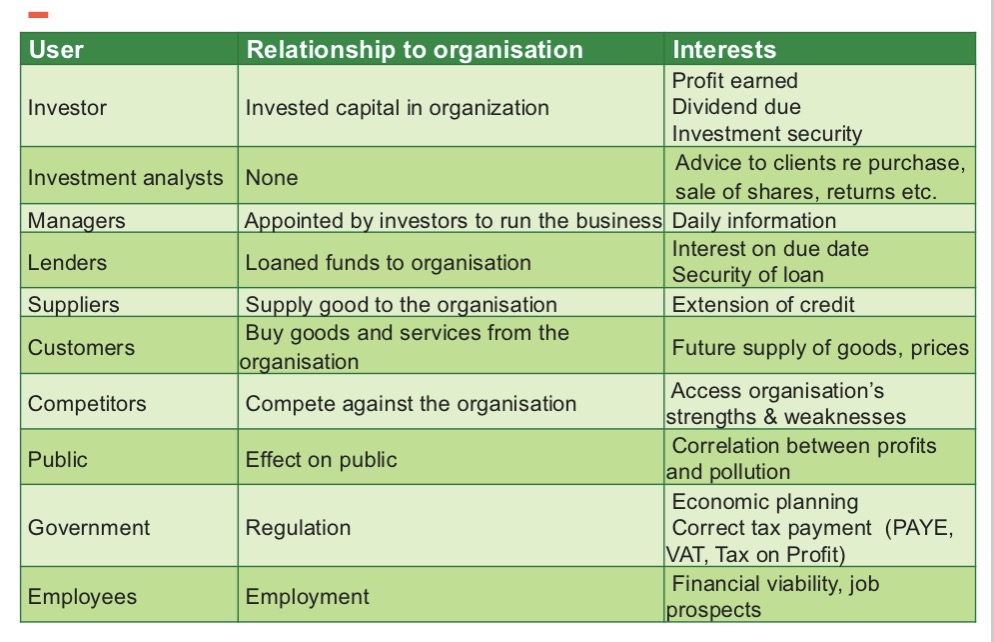
Main users of accounting information
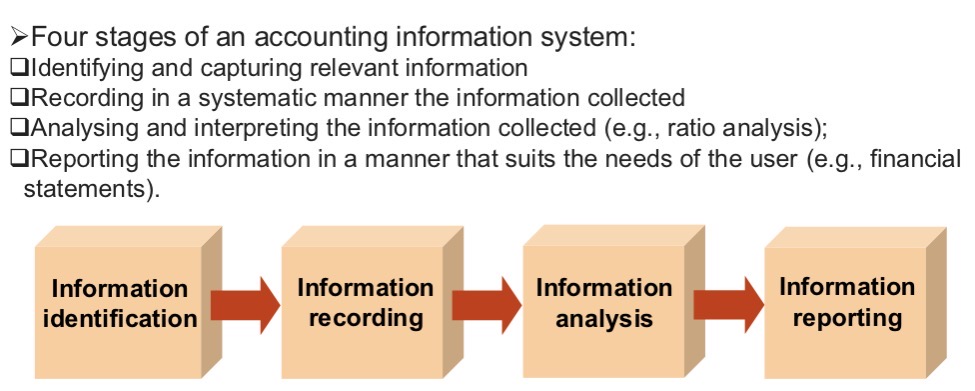
Accounting information system
Involves the identification, collection, analysis and reporting of accounting information
Accounting information characteristics
Accounting information is used to help users (internal+external) make a decision
Characteristics of useful accounting information:
Relevance: should i invest? Etc.
Faithful representation: accurately reflect condition of business
Comparability: over time and between businesses
Verifiability: correct information
Timeliness: made available in time
Understandability:
Materiality
What is capital?
Amount owners have invested in the business
What are drawings?
Amounts taken out of business for owners personal use
What are purchases?
Costs incurred by business to buy goods it plans to sell to customers. Purchase is usually recognised when goods are received from supplier.
What are sales/revenue/turnover?
Income earned from selling goods or services
What are expenses/costs?
Costs incurred by businesses to enable trading
What are accounting conventions and what are examples of some?
Generally accepted rules that accountants tend to follow when preparing financial statements
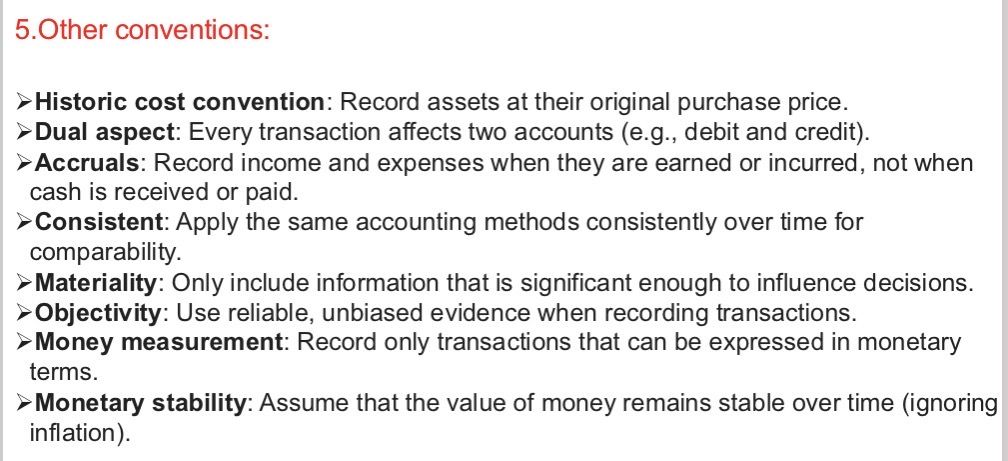
E.g. Business entity convention, prudence, going concern, matching, other conventions
What is a business entity convention?
For accounting purposes, business and it’s owner(s) are treated separately
Clear distinction between business and personal assets
What is prudence?
Caution should be exercised when preparing financial statements
Revenue and profits aren’t anticipated, but recognised only when realised in the form of cash or other assets
The expected expenses and losses are allowed to be recognised
Ensure revenues aren’t overestimated or expenses are underestimated
What is going concern?
Convention that assumes that the business will continue operations for the foreseeable future unless there is a reason otherwise
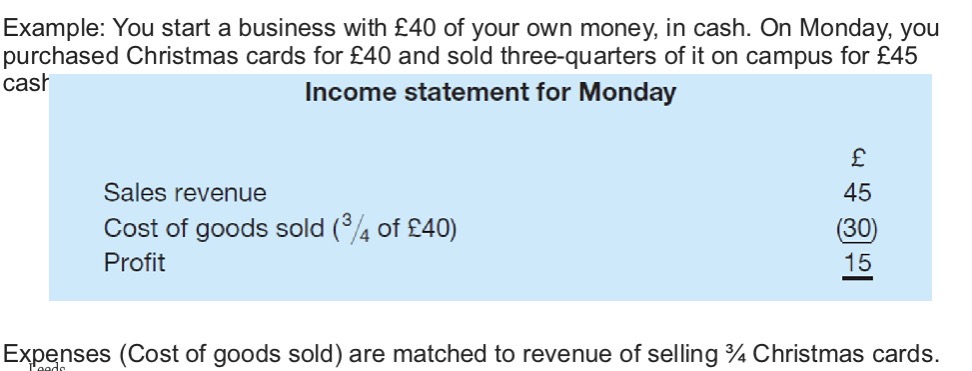
What is matching?
When measuring income, expenses should be matched to revenues that they helped generate, in the same accounting period as those revenues were realised
Examples of other conventions:
Types of accounts
Assets
Liabilities
Revenue/Income
Expenses
Equity
Drawings
Assets Account: What is an asset and current asset? + examples
Asset: Resource controlled by the business for future economic benefits
Current assets: Held for a short amount of time
Held for sale or consumption during the business’s normal operating cycle (e.g. inventories for resale)
Expected to be sold within a year
Held for trading
Examples:
Cash and cash equivalents, such as commercial paper, short term government bonds
Inventories
Trade receivables and prepayment
Assets account: What are non-current assets? + examples
Non-current assets: Assets used in an organisation on a long-term basis in order to generate wealth.
Examples:
Land
Buildings
Machinery and equipment
Vehicles
Furniture and fixtures
Plant equipment
Assets account: What are intangible assets? When are they included in financial statements?
Intangible assets: Non-physical assets like patents, trademarks, goodwill, and brands. Valuable to a business but difficult to measure in comparison to tangible assets.
Included in financial statements: When acquired through arm’s-length transaction, e.g. purchasing another business, given a measurable value.
Excluded from financial statements: Internally generated intangible assets are excluded due to difficulty in reliability measuring their value.
Liabilities account: Definition and examples of current and non-current liabilities
Liabilities: An amount owed by the business to a third party (e.g. bank), normally arise when organisations lend money to a business.
Examples of current liabilities:
Bank overdraft
Trade payables
Short-term loans
Examples of non-current liabilities:
Long-term loans
Equity account: Definition and examples
Equity: The remaining value of the owners’ interest in a company after subtracting all liabilities from total assets.
Examples:
Share capital
Retained earnings
Types of financial statements
Statement of financial position (or balance sheet): Show the assets, liabilities and equity (owners’ interest) at the end of a period
Statement of profit or loss (income statement): Show revenue and expenses to determine profit or loss for an accounting period
Statement of cash flows: Show the major sources and uses of cash during a period
Accumulated wealth=
Asset - Liability
Statement of financial position
Reports the assets of a business on one hand and the claims against the business on the other
Asset: resource controlled by a business that produces future economic benefits
Claims against the business include: Equity: Claim of the owner/investors against the business
Liabilities: Claims of other parties, business has an obligation to make a payment of the owed amount
Assets=
Equity + Liabilities
Equity=
Assets - Liabilities
Statement of profit or loss (Income statement): Definition and formula
Shows revenue and expenses to determine profit or loss for an accounting period
Profit/ Loss for the period= Total revenue for the period - Total expenses incurred in generating that revenue
Profit if revenue exceeds expenses
Loss if expenses exceeds revenue
What are sales/ revenue/ turnover?
Income earned from selling goods or services
What is cost of sales?
The cost of goods sold in a period
What is gross profit?
Calculated as the difference between sales revenue and the cost of goods sold
What is operating profit?
The profit calculated after all the operational expenses have been deducted
What is net profit?
The profit calculated after all business expenses have been deducted
Examples of expenses
Cost of sales: cost of goods sold in a period
Operating expenses: cost incurred through normal business operations
E.g. Salaries and wages
Rent
Heat and light
Interest and taxation
Process of preparing financial statements
Record transactions: Recorded with two entries, Debit (Dr) and Credit (Cr). This ensures that accounting equation (Assets= Liabilities + Equity) remains balanced. E.g. When cash is received, the cash account is debited, while the corresponding revenue account us credited.
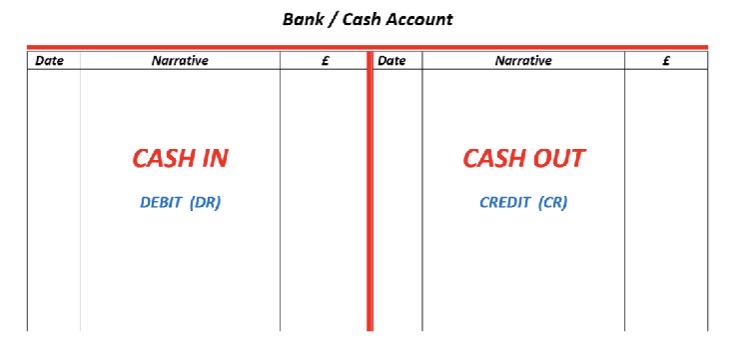
Prepare and close off T accounts: Visual layout of individual accounts resembles a T shape, also known as Ledger accounts.
Compile Trial Balance: Used in bookkeeping to list all the balances in the business’s general ledger accounts.
Post year-end adjustments: Adjustments are made at the end of an accounting period to record any unrecognised transactions.
Prepare financial statements: Prepared to reflect the financial position and performance of the business.
Preparing financial statements: Recording transactions
DEALER rule
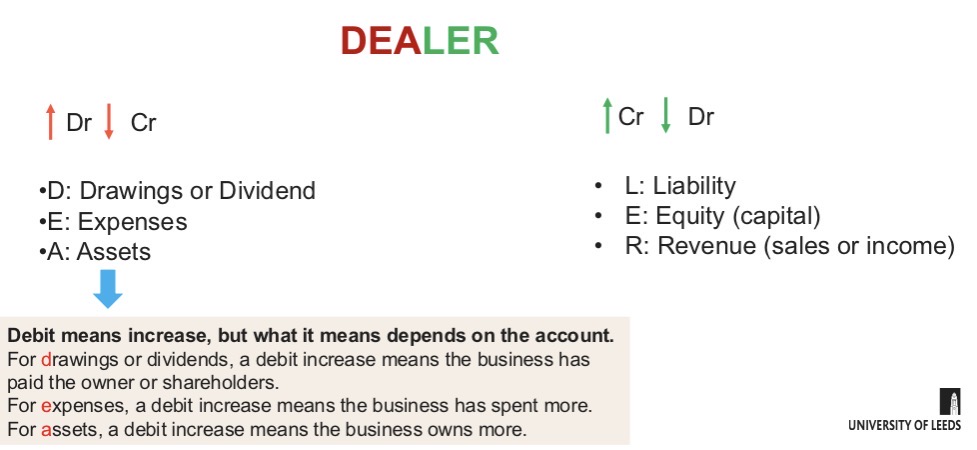
Preparing financial statements: Prepare and close off T accounts
Preparing financial statements: Compile Trial Balance (TB)
Trial balance: An accounting report prepared at the end of an accounting period to ensure that the general ledger is accurate and that total debits = total credits
Aims to identify any accounting errors, including transposition errors where digits may have been reversed. Checks for accuracy.
Debits=
Assets + Expenses + Drawings
Credits=
Equity (capital) + Liabilities + Revenue
Preparing financial statements: Post year- end adjustments
Adjustments made at the end of an accounting period to record any unrecognised transactions
The trial balance is the starting point of preparing financial statements
Adjustments after trial balance:
Accruals and prepayments
Depreciation and disposal
Inventory and cost of sales
Accruals and prepayments
Recording income and expenses when they are earned or incurred, not when cash is received or paid
Expenses must be recorded in the correct accounting period when they are incurred, even if cash is paid in a different period
Prepayment: If a business paid before using the service (asset).
Where a business has paid amounts relating to future accounting periods
E.g. paid next months rent in advance
Accrual: If a business has used the service first but has not paid yet (liability).
Business has not paid all its expenses incurred for current accounting period
E.g. Used electricity this month but not paid
Depreciation
Most non-current assets (e.g. furniture, equipment) have a limited useful life. They wear out with use so decrease in value over time.
At the end of their useful life, the non-current asset will either be sold for a small sum or scrapped. Known as the residual value. May often be 0.
Land is an exception here since it tends not to wear out or reduce in value.
Depreciation calculation: Straight-line
Same depreciation amount each year during useful life
Annual depreciation= (Historical cost of assets - Estimated residual value) / Useful life
→ Historical cost: initial cost of purchase
→ Estimated residual value: amount for which a non-current asset is expected to be sold when the business has no use for it. May be 0
→ Useful life: Estimate of useful years of asset
Question may give depreciation rate instead of the useful life, depreciation rate= 1 / Useful life
→ Therefore calculation can also be Annual depreciation= (Historical cost of assets - Estimated residual value) x Straight-line depreciation rate
Net book value definition and calculation
Net book value: Value of asset recorded after deducting accumulated depreciation
Net book value= Historical cost - Accumulated depreciation
Accumulated depreciation: The total amount of depreciation expense allocated to a specific asset since the asset was put into use
Reducing balance depreciation method
Compared to straight-line depreciation, this method has higher depreciation in the earlier years (because accumulated depreciation is very limited in earlier years) and have lower depreciation in later years
Net book value= Cost of assets - Accumulated depreciation
Annual depreciation= Net book value x Depreciation rate
Reducing balance method: Reducing balance depreciation=
Depreciation= (Historical cost of assets - Accumulated depreciation) x Depreciation rate
→ Historical cost: initial cost
→ Accumulated depreciation: sum of depreciation of an asset up to this period
→ depreciation rate: percentage rate of depreciation each year
Don’t need to subtract residual value when calculating annual depreciation under the reducing balance method
Disposal of assets
Previous situations show that we hold all non-current assets until the end of their useful life
However, in reality, we may sell such assets before the end of their useful life
How to calculate the disposal price of the machine with the net book value recorded in financial statement
Calculate annual depreciation
Calculate net book value after 2 years
Calculate the profit/ loss for the disposal of assets using the disposal price - NBV