chapter 19: immunological disorders
 Call Kai
 Learn
Learn Practice Test
 Spaced Repetition
 Match
Match Flashcards
 Knowt Play
1/24

There's no tags or description
Looks like no tags are added yet.
Name | Mastery | Learn | Test | Matching | Spaced | Call with Kai | Chat |
|---|
No analytics yet
Send a link to your students to track their progress
25 Terms
immune system: overview
fxn: protects human host from pathogens (invaders)
humoral immunity → B cells & antibodies
cell-mediated immunity (CMI) → T cells
antigens (Ag)
non-self Ag: foreign/external antigen (pathogens, allergens)
self Ag: body’s own cells/tissues
self-tolerance vs. loss of self-tolerance
self-tolerance: immune system ignores your own tissues
loss of self-tolerance: immune system attacks your own body (autoimmunity)
immunosuppression: weakened immune system
d/t: HIV/AIDs, immunosuppressive drugs (organ transplant), chemotherapy
immune deficiencies
immune system partially or completely absent (affects humoral, CMI, or both)
types:
primary (congenital): inherited, present since birth, d/t defective/missing genes
secondary (acquired): develop later in life (d/t HIV destroy CD4+ T cells, chemotherapy, immunosuppressive transplant drugs)
results in: weak or nonfunctional immune system, partial or complete immune deficiency
immune diseases
immune system present but abnormal
exaggerated immune response: attacks non-self Ag, hypersensitivity (allergies)
altered immune response: attacks self Ag, autoimmune disease
primary (congenital) immune deficiencies
X-linked Infantile (Bruton’s) Agammaglobulinemia: defective B cells (↓ Ab’s) & humoral, mostly boys (X-linked), more bacterial infections, present CMI
DiGeorge Syndrome (Thymic Aplasia): defective T cells & CMI, present humoral
SCID (Severe Combined Immunodeficiency): defective stem cells (↓ B & T cells), defective humoral/CMI (complete deficiency)
ex. Bubble Boy disease
hypersensitivity: overview
an exaggerated immune response to non-self antigens (allergens)
occurs when sensitized by previous exposure to non-self Ag’s (allergens → pollen, dust)
exposure process:
first exposure → no harmful reaction → become sensitized (memory B cells form)
second exposure → same allergen triggers harmful immune response (allergic reaction; memory B cells → plasma cells → Ab)
ACID (Anaphylactic, Cytotoxic, Immune Complex, Delayed Cell-Mediated)
types I-III: humoral immunity, B cells, Ab’s (rapid)
type IV: CMI, TD cells (slow)
type I hypersensitivity (anaphylactic)
fast reaction (minutes after second exposure to non-self Ag’s)
first exposure: IgE produced → IgE binds mast cells/basophils, no degranulation yet
second exposure: allergen binds IgE → mast cells/basophils degranulate
released mediators:
histamine: ↑ capillary permeability (leaky)
leukotrienes: prolong smooth muscle contraction → airways narrow
effects: (d/t neutrophils) edema, erythema, ↑ mucus, difficulty breathing
ex: allergic reactions (seasonal allergies/asthma), anaphylactic shock (drug/insect venom)
localized vs. systemic anaphylaxis
localized: d/t pollen, dust, smoke, foods, pet dander
sxs depend on entry route: sneezing, itchy eyes, runny nose
tx: antihistamines
systemic (anaphylactic shock): medical emergency! d/t bee stings, drugs, peanuts, shellfish
effects: airway dialation needed, severe drop in BP, whole body affected
tx: epinephrine (EpiPen)
preventing allergies (skin testing & desensitization)
skin test: inject allergen under skin, watch for inflammatory reaction
desensitization: gradually inject increasing doses of allergen beneath skin
purpose: produce IgG → acts as a blocking antibody → binds allergen before IgE can (intercepts & neutralizes)
hypersensitivity type II (cytotoxic)
involves non-self antigens bound on a fixed location or on cell surface
IgG or IgM Ab’s target Ags on RBC or tissue cells
cell lysis is caused by complement activation or damage by macrophages
examples:
blood transfusion reactions (mismatching): ABO blood group system
hemolytic disease of the newborn: Rh blood group system
thrombocytopenic purpura & hemolytic anemia: drug-induced cytotoxic reactions
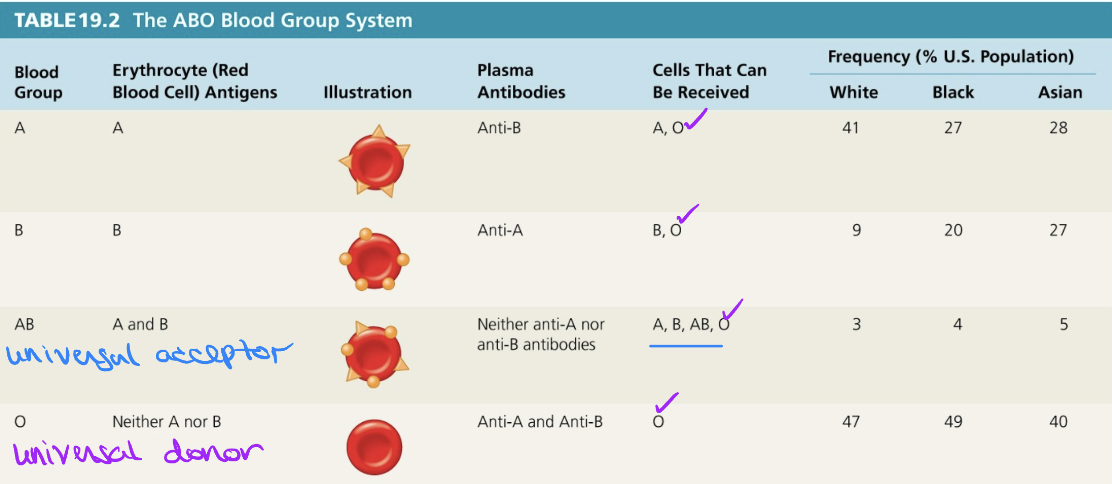
ABO blood group system
transfusion reactions: ABO & Rh blood group systems mismatched between donor & recipient
carbohydrate surface Ag on RBC → blood cell types
Type A blood: anti B Ab
Type B blood: anti A Ab
Type AB: no Ab (universal acceptor)
Type O: anti A and anti B (universal donor)
ex. anti A + type A RBC → agglutination & hemolysis of RBCs (mismatching)
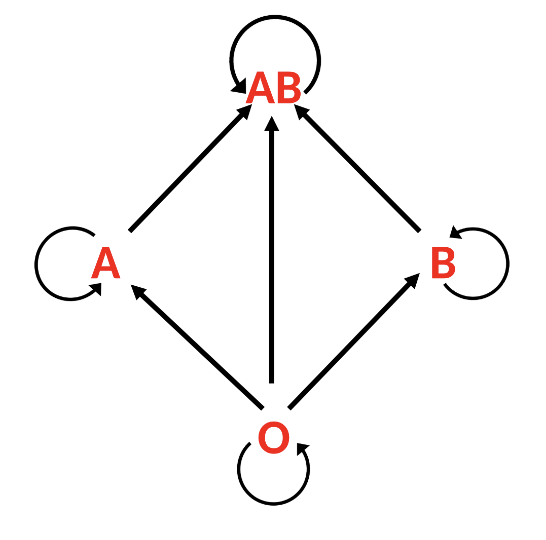
ABO blood group system: transfusion reactions
type A:
donate to AB
receive from A, O
type B:
donate to AB
receive from B, O
type AB (universal acceptor):
donate to AB
receive from A, B, AB, O
type O (universal donor):
donate to A, B, AB
receive from O
Rh blood group system
Rh factor: antigen (Rh+) found on RBC surfaces
Rh+ person: no anti-Rh Ab’s
Rh- person: may possibly have anti-Rh Ab’s
Rh- person will develop anti-Rh Ab’s only when immune system provoked
Rh+ donor blood to Rh- recipient → Rh- recipient will produce anti-Rh Ab’s
anti-Rh Ab’s will bind to Rh+ donor RBCs → mismatching → Rh+ donor RBCs damaged/lysed!
Hemolytic Disease of The Newborn (HDNB)
Rh- female (but no anti-Rh ABs yet) → Rh+ fetus (1st pregnancy) → mom produce anti-Rh Ab’s AFTER birth (mixing of maternal & fetal circulation)
mom’s anti-Rh Ab’s will attack 2nd Rh+ fetus (2nd pregnancy) → damageing fetal RBCs → HDNB
outcomes (newborn):
50% normal RBC count
25% moderate dz & require immediate tx
25% severe dz → stillborn/severe complications
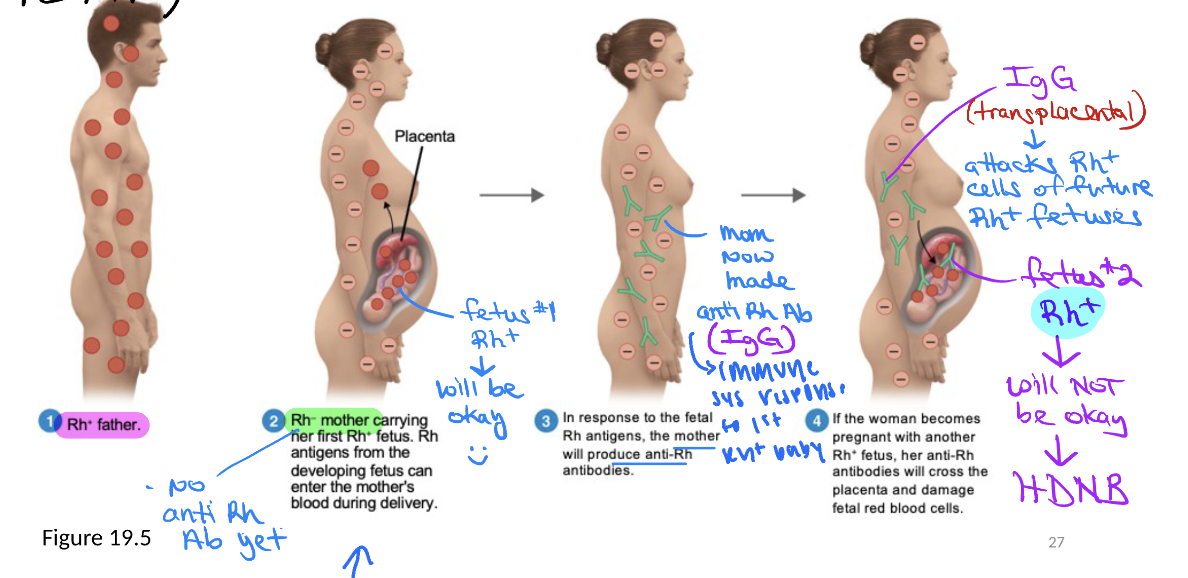
prevention of HDNB
prevention w/ RhoGAM (antibodies) inject into Rh- mom during 1st pregnancy or with 72 hours of delivery of Rh+ infant
artificial passive immunity
antibodies against mother’s anti-RH antibodies
drug-induced cytotoxic reactions
target cell (PLT or RBC) coated w/ drug → drug-target cell complex
Abs produced against drug → Abs bind drugs
complement binds stem region of Abs → target cell destroyed! (exaggerated reaction to drug)
thrombocytopenic purpura
hemolytic anemia
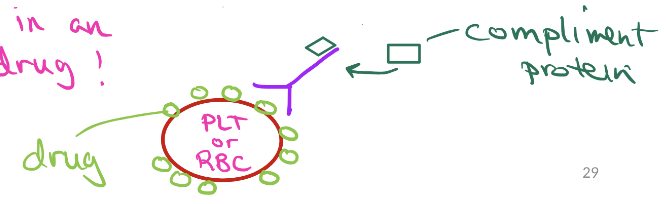
thrombocytopenic purpura
thrombocyte: platelets (target cell)
“-penia”: low or decreased cell numbers
purpura: purple color of skin (hemorrhaging d/t ↓ # PLTs)
hypersensitivity type III (immune complex) reactions
involves non-self Ag’s circulating (not fixed) in blood
formation of circulating immune complexes in serum w/ either excess Ag or excess Ab (IgG) present
immune complexes lodge in basement membrances beneath cells → activates complement & attracts neutrophils → inflammation & tissue damage
arthus reaction: too many Ab made
serum sickness: not enough Ab made
serum sickness
excess antigens → immune complexes form in presence of ↑ local concentration of injected serum Ag’s & ↓ circulating Ab concentration
too little or few Abs formed
arthus reactions
excess antibody → immune complexes form in presence of vaccine antigens & ↑ circulating antibody concentration
too many Abs formed
hypersensitivity type IV (delayed cell-mediated) reactions
delayed-type hypersensitivities
CMI responses d/t TD cells
TD cells release cytokines → attract macrophages → initiate tissue damage (inflammation)
tuberculin skin test
allergic contact dermatitis (not allergy)
“allergic” contact dermatitis
chemicals combine w/ proteins in skin → produce immune response
“allergic” response to poison ivy, cosmetics, metals, latex
NOT HS type I reaction: delayed rxn, involves TD cell (not IgE)
primary contact: make memory T cells (sensatization → no sxs)
secondary contact: many active TD cells (sxs)
autoimmune diseases
immune system responds to self-antigens → damage to organs
autoimmunity: loss of self-tolerance
affect any part of body; some more common than others
some life-threatening but MOST are debilitating & require lifetime tx (NO CURE; yes management)
origin largely unknown → result from genetic, environmental, lifestyle factors
80% women d/t ↑ hormone levels (esp during pregnancy)
ex. lupus, RA, MS