TEAS BIOLOGY
 Call Kai
 Learn
Learn Practice Test
 Spaced Repetition
 Match
Match Flashcards
 Knowt Play
1/152

There's no tags or description
Looks like no tags are added yet.
Name | Mastery | Learn | Test | Matching | Spaced | Call with Kai | Chat |
|---|
No analytics yet
Send a link to your students to track their progress
153 Terms
_____________ molecules contain carbon, and ____________ do not
organic molecules, inorganic molecules
glucose, guanine, triglycerol are all examples of ___________________
organic compounds
_____________ are used in DAY TO DAY METABOLIC PROCESSES
organic molecules
____________ are a single unit of an organic molecule
monomer
___________ are multiple units or CHAINS of monomers
polymers
list all 4 organic molecules
1)
2)
3)
4)
nucleic acids, lipids, proteins, carbs
______________ compounds DO NOT CONTAIN CARBON
inorganic compounds
___________ make up a very SMALL AMOUNT of living things and are USUALLY MINERALS such as IRON, POTASSIUM, SODIUM
inorganic compounds
_______________ are sugars made of CARBON, HYDROGEN, AND OXYGEN
carbohydrates
___________ are broken down to release energy, and that energy is used to build ATP
carbohydrates
energy molecules such as adenosine triphosphate (ATP) provide a source of _________ to drive cellular processes
electrons
the monomer of carbohydrates is called __________________
monosaccharides
_________________ are all different types of simple sugars
monosaccharides
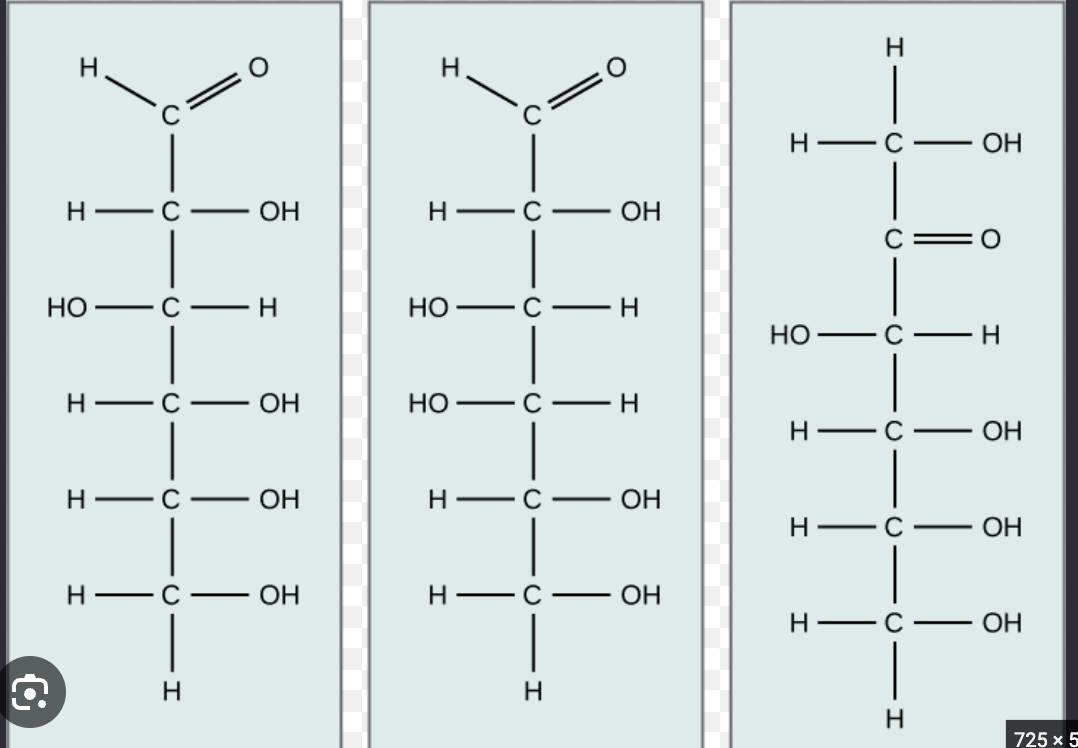
this image is an example of what
monosaccharides

what SPECIFIC monosaccharide is this
glucose
_____________ are multiple monomers of carbohydrates bonded together chains of CnH2nOn
polysaccharides
glucose bonded together make the polysaccharide _________-
starch
________ is used to store excess sugar
starch
which of the following compounds is NOT created by joining monosaccharides
guanine
_____________ is the polysaccharide which is responsible partly for strength in plants
cellulose
_________ are made of MAINLY CARBON AND HYDROGEN with a SMALL AMOUNT OF OXYGEN
lipids
the HEAD of a lipid is composed of which molecule
phosphate group
the BACKBONE of a lipid is composed of which molecule?
glycerol
the HEAD OF A LIPID IS______ whereas lipid TAILS ARE _______
polar, nonpolar
polar=_____________ whereas nonpolar= ________________
hydrophilic, hydrophobic
the TAIL of lipids is composed of _______________
hydrocarbons
the more double bonds in the tail of a lipid the more ___________________it is
unsaturated
the combined polarity of the water loving lipid head, and the non water loving lipid tails are a critical feature of what?
phospholipid membrane
phospholipid membranes are _______________ meaning certain molecules can come in and out
semipermeable
in semi permeable phospholipid membranes ________ point in, and ________ point out
tails, heads
______________ fatty acids are LIQUIDS at room temp, such as oils
unsaturated
_____________ fatty acids are SOLIDS at room temp such as LARD AND BUTTER
saturated
___________ play an important role in ALMOST EVERY CELLULAR PROCESS IN THE HUMAN BODY
such as:
1) acting as a CATALYST for bodily reactions
2) TRANSPORT MOLECULES ACROSS MEMBRANES
3) facilitate DNA REPLICATION
4) regulate CELL CYCLE
proteins
________ are MADE OF CHAINS OF AMINO ACIDS!!!!!!!!!!
proteins
the monomer of proteins are _____________
amino acids
amino acids are composed of
1)
2)
3)
amino group, R group, carboxyl group
there are _____ different amino acids
22
the _____________ part of amino acids is the one that varies, i is UNIQUE TO EACH AMINO ACID
R group
____________ are a POLYMER of DNA
____________ are MONOMERS of DNA
nucleic acids, nucleotides
_______________ store ALL information necessary to produce PROTIENS
DNA/RNA
another word for “nucleic acids” is
DNA/RNA
MONOMERS of nucleic acids (DNA/RNA) are called ______________
nucleotides
what are the MONOMERS of lipids?
glycerol/ fatty acids
NUCLEOTIDES are composed of 3 groups a _______________, _______________ and a _______________
nitrogenous base, phosphate group, 5 carbon sugar
there are FOUR different nucleotides (nitrogenous bases)
1_____________
2____________
3______________
adenine, guanine, thymine, cytosine
ADENINE and GUANINE are ___________________
CYTOSINE and THYMINE are __________________
purines, pyrimidines
_______ REPLACES THYMINE in RNA
uracil
______________are 1 RING STRUCTURES, whereas
______________are 2 RING STRUCTURES
pyrimidines, purines
can purines bond with purines? and can pyrimidines bond with pyrimidines?
no
another word for a complimentary pair is a ______________
dimer
a PURINE+ PYRIMIDINE is called ___________________
complimentary pair
adenine always bonds with____________
thymine
guanine always bonds with ________________
cytosine
ADENINE BONDED WITH THYMINE is an example of what
dimer
when many DIMERS BOND TOGETHER they form_______________
polymers
DNA has ______________ sugar whereas
RNA has ______________ sugar
deoxyribose, ribose
does it matter which direction DNA is read?
yes
DNA is ALWAYS read from what end to what end?
5’ to 3’
the bond that holds together each complimentary nitrogenous base in DNA is a
hydrogen bond
An analysis of a laboratory tissue sample reveals a single-stranded nucleic acid polymer containing a sugar-phosphate backbone with a high concentration of uracil. Which organelle is this macromolecule most likely synthesized in, and what is its identity?
nucleus, ribonucleic acid
A segment of double-stranded DNA is analyzed and found to consist of 22% Adenine. Based on complementary base-pairing rules, what total percentage of the DNA segment consists of Guanine?
28%
Which of the following descriptions accurately distinguishes between the physical structures of purines and pyrimidines?
purines (adenine/guanine) have a double-ring structure, pyrimidines (cytosine/thymine) have a single-ring structure
During DNA replication, an enzyme reads the template strand in the 3' to 5' direction to synthesize a new complementary strand. If the template strand reads 3'-GGCTACC-5', what is the sequence of the newly synthesized strand written in the standard 5' to 3' direction?
5'-CCGATGG-3'
A regular human somatic cell contains 46 chromosomes grouped into 23 pairs. Through the process of meiosis, this cell produces gametes (sperm or egg cells). How many total chromosomes will be present in one of these resulting gametes?
23 single chromosomes
Which of the following correctly pairs a biological structure with its exact description?
histone: an individual protein molecule that helps package DNA.
A scientist looks into a microscope and observes a human cell that is currently in interphase, performing its normal daily metabolic operations. What will the DNA look like inside this cell's nucleus?
loose, uncoiled strands of chromatin wrapped around histones
During cell division, a cell must evenly pull apart the duplicated genetic material. What is the specific name for the identical copies of a chromosome that are pulled to opposite sides of the cell?
sister chromatids
If a mutation prevents a cell from separating its identical twin copies of DNA during cell division, which specific structure is failing to separate?
sister chromatids
A student is reviewing the level of compaction required to fit human DNA inside the cell nucleus. Which of the following lists the structural levels of DNA organization in the correct order from the least condensed to the most condensed?
double helix, nucleosome, chromatin, chromosome
following DNA replication, an x-shaped structure forms in preparation for cell division. what is the correct term for the two identical halves of this structure, and what holds them together?
chromatids, held together at the centromere
a _____________ is an organisms COMPLETE SET OF GENETIC INSTRUCTIONS CONTAINING ALL OF THE DNA NEEDED TO BUILD, GROW, AND MAINTAIN THE LIVING THING
genome
genomes are composed of
1________________
2________________
3________________
DNA, chromosomes, genes
_______ is a SMALL SEGMENT OF DNA STRANDS THAT PROVIDES INSTRUCTIONS FOR MAKING PROTEINS
gene
____________ are large protein complexes, that arestand alone and do not have dna wrapped around them
histones
___________ are when formed when DNA WRAPS AROUND 8 ____________
nucleosomes, histones
____________ area continuous chain of NUCLEOSOMES, this is seen during a cell’s INTERPHASE
chromatin
______________ during interphase
______________ during mitosis
chromatid, chromosomes
during MITOSIS, chromatin becomes what? __________________
chromosomes
_______ is when the cell splits into two new cells, during this phase CHROMATID BECOMES TIGHTLY WOUND CHROMOSOMES
mitosis
a ___________ links a pair of sister chromatids together during cell division, it is the CENTRAL CONNECTING POINT
centromere
__________are TWO IDENTICAL HALVES OF A CHROMOSOME
chromatids
chromosomes are split down the middle __________ to separate _________ during cell division
vertically, sister chromatids
these cells exist purely to keep you alive and functioning they build your physical structure, pump your blood, filter toxins, and protect you from infections. they have no role in reproduction
somatic cells
these cells have only one job, reproduction.they carry your genetic legacy forward to the next generation. they do not help you digest food, breathe, or move your muscles
gametes
___________ are diploid 2n, 46 chromosomes
__________ are haploid, 1n, 23 chromosomes
somatic cells, gametes
__________ have ONE SET of chromosomes
and ____________have TWO SETS of chromosomes
gametes, somatic cells
If a human gamete contains 23 chromosomes, which of the following statements accurately describes the chromosome composition of a human somatic cell?
it contains 23 pairs of chromosomes, making it a diploid cell
during DNA replication, a genetic mutation causes a cell to produce a non-functional version of DNA Polymerase I. Which of the following problems will this cell most likely experience?
RNA primers on the lagging strand will fail to be removed and replaced with DNA
an enzyme complex is actively synthesizing a new strand of DNA. according to standard biological directionality, in which direction is the new strand built, and in which direction is the old template strand read?
built 5’ to 3’ read 3’ to 5’
during the elongation phase of replication, what is the primary function of single-strand binding proteins (SSBs)?
to physically hold the unzipped parent strands open and stable
_______seals the final gaps between adjacent okazaki fragments
DNA ligase
a student is explaining the concept of the hayflick limit, which dictates that human somatic cells can only divide a finite number of times. which structural event during termination directly causes this limitation?
the progressive shortening of non-coding telomeres at the tips of chromosomes
__________ lengthens noncoding telomeres at the end of DNA, only in specific cells so they can have extra divisions
DNA telomerase
_____________ SYNTHESIZES OKAZAKI FRAGMENTS while
_____________ WORKS ON THE LEADING STRAND OF DNA
polymerase I, polymerase III
_________ unwinds hydrogen bonds to leave two strands (during initiation)
DNA helicase
__________ is the process in which A COPY OF DNA IS CREATED IN A CELL
DNA replication
___________ is when proteins bind to regions known as ORIGIN SITES and helicase UNZIPS HYDROGEN BONDS in parent DNA strand to form two single strands
initiation
__________ is when NEW strands of DNA are created, here various enzymes such are single stranded binding protiens, and polymerase (I and III) are present
elongation
the _____________ is the “easy” strand built continuously by ______________ and ________________ is the “harder” strand BUILT BACKWARDS built in SHORT, CONTINUOUS CHUNKS called okazaki fragments by _______________
leading, dna polymerase III, lagging, dna polymerase I
____________ is when DNA polymerase is done replicating, the replication forks meet
termination