9.2 Protein Dynamics and Protein Folding
 Call Kai
 Learn
Learn Practice Test
 Spaced Repetition
 Match
Match Flashcards
 Knowt Play
1/28

There's no tags or description
Looks like no tags are added yet.
Name | Mastery | Learn | Test | Matching | Spaced | Call with Kai | Chat |
|---|
No analytics yet
Send a link to your students to track their progress
29 Terms
Proteostasis
Continual maintenance of the active set of cellular proteins required under a give set of conditions
Native Proteins
Proteins that are synthesized, forms intermediates, or chaperone assisted folding
Misfolded Protein
Reformed or form aggregates that leads to diseased state or degradation
Protein folding sequence
Transcription of DNA into RNA; RNA to protein; Protein to supramolecular complex
Thermodynamic terms that influences stability
Entropy, Free Energy, and Enthalpy
Bonding interactions/factors that influence stability
H-bonds, Ionic bonds, Hydrophobic interactions, Van der Waals interactions, Disulphide bonds
Recall importance of AA sequence, denaturation, and renaturation
AA sequence determines structure and function
Denaturation: allows upkeep of protein and breakdown of improper proteins; loss of 3D structure sufficient to cause loss of function
Renaturation: process by which certain denatured proteins regain their native structure and biological activity
Protein stability depends on the balance of three factors
unfavorable conformational entropy (delta S is negative) change → folding
favorable enthalpy (delta H is negative) from intramolecular noncovalent interactions
favorable entropy (delta S is positive) from burying hydrophobic residues in water
Anfinsen experiment
Used Urea and B-mercaptoethanol; showed that AA sequence contains all info to fold the protein
Stepwise process of protein folding
Local secondary structures fold first, longer range interactions follow, continues until entire protein is folded
Levinthal’s paradox
It’s mathematically impossible for protein folding to occur by randomly trying every confirmation until the lowest energy is found
Energy well/Free-energy tunnel
proteins have a sequence and have no choice but to fold due to the loss of free energy
A model that shows how multiple pathways can lead proteins to fold into one conformation. Caveat: Doesn’t consider stable intermediate states leading to final fold.
van der Waals interactions operate over
short distances (attractive force is proportional to distance) -6
van der Waals result from the overlap of
short lived, highly fluctuating dipoles of nonbonding electron orbitals
Inside the densely packed protein interior, numerous van der Waals interaction sum up and contribute to the
stability of a folded protein
Hydrogen bonding is/is not a driving force for protein folding because H-bonds with water are broken to make intramolecular H-bonds
IS NOT
Formation of extended H-bond networks (especially in a-helices or B-sheets) compensate for
loss of AA-water bonds, so H-bonding changes do not effect free energy much
Contribution of noncovalent interactions, particularly hydrogen bonding, to enthalpy of folding is offset by
protein folding decreases interactions between the protein and water
Hydrophobic interactions is a major contribution to
protein folding and stability; water around unfolded protein is ordered and structured
Proteins fold with hydrophobic residues on the
interior
Protein folding increases entropy of the
protein-water system because water is less ordered (delta S is positive)
Once a protein folds, the protein structure can be stabilized by the formation of
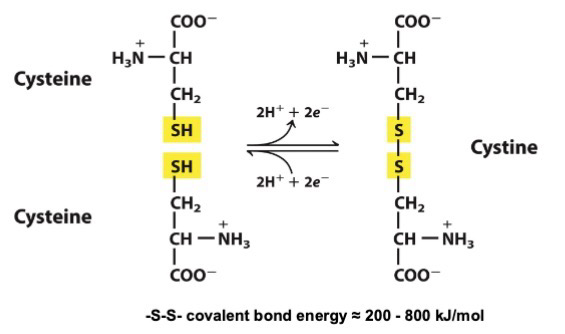
disulfide (-S-S-) bonds between sulfhydryls (-SH) of cysteine
Chaperonins (GroEL & GroES)
helper proteins that “assist” polypeptide folding into native structure (or prevent improper folding or aggregation)
Hsp; Two types
Heat shock protein; binds to hydrophobic regions of unfolded proteins and guides it towards chaperonins
HPS 40 & 70
Amyloid fibers/peptides/fibril
Misfolded proteins self-associates to form these
Alzheimer disease
Amyloid deposition by neurons involving the amyloid-beta peptide
Parkinson disease
misfolded alpha-synuclein aggregates that forms spherical masses called Lewy bodies
Huntington disease
Aggregation of huntingtin (Contains long polyglutamine repeats)
Prion disease
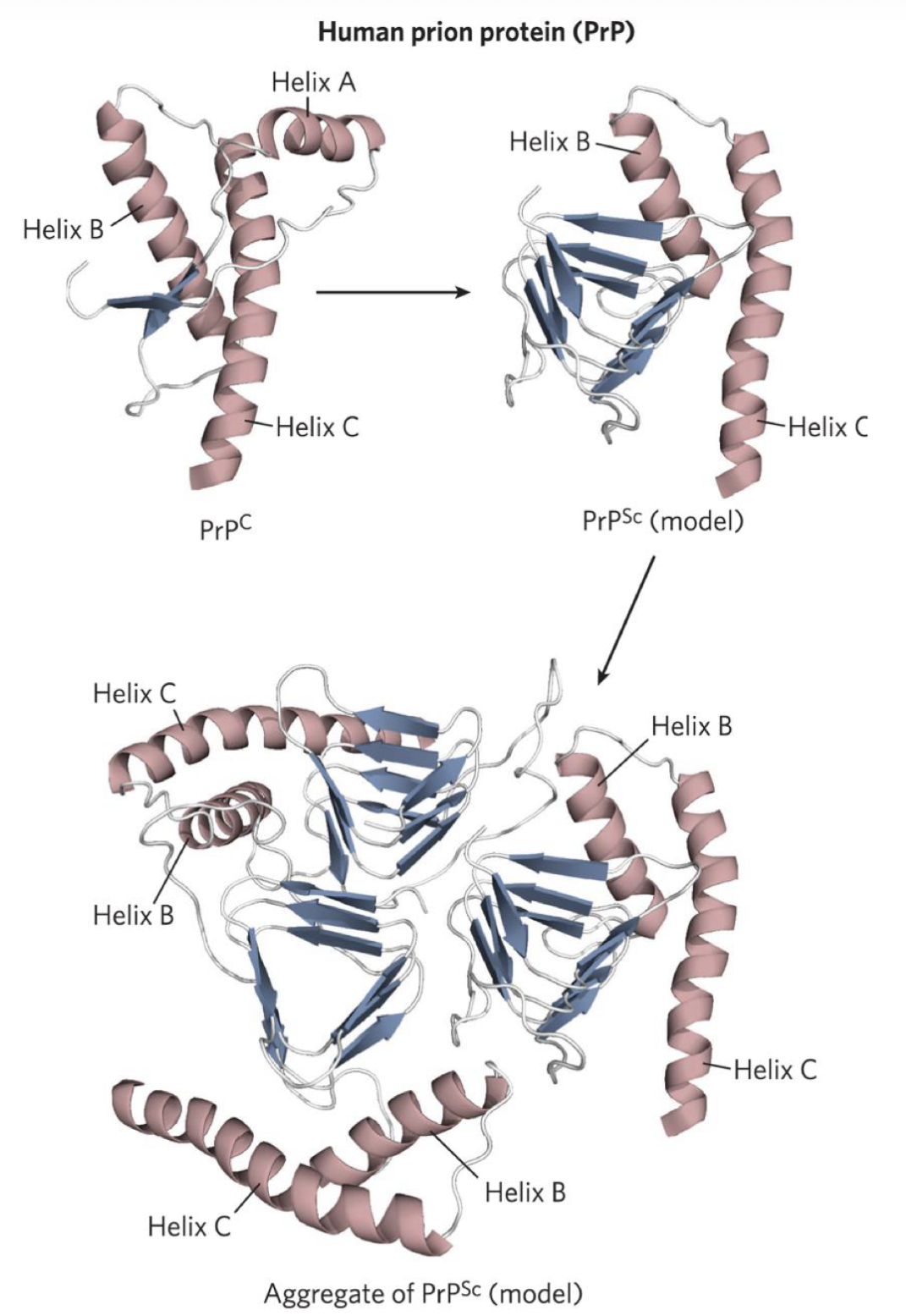
Prion protein (PrP) = misfolded brain protein; misfold forms prions that interacts with other normal proteins, causing aggregation