Lecture 9 - Mitosis and Cancer
 Call Kai
 Learn
Learn Practice Test
 Spaced Repetition
 Match
Match Flashcards
 Knowt Play
1/30

There's no tags or description
Looks like no tags are added yet.
Name | Mastery | Learn | Test | Matching | Spaced | Call with Kai | Chat |
|---|
No analytics yet
Send a link to your students to track their progress
31 Terms
Cells come from other cells:
Growth
Replacement
Three Main Steps:
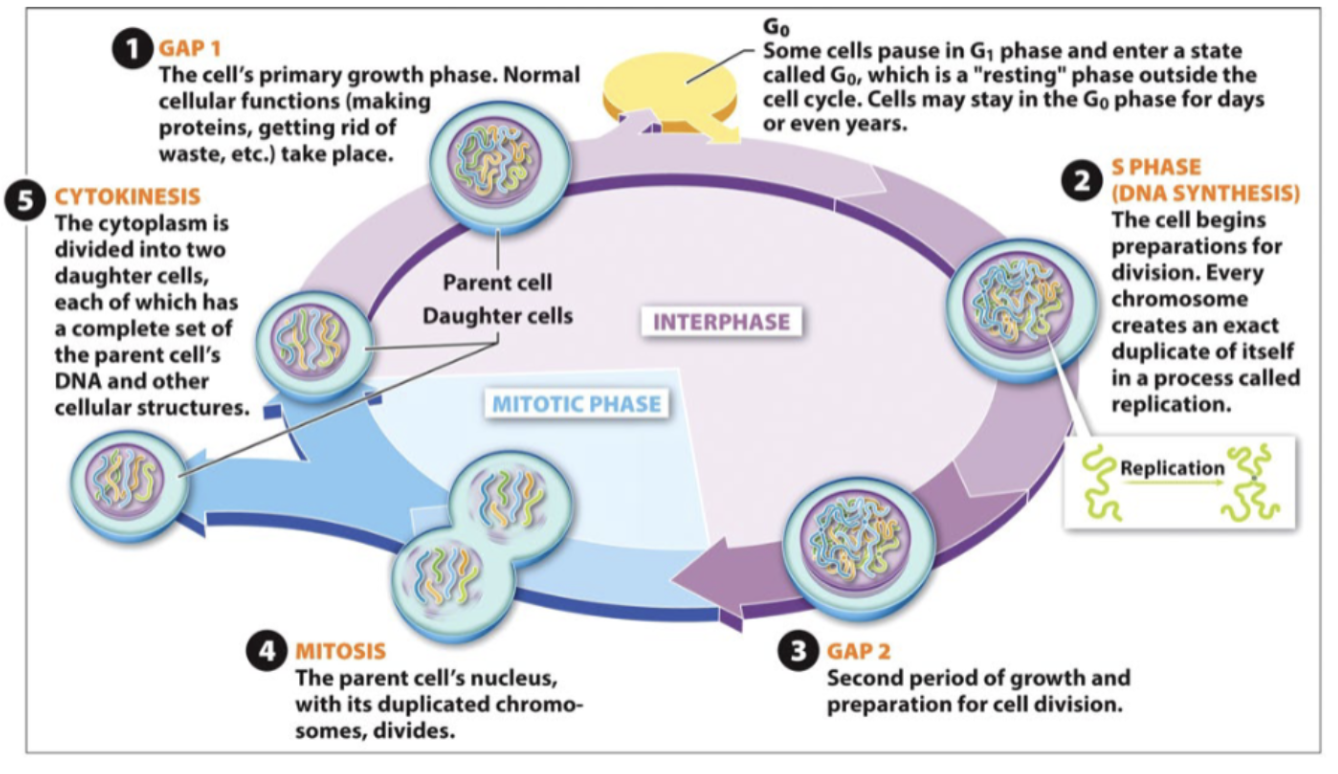
1. DNA replication.
2. Mitosis: division of the parent cell’s nucleus and chromosomes.
3. Cytokinesis: division of the parent cell into two daughter cells.
Deoxyribonucleic acid (DNA):
primary information bearing molecule of life:
DNA
Two chains of nucleotides linked together to form a double helix.
Nucleotide: nitrogenous base attached to a five-carbon sugar (ribose) and a phosphate molecule.
Complementary base pairs:
Adenine and Thymine.
Guanine and Cytosine.
DNA & Chromosomes:
Gene
Chromatin
Chromosomes
Chromosomes
Genome
Karyotype
Gene
A specific section of DNA that contains information necessary to produce protein.
Chromatin
Linear strand of DNA wrapped around histones
Histones: proteins that keep DNA from getting tangled
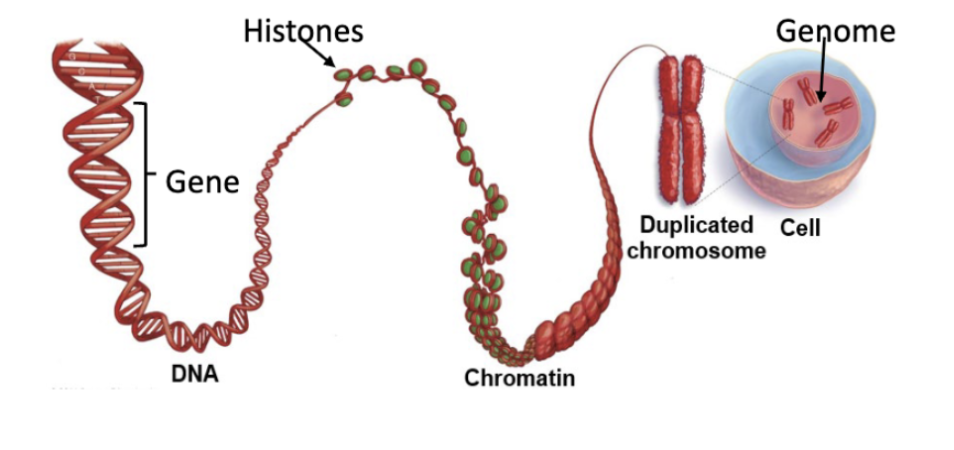
Chromosomes:
A compact strand of DNA
Genome:
Complete collection of an organisms genetic information
Karyotype
Pictorial arrangement of chromosomes
Haploid:
Cells with a single copy of each chromosome
Gamete: sex cell
Egg & sperm
Diploid:
Cells with 2 copies of each chromosome, one maternal, and one paternal
Somatic cells: cells forming the body of the organism
Percentage of Coding DNA
Many organisms have large portions of DNA that do not code for proteins & have no known purpose.
Only 1-2% of human DNA codes for proteins
DNA Replication:
DNA of unduplicated chromosomes unwinds.
New DNA nucleotides join with each individual DNA strand to form a new double helix.
Duplicated DNA results in duplicated chromosomes.
Sister chromatids.
Centromere.
Helicase:
Enzyme that unwinds DNA separating it into 2 complementary strands
DNA Polymerase:
Enzyme that creates the complementary strand by adding new DNA nucleotides to the template strand
Mitosis Phases
Interphase (3 parts)
Mitosis: Prophase
Mitosis: Metaphase
Mitosis: Anaphase
Mitosis: Telophase & Cytokinesis
Interphase (3 parts)
G1 (gap 1 phase) = growth & normal functions.
S (synthesis phase) = DNA (chromosome ) replication
G2 (gap 2 phase) = growth & normal functions continue
Centrosomes develop
Mitosis: Prophase
Chromatin condenses to form chromosomes
Nuclear membrane & nucleolus disappear
Chromosomes:
Two chromatids with centromere
Mitotic Spindles form
Microtubules
Mitosis: Metaphase
Centrosomes at opposite poles
Microtubules attach to sister chromatids
Chromosomes line up on the metaphase plate.
Mitosis: Anaphase
Duplicated chromosomes (sister chromatids) are pulled apart by spindle fibers
One full set of chromosomes goes to one end of the cell & one set goes to the other end.
Mitosis: Telophase & Cytokinesis
Reverse of Prophase:
Nuclear envelopes reform around chromosomes
Cytokinesis:
Animal cells:
Cleavage furrow
Plant cells:
Cell plate
Cancer Cells
Cancer = Unregulated cell multiplication, which invade nearby tissues or other parts of the body, destroying working tissues
Characteristics of Cancer Cells
Membrane proteins have reduced adhesive properties.
No contact inhibition;
Indefinite cell division:
T-cell deactivation:
Membrane proteins have reduced adhesive properties.
Malignant tumors.
No contact inhibition;
Lumped arrangement as opposed to a single layer
Indefinite cell division:
Cancer cells can divide unlimited number of times
T-cell deactivation:
Cancer cells have membrane proteins that turn off some immune system cells called T-cells
This prevents T-cells from finding & killing cancer cells
Chemotherapy:
Treatment using drugs that either kill cancer cells or keep cancer cells from dividing
Drugs designed to attack fast dividing cell
Prevent DNA replication
Prevent transcription
Inhibit microtubule formation
Alter mitochondria & transcription
Radiation Therapy:
Ionizing radiation used to damage the DNA of cancer cells which prevents them from replicating
Is radiation caused by high energy particles that cause electrons to detach from atoms or molecules
Radiation can be administered externally or internally
Surgery:
Surgeons remove cancerous cells or tumors from the body
Cryosurgery: extreme cold used to destroy cancerous tissue.
Hyperthermia: extreme heat used to damage & kill cancerous cells
Lasers: precision lasers used to cut through cancerous tissue
Immunotherapy:
Drugs that contain protein inhibitors that prevent the cancer proteins from binding with the t-cell receptors, which allows t-cells to destroy cancer cells.