1. Health Status Eval/Physical Exam & Principles of Uncomplicated Exodontia
 Call Kai
 Learn
Learn Practice Test
 Spaced Repetition
 Match
Match Flashcards
 Knowt Play
1/71

There's no tags or description
Looks like no tags are added yet.
Name | Mastery | Learn | Test | Matching | Spaced | Call with Kai | Chat |
|---|
No analytics yet
Send a link to your students to track their progress
72 Terms
what is a one sentence summary written in the patient’s own words?
chief complaint
what information should be included in history of present illness (HPI)?
info gathered by your questioning of pt regarding their CC
OLD CARTS!! (onset, location, duration, character, aggravating factors, relieving factors, timing, severity)
what are metabolic equivalents?
energy cost of physical activity (gives a good idea of pt’s CV health)

how are metabolic equivalents (METS) defined?
ratio of metabolic rate during activity to reference metabolic rate
1 MET = 1 kcal / (kg x h)
what type of radiograph should be taken for a single tooth (not including 3rd molars)?
PA
what type of radiograph should be taken for an overview of the maxilla and mandible?
pano
what type of radiograph should be taken for boney pathologies, 3rd molars, dentoalveolar/trauma to manible and maxilla?
pano
what type of radiograph should be taken for a detailed 3D view of the facial skeleton and soft tissue?
CT
what type of radiograph should be taken for maxillofacial trauma, severe infection, maxillofacial pathology, implant planning, etc.?
CT
what should go under “assessment”?
a summary of your findings
eg. 30 yo male presents w pain associated with #3. The pt is being treated for asthma, but is controlled with albuterol
what should go under “plan”?
stepwise tx for the pt
include type of anesthesia
eg. the plan is to extract #3 under local anesthesia
what are 4 key reasons why clinical documentation is so important?
pts have access to medical records
legal and regulatory considerations
justifies billed services and supports claims approval by payers
clear trail of clinical decisions and action (safeguard against audits and legal scrutiny)
which note is to be completed at initial visit (150 exam completion in UG clinics) to TUSDM clinics including consultation visits to specialty departments?
New Patient History and Physical Note
which note is to be completed for patients who are new to TUSDM (do not have established providers) and are having a procedure performed?
Details of the procedure may be recorded under the section “Record of Procedure”. This template includes components of both the New Patient note and the Procedure Note.
Emergency Procedure Note
which note is to be completed when a procedure is performed on an established patient who has already had a New Patient note completed?
Details of the procedure may be recorded under the section “Record of Procedure”.
Procedure Note
which note is to be completed during follow up visits after a procedure or other situations outside of those outlined in the above templates?
This template is in the SOAP format.
Follow Up Note
where do you document what you did during a particular procedure?
“Record of Procedure”
what are the 5 elements of informed consent?
• Disclosure of information
• Patient competency
• Voluntary decision-making
• Reasonable alternatives with risks
• Assessment of understanding
t/f: Consent involves a discussion of the risks, benefits, and alternatives of a procedure
true
what must be completed before ALL irreversible procedures?
Time Out (The individual signing the time out must see you identify the tooth with an instrument and obtain the patients agreement)

what are these surgical instruments?
mirror
no. 9 molt periosteal elevator
periapical curette

what are these surgical instruments?
• Root Picks (TOP 2)
• Bone File
• Seldin Retractor

Minnesota retractor
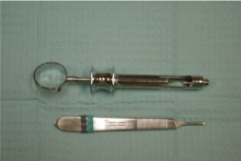
• Syringe
• Scalpel Handle
what type of scalpel blade is most commonly used in OMFS?
no. 15
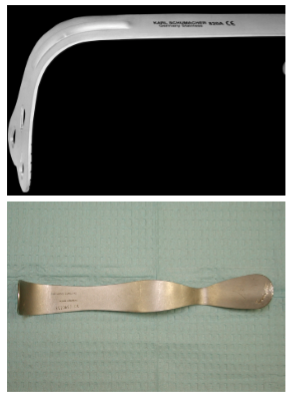
Cheek / Tongue Retractor
• “Sweetheart” tongue retractor
• Bishop retractor

Side Cutting Rongeur

End Cutting Rongeur (used for cutting proximal pieces of bone, granulation tissue, etc.)
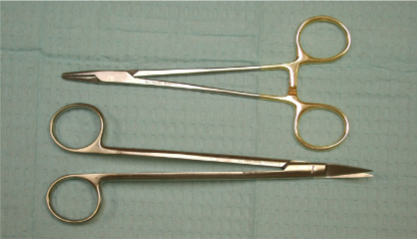
• Needle Holder
• Suture Scissors

small curved hemostat
tissue forceps

• Small Straight Elevator
• Large Straight Elevator
what are the 3 parts of an elevator?
blade
shank
handle

east/west elevators (for extracting root tips)
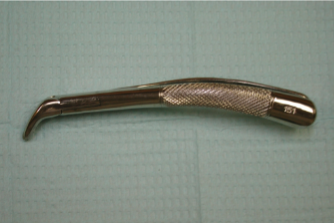
#151 Lower Universal Forceps

#150 Upper Universal Forceps

• Root Tip Forceps (286)
• Bayonet forceps

Maxillary Anterior Forceps (#1)

Cowhorn Forceps #23

Ash Forceps (English Style)
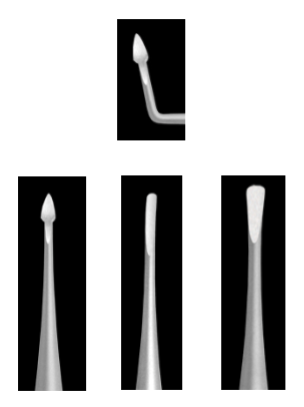
Proximators
fractured teeth where it’s hard to use elevators

hall drill (sectioning teeth)
Numbers denote the _______ of suturing material
thickness (higher # = thinner material)
what is an absorbable suture material derived from bovine intestine?
chromic gut
(bovine intestine + chromic salts → slow absorption compared to plain gut)
how many days of tensile strength does chromic gut suture offer?
6-10 days
what is the most commonly used intraoral suture?
chromic gut
what is an absorbable braided synthetic suture material?
vicryl
vicryl holds tensile strength for how long?
14-21 days
what is a common, traditional non-resorbable suture?
silk
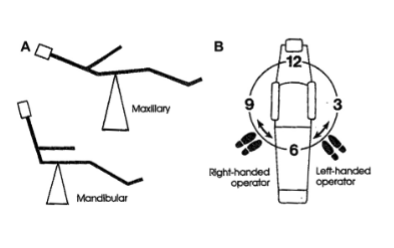
how should your patient be positioned for maxillary extractions?
higher / more reclined chair position

how should your patient be positioned for mandibular extractions?
lower, more upright position
when are simple extractions indicated?
extraction, erupted tooth or exposed root (ele- vation, and/or forcep removal)…routine removal of tooth structure, minor smoothing of socket bone and closure as necessary.
when are surgical extractions indicated?
Requiring removal of bone and/or sectioning of tooth, and including elevation of mucoperiosteal flap if indicated
what’s the code for simple extraction?
D7140
what’s the code for surgical extraction?
D7210
what must be done to soft tissue surrounding the tooth in a simple extraction?
detach soft tissue off of the tooth circumferentially
in a simple extraction, luxate the tooth in what direction to create space with an elevator?
mesio-distal
in a simple extraction, luxate the tooth in what direction to create space / overcome the undercuts for the tooth to be removed with a forcep?
bucco-lingually (primarily buccal)
what are the basic steps of a simple extraction?
• After the patient is positioned properly, the patient is anesthetized with local anesthetic
• For mandibular teeth a bite block must be placed
• Gauze is placed to prevent aspiration or ingestion of tooth fragments
• Periosteal elevator used to lift the periosteum off of the tooth, mostly on the buccal of the tooth
• Straight elevator used to luxate the tooth
• Forceps used to deliver the tooth
the concave surface of a periosteal elevator always faces…?
TOWARD the tooth/bone

straight elevator is used as a type ___ level and a wedge
type 1
how should a straight elevator be placed?
in the PDL space, adjacent to interproximal alveolar bone with apical pressure
Once in the PDL space-interproximal bone, continuous ______ pressure is placed as well as ________ force to luxate the tooth
apical; rotational
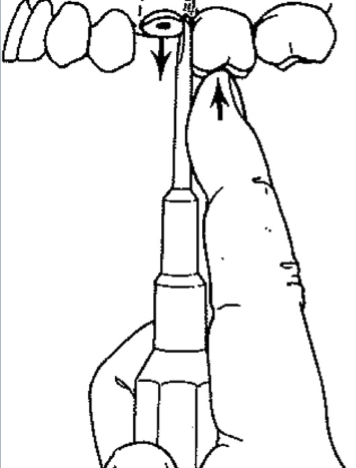
what type of forcep is used for anterior teeth (canine to canine)?
Straight Maxillary Anterior Forceps (#1)
what types of force should be applied with Straight Maxillary Anterior Forceps (#1)?
Apical Force placed to wedge the tooth into the socket
Bucco-lingual forces (mostly buccal) placed to expand the socket
Rotational forces can be applied to single rooted teeth

delivery of the tooth is mostly toward the ______
buccal (except when using Cowhorn forceps; this is delivered occlusally)
what types of force should be applied with Extraction Forceps (Ash)?
• Apical Force placed to wedge the tooth into the socket
• Bucco-lingual forces (mostly buccal) placed to expand the socket
• Rotational forces can be applied to single rooted teeth

what types of force should be applied with Extraction Forceps (#1 or150)?
• Apical pressure is used to expand the socket
• Bucco-lingual motion (mostly buccal) is used to expand the socket
• Figure 8 movement can be used to continue expanding the socket
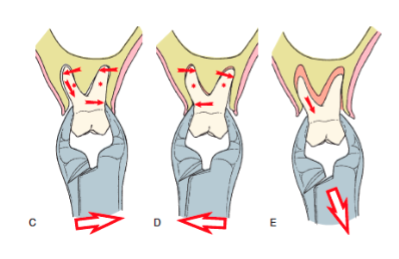
what types of force should be applied with Mandibular Extraction Forceps (#151)?
• Apical pressure is used to expand the socket
• Bucco-lingual motion (mostly buccal) is used to expand the socket
• Figure 8 movement can be used to continue expanding the socket
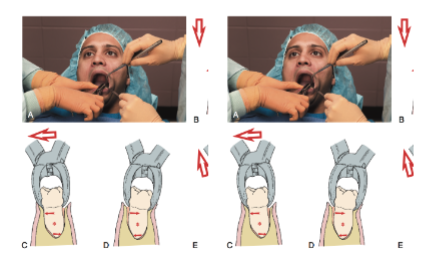
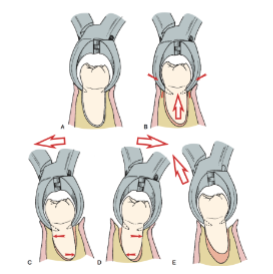
what types of force should be applied with Cowhorn Forceps #23?
• Apical pressure is used to expand the socket and to sink the teeth into the furcation
• A pumping motion may be used to extrude the tooth
• Buccal-lingual movement may also be incorporated to remove the tooth towards the buccal
• Tooth is delivered occlusally
• Apical pressure is used to expand the socket
what are some post-extraction management techniques?
debride (if necessary)
finger pressure around socket to reduce expanded socket
sharp boney protuberance should be filed/removed w bone file
irrigate with saline
gauze for pressure
what are some indications of leaving root tips?
<4-5 mm (generally)
deeply imbedded in bone
not infected
what are risks of removing impacted root tips?
• Destruction of surrounding tissue
• Damage of vital structure
• Potential displacement of root into tissue or maxillary sinus