Organic Chemistry Chapter 8 Reactions (Alkenes)
 Call Kai
 Learn
Learn Practice Test
 Spaced Repetition
 Match
Match Flashcards
 Knowt Play
1/12

There's no tags or description
Looks like no tags are added yet.
Name | Mastery | Learn | Test | Matching | Spaced | Call with Kai | Chat |
|---|
No analytics yet
Send a link to your students to track their progress
13 Terms
When studying this set:
- Focus less on knowing the names of the reactions and more on the reagents and what they do
- Shuffle the terms so you aren't just memorizing the order that we learned the reactions
- Practice with term first to think about how the given reagents will react with an alkene
- Practice with the definition first to think about which reagents are necessary to cause the given reaction
I believe in all of you !!!!

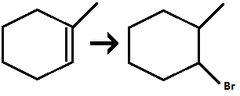
Hydrohalogenation (Markovnikov) *
HBr (or HX)
Markovnikov addition of H and X across the alkene

Hydrohalogenation (anti Markovnikov)
HBr, ROOR
anti-Markovnikov addition of H and Br across the alkene
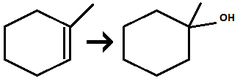
Acid-Catalyzed Hydration *
H3O+
Markovnikov addition of H and OH across the alkene
Oxymercuration-Demercuration
1) Hg(OAc)2, H2O
2) NaBH4
Markovnikov addition of H and OH across the alkene *without rearrangement*

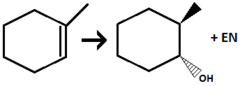
Hydroboration-Oxidation
1) BH3, THF
2) H2O2, NaOH
anti-Markovnikov addition of H and OH across the alkene, exclusively via a syn addition
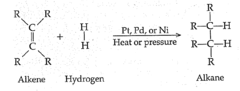
Hydrogenation
H2, Pt
syn addition of H and H across the alkene
Bromination *
Br2
anti addition of Br and Br across the alkene

Halohydrin Formation
Br2, H2O
anti addition of Br and OH across the alkene, with OH in the more substituted position

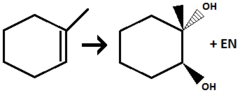
Anti Dihydroxylation
1) RCO3H (peroxy acid)
2) H3O+
treatment of an alene with a peroxy acid converts the alkene into an epoxide, which is then treated with an aqueous acid to give a trans-diol
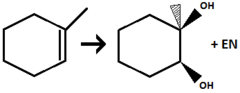
Syn Dihydroxylation
1) OsO4
2) NaHSO3, H2O
or
KMnO4, NaOH, cold
syn addition of OH and OH across the alkene
Ozonolysis
1) O3
2) DMS
causes cleavage of the C=C bond, giving 2 compounds with a C=O bond

Elimination
NaOMe/NaOEt gives Zaitsev product (more substituted)
t-BuOK gives Hofmann product (less substituted)