Feeds and Feeding Exam 1 Review
0.0(0)
Studied by 4 people Call Kai
 Learn
Learn Practice Test
 Spaced Repetition
 Match
Match Flashcards
 Knowt Play
Card Sorting
1/84

Earn XP
Last updated 8:27 PM on 2/20/23
Name | Mastery | Learn | Test | Matching | Spaced | Call with Kai | Chat |
|---|
No analytics yet
Send a link to your students to track their progress
85 Terms
1
New cards
nutrition
process of providing or obtaining the food necessary for support of life processes
2
New cards
digestion
process of converting complex nutrients into simple forms that can be more easily absorbed
3
New cards
absorption
process by which digested nutrients cross the membranes of the GIT and pass to the blood supply or lymphatic system
transporting components of digested feeds across cellular membranes (gut wall)
transporting components of digested feeds across cellular membranes (gut wall)
4
New cards
metabolism
all changes that take place after absorption from digestive into cell
provision of nourishment and energy for bodily processes
provision of nourishment and energy for bodily processes
5
New cards
The gastrointestinal tract anatomy of livestock is classified into non-ruminants and ruminants. Discuss these 2 classes
ruminant rely on microbes in stomach to break down forages that non-ruminants cant do (as efficiently)
6
New cards
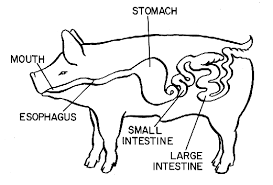
Label the diagrammatic representation of the gastrointestinal tract of the pig
total GIT, stomach, small intestine, and large
intestine
intestine
7
New cards
Discuss the anatomy and functions of the pig’s gastrointestinal tract (total GIT, stomach, small intestine, and large intestine)
non-ruminant:
stomach - initiate chemical/enzymatic digestion, secrete HCl/digestive enzymes(pepsin, rennin, lipase), mechanical preparation of feed, inborn protection, storage
small intestine -absorption, mechanical preparation via muscle contractions mixing bile/enzymes
large intestine - water absorption, some fermentation by anaerobic microbes
stomach - initiate chemical/enzymatic digestion, secrete HCl/digestive enzymes(pepsin, rennin, lipase), mechanical preparation of feed, inborn protection, storage
small intestine -absorption, mechanical preparation via muscle contractions mixing bile/enzymes
large intestine - water absorption, some fermentation by anaerobic microbes
8
New cards
Discuss functions of the lips
entrance to mouth
9
New cards
Discuss functions of the teeth, and beak
differ based on species (cut, rip, smash, grind, etc.)
10
New cards
Discuss functions of the salivary glands
Secrete serous, mucous, or mixed saliva into the mouth which are responsible for \n -Lubrication and buffering \n -Chemical digestion of feeds
11
New cards
Discuss functions of the esophagus
swallowing, rumination
12
New cards
Discuss functions of the non-ruminant stomach
Initiate chemical/enzymatic digestion
Mechanical preparation of feed
Inborn protection
Storage
Mechanical preparation of feed
Inborn protection
Storage
13
New cards
Discuss functions of the ruminant stomach
Forestomach (non-glandular) = Microbial digestion of feedstuffs
Abomasum (glandular) = similar to non-ruminant stomach
Abomasum (glandular) = similar to non-ruminant stomach
14
New cards
Discuss the inborn protection mechanism of the stomach
Stomach secretes mucus, which protects the stomach lining from strong acids and digestive enzymes
15
New cards
Discuss the functions of the small intestine
Final stages of enzymatic digestion and serves as the main site of nutrient absorption
16
New cards
Discuss why the small intestine is the major site of absorption
Effective at absorbing nutrients because it has a large surface area, due to many folds as well as villi and microvilli
17
New cards
Discuss functions of the large intestine
water absorption and some bacterial fermentation (hind-gut fermenters)
18
New cards
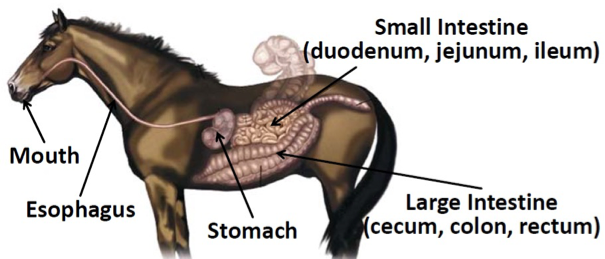
Label the diagrammatic representation of the gastrointestinal tract of the horse
total GIT, stomach, small intestine, and large
intestine
intestine
19
New cards
Discuss the anatomy and functions of the horse’s gastrointestinal tract (total GIT, stomach, small intestine, and large intestine)
non-ruminant, hindgut fermentors:
stomach - initiate chemical/enzymatic digestion, secrete HCl/digestive enzymes(pepsin, rennin, lipase), mechanical preparation of feed, inborn protection, storage
small intestine -absorption, mechanical preparation via muscle contractions mixing bile/enzymes
large intestine - water absorption, significate digestion, active microbe population to break down carbs/fiber to VFAs
stomach - initiate chemical/enzymatic digestion, secrete HCl/digestive enzymes(pepsin, rennin, lipase), mechanical preparation of feed, inborn protection, storage
small intestine -absorption, mechanical preparation via muscle contractions mixing bile/enzymes
large intestine - water absorption, significate digestion, active microbe population to break down carbs/fiber to VFAs
20
New cards
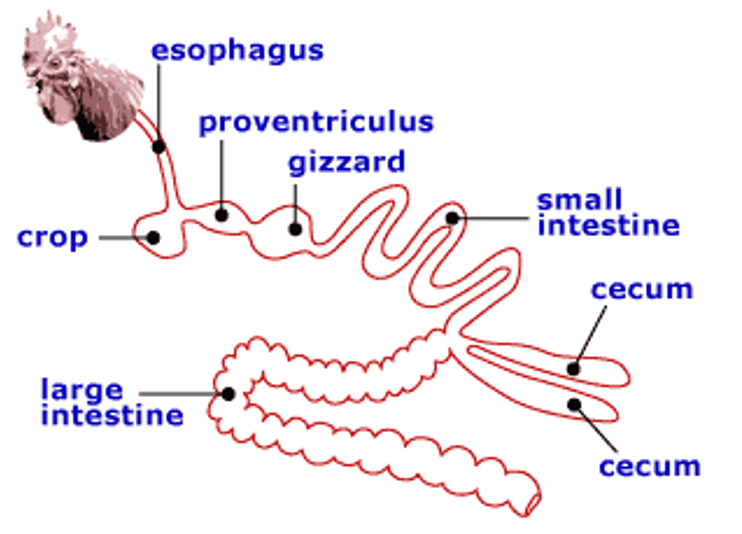
Label the diagrammatic representation of the gastrointestinal tract of the chicken
total GIT, crop, proventriculus, gizzard, small
intestine, ceca, and large intestine
intestine, ceca, and large intestine
21
New cards
Discuss the anatomy and functions of the chicken’s gastrointestinal tract (total GIT, crop, proventriculus, gizzard, small intestine, ceca, and large intestine)
non-ruminant:
crop - storage of excess feed, regulate intake/flow to proventriculus
proventriculus - “true stomach,” chemical digestion (glandular chamber secretes HCl/digestive enzymes)
gizzard - “mechanical stomach,” “teeth,” muscular contractions with stones grinds feed, mixes with acid from proventriculus
small intestine - site for absorption and chemical digestion
ceca - have 2, fermentation of fibrous feed
large intestine - water absorption, some fermentation by anaerobic microbes
crop - storage of excess feed, regulate intake/flow to proventriculus
proventriculus - “true stomach,” chemical digestion (glandular chamber secretes HCl/digestive enzymes)
gizzard - “mechanical stomach,” “teeth,” muscular contractions with stones grinds feed, mixes with acid from proventriculus
small intestine - site for absorption and chemical digestion
ceca - have 2, fermentation of fibrous feed
large intestine - water absorption, some fermentation by anaerobic microbes
22
New cards
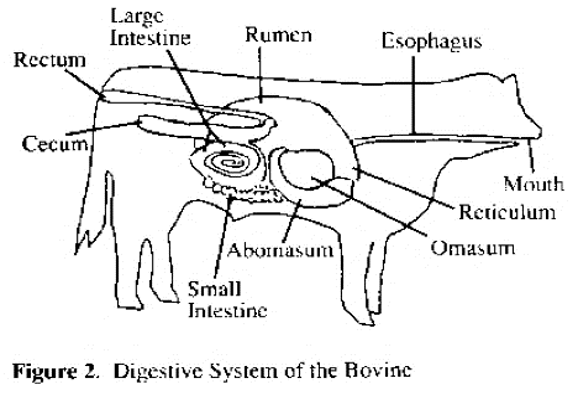
Label the diagrammatic representation of the gastrointestinal tract of the cow
total GIT, stomach and its compartments, small
intestine, and large intestine
intestine, and large intestine
23
New cards
Discuss the anatomy and functions of the cow’s gastrointestinal tract (total GIT, stomach and its compartments, small intestine, and large intestine)
ruminant:
stomach:
omasum - slow down food passage, push food to abomasum, absorb 30-60% water
abomasum - “true stomach,” glandular, like non-ruminants in function and anatomy
rumen - holding vat for fermentation, mechanical preparation of feed, absorption of fermentation products, papillae increase area, symbiosis with microbes
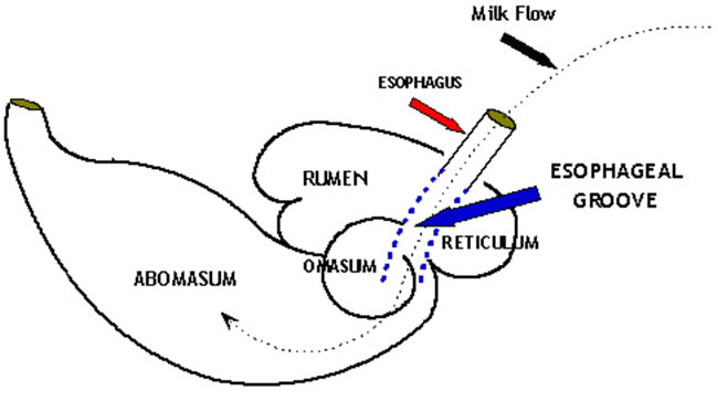
reticulum - receives and traps foreign objects, gateway to rumen, gather ingested food for regurgitation, reticular groove allows milk to bypass rumen
small intestine - final stage of enzymatic diegstion, main site of absorption
large intestine - water absorption, some bacterial fermentation, excretion of waste
stomach:
omasum - slow down food passage, push food to abomasum, absorb 30-60% water
abomasum - “true stomach,” glandular, like non-ruminants in function and anatomy
rumen - holding vat for fermentation, mechanical preparation of feed, absorption of fermentation products, papillae increase area, symbiosis with microbes
reticulum - receives and traps foreign objects, gateway to rumen, gather ingested food for regurgitation, reticular groove allows milk to bypass rumen
small intestine - final stage of enzymatic diegstion, main site of absorption
large intestine - water absorption, some bacterial fermentation, excretion of waste
24
New cards
Compare the anatomy and function of the gastrointestinal tract of the horse to that of the pig, the chicken, and the cow.
horse is a hindgut fermenter, pig is a monogastric
chicken is a non-ruminnat, cow is a ruminant
chicken is a non-ruminnat, cow is a ruminant
25
New cards
Label the diagrammatic representation by identifying the 4 compartments of the stomach of a ruminant
reticulum, rumen, omasum, abomasum
26
New cards
rumination
passage of food bolus, formed in stomach to mouth
27
New cards
Discuss the function of the reticulum
receives swallowed particles and traps foreign objects, gateway to rumen, gathers ingested feeds for regurgitation
28
New cards
Discuss the function of the rumen
holding vat for microbial fermentation, mechanical preparation of feed, absorption of fermentation products, storage of feed and delayed passage
29
New cards
Discuss the function of the omasum
slow down food passage, push food to abomasum, absorb water (30-60% that enters)
30
New cards
Discuss the function of the abomasum.
chemical/enzymatic digestion, secrete HCl and digestive enzymes, inborn protection, storage, mechanical preparation of feeds
31
New cards
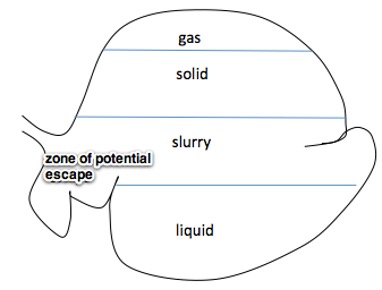
Label the diagrammatic representation by identify the 4 different layer of contents in the rumen
gas, solid (fiber mat), slurry, liquid
32
New cards
Discuss the 3 groups of microorganisms that are found in the ruminant stomach
bacteria (>20billion/mL), protozoa (>20 million/mL), and fungi
33
New cards
Discuss why ruminants are more effective with regard to utilizing fiber as sources of energy than non-ruminants
Rumen has symbiosis between ruminants and microbes, microbes provide special digestive enzymes that animals cannot synthesize, but are designed to digest fiber.
34
New cards
Discuss the symbiotic relationship between the ruminant animal (host) and anaerobic microorganisms in its gastrointestinal tract
microbes provide nutrients for the animal as:
Protein (microbes that wash to abomasum)
Energy (microbial fermentation end-products like VFA as energy)
Vitamins ( vitamins synthesized by microbes)
Protein (microbes that wash to abomasum)
Energy (microbial fermentation end-products like VFA as energy)
Vitamins ( vitamins synthesized by microbes)
35
New cards
nutrient
any element or compound in a diet of living organisms that support normal functioning of life processes like:
growth, maintenance, reproduction, lactation, and health
growth, maintenance, reproduction, lactation, and health
36
New cards
Name the 6 classes of nutrients
water, carbohydrates, proteins, lipids, vitamins, minerals
37
New cards
Provide 4 general classifications for feedstuffs
high roughage feeds, roughages (TDN<70%, NDF > 30%, CP 20%)
high energy feeds, concentrates (TDN>70%, NDF<30%, CP 20%)
high protein feeds (TDN>70%, NDF<30%, CP>20%)
minerals/other
high energy feeds, concentrates (TDN>70%, NDF<30%, CP 20%)
high protein feeds (TDN>70%, NDF<30%, CP>20%)
minerals/other
38
New cards
Discuss how feedstuffs are classified internationally and name the 8 classification categories
based on nutrient composition and physical characteristics: \n Dry Roughages \n Pasture and range grasses \n Ensiled roughages \n High-energy concentrates \n Protein sources \n Minerals \n Vitamins \n Additives
39
New cards
Why are feedstuffs assigned an International Feed Number (IFN)?
allows people to discuss same feed because the name may vary (ie. corn v maize)
40
New cards
Describe the proximate analysis system
Most common method used to determine nutrient content of feeds: \n Dry Matter \n Ash \n Crude Protein \n Crude Fiber \n Ether Extract \n Nitrogen Free Extract
41
New cards
Discuss how the proximate analysis system can be used to classify feeds
can be used to classify feeds bas on energy concentrates (ie TDN = all organic nutrients summed x digestion coeff)
42
New cards
Identify the feedstuff based on their proximate analysis: Feed 1 = <70% TDN, >18% CF,<20% CP
high roughage feeds
43
New cards
Identify the feedstuff based on their proximate analysis: Feed 2 = >70% TDN, <18% CF, <20% CP
high energy feeds
44
New cards
Identify the feedstuff based on their proximate analysis: Feed 3 = >70% TDN, <18% CF, >20% CP
high protein feeds
45
New cards
Describe the detergent fiber system.
NDF (hemicellulose, cellulose, lignin) measured by washing in Neutral Detergent
ADF (cellulose, lignin) measured by washing in Acid Detergent
ADL (lignin) measured by washing in strong Acid
ADF (cellulose, lignin) measured by washing in Acid Detergent
ADL (lignin) measured by washing in strong Acid
46
New cards
How does the detergent fiber system differ from fiber analysis for the proximate analysis system?
NDF is more used today as its more accurate
47
New cards
Discuss 3 sources of water
drinking water - commonly available at all times
free water - moisture associated with feeds
metabolizable water - chemically bound and released during metabolism (nutrient oxidation)
free water - moisture associated with feeds
metabolizable water - chemically bound and released during metabolism (nutrient oxidation)
48
New cards
Discuss the functions of water
Solvent
Substrate for chemical reactions
Transportation of nutrients and waste
Regulation of temperature
Lubrication, shaping, cushioning
Substrate for chemical reactions
Transportation of nutrients and waste
Regulation of temperature
Lubrication, shaping, cushioning
49
New cards
Discuss the digestion and absorption of water
water doesn’t need to be digested
absorbed by small/large intestines (non-ruminants) or rumen, omasum, small/large intestine (ruminants)
absorbed by small/large intestines (non-ruminants) or rumen, omasum, small/large intestine (ruminants)
50
New cards
Compare water consumption of ruminants to non-ruminants. Give reasons for possible differences
type of digestive tract affects consumption
ruminants require larger amounts of water to form suspension of ingesta
ruminants require larger amounts of water to form suspension of ingesta
51
New cards
Compare water consumption of dairy cattle to beef cattle. Give reasons for possible differences
dairy require far more water
water loss is greater in lactating animals, milk production lowers when water supply’s low
water loss is greater in lactating animals, milk production lowers when water supply’s low
52
New cards
Compare water consumption of cattle to horses. Give reasons for possible differences
cattle require more water due to them being ruminants (GIT is different)
53
New cards
Discuss factors that affect drinking water consumption
environmental factors (temperature and humidity)
species type (GIT type, water loss amount, urinary tract type)
stage of production (ie lactating animals)
dietary factors (DM consumption, diet type)
toxic elements (salinity, nitrates, sulfates, iron, algae, ag. chemicals)
species type (GIT type, water loss amount, urinary tract type)
stage of production (ie lactating animals)
dietary factors (DM consumption, diet type)
toxic elements (salinity, nitrates, sulfates, iron, algae, ag. chemicals)
54
New cards
Discuss how the type of urinary system of mammals versus birds may affect water consumption
mammals require more water
mammals excrete urea in urine (95% water) and birds excrete uric acid (semi-solid) as they don’t actually urinate
mammals excrete urea in urine (95% water) and birds excrete uric acid (semi-solid) as they don’t actually urinate
55
New cards
Discuss water quality and how it may affect water consumption
lower quality lowers consumption
56
New cards
Discuss potential toxic elements in drinking water
high salinity, nitrates, sulfates, iron, algae, agricultural chemicals
57
New cards
Discuss deficiencies of water
depresses performance (more quickly than any other deficiency)
decreases intake
weight loss (due to dehydration)
decreases intake
weight loss (due to dehydration)
58
New cards
Discuss the chemical composition of carbohydrates
Organic compounds that contain carbon, hydrogen, and oxygen \n 1C:2H:1O
59
New cards
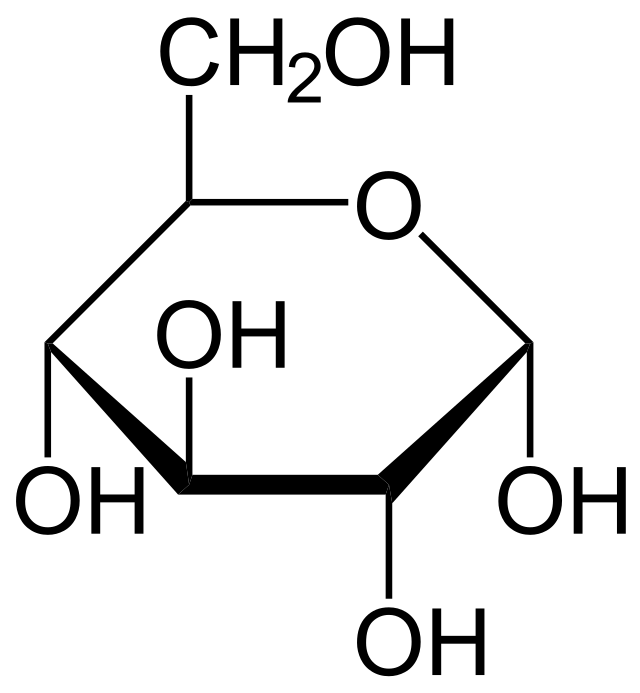
Identify a glucose molecule
it is this lol
60
New cards
Discuss the classification of carbohydrates
Monosaccharides (simple sugars - not decomposable into simpler sugars by hydrolysis)
Oligosaccharides (2 to 10 saccharide units)
Polysaccharides (>10 saccharide units)
Oligosaccharides (2 to 10 saccharide units)
Polysaccharides (>10 saccharide units)
61
New cards
examples of monosaccharides
Aldopentose (5C), Aldohexose (6C), Ketohexoses (6C)
62
New cards
examples of oligosaccharides (disaccharides)
Maltose (a1,4 glucose-glucose)
Lactose (beta1,4 glucose-galactose)
Sucrose (alpha1,4 glucose-fructose)
Lactose (beta1,4 glucose-galactose)
Sucrose (alpha1,4 glucose-fructose)
63
New cards
examples of polysaccharides
Starch (Amylose and Amylopectin)
Glycogen
Cellulose
Hemicellulose
Pectins
Glycogen
Cellulose
Hemicellulose
Pectins
64
New cards
Describe the difference between amylose and cellulose
amylose - unbranched starch with alpha 1,4 linkages
cellulose - unbranched fiber with beta 1,4 linkages
cellulose - unbranched fiber with beta 1,4 linkages
65
New cards
Describe the difference between amylopectin and glycogen
amylopectin is a starch?
66
New cards
Describe the differences between pentoses and hexoses
pentose - 5 Carbons
hexose - 6 Carbons
hexose - 6 Carbons
67
New cards
Describe the difference between an alfa-linkage and a beta-linkage between sugars and how these linkages affect the digestibility of carbohydrates
alpha - “U” shaped, both Oxygen on bottom and face downward, easier to break
beta- “zig-zag” shape, Oxygens on opposite sides, harder to break apart
beta- “zig-zag” shape, Oxygens on opposite sides, harder to break apart
68
New cards
Discuss the difference between structural carbohydrates and non-structural carbohydrates
Non-structural - alpha linkages \n Structural - beta linkages
69
New cards
Discuss the digestion of carbohydrates in mammals
saliva, pancreas, and duodenum secrete enzymes that cleave alpha linkages resulting in monosaccharides (ie glucose)
70
New cards
\n Discuss the digestion of carbohydrates in anaerobic microorganisms
found in rumen and large intestine and secrete enzymes that cleave alpha and beta linkages resulting in VFAs
71
New cards
Discuss carbohydrate requirements
Little evidence of requirement for any specific CHO by mammals
Ultimate source of energy for most animal tissues is glucose
Ultimate source of energy for most animal tissues is glucose
72
New cards
Discuss deficiencies of carbohydrates. Describe ketosis.
disorder in CHO and lipid metabolism, common in lactating and pregnant animals
caused by a blood glucose drain causing the mobilization of fat faster than what it can be used for energy, result in production of ketones.
Symptoms: weight loss, decreased milk production, and abortion in pregnant animals
Prevention: energy supplementation during last trimester of pregnancy and lactation
caused by a blood glucose drain causing the mobilization of fat faster than what it can be used for energy, result in production of ketones.
Symptoms: weight loss, decreased milk production, and abortion in pregnant animals
Prevention: energy supplementation during last trimester of pregnancy and lactation
73
New cards
Describe the composition of a protein
Chemically consist of long chains of amino acids
Physical and chemical nature of proteins are determined by amino acid sequence, length of amino acid chain, and type of linkages
Physical and chemical nature of proteins are determined by amino acid sequence, length of amino acid chain, and type of linkages
74
New cards
Describe an amino acid
carbon center, hydrogen, carboxyl group, amino group, side chain / R group
75
New cards
Describe how amino acids are classified
essential and non-essential
76
New cards
Give 2 examples of an essential amino acid and 2 examples of an nonessential amino acid
essential - lysine and valine
non-essential - alanine and aspartate
non-essential - alanine and aspartate
77
New cards
Discuss the functions of proteins
basic structural units of body
metabolism (enzymes, hormones, immune, energy source)
metabolism (enzymes, hormones, immune, energy source)
78
New cards
Describe how proteins are digested.
proteins too big to be absorbed so they need to be broken into amino acids, which occurs via digestive secretions in the stomach (HCl and Pepsin) and small intestine (trypsin)
79
New cards
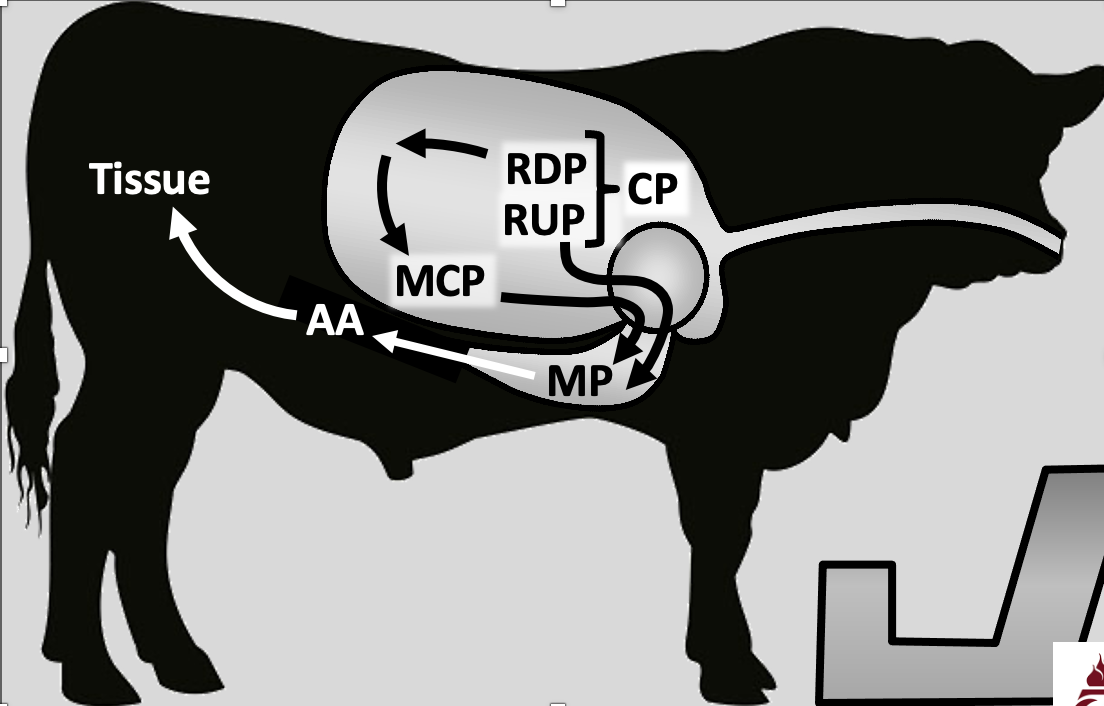
Discuss protein digestion in the rumen of ruminants by using the diagram of a ruminant stomach
microbes degrade RDP to ammonia and rest of protein (RUP) cannot be degraded by microbes
rumen can also synthesize protein from many sources of Nitrogen (RDP and NPN)
rumen can also synthesize protein from many sources of Nitrogen (RDP and NPN)
80
New cards
Discuss the protein requirements of non-ruminants
cannot synthesize some amino acids, essential amino acids are required in the diet
81
New cards
Discuss the protein requirements of ruminants
cannot synthesize essential amino acids, but ruminant microbes can synthesize both essential and non-essential amino acids, but they may be limited in what they can produce
82
New cards
Describe the role that rumen microbes play in protein metabolism by ruminants
ruminant microbes can synthesize both essential and non-essential amino acids, but they may be limited in what they can produce (ie. methionine)
83
New cards
What are the most limiting amino acids for pigs, cattle, sheep? Explain why?
pigs - lysine (requirements of outweigh the amount in diet)
ruminants (cattle, sheep) - methionine (lack of results in lower protein products, even if rest of AA are in high concentrates)
ruminants (cattle, sheep) - methionine (lack of results in lower protein products, even if rest of AA are in high concentrates)
84
New cards
Discuss protein deficiencies and symptoms
caused by 1 or more limiting As or inadequate protein consumption
symptoms - poor growth and reproduction, reduced milk/egg production
prevention/treatment - increase dietary protein supply, supplement diet with limiting AAs
symptoms - poor growth and reproduction, reduced milk/egg production
prevention/treatment - increase dietary protein supply, supplement diet with limiting AAs
85
New cards
Discuss protein toxicities and symptoms
excess degradable protein particularly NPN can cause Ammonia toxicity
symptoms - excessive salivation, rapid breathing, incoordination, bloat, tetany, death (neurological disturbances)
treatment - oral administration of vinegar
symptoms - excessive salivation, rapid breathing, incoordination, bloat, tetany, death (neurological disturbances)
treatment - oral administration of vinegar