econ test 3
 Studied by 0 people
 Call Kai
 Learn
Learn Practice Test
 Spaced Repetition
 Match
Match Flashcards
 Knowt Play
1/42

There's no tags or description
Looks like no tags are added yet.
Name | Mastery | Learn | Test | Matching | Spaced |
|---|
No study sessions yet.
43 Terms
The interest rate effect is one of the
a. reasons why an AD curve is downward-sloping.
b. shifters of an AD curve.
c. reasons why a short-run aggregate supply curve can be derived
d. shifters of a short-run aggregate supply curve.
reasons why an AD curve is downward-sloping.
Individuals' expectations of lower future prices is a
a. rightward shifter of the AD curve.
b. leftward shifter of the AD curve.
c. reason for moving up along a given AD curve.
d. reason for moving down along a given AD curve.
leftward shifter of the AD curve.
If individuals expect lower prices in the future, they will delay consumption to buy later at cheaper prices.
Current consumption falls → aggregate demand decreases.
A decrease in aggregate demand shifts the AD curve leftward.
As the interest rate rises, the cost of a given investment project _______ and businesses invest ______
a. rises; more b. rises; less
c. falls; more d. falls; less
rises; less
When the interest rate rises, the cost of financing an investment project increases, making some projects less profitable. As a result, businesses tend to invest less because fewer projects meet the required return. In short, higher interest rates → higher costs → lower investment.
A rise in foreign real national income tends to raise U.S. ______, shifting the U.S. AD curve to the ____.
a. exports; left
b. exports; right
c. imports; left
d. imports; right
exports; right
Changes in which of the following factors shifts the AD curve?
a. net exports
c. supply shocks
b. prices of nonlabor inputs
d. productivity
net exports
Business optimism about future sales tends to_______ investment expenditures, shifting the AD curve to the _______.
a. increase; left b. increase; right
c. decrease; left d. decrease; right
increase; right
A decrease in the money supply may _____ total expenditures and thus _______ aggregate demand.
a. raise; raise b. raise; lower
c. lower; raise d. lower; lower
lower; lower
The short-run aggregate supply curve is
a. downward sloping.
b.upward sloping
c. vertical.
d. horizontal.
upward sloping
An increase in the price of nonlabor inputs
a. shifts the AD curve leftward.
b. shifts the SRAS curve leftward.
c. is the same thing as a beneficial supply shock.
d. shifts the AD curve rightward
shifts the SRAS curve leftward.
An increase in the price of a nonlabor input such as oil will cause
a. a movement down the SRAS curve. b. a movement up the SRAS curve.
c. a leftward shift in the SRAS curve. d. a rightward shift in the SRAS curve.
a leftward shift in the SRAS curve
An increase in labor productivity shifts the
a. AD curve rightward. b. AD curve leftward.
c. SRAS curve leftward. d. SRAS curve rightward.
SRAS curve rightward.
A simultaneous rise in aggregate demand and fall in short-run aggregate supply will definitely
a. a raise the price level, but there is not enough information to know how Real GDP will change.
b. lower Real GDP, but there is not enough information to know how the price level will change.
c. raise the price level and Real GDP.
d. raise Real GDP, but there is not enough information to know how the price level will change.
a raise the price level, but there is not enough information to know how Real GDP will change
In the short run, an increase in investment, ceteris paribus, shifts the
a. AD curve to the right, causing equilibrium price level to rise and equilibrium Real GDP to increase.
b. AD curve to the left, causing equilibrium price level to fall and equilibrium Real GDP to decrease.
c. SRAS curve to the right, causing equilibrium price level to fall and equilibrium Real GDP to increase.
d. SRAS curve to the left, causing equilibrium price level to rise and equilibrium Real GDP to decrease.
AD curve to the right, causing equilibrium price level to rise and equilibrium Real GDP to increase.
* If wage rates rise at the same time that labor productivity increases, what is the effect on short-run aggregate supply
(SRAS)?
a. SRAS rises.
b. SRAS falls.
c. SRAS remains constant.
d. SRAS may rise, fall, or remain constant.
SRAS may rise, fall, or remain constant
*Starting from short-run equilibrium, the following occurs: personal income taxes rise and foreign real national income rises. What is the effect on the price level and Real GDP in the short run?
a. The price level rises and Real GDP falls. b. The price level falls and Real GDP falls.
c. The price level rises and Real GDP rises. d. There is not enough information to answer this question.
There is not enough information to answer this question
Starting from short-run equilibrium, the following occurs: individuals expect higher (future) incomes and wage rates rise. What is the effect on the price level and Real GDP in the short run?
a. The price level rises and Real GDP rises.
b. The price level falls and Real GDP falls.
c. The price level rises, but the effect on Real GDP cannot be determined.
d. Real GDP rises, but the effect on the price level cannot be determined.
The price level rises, but the effect on Real GDP cannot be determined
Which of the following is consistent with the sticky-wage explanation of the upward-sloping SRAS curve?
a. The price level rises, the real wage falls, and the quantity demanded of labor declines.
b. The price level falls, the real wage rises, and the quantity demanded of labor falls.
c. The price level rises, the real wage rises, and the quantity demanded of labor falls.
d. The nominal wage rises, the real wage rises, and the quantity demanded and supplied of labor rise.
The price level falls, the real wage rises, and the quantity demanded of labor falls.
The worker-misperception explanation of the SRAS curve is used to explain why
a. SRAS curves shift to the right
b. SRAS curves shift to the left
c. the SRAS curve slopes upward.
d. the SRAS curve slopes downward.
the SRAS curve slopes upward.
Say's law states that
a. demand creates its own supply.
b. the more supply there is, the lower prices are.
c. supply creates supply.
d. supply creates its own demand.
supply creates its own demand
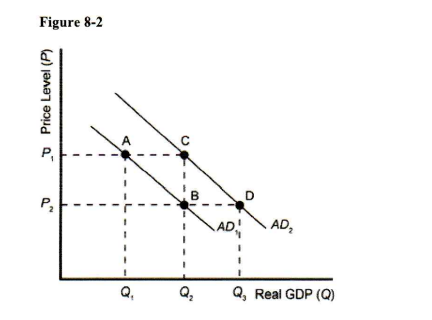
Refer to Figure 8-2. A movement from point A to point B on AD would have been the result of
a. a decrease in the price level. b. an increase in the price level.
c. an increase in income taxes. d. a decrease in income taxes.
a decrease in income taxes
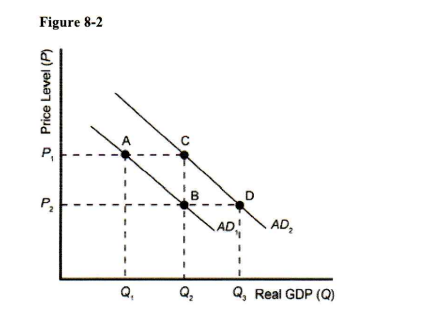
Refer to Figure 8-2. A shift in aggregate demand from AD2 to AD1 could have been the result of
a. a decrease in the price level.
b. an increase in the price level.
c. businesses become more optimistic about future sales.
d. businesses become more pessimistic about future sales.
businesses become more pessimistic about future sales.
If the SRAS curve intersects the AD curve to the right of Natural Real GDP, the economy is
a. in a recessionary
b. in either a recessionary gap or an inflationary gap, but we need more information to gap determine which one.
c. in an inflationary gap.
d. at full-employment Real GDP.
in an inflationary gap.
*Which of the following is consistent with the classical view of Say's law?
a. Saving increases by $2 billion and investment decreases by $2billion.
b. Saving increases by $2 billion and consumption rises by $2 billion.
c. Saving increases by $2 billion, consumption decreases by $2 billion, and investment rises by something less than $2 billion.
d. Saving increases by S2 billion and investment increases by $2 billion.
Saving increases by $2 billion and investment increases by $2 billion.
According to Say's law,
a. if there is demand for a good, someone will supply it.
b. production creates demand sufficient to purchase all goods and services produced.
c. supply and demand work together to determine price.
d. trading takes longer in a barter economy than in a money economy.
production creates demand sufficient to purchase all goods and services produced.
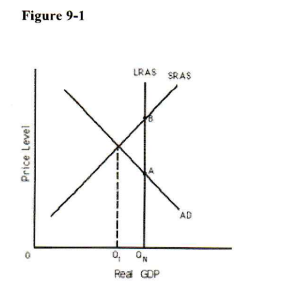
Refer to Figure 9-1. The economy is currently producing Q1. At this level of Real GDP, the economy is in
a. an inflationary gap. b. a recessionary gap.
c. long-run equilibrium. d. a structural gap.
a recessionary gap.
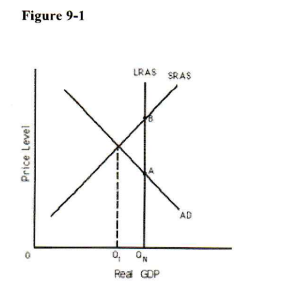
Refer to Figure 9-1. The economy is currently producing Q1. If an economist believes the economy can move itself without government intervention to QN, then the economist believes that the
a. LRAS curve will shift leftward until it intersects the SRAS and AD curves at Q.
b. AD curve will shift rightward and intersect the SRAS curve at point В.
c. SRAS curve will shift rightward and intersect the AD curve at point A.
d. economy will likely stay "stuck" in short-run equilibrium.
SRAS curve will shift rightward and intersect the AD curve at point A.
Which of the following is consistent with Keynes's view of Say's law?
a. Saving increases by $3 billion, consumption falls by $3 billion, and investment rises by $3 billion.
b. Consumption rises by $3 billion and saving rises by more than $3 billion.
c. Saving rises by $3 billion, consumption falls by $3 billion, and investment rises by something less than $3 billion.
d. Saving rises by $3 billion, consumption falls by $3 billion, and investment rises by $6 billion.
Saving rises by $3 billion, consumption falls by $3 billion, and investment rises by something less than $3 billion.
According to Real Business Cycle Theory decreases in productivity could be caused by:
a. decreased foreign income. b. increased concerns about the economy.
c. increased government regulation. d. increases in technology.
increased government regulation
Real Business Cycle Economists generally would __________ fiscal policy because in their models the aggregate supply curve is ___________.
a oppose; vertical b. favor; vertical
c. favor; horizontal d. oppose; horizontal
oppose; vertical
In the RBC framework, a movement of workers from high-tech to the service industry causes the AS curve to shift:
a. up. b. down.
c. left. d. right.
left
Fiscal policy is difficult to implement because:
a. it takes time to implement and enact fiscal policy.
b. the policymakers may not know what potential output is.
c. households respond to incentives and policies in unexpected ways.
d. all of the above.
all of the above.
All of the following can explain the asymmetric response of the economy to oil prices except:
a. A strict countercyclical foreign policy.
b. The costs of adjustment in oil prices.
c. Financial stress due to oil price movements.
d. The asymmetric monetary policy response.
A strict countercyclical foreign policy.
According to the Permanent Income Hypothesis, consumption expenditures are determined by:
a. Current year income b. Previous year income
c. Permanent year income d. Year-end bonus income
Permanent year income
When the MPC = 0.6, the multiplier is
a. 0.40. b. 2.50.
c. 1.67. d. 6.00.
2.50.
Government purchases rise by $100 billion and the MPC equals 0.75. Assuming that idle resources exist at each expenditure round, and the multiplier is operative, the change in Real GDP equals
a. $40 billion. b. $75 billion.
c. $400 billion. d. $750 billion.
$400 billion
Autonomous spending rises by $10 billion and Real GDP rises by $50 billion. What does the marginal propensity to save equal?
a. 0.10 b. 0.20
c. 0.80 d. 0.90
0.20
If an economy consumes 68 percent of any increase in disposable income, then an increase in autonomous investment of $1 billion would result in an increase in total spending of as much as
a. $1.125 billion.
b. $3.125 billion.
c. $5.0 billion.
d. $1.47 billion.
$3.125 billion.
Autonomous consumption is
a. the change in consumption that results as a person's (or nation's) income increases or decreases.
b. that portion of total consumption that is dependent upon the level of income.
c. the steady increase in the consumption of goods and services that automatically occurs as a person grows from a child to an adult.
d. that portion of total consumption that is independent of the level of income.
that portion of total consumption that is independent of the level of income.

Refer to Figure 9-4. Assume the economy is currently in long-run equilibrium with the price level equal to P3. If foreigners begin to buy more U.S. goods, the economy will, in the short run, move to price level equal to ________ and Real GDP equal to _________?
a. P2. Q4. b. P3: Q3.
c. P4: Q2. d. P4: Q4
P2. Q4
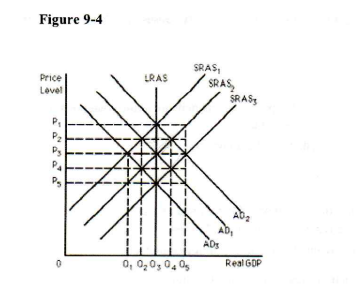
Refer to Figure 9-4. When AD and SRAS cross at the point at which the price level is equal to P₁ and Real GDP is equal to Q3, the economy is in
a. a recessionary gap. b. an inflationary gap.
c. long-run equilibrium. d. experiencing an excessive amount of unemployment.
long-run equilibrium
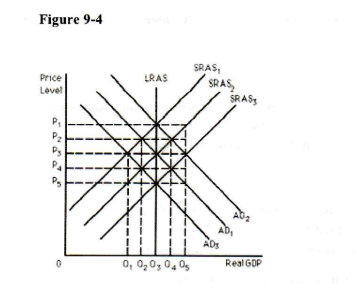
Refer to Figure 9-4. Assuming the economy is in an inflationary gap at a short-run equilibrium point with the price level at P2, the movement toward long-run equilibrium will be
a. down and along AD. b. up and along AD2.
c. down and along SRAS. d. up and along SRAS2.
up and along AD2
The multiplier assumes all of the following except:
a. a fixed price level.
b. a fixed interest rate.
c. people have rational expectations
d. consumption depends on disposable income.
people have rational expectations
Classical economists argued that unemployment during the Depression could be reduced by:
a. lowering taxes.
b. eliminating labor unions and government policies that kept wages too high.
c. strengthening unions and government regulations protecting unions and workers.
d. increasing real wages so that people are encouraged to work.
eliminating labor unions and government policies that kept wages too high