Reinforcement Learning
 Call Kai
 Learn
Learn Practice Test
 Spaced Repetition
 Match
Match Flashcards
 Knowt Play
1/26

Earn XP
Description and Tags
Name | Mastery | Learn | Test | Matching | Spaced | Call with Kai | Chat |
|---|
No analytics yet
Send a link to your students to track their progress
27 Terms
Return
Total discounted long term future reward. To evaluate the decision process of the agent.
Estimates the quality of the agent’s sequence of actions
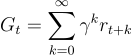
Agent goal
Maximizing cumulative rewards over time.
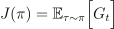
Markov Property
The furure is independent of the past given the present.
Value functions
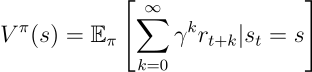
Estimate how good it is for an agent following policy \pi to be in a certain state or how good it is to perform a certain action from a state, based on expected rewards.
State Value Function
Expected return starting from state s anf following policy \pi
State-action Value Function
Expected return starting from state s, performing action a and following policy \pi

Advantage Function
Relative measure of action quality.
Estimates how much better (or worse) an action is compared to the average action in a given state
Mainly used for variance reduction
If A(s,a)>0, action a is better than the expected return from state s

Bellman Equation
The value of a state equals the immediate reward plus the discounted value of future states
Recursive relationship
Bellman optimality equation for V*

What does P(s′∣s,a) mean?
The probability of transitioning to state s′ after taking action a in state s.
What does R(s,a,s′) represent?
The immediate reward received when transitioning from s to s′ after taking action a.
What does the discount factor γ do?
It determines how much future rewards matter relative to immediate rewards
What does a small γ mean?
The agent focuses more on immediate rewards.
What does a γ close to 1 mean?
The agent places more importance on long-term rewards.
Why does the Bellman optimality equation contain max_a?
Because an optimal agent chooses the action with the greatest expected return.
What is the Bellman expectation equation for a policy π?

What is the difference between the Bellman expectation equation and Bellman optimality equation?
The expectation equation averages actions according to a fixed policy π, while the optimality equation chooses the best action using maxa.
What question does policy evaluation answer?
How good is this particular policy?
What question does the Bellman optimality equation answer?
What is the best possible return I can achieve?
What is iterative policy evaluation?
Repeatedly applying the Bellman expectation update to estimate V^\pi

Why can value functions be estimated iteratively?
Because the value of a state depends recursively on the values of successor states.

What does V_k^\pi(s) mean?
The estimate of the value of state s under policy \pi after k iterations of policy evaluation.
What is value iteration?
An iterative method for estimating the optimal value function using:

What is the key difference between iterative policy evaluation and value iteration?
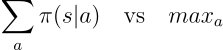
Policy evaluation uses (sum \pi(s|a)) = Weighted average
Value iteration uses max_a
iterative policy evaluation, you already have a policy π, and you want to find out how good it is. So you follow that policy. If the policy sometimes chooses different actions, you take the weighted average
value iteration: you want to find the optimal behavior. So instead of averaging according to a policy, you choose the best action:
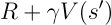
What is the intuitive meaning of
What I get now + what I expect to get later.
What is the difference between V^\pi(s) and V*(s)?
Vπ(s) is the expected return from state s when following a specific policy π, while V*(s) is the maximum expected return achievable from s over all possible policies.
When do we use Vπ instead of V*?
Use Vπ when evaluating a fixed policy; use V* when reasoning about the optimal policy.