opd quiz #1
 Call Kai
 Learn
Learn Practice Test
 Spaced Repetition
 Match
Match Flashcards
 Knowt Play
1/54

There's no tags or description
Looks like no tags are added yet.
Name | Mastery | Learn | Test | Matching | Spaced | Call with Kai | Chat |
|---|
No analytics yet
Send a link to your students to track their progress
55 Terms
restorative dentistry
is a branch of dentistry which deals with the restoration of teeth destroyed by the dental caries & other causes to prevent destruction of the tooth tissue & intercept the progress of disease
diagnosis, treatment and prognosis
restorative dentistry is the ______ defects of teeth that DO NOT require full coverage restorations for correction
1. restoration of proper tooth form
2. restoration of function
3. restoration of esthetics
4. maintenance of physiologic integrity of the teeth in harmonious relationship with the adjacent hard and soft tissues
restorative dentistry treatment results in?
1. caries
2. malformed, discolored, nonesthetic or fractured
3. restoration replacement or repair
restorative dentistry is categorized into three primary treatment needs (indications)
dental caries
is an infectious microbiologic disease of the teeth that results in localized dissolution and destruction of the calcified tissues
dental caries
irreversible biochemical process characterized by demineralization of inorganic substances & disintegration, dissolution of organic substances
cavity
a defect in enamel or in enamel and dentin resulting from a pathologic process which is dental caries
biofilm (plaque)
- soft, translucent, and tenaciously adherent material accumulating on the surface of the teeth
- a gelatinous mass of bacteria adhering to the tooth surface
non specific plaque hypothesis
specific plaque hypothesis
2 theories of pathogenicity of plaque
non specific - assumes that all plaque is pathogenic
specific - recognizes that plaque is pathogenic only when signs of associated disease are present
differentiate non specific and specific plaque hypothesis
non specific plaque hypothesis
assumes that all plaque is pathogenic
specific plaque hypothesis
recognizes that plaque is pathogenic only when signs of associated disease are present
high frequency sucrose exposure
may be the single most important factor in producing a cariogenic plaque
host + bacteria + diet = caries
general mechanisms of dental caries
a. tooth
b. saliva
c. muscular activity
d. habits
e. group susceptibility
f. age
g. environment
factors under host
fluoride & calcium content
caries susceptibility of tooth is inversely proportional to its ? & ? content
less prone to caries
high salivary phosphate content = ?
5.5 - 5.7
critical pH
below 5.5 -5.7 → demineralization ; higher than 5.7 → remineralization
pH for demineralization? remineralization?
SEROUS - (low viscosity) – less decay
MUCINOUS - (thick and ropy, more viscous) - more prone to caries
2 types of viscosity? explain
parasite
microorganisms brought into contact w/ the tooth surface via a bacterial plaque, creating a classic parasitic relationship
s. mutans
lactobacillus acidophilus
actinomyces viscosus
bacterias/parasites found in dental caries
s. mutans
the principal bacterial agent involved in the carious agent = enamel (coronal)
lactobacillus acidophilus
bacteria grows/found in dentin
actinomyces viscosus
bacteria grows/found in root surface
carbohydrates
is the most cariogenic of all food materials
1. protective factor deleted from food materials during processing, storage & preparation
2. cariogenic factor added
3. frequency of meals
three detrimental changes in diet
1. recesses of developmental pits and fissure
2. smooth enamel surfaces that shelter plaque
3. root surface
clinical sites for caries initiation
enamel rods
- the basic unit of the enamel structure
- run perpendicularly from the surface of the tooth to the dentin
dentinal tubules
the structure of dentin is an arrangement of microscopic channels, which radiate outward from the pulp chamber to the exterior cementum or enamel border
the pulp chamber to the exterior cementum or enamel border
dentinal tubules is the structure of dentin is an arrangement of microscopic channels, which radiate outward from ? to the ?
false, it always follows the direction of enamel rods
demineralization of enamel by caries does not generally follows the direction of the enamel rods
T or F
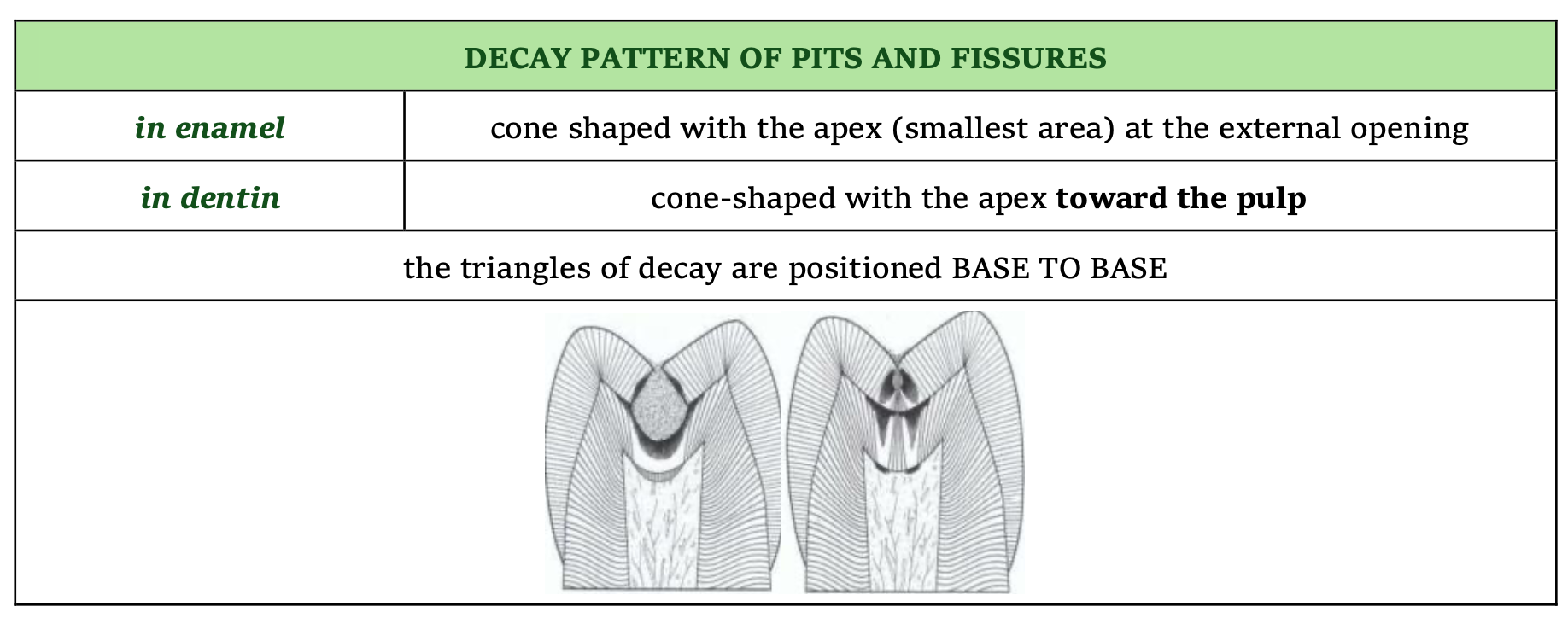
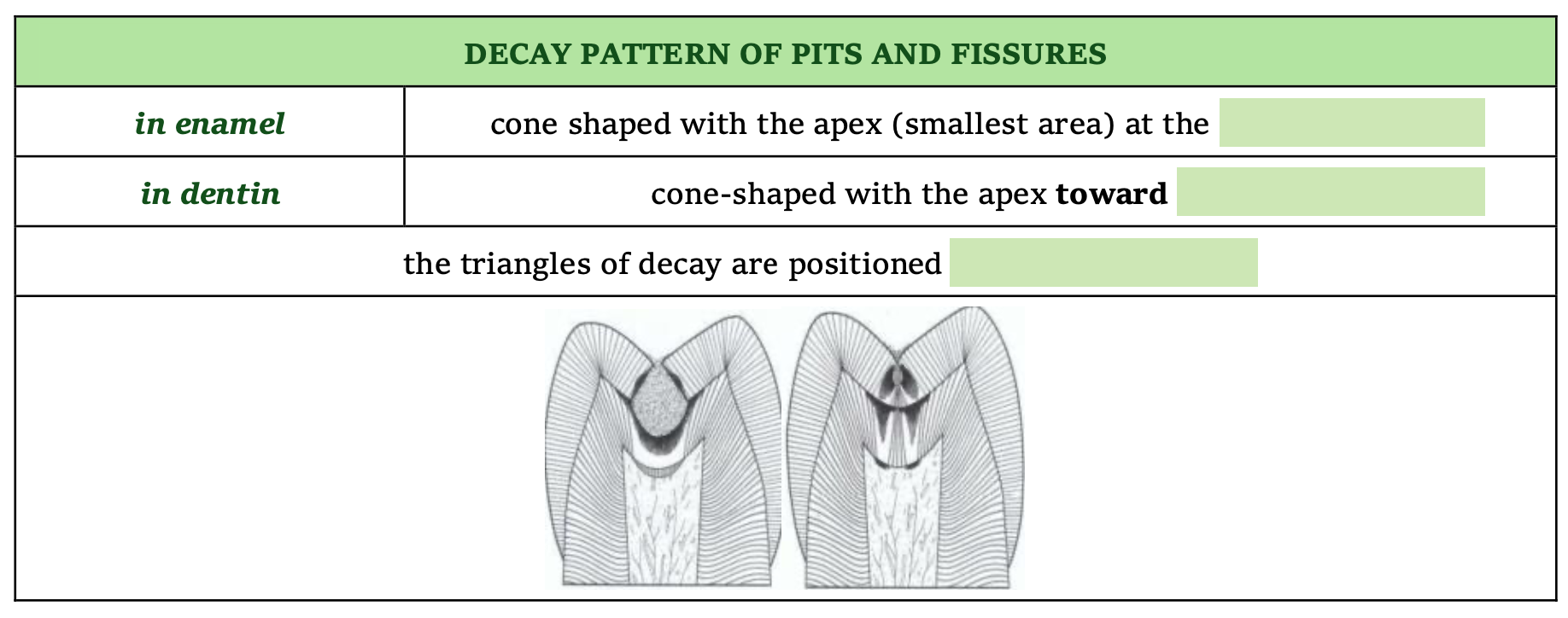
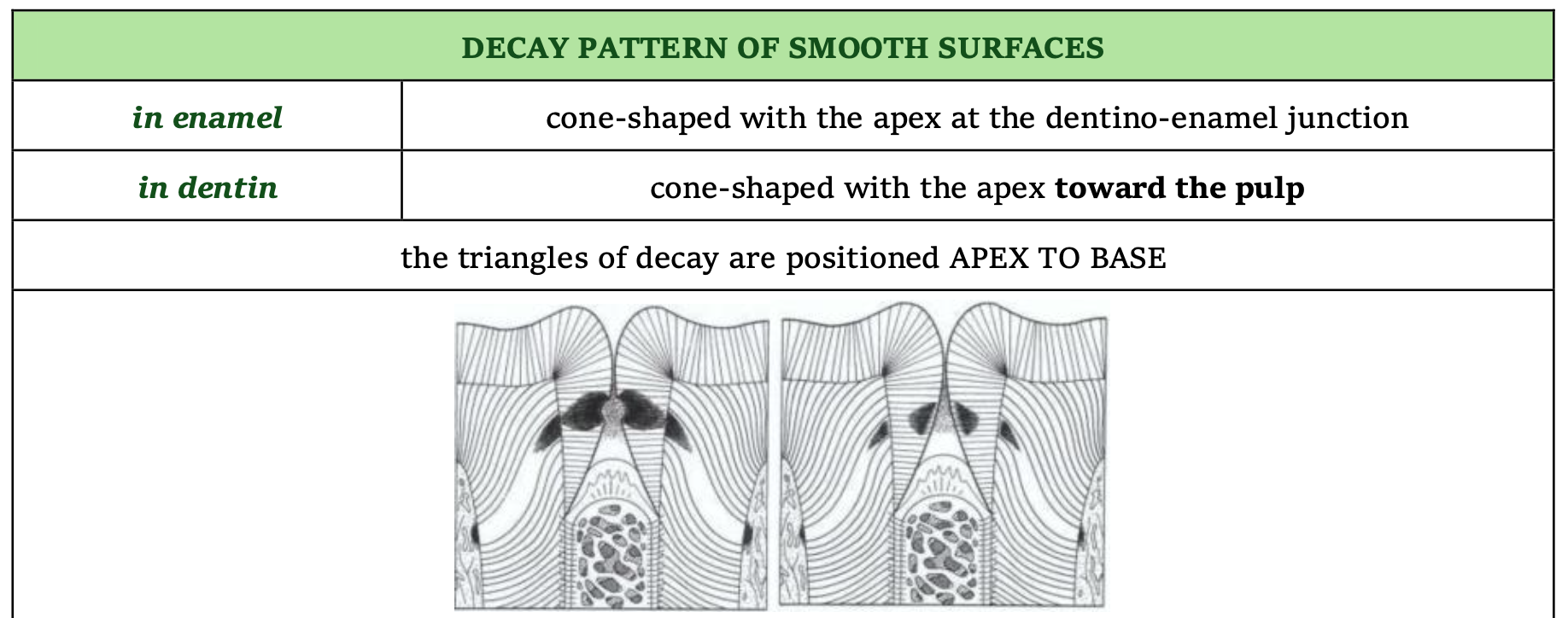
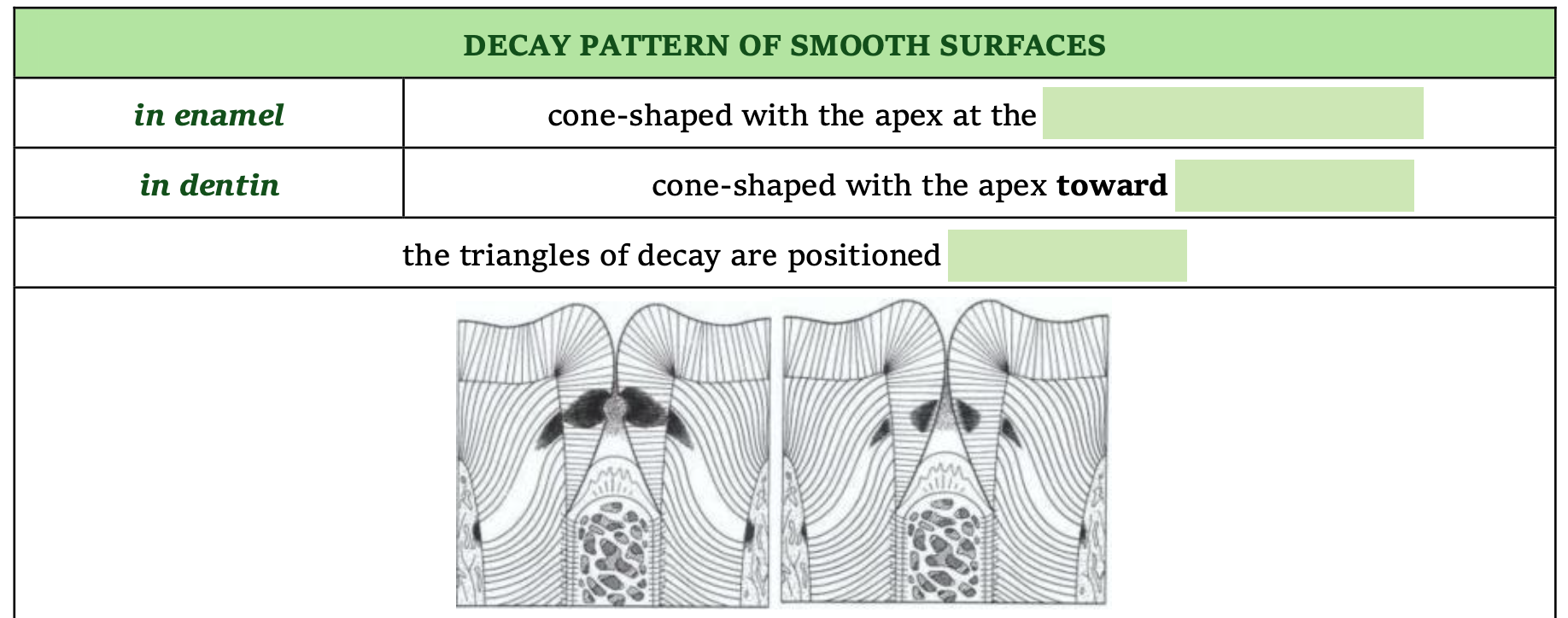
the orientation of enamel rods are different in the two areas of the tooth
the different triangles of decay patterns between pit and fissure and smooth-surface caries develop in the enamel because ?
primary caries
secondary caries
classification of dental caries: according to location
primary caries
refers to a new, initial dental caries (tooth decay) that develops on a surface of the tooth that has never been affected by decay before
secondary recurrent caries
occurs at the junction of the restoration and the tooth and may progress under the restoration
microleakage
primary cause of secondary caries
→ inadequate cavity fillings or adaptation of the filling material to the margin of the restoration
→ may be due to soft infected dentin which is not completely eradicated during the first treatment
→ due to ineffective sterilization of the prepared cavity
other possible causes of secondary caries
acute rampant caries
chronic (slow or arrested) caries
classification of dental caries: according to rapidity of process
acute rampant caries
- disease is rapid in damaging the tooth; involves several teeth
- usually in the form of many soft, light-colored lesions in the mouth
- has less time for extrinsic pigmentation hence the light color
- common in children and young adults
chronic (slow or arrested) caries
- may be slow or may be arrested following several active phases
- slow rate resulting from episodic demineralization and remineralization due to changes
in the oral environment
- lesion is discolored/dark and hard
simple - 1 surface
compound - 2 surfaces
complex - 3 or more
classification of dental caries: according to no. of surfaces involved - explain
shallow cavity depth - more than 2.0 mm remaining dentin
moderate cavity depth - less than 2.0 mm, greater than 1.0 mm remaining dentin
deep cavity depth - less than 1.0 mm remaining dentin
classification of dental caries: according to depth - explain
incipient caries (reversible)
cavitated caries (irreversible)
classification of dental caries: according to severity
incipient caries
- it is the first evidence of caries activity in the enamel
- enamel surface hard and still intact
- lesion can be remineralized through plaque removal and control and fluoridization
cavitated caries
- enamel surface is broken
- lesion has advanced into dentin
- remineralization NOT POSSIBLE
backward caries
it is a condition when the spread of caries along the DEJ exceeds the caries in the contiguous enamel
forward caries
when the caries cone in the enamel is larger or at least the same size as that in dentin
residual caries
caries that remain in a completed tooth preparation, whether by intention or by accident
infected dentin
affected dentin
carious dentin consists of 2 layers
affected dentin
→ has no bacteria
→ can be remineralized
→ should be preserved
infected dentin
→ has bacteria
→ cannot be remineralized
→ should be removed