advanced micro exam #2
 Call Kai
 Learn
Learn Practice Test
 Spaced Repetition
 Match
Match Flashcards
 Knowt Play
1/71

There's no tags or description
Looks like no tags are added yet.
Name | Mastery | Learn | Test | Matching | Spaced | Call with Kai | Chat |
|---|
No analytics yet
Send a link to your students to track their progress
72 Terms
why do bacteria and viruses make good model systems for genetic studies?
fast generation time
short genomes
easy to grow in high populations
same underlying biochemistry from DNA sequence to proteins
what is a plasmid?
small loop of DNA with a few genes that aren’t essential to the organism's growth (found in prokaryotes)
can contain virulence factors that are problematic
why does DNA with higher GC content denature at a higher temperature than DNA wih higher AT content?
GC bonds (3H) have more hydrogen bonds than TA bonds (2H)
what roles do tRNA, mRNA, and rRNA play in protein synthesis ?
tRNA: carries the correct amino acid to the polypeptide chain in the ribosome
mRNA: messenger between DNA and protein; photocopies genes from DNA to RNA
rRNA: aligns RNA to tRNA, and ribosome; catalyzes peptide bond formation between amino acids
tRNA and rRNA both more stable than mRNA*

label mRNA, rRNA, and rRNA in the figure
i. tRNA
ii. mRNA
iii. rRNA
new bacteriophage just dropped. the base composition of the phage is: A (15%), C (20%), G (30%), and T (35%). what can you conclude about the genome of the virus?
the virus has a single-stranded DNA
a certain DNA sample is found to have a makeup consisting of 22% thymine. what is the percentage of A,C, and G?
A= 22%
C = 28%
G = 28%
(add A & T, subtract from 100 and divide by 2)
what are some differences in chromosomal structures between prokaryotes and eukaryotes?
prokaryotes —> single, circular, short chromosome within the nucleoid; haploid chromosomes
eukaryotes —> multiple chromosomes arranged linearly within the nucleus; diploid chromosomes
in the chromatin of eukaryotic cells, which regions of the chromosome would you expect to be more compact: the regions that contain genes being actively copied into RNA or those that contain inactive genes?
the regions that contain inactive genes
how do prokaryotes and eukaryotes manage to fit their lengthy DNA inside of cells? what is the name of the class of enzymes that helps with this process, and what is the name of the specific enzyme that bacteria use (good antibiotic target)?
supercoiling: process where DNA is twisted and condensed to fit into the genome
topoisomerases help with this
DNA gyrase: topoisomerase unique to prokaryotes (antibiotic target)
what is the main challenge eukaryotes have when replicating the genome? what enzyme helps with this challenge in single-celled eukaryotes?
the ends of the linear chromosome (telomeres) remain unpaired and get progressively shorter as cells continue to divide
telomerase: prevents degradation of telomeres
what is the main challenge prokaryotes have when replicating the genome? what enzyme helps with this challenge in prokaryotes?
after replication, DNA chromosomes must be separated from each other
topoisomerase IV: cuts one of the circular chromosome to separate them
dna ligase: seals the break
can two observably different cells have the same genotype? explain.
yes! because the genotype is the full collection of genes contained in a cell, and they’re not expressed at all times
different phenotypes arise based on the environment
what is the purpose of RNA processing in eukaryotes? Why don’t prokaryotes require similar processing?
protects RNA from degradation and initiates translation by ribosomes (adding 5’ cap and 3’ poly A tail)
prokaryotes don’t have a nucleus or non-coding introns that require splicing
what are the steps involved in RNA processing?
5’ cap is added
3’ poly-A tail is cleaved
splicing (removal of introns)
below is a DNA sequence. envision that this is a section of a DNA molecule that has separated in preparation for replication, so you are only seeing one DNA strand. construct the complementary DNA sequence (indicating 5’ and 3’ ends).
DNA Sequence: 3’- T A C T G A C T G A C G A T C -5’
complementary sequence: 5’ ATGACTCACTGCTAG 3’
below is a DNA sequence. Envision that this is a section of a DNA molecule that has separated in preparation for transcription, so you are only seeing the antisense strand. Construct the mRNA sequence transcribed from this template.
Antisense DNA strand: 3’ – T A C T G A C T G A C G A T C- 5’
sequence: 5’ AUGACUGACUGCUGCUAG 3’

below is an antisense DNA sequence. translate the mRNA molecule synthesized using the genetic code, recording the resulting amino acid sequence, indicating the N and C termini.
Antisense DNA strand: 3’ – T A C T G A C T C A C G A T C- 5’
sequence: 5’ AUGACUGAGUGCUAG 3’
Met-Thr-Glu-Cys
why does translation terminate when the ribosome reaches a stop codon? what happens?
because the sequences don’t code for any amino acid
previous example: a nonsense codon reaches A site on the ribosome and release factors that cause the last amino acid at the P site to detach
how does the process of translation differ between prokaryotes and eukaryotes?
prokaryotes —> 70s ribosome; amino acid is formylated into methionine; Shine Dalgarno (sequence upstream of start codon AUG); occurs simultaneously
eukaryotes —> 80s ribosome; methionine isn’t formulated; methionine isn’t formulated; occurs temporarily and physically separate
why is it more likely that insertions or deletions will be more detrimental to a cell than point mutations?
insertions/deletions frequently cause frameshift mutations
what are the 3 main forms of horizontal gene transfer (HGT)? briefly define all 3.
transformation: occurs when a prokaryote takes up naked DNA found in its environment (from dead/lysed cells)
transduction: occurs when a bacteriophage transfers bacterial DNA from one host to another during sequential infections
conjugation: process of transferring DNA directly from one prokaryote to another by means of a conjugation pilus
describe two ways in which chromosomal DNA from a donor cell may be transferred to a recipient cell during the process of conjugation.
F-plasmid occasionally integrates into bacterial chromosome through recombination, forming an Hfr cell; it can be excised imprecisely and bring chromosomal genes with it
Hfr cells sometimes treat the entire chromosome like an F-plasmid and attempt to transfer using rolling circle replication
what happens when a nonsense mutation is introduced into the gene encoding transposase within a transposon?
synthesis of the transpose would end early, resulting in a nonfunctional version of the enzyme
transpoon would become permanently integrated and unable to jump/move
what’s an operon? what’s the difference between an inducible operon and a repressible operon (suggestion: practice using correct vocabulary/terminology as you explain this)?
genes controlled by the same promoter and transcribed together into a single mRNA molecule in prokaryotes (some needed some not!)
inducible operon: inducer molecule removes a repressor from the operator immediately upstream of the operon
repressible operon: repressor isn’t attached to the operator until an inducer attaches to the repressor which blocks RNA polymerase from moving foward with transcription
what are two ways that bacteria can influence the transcription of multiple different operons simultaneously in response to a particular environmental condition?
production of alarmones (small intracellular nucleotide derivatives) in response to enviromental stress
changing of sigma factor in RNA polymerase for transcription; changes its recognization of new promoters
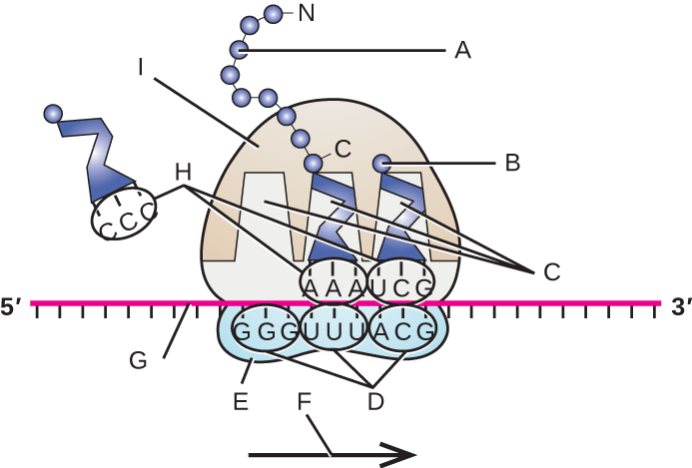
label the following in the figure: ribosomal E, P, and A sites; mRNA; codons; anticodons; direction of translocation; small ribosomal unit; large ribosomal unit
a. growing polypeptide
b. incoming amino acid
c. ribosomal E, P, and A sites (L to R)
d. codons
e. small ribosomal unit
f. direction of translocation
g. mRNA
h. anticodons
prior to the elucidation of the genetic code, prominent scientists had predicted that each mRNA codon, coding for one of the 20 amino acids, needed to be at least 3 nucleotides long. why is it not possible for codons to be any shorter?
because shorter combinations (less than 3) don’t have enough unique codons for each amino acid
what makes an organism transgenic? what forms of horizontal gene transfer do humans use to intentionally make an organism transgenic?
if it contains recombinant DNA from a different organism
humans use —> transformation, transduction, conjugation
why was the discovery of Thermus aquaticus important for the field of genetics?
produces a heat-stable version of DNA polymerase that survives high temperatures in PCR
in chain-termination sequencing, how is the identity of each nucleotide in a sequence determined?
fluorescently labeled ddNTPs that mark the location of DNA fragments at different lengths
how are proteins separated in SDS-PAGE?
by size
what are restriction enzymes used for, broadly speaking?
to cut DNA at palindromic sites
which is more efficient: blunt-end cloning or sticky-end cloning? why?
sticky end cloning —> because they can easily anneal to complementary nucleotides on inserted DNA fragment
what’s the difference between reverse-transcriptase PCR and real-time quantitative PCR (qPCR)?
reverse transcriptase PCR: used to obtain DNA copies of a specific mRNA molecule; detects whether a certain gene has been expressed
real-time quantitative PCR (qPCR): uses fluorescence to monitor the increase in a double-stranded template during the PCR reaction as it occurs
what are some advantages of cloning human genes into bacteria to treat human diseases caused by specific protein deficiencies?
lowering immune reactions in proteins (eliminating pathogens)
continuous expression of human bacteria
what is a reporter gene and in what situation(s) might a reporter gene be useful?
encode for easily observable characteristics that can be attached to genes of interest
gives reseacher info about the gene of interest’s location and expression
how do fluorescent DNA probes work, in general? what are some applications where you might want a fluorescent probe?
short single-stranded pieces of DNA that bind to a specific target sequence; if the sequence is present, it’s highlighted by light
southern blotting, flurouscent in situ hybridization (fish), quantitative PCR, microarrays
when would a scientist want to generate a cDNA library instead of a genomic library? what virus-derived enzyme is used to create a cDNA library?
in research about genes being expressed by a particular organism
reverse-transcriptase from HIV
what is the Ames test used for? Describe how the Ames test works.
used to identify carcinogens and mutagens.
isolates auxotrophic bacteria for a particular amino acid based on a recent mutation
bacteria are cultured in liquid media with carcinogen/rat liver and plated onto agar that doesn’t have the missing amino acid
compare growth to the same strain with rat liver, no carcinogen, and place on the same media
result: if there’s more growth on mising amino acid plate its considered mutagenic/carcinogenic
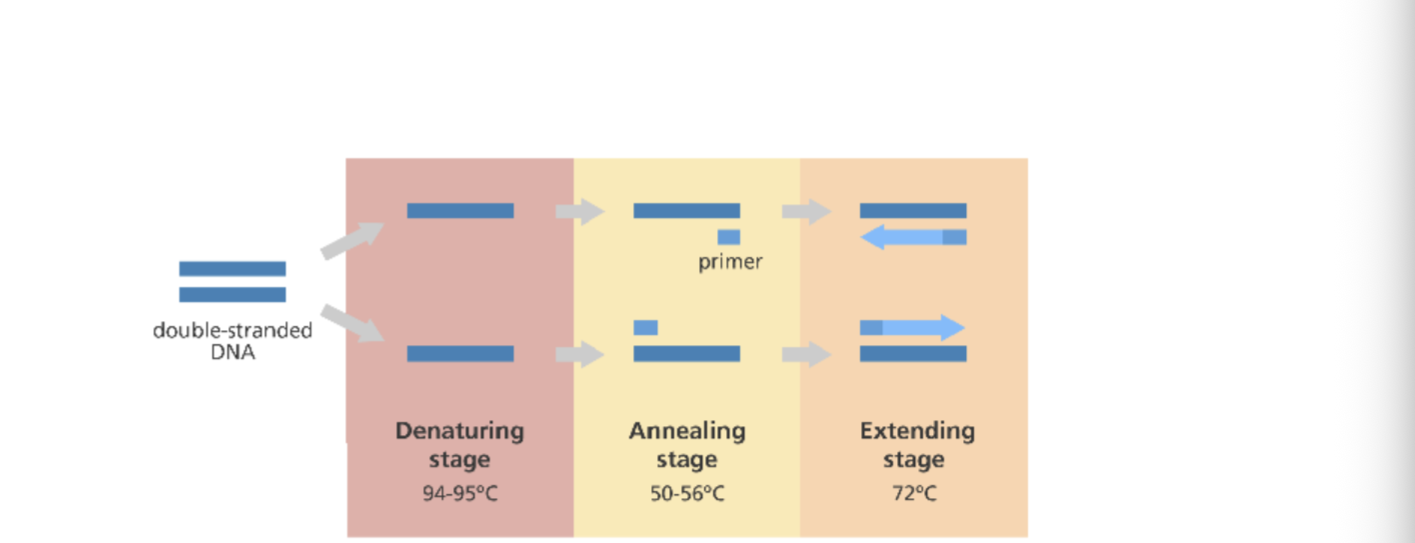
draw and label one complete PCR cycle (include temperatures)
a viral genome was sequenced and the composition of the genome was A (24%), U (32%), C (21%), G (23%)? what type of genome does the virus have?
single stranded RNA
why are TA bonds often found in this region rather than several GC bonds?
fewer H bonds and easier to denature (break)
what class of enzymes is responsible for assisting in supercoiling and preventing overwinding in DNA?
topoisomerase
during what process is mRNA synthesized?
transcription
in additon to physically holding tRNA and mRNA close together, what role does rRNA play in protein synthesis?
catalyzing the formation of peptide bonds
which type of RNA is least stable, especially in prokaryotes?
mRNA

what are the 3 main steps involved in DNA replication, mRNA, transcription, and translation?
initiation
elongation
termination
which is faster, DNA replication in Salmon or Salmonella?
salmonella
what enzyme is used to separate complementary DNA strands during DNA replication?
helicase
fragments of DNA synthesized on lagging strand during replication are referred to as?
Okazaki fragments
many eukaryotic organisms contain the enzyme ____ to remedy the fact that DNA replication results in unpaired nucleotides at the end of linear chromosomes
telemorase
at the termination step of DNA replication in prokaryotes, the enzyme topoisomerase IV is used to solve what problem?
link circular chromosomes
what is the name of the strand mRNA uses as a template during transcription?
anti sense strand
what modifications are made to mRNA after transcription in eukaryotes?
5’ cap, 3’ poly-A tail, splicing
translate the mRNA code into amino acid sequence: AUGUUAGGC
Met Glu Gly
there are 3 important sites on 50S ribosomal subunit during translation what are they in the order a tRNA molecule would experience them?
A, P, E
what is the main signal that initiates termination of translation?
stop codon
what type of organism can perform transcription and translation simultaneously?
prokaryotes
what type of mutation results in early termination of the polypeptide chain?
nonesense mutations
what type of mutagen results in the formation of thymine dimers?
UV radition
what is the purpose of the Ames test?
identifying carcinogens and mutagens
what mechanisms of horizontal gene transfer results in the transfer of the F-plasmid from 1 cell to another?
conjugation
what type of transcription factor promotes transcription of an operon?
repressor
how does the presence of lactose allow for transcription of the lac operon?
removes repressor
what mechanisms of prokaryotic horizontal gene transfer are used by humans to create transgenic organisms?
transformation, transduction, conjugation
what type of enzyme is used to cut DNA into fragments based on location of palindromic sequences known as recognition sites?
restriction enzymes
a ____ is a collection of an organisms genes stored as a recombinant DNA in either bacterial cells or bacteriophages
genomic library
what are the 3 steps (in correct order) in one PCR cycle?
denature (95°), anneal (55°), extension (72°)
how can we visualize a specific DNA sequence? (especially useful for microarrays and southern blotting)
fluorescence probes
what molecule derived from certain viruses is used to create cDNA using only expressed genes?
reverse transcriptase
where was Thermas aquaticus(the organism used to produce heat-stable DNA polymerase) first isolated?
yellowstone national park