LAGOS Urban Opportunities & Challenges Flashcards
 Call Kai
 Learn
Learn Practice Test
 Spaced Repetition
 Match
Match Flashcards
 Knowt Play
1/40

There's no tags or description
Looks like no tags are added yet.
Name | Mastery | Learn | Test | Matching | Spaced | Call with Kai | Chat |
|---|
No analytics yet
Send a link to your students to track their progress
41 Terms
What is Urbanisation?
an increase in the percentage of people living in urban areas such as towns or cities
Where is Urbanisation happening?
Urbanisation is happening all over the word but in LICs and NEEs rates are much faster than HICs. This is mostly because of the rapid economic growth they are experiencing so rural-urban migration is high.
Natural increase
when birth rates are higher than death rates.
Rural-Urban Migration
when people move from the countryside (rural area) to the city (urban area)
Counter-urbanisation
when people move back out to the countryside from the city usually in HICs
Megacity
a city with at least 10 million people
push factors for rural-urban migration
Mechanisation of farming led to job loss |
Poor infrastructure |
Desertification in rural areas had led to a loss of land |
High unemployment and only primary jobs available |
Lack of services like schools, hospitals, electricity and water |
Natural disasters
War and Conflict
Drought
pull factors for rural-urban migration
Better infrastructure such as roads and schools |
More access to services such as water and electricity |
Centres of economic activity with job opportunities |
To join relatives who have already moved |
Increase in birth rate
High percentage of population are child-bearing age which leads to high fertility rate.
Lack of contraception or education about family planning.
Lower death rate (DR)
Higher life expectancy due to better living conditions and diet.
Improved medical facilities helps lower infant mortality rate.
Suggest two reasons for the slow rate of urban growth in many HICs (2 marks)
· in many HICs the process started earlier than LICs and NEEs so the vast majority of people moved to the cities when industry was developing (rural-urban migration is low)
· Most people already live in urban areas as they developed earlier so rural-urban migration is low
· many cities are already overcrowded in HICs so some people are tending to move to rural areas (counter-urbanisation)
· in some HICs, inner city industries collapsed, resulting in large scale unemployment. People wanted a better quality of life and to be able to live in a clean and quiet rural area (counter-urbanisation)
Suggest two reasons for the fast rate of urban growth in many LICs (2 marks)
Industry is now developing in LICs so many people are moving into the cities to look for work (rural-urban migration)
· There are massive inequalities between rural and urban areas so push factors from rural areas like lack of services are making people move to the city (rural-urban migration is rapid)
· There is high rural-urban migration of young working age population so natural increase is higher in cities due to higher birth rates
Suggest why an increasing number of megacities are located in lower income countries (LICs) or newly emerging economies (NEEs) (2 marks)
· many cities in LICs/NEEs are growing rapidly because of high levels of migration from the countryside to the cities (rural-urban migration) (1). This is mainly due to the opportunities for a higher standard of living/food security/health/education in urban areas (pull factors)(1)
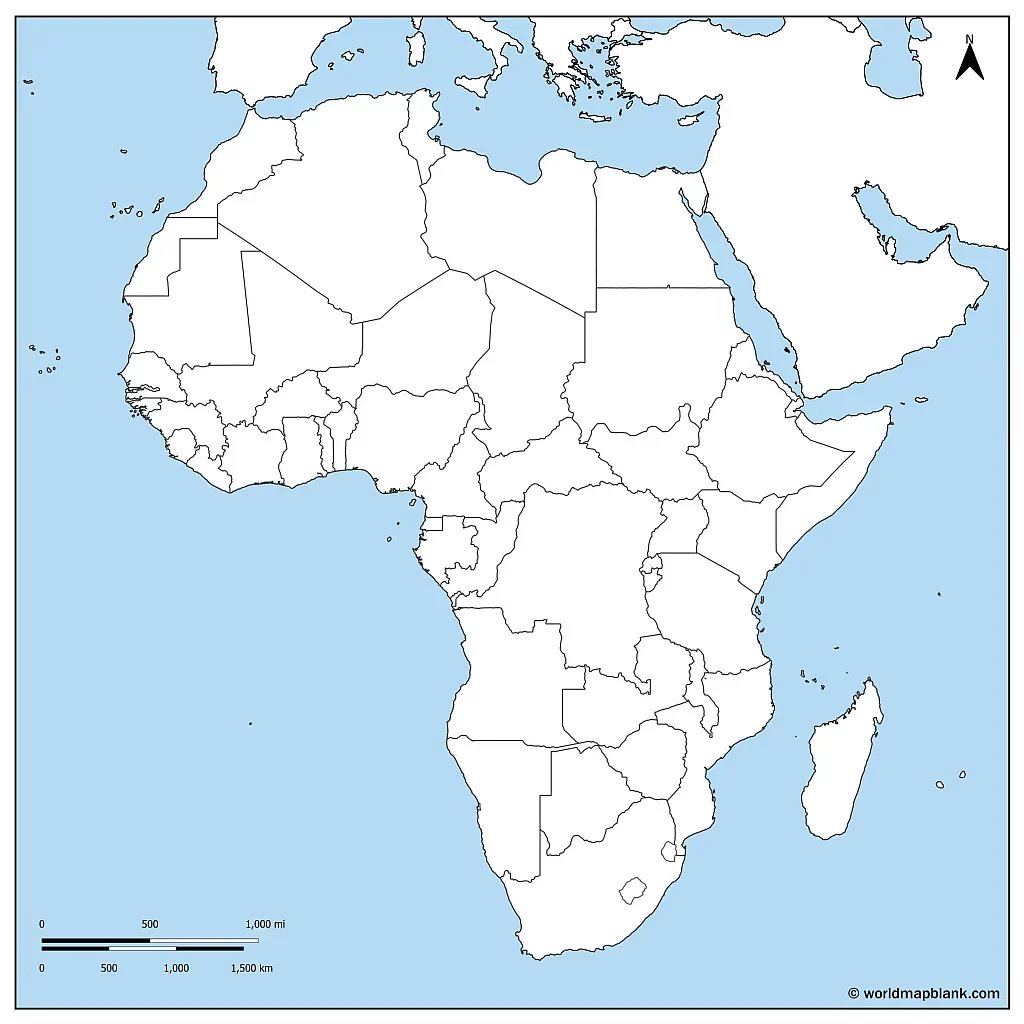
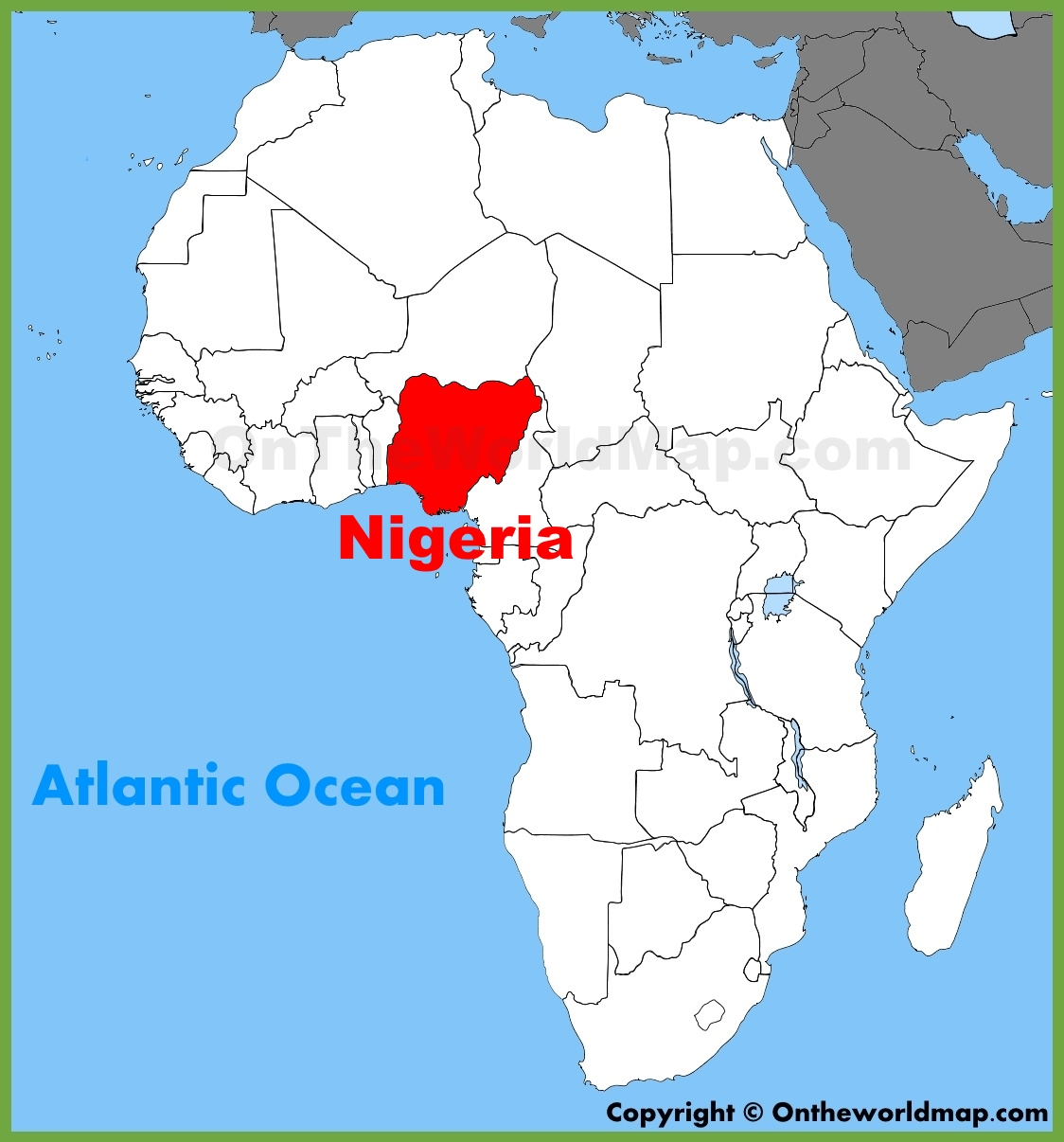
Nigeria on Africa map
Lagos’ Regional Importance
Lagos has more schools, universities and hospitals than local areas - Lagos State University
Lagos’ National Importance
• 80% of Nigeria’s industry is located in Lagos
• The city generates 25% of Nigeria’s GDP
Lagos’ International Importance
· 80% of flights into West Africa go through Lagos
Push factors for migration into Lagos from rural areas in Nigeria
· Climate change is threatening farming in the north of Nigeria
· Mechanisation of farming has led to job loss
· Northern parts of Nigeria is drier and there is mass desertification and soil erosion
Pull factors for migration into Lagos from rural areas in Nigeria
· Industries are developing in urban areas creating many job opportunities
· Many family members have already moved
· There is greater access to services like schools and electricity in the city
· More jobs in secondary and tertiary sectors that pay more
· The idea that quality of life is better
advantages of Lagos’ location
A large population (21 million) offers a huge market for products |
There is a huge amount of transport like airports, rail, ports and roads. |
disadvantages of Lagos’ location
Near the coast means there is a threat from rising sea levels |
Most industry is located on Victoria island with only 3 bridges so traffic can be awful
There are often power cuts so industry but set up and pay for their own generators |
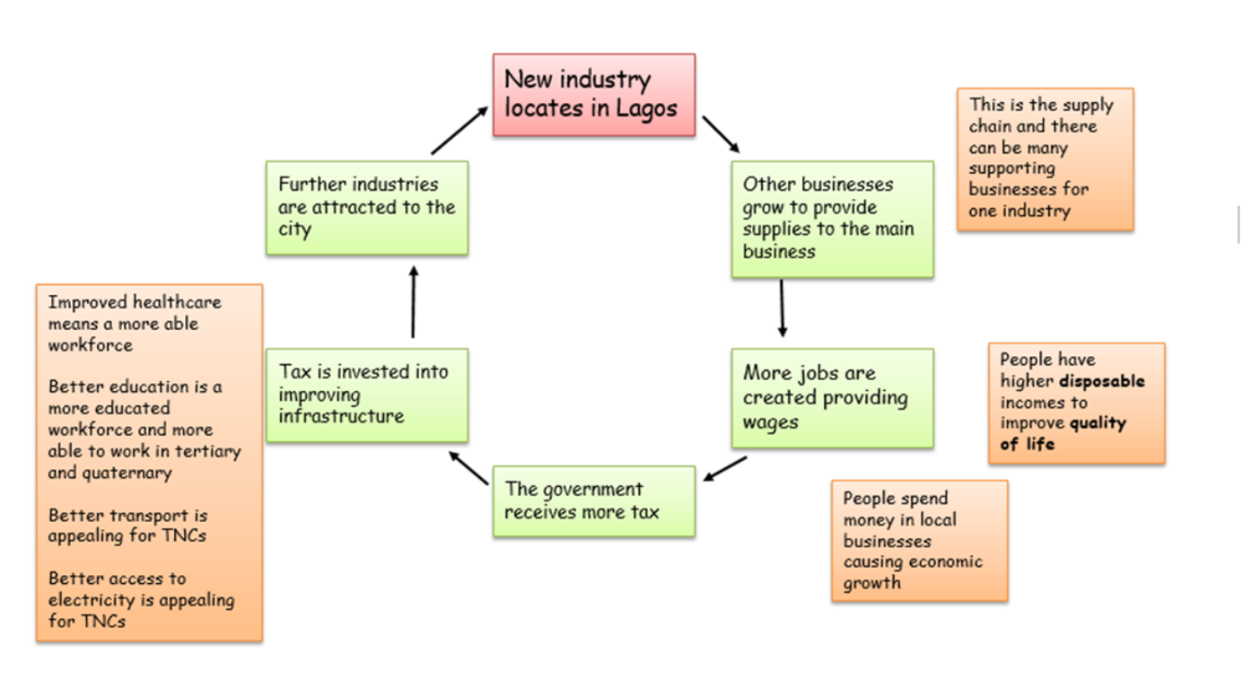
Formal jobs in Lagos and the multiplier effect
Many new industries are locating to Lagos. They are well known for car manufacturing (Nissan), pharmaceuticals and food and beverages.
New developments such as Eko-Atlantik are increasing the number of higher-paying jobs in Lagos
Informal Jobs in Lagos
Some of the population are not able to find jobs so they make their own such as selling products, cleaning cars, collecting rubbish from Olososun landfill site.
90% new jobs in Lagos are informal
Advantages & disadvantages of informal jobs
Advantages:
flexible working hours
being your own boss
not paying tax
Disadvantages:
No health and safety - it can be dangerous
No holiday, sick pay, or guaranteed wages, can be long hours
Government does not receive tax but has to provide services for these people still
advantages & disadvantages of the Olososun Rubbish Dump
Advantages:
500 jobs at the dump
3000 tonnes of rubbish is sorted and recycled each day
Disadvantages:
Workers can breathe in dangerous fumes which is bad for their health
Sorting through waste especially at night can be dangerous
Natural gases built up under the decaying waste can lead to dangerous fires - nobody can work during fires so no money is earned at all
Social Opportunities in Lagos
Energy/electricity: Better than surrounding rural areas. Much of the energy and wealth coming from nearby discoveries of oil
Water: Water supplies are better than surrounding rural areas and there are communal taps and wells available, charities build communal pumps
Education: The government offers free education for the first 9 years, about 90% of children in urban areas attend primary school in comparison to 60% in rural areas, universities in the city which creates a more educated workforce
Healthcare: There is greater access to healthcare than in the countryside, private healthcare is available
Crime: police have 2 new helicopters, improved street lighting
Social Challenges in Lagos
Energy/electricity: There are frequent power cuts affecting businesses and water supplies, some people rely on generators to produce electricity but these use diesel and are very polluting
Water: Only 10% of the population has access to safe, piped water supplies (the wealthier houses), water is in such high demand people pay hugely inflated prices from informal sellers, the water extracted from the ground may be polluted and contaminated
Education: Education is not free after 9 years of age. There are limited and expensive high schools. Many of the poorest children have to work rather than go to school
Healthcare: Vaccinations have to be paid for, not all medical help is free and medications have to be paid for
Sanitation: Most people have no access to flushing toilets instead using pits where sewerage could drain into the ground (polluting groundwater), and the number of cases of diseases such as cholera and dysentery has increased
Crime: Crime rates are high, particularly those involving drugs, vandalism and theft. Rates of assault and armed robbery are high as are bribery and corruption. local gangs e.g. Area Boys
Why could rising sea level be a threat to Lagos?
Flooding could increase and groundwater could become contaminated by salt.
Lagos’ coastal location makes it vulnerable to the sea
Environmental Challenges in Lagos
Waste Disposal: 10 000 tonnes of waste is produced daily, and only 40% of waste is collected and this is lower in squatter settlements
Air Pollution: Air pollution is 5x higher than recommended limits; older, diesel, poorly maintained vehicles are a huge source of this pollution
Traffic Congestion: Lagos is one of the most congested cities in the world, the average commuter spends 3 hours in traffic each day
squatter settlements
A squatter settlement is an area of informal housing that is often illegal. These areas are unattractive for the wealthy due to a very polluted and smelly lagoon.
The presence of squatter settlements highlights the huge inequality that exists within Lagos.
challenges of living in squatter settlements
One problem is overcrowding.
75% of households live in one room.
This decreases quality of life and can lead to diseases spreading quickly.
There is no safe water supply in squatter settlements.
Only 11% have piped water.
People drink very dirty and polluted water leading to disease which is often untreated and can affect their ability to work.
There is a lack of safe sewage in the area
55% of people use pit latrines.
This means that sewage soaks into groundwater which 55% of people use for drinking water leading to disease.
challenges caused by traffic in Lagos
Being stuck in traffic for up to 3 hours
Pollution is 5x higher than recommended limits
Many of the cars are older diesel cars which are more polluting
Huge traffic jams on the limited bridges that lead to Victoria island
Delays to people getting to work and school
Delays for deliveries and trade
BRT
Bus Rapid Transit
a new bus route running from the North to the South of the city which has created bus lanes to avoid the traffic jams.
Advantages of the BRT
Over 200 000 people use the BRT route a day
Tickets are cheap enough for even the poorest
2000 new jobs were created
Air pollution along the route has reduced by 13%
Disadvantages of the BRT
The one route only covers part of the city so not everyone has access
It is not enough to deal with all the pollution problems
Lack of cameras means that pedestrians and traders can set up market stalls in the lanes
Floating School successes
Helps to solve the issue of a lack of schools and education for those in Makoko - education for 60 children
Provided a sense of community in the area with a meeting point for fishermen
Made to be sustainable: recycled rainwater (good as there is a lack of freshwater) with solar panels and recycled materials from the rivers. Also to recycle waste.
Was a prototype for future designs to help communities such as Makoko
Floating School failures
Collapsed during a storm
Now slums are again at risk from being demolished by the government for being an eyesore
Has reduced hope for the area
Eko-Atlantic successes & what is it
Will bring increased wealth to Lagos that can filter down to the poorest through supply chains and general infrastructure improvements (multiplier effect)
Jobs in construction in the short term
Will attract further TNCs into Lagos bringing about the multiplier effect
The new financial hub being built on reclaimed land from the sea
TNCs meaning
Transnational corporation
Eko-Atlantik failures
May cause water pollution and damages to marine ecosystems upon which poorer fisherman rely on
The 150 000 jobs created are highly skilled and not for the poor
The new homes are unaffordable for the poorest in Lagos
There will be increased pressure on local services such as roads, water, electricity and education which will negatively impact the poor
Local communities were not consulted in the plans
Why does the government struggle to provide for Lagos’ population?
many work in the informal economy - no tax
rapid population growth
unplanned settlements (Makoko)