Anatomy 2040 Lab Midterm
 Call Kai
 Learn
Learn Practice Test
 Spaced Repetition
 Match
Match Flashcards
 Knowt Play
1/677

Earn XP
Description and Tags
Anatomical language, Axial skeleton, Appendicular skeleton, Joint stucture, Functional anatomy, Muscles I, Muscles II
Name | Mastery | Learn | Test | Matching | Spaced | Call with Kai | Chat |
|---|
No analytics yet
Send a link to your students to track their progress
678 Terms
fissure
narrow slit or cleft in bone
vertebral column

meatus
tube like passageway or opening
fossa
shallow depression
condyle
smooth, rounded articular process
ramus
small branch
spine
pointed process
epicondyle
roughened projection above condyle
line
long, narrow ridge or border
spinous process
sharp, slender projection
trochanter
very large projection
tubercle
variably sized rounded projection
tuberosity
variably sized projection that has a rough, bumpy surface
frontal bone

parietal bone

palatine bone

zygomatic bone

vomer

carotid foramen

styloid process

mastoid process

foramen magnum
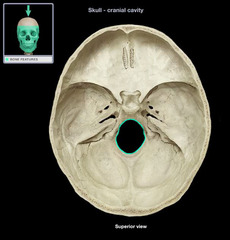
olfactory foramina

cribriform plate

internal auditory meatus

coronal suture

saggital suture

lambdoid suture

squamous suture

hyoid bone

cervical vertebrae
top seven

thoracic vertebrae
middle twelve
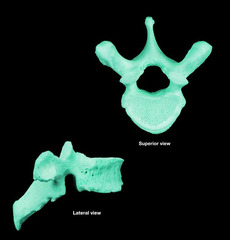
spinous process of vertebrae

transverse process of vertebrae

lamina of vertebrae

pedicle of vertebrae

vertebral body

axis
C2

dens/odontoid process
axis

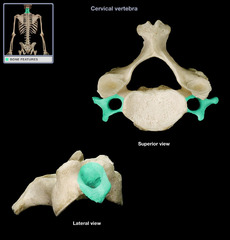
transverse foramen (only in cervical)
sacrum

base of sacrum

apex of sacrum

sacral foramina

sacral canal

superior articular facet of sacrum

coccyx

sternum
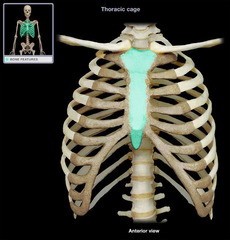
manubrium of sternum

body of sternum
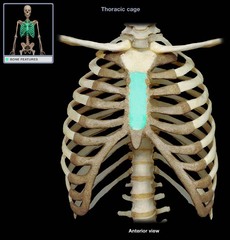
xiphoid process

true ribs

false ribs
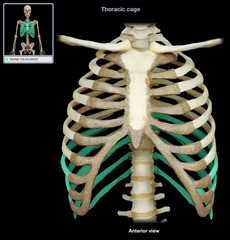
floating ribs

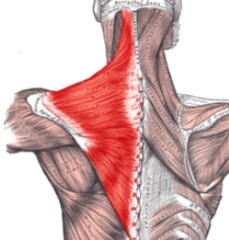
trapezius
either of a pair of large triangular muscles extending over the back of the neck and shoulders and moving the head and shoulder blade
pectoralis minor
depresses the point of the shoulder, drawing the scapula inferior and medial, towards the thorax, and throwing its inferior angle posteriorly.

internal intercostals
Fix intercostal spaces during espiration. Aids forced inspiration by elevating ribs
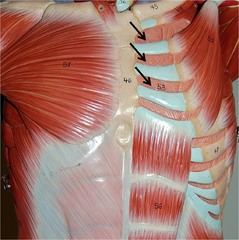
serratus anterior
originate on the upper eight ribs and insert into the medial border of the scapula.
They stabilize the shoulder blades and when flexed will spread the ribs for an inhale

deltoid
each of the three parts of a deltoid muscle, attached at the front, side, and rear of the shoulder.

pectoralis major
Extends the arm at the shoulder joint from a flexed position.

rectus abdominis
each of a pair of long flat muscles at the front of the abdomen, joining the sternum to the pubis and acting to bend the whole body forward or sideways.

linea alba
band of connective tissue
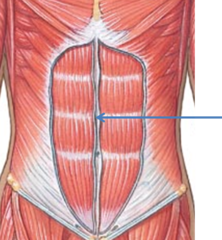
aponeurosis of external oblique
sheetlike tendon

trapezius
either of a pair of large triangular muscles extending over the back of the neck and shoulders and moving the head and shoulder blade.

levator scapulae
is located at the side and back of the neck. It is one component of the muscle system of the shoulder. Its primary function is to lift the scapula

rhomboid major
connects the scapula with the vertebrae of the spinal column.

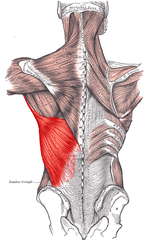
latissimus dorsi
the larger, flat, dorso-lateral muscle on the trunk, posterior to the arm, and partly covered by the trapezius on its median dorsal region.
supraspinatus
one of the four rotator cuff muscles and also abducts the arm at the shoulder

infraspinatus
thick triangular muscle, which occupies the chief part of the infraspinatous fossa.[1] As one of the four muscles of the rotator cuff, the main function of the infraspinatus is to externally rotate the humerus and stabilize the shoulder joint.
![<p>thick triangular muscle, which occupies the chief part of the infraspinatous fossa.[1] As one of the four muscles of the rotator cuff, the main function of the infraspinatus is to externally rotate the humerus and stabilize the shoulder joint.</p>](https://assets.knowt.com/user-attachments/9a9628cb-d590-4c62-ba9b-c7a10970d4f2.jpg)
teres minor
narrow, elongated muscle of the rotator cuff.

teres major
muscle of the upper limb and one of seven scapulohumeral muscles

Origin
Insertion
Prime movers
Antagonist
Synergist
Fixators
rectus abdominis
trunk flexion

internal intercostals
depress ribs

external intercostals
elevates ribs

diaphragm
contracts and flattens, increasing the vertical diameter of the thoracic cavity

illiocostalis
trunk extension
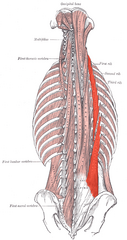
longissimus
trunk extension

spinalis
trunk extension

rectus femoris
knee extension

vastus lateralis
extends knee

vastus medialis
extends knee

vastus intermedius
extends knee

sartorius
Flexes, abducts, and laterally rotates thigh at the hip
flexes knee

adductor longus
adduction of hip

adductor brevis
adduction of hip

adductor magnus
hip adduction

gracilis
adducts thigh, flexes and medially rotates leg

tensor fasciae latae
flexes and abducts thigh

biceps femoris
flexes knee

semitendinosus
flexes knee

semimembranosus
flexes knee

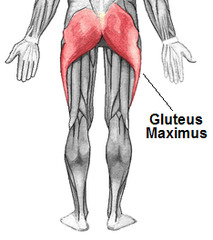
gluteus maximus
extension of hip
gluteus medius
abduction of hip
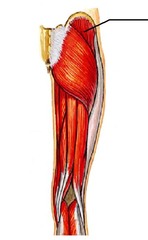
gluteus minimus
adbucts hip
