Lecture 6 - Deriving Energy From Food – Cellular Respiration
 Call Kai
 Learn
Learn Practice Test
 Spaced Repetition
 Match
Match Flashcards
 Knowt Play
1/55

There's no tags or description
Looks like no tags are added yet.
Name | Mastery | Learn | Test | Matching | Spaced | Call with Kai | Chat |
|---|
No analytics yet
Send a link to your students to track their progress
56 Terms
Energy:
The capacity to bring about movement against a force; the ability to do work.
Forms of Energy:
Potential Energy: Stored Energy
Chemical Energy
Ex: Hydroelectric dam, food
Kinetic Energy: energy in motion
Running, biking, flying, etc.
1rst Law of Thermodynamics
Energy can not be created or destroyed, only transformed.
Excess energy released as heat
2nd Law of Thermodynamics
Energy conversions increase the entropy of the universe
Entropy: the amount of the disorder.
Exergonic Reactions:
Reactants contain more energy than the products
Ex: Energy released
Ex: Cellular respiration
Endothermic Reactions:
Products contain more energy than reactants
Ex: Energy captured
Ex: Photosynthesis

Photosynthesis
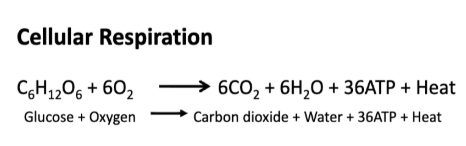
Cellular Respiration
Adenosine triphosphate (ATP):
Energy transfer molecule
Adenosine diphosphate (ADP)
an essential organic compound in cellular metabolism, formed when ATP releases energy
Phosphorylation:
Addition of a phosphate ion to a molecule
Oxidation:
The process of removing electrons
Reduction:
The process of adding electrons
Reduction in charge
Reduction & Oxidation are always linked
Redox reaction: the transfer of electrons from one molecule to another.
Macromolecules & Energy
Through the cellular respiration process, stored energy in chemical bonds of sugar and other macromolecules is captured and converted into the bonds of ATP.
Cellular Respiration
3 part process that converts a single glucose molecule to energy/ATP
Glycolysis
2 ATP
Krebs cycle
2 ATP
Electron transport chain
32 ATP
Glycolysis
Breakdown of 1 glucose molecule into 2 pyruvate molecules
Present in cytoplasm/cytosol
Two Stages
Energy investment stage: requires 2 ATP
Energy harvesting stage: produced 4 ATP & NADH
Steps for Glycolysis
1. 2 ATP are used to attach two phosphate groups to the 6-carbon glucose molecule.
2. 6-carbon glucose split into two 3-carbon molecules.
3. Phosphate added with energy from NAD+ oxidation.
Two NADH molecules produced.
4. Phosphate groups lost to ADP.
Four ATP produced.
5. Pyruvate end product.
Transition Phase
Coenzyme A (acetyl CoA) added to pyruvate producing Acetyl Coenzyme A.
Carbon Dioxide (CO2) byproduct
One NADH molecule produced from each pyruvate molecule.
Krebs Cycle
Inner compartment of mitochondria (matrix)
One glucose molecule:
= 2 pyruvate
= two cycles produces
4 CO2
6 NADH
2 ATP
2 FADH2
Electron Transport Chain
Energy from electrons (e - ) used to push H + ions from inner compartment to outer compartment against concentration and electrical gradient.
Inner membrane of mitochondria.
Oxygen is the final electron acceptor.
Chemiosmosis
Movement of ions across semi-permeable membranes, down their electrochemical gradient.
ATP Synthase: enzyme uses energy from H+ ions to spin, which add phosphate to ADP making ATP.
Anaerobic
without the use of oxygen.
Glycolysis.
Fermentation
Aerobic
with the use of oxygen.
Cellular respiration
Fermentation:
metabolic pathway that regenerates NAD+ from NADH and allows for glycolysis to continue making ATP in the absence of oxygen.
Alcohol fermentation:
Yeast in an anaerobic environment.
Lactic acid fermentation:
Occurs in muscle when ATP use exceeds oxygen uptake
Lactic acid fermentation:
Occurs in muscle when ATP use exceeds oxygen uptake
Alcohol Fermentation
Ethanol (drinking alcohol) is produced when acetaldehyde (pyruvate derivative) accepts electrons from NADH
Lactic Acid Fermentation
produced when pyruvate accepts electrons from NADH
Occurs when oxygen delivery to cells is lagging
Cause burning in muscles
Anaerobic and Aerobic Contributions
Energy from anaerobic respiration is used for short bursts of activity.
Homeostasis
a physiological state where internal conditions are regulated.
Regulators:
use internal mechanisms to minimize external fluctuations.
Conformers:
allow internal conditions to change due to external fluctuations.
Thermoregulation
Process by which animals maintain their body temperature within a normal range
Endothermic:
Body temperature maintained by metabolism
Birds, mammals, & insects
Ectothermic:
Body temperature controlled by environment
Most reptile, fish, & invertebrates
Poikilotherm:
Animals whose body temperature fluctuates with the environment
Homeotherm
Animals with a relatively constant body temperature.
Conduction:
Transfer of heat via touch
Convection:
Transfer of heat by the movement of particles across a surface
Radiation:
Emission of electromagnetic waves
Evaporation:
Loss of heat from changing a liquid into a gas
Adaptations for Thermoregulation
Insulation
Behavior Responses
Evaporative heat loss
Insulation:
Hair
Feathers
Fat (blubber)
Behavior Responses:
Basking.
Huddling.
Burrowing.
Hot tubbin’.
Evaporative heat loss:
Sweating.
Panting.
Defecating.
Torpor
physiological state of decreased activity and metabolism.
Hibernation
long term torpor and a decreased body temperature in response to winter cold and food scarcity
Estivation
decreased metabolic rate and activity during hot summer months
Vasodilation:
The widening of superficial blood vessels
Increase heat transfer
Vasoconstriction
Reduces the diameter of superficial blood vessels
Adaptations for Thermoregulation
Countercurrent heat exchange:
Warm blood in arteries from an animal's core comes in close contact with veins returning from extremities.
Blood in arteries remains slightly warmer than blood in veins resulting in heat transfer.
Returning blood is almost as warm as arterial blood.
Animal Diets:
All animals are heterotrophic:
Herbivores.
Carnivores.
Omnivores.
Insectivores.
3 Nutritional Needs:
Energy for cellular processes.
Organic building blocks for macromolecules.
Acquisition of essential nutrients.
Trade-offs of Thermoregulatory Strategy
Smaller endotherms have a greater surface area to volume ratio.
Lose more heat to the environment.
Must produce more energy to maintain a constant body temperature.