Environmental Science: Mananaging Pollution
 Call Kai
 Learn
Learn Practice Test
 Spaced Repetition
 Match
Match Flashcards
 Knowt Play
1/59

There's no tags or description
Looks like no tags are added yet.
Name | Mastery | Learn | Test | Matching | Spaced | Call with Kai | Chat |
|---|
No analytics yet
Send a link to your students to track their progress
60 Terms
Pollutant
A substance that, when released harms or alters the environment in a negative way.
Contaminant
A substance that is present in an environment where it doesn't occur or is found in higher concentrations than normal
Source
The origin of a pollutant that enters an environment.
Point source emission
Pollution that originates from a single discharge point. E.g. A chimney or smoke stack.
Diffuse source emission
Pollution that enters the environment across a broad area and has no single point. E.g. fertiliser run-off from agricultural land.
Direct pollution
The discharge of a pollutant directly into the environment. E.g. a factory discharging pollutants into a water source.
Indirect pollution
When a pollutant enters the environment through secondary actions or pathways. E.g. Nitrogen from fertilisers in run-off making their way into oceans or aquifers.
Fugitive diffuse source
Emissions that escape from an instrument or facility seperate to any designated discharge points. E.g. A leak in a factory.
Mobile diffuse source
Emissions from mobile sources. E.g vehicles.
Dispersal
The spreading, movement and dilution of pollutants away from the original point.
Primary pollutants
Substances directly released into the environment from a polluting source. E.g burning fossil fuels
Secondary pollutants
Formed by chemical changes to the primary pollutants. E.g Nitric oxide (NO) -> Nitrogen dioxide (NO2) when it comes in contact with the ozone.
Types of pollution
Atmospheric; water; land; light; noise; thermal.
Atmospheric pollution
Pollutants released into the air from human activities (burning fossil fuels, agriculture) or natural sources (volcanic activity, bushfires). E.g carbon dioxide (CO2), methane (CH4)
Water pollution
Harmful substances that enter the waterways. Human activities include agricultural run-off, discharge from industrial activities, plastics. Negatively impacts aquatic life.
Land pollution (Terrestrial)
Substances or rubbish negatively impact the soil pH, salinity and overall surface of the land. E.g Landfill negatively impacts organisms that can ingest plastic particles, chemical fertilisers alter pH and soil quality.
Light pollution
Bright, impactful light emitted by human activities and residential areas which can disturb, confuse and indirectly kill animals. E.g big city lights can disorientate migratory birds at night.
Noise pollution
Continuous or recurrent loud noise which can be disruptive or physically harmful to animals and people. E.g AI data centres emit loud noises day and night which can drive animals away or severely disorientate and endanger them.
Thermal pollution
Heat from hot water directly discharged into waterways which can endanger aquatic life- mostly from human activities. E.g industrial discharge from factories into rivers.
Heavy metals
Toxic metals that persist in the environment. Heavier atomic mass than calcium. Safe and naturally occurring in low levels, but increased by human activities such as smelting and burning fossil fuels and ores. E.g Lead, mercury, arsenic.
Waste
A mineral, substance or by-product discarded due to it not being useful or required. CAN become a pollutant if not treated properly. E.g sewage water
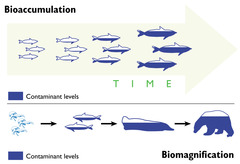
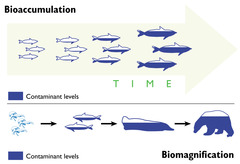
Bioaccumulation
When an organism absorbs or takes in a substance faster than its body can remove it. I.e substance increases over time.
Bioconcentration
The build up of a chemical taken in directly from the environment but NOT through food, to a concentration higher than the surrounding air or water.
Biomagnification
The increasing concentration of a chemical in organisms as you go higher in the food chain. i.e Higher trophic organisms ingest more pollutant or substance than a lower trophic organism.
Scale of environmental impacts
Local: Small scale- affects an area of a few square Kms.
E.g chemical spill on road.
Regional: A large but specific area of impact.
E.g Soil salinity increase, coral bleaching in reefs.
Global: A global and international impact
E.g enhanced greenhouse effect
Exposure
A measure of how much of a pollutant an organism or person is exposed to in a given amount of time.
Ingested
Absorbed via food or drink.
Inhaled
Absorbed via breathing in pollutants.
Dermal absorption
Absorbed through the skin
Dosage
The amount of a chemical absorbed per unit of body weight. Affected by respiration rate (breathing), concentration, frequency of exposure, length of exposure, the chemicals properties and the organisms body weight.
Toxicity
A measure of harm (resulting in illness or death) that a substance can cause in an organism.
Acute toxicity
The adverse health effect from a single dose of the toxic substance. E.g snake venom
Chronic toxicity
The adverse health effects of repeated exposure to the material over a prolonged period of time. E.g cigarette smoking.
Threshold
The level of chemical exposure below which there is no adverse effect and above which is toxic and or harmful. This includes LD50
Threshold pollutant
A substance that is harmful to a certain concentration, of threshold. E.g sulfur dioxide.
Lethal Dose 50 (LD50)
Lethal Dose 50 is how much of a substance is required to kill 50% of an organism (often a tested animal) in a set period of time.
Endocrine Disrupting Chemicals (EDCs)
Synthetic (human made) or naturally occurring chemicals that can affect the hormonal systems in animals. E.g Bisphenol A (BPA), found in plastics, food containers, and the epoxy resin linings of canned foods.
Environmental indicators
Physical, chemical, biological, socio-economic.
Ecological niche
The organisms structural and functional role within its given environment or habitat. E.g Lyrebirds turn many tonnes of soil per year, fertilising the soil, giving them a role in the forest.
Range of tolerance
The environmental parameters in which a given organism can survive.
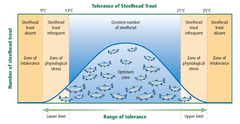
Optimum range
The environmental parameters in which a given organism thrives.
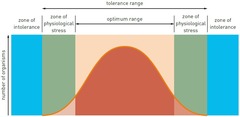
Stress zone
The environmental parameters beyond which a given organism can thrive and begins to show signs of discomfort or stress.
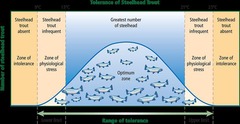
Lethal zone
The zone beyond which a given organism survives and most if not all will die.
Turbidity
The cloudiness or haziness of water caused by disrupted sediments or pollution. Can block sunlight for aquatic plants.
pH
The pH scale is a measure of the acidity or alkalinity of water or soil.
Light intensity
The amount of light that an area or surface receives in a given amount of time.
Dissolved oxygen
The amount of free, non-bound oxygen molecules in the water. It is an indicator of water quality and can be a sign of a healthy ecosystem if it is high.
Biological Oxygen Demand
The amount of dissolved oxygen in the water needed by bacteria and other microorganisms that break down organic matter.
Salinity
The amount of salt dissolved in water or present in the soil.
Eutrophication
The process in which a water body becomes overly enriched with nutrients, mainly nitrogen and phosphorus, often from agricultural run-off.
Temperature
The average kinetic energy of particles in a substance. A higher temperature means faster moving particles, while a lower temperature indicate slower moving particles.
Biological indicators
Bacteria, fish, frogs, macroinvertabrates, algae, soil biota etc. Some organisms can thrive in polluted or murky water while others are incredibly sensitive and their presence can indicate a healthy environment.
Biomarkers
A measurable biological response- a biomarker species for example has a low threshold for a particular contaminant, and any levels higher than that threshold will result in abnormal growth or other defects.
Bioassays
A scientific test that measures the effect or tolerance of a specific chemical, toxin or pollutant on an organism. E.g the canary in the coal mine was miners using canaries to test how much methane was in a mine as they are more sensitive.
Bioremediation
The process of living organisms (bacteria, fungi, plants etc) to convert harmful environmental contaminants into less toxic substances.
Scrubbers
A machine or system that moves gases through a substance to extract pollutants.
Wet scrubbers
A scrubber that removes pollutant particulates by passing the stack gases through water (either a pool of fluid or mist).
Can be difficult to dispose and/or store.
Dry scrubbers
Gas passes through a dry medium that chemically reacts with the new pollutant to change its chemical composition.
Electrostatic precipitators
A form of industrial air pollution control which removes pollutant particles with an electric charge.
Pollution sink
A process or place that removes a pollutant from the air, water etc. E.g CO2 (photosynthesis is the sink) and heavy metals (wetland sediments).