Geometry
 Call Kai
 Learn
Learn Practice Test
 Spaced Repetition
 Match
Match Flashcards
 Knowt Play
1/34

Earn XP
Description and Tags
Trig, Angles, Area, Volume
Name | Mastery | Learn | Test | Matching | Spaced | Call with Kai | Chat |
|---|
No analytics yet
Send a link to your students to track their progress
35 Terms
angle rules (3)
total angle in triangle = 180
total on straight line = 180
total angle around a point = 360
corresponding angles
equal when 2 lines parallel
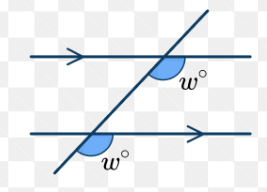
alternate angles
equal when 2 lines parallel

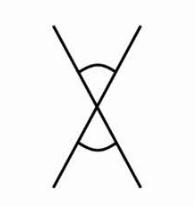
vertically opposite angles
2 lines intersect
polygon
2D enclosed shape with straight sides
interior + exterior angle = ?
? = 180 degrees
equation to find sides from exterior angles
360 / value of one exterior angle
degrees * n = 360
equation to find interior angles from # of sides (n)
180 * (n-2) / n = degrees
equation for total sum of interior angles
(n-2) * 180
pythagoras’ theoreom:
a2+ b2= c2 (hypotenuse)
sine
sin(degrees) = opp / hyp
opp = the side opposite to the unknown angle
cosine
cos(degrees) = adj / hyp
adj= side next to the unknown angle
tangent
tan(degrees) = opp / adj
sin/cos/tan -1
uses the ratio to find the angle
sin(degrees) uses degree to find ratio
exact trig value song
volume + area of a cone
V: 1/3 * πr2 h
A: πr2 + πrl
frustum
when the tip of a cone is excluded
volume = cone - smaller cone
volume + area of a pyramid
V: base area * h / 3
A: base area + (# of faces * face area)
volume + area of a sphere
V: 4/3πr2
A: 4πr2
what is a prism?
3D object with same cross section throughout
volume + area of a prism
V: base area * length
A: (area of each face * # of each face) + 2(base area)
volume + area of a cylinder
V: πr2h
A: 2πrh(circumference + height) + 2πr2 (2 faces)
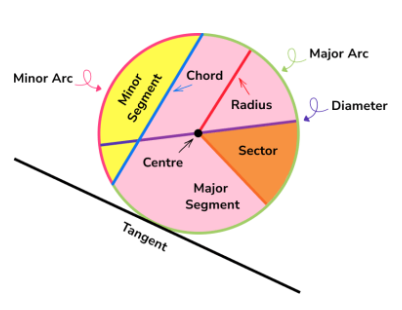
labelled circle
area + circumference of an arc
A: degree/360 * πr2
C: degree/360 * 2πr
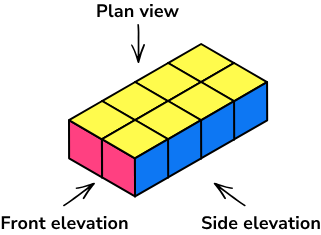
plan vs elevation
plan: birds-eye view directly from above
elevation: view from front or side
reflections
count squares perpendicularly to each vertex
plot each vertex equal distance to the opposite side
when going diagonally, draw lines of reflection, flip tracing paper to line up /w LoR
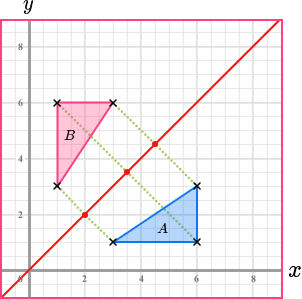
describing a reflection
M1: naming “reflection”
M2: naming equation for line or reflection
vectors
Top: x // Bottom: y
(+) move up or right // (-) move down or left

transformation
count how many times vertice must be moved
plot new points
describing a transformation
M1: naming “transformation”
M2: naming the vector
rotation
copy vertices on both sides of tracing paper
keep pencil on center point of rotation when turning
describing a rotation
M1: naming “rotation”
M2: naming point of rotation
M3: naming degrees of turning
M4: naming clockwise/anticlockwise
enlargement
count squares for distance to center of enlargement
plot new vertices by multiplying scale factor (distance * sf)
describing an enlargement
M1: naming “enlargement”
M2: naming center of enlargement
M3: naming SF
todo, bisectors and constructions, new trig sheet