Week 2 (1B)
 Call Kai
 Learn
Learn Practice Test
 Spaced Repetition
 Match
Match Flashcards
 Knowt Play
1/42

Earn XP
Description and Tags
Joints and cartilage, muscle basics
Name | Mastery | Learn | Test | Matching | Spaced | Call with Kai | Chat |
|---|
No analytics yet
Send a link to your students to track their progress
43 Terms
Types of cartilage
Elastic cartilage (with elastic fibers, maintain structure shape)
Hyaline cartilage (articular cartilage, smooth surface for glide and support at synovial joints)
Fibrocartilage (durable, joint support andd cushioning)

What is the name of the cell that makes up cartilage
Chondrocytes
Visco = ?
Viscosity 黏度
What type of connective tissue is hyaline cartilage?
Viscoelastic connective tissue (solid at first but overtime when force applies it will become liquid)
disturbutes load over wider area
smooth surface reduces friction

what fibers does hyaline cartilage have
type ll collagen fibers
Whats osteoarthritis
Loss of hyaline cartilage

Rheumatoid arthritis
Inflammation of the synovial cavity and cartilage
decreases mobility over time
What type of fiber does fibrocartilage contain
type l and type ll collage
create disc-like structures within joints (between scapula and humerus, between femur and tibia(menisci, a type of fibrocartilage elements) , pubic symphysis)
Factors contributing to range of motion
Shape and arrangement of articulating surfaces
Ligaments crossing the joint
Surrounding muscles
What considers grade 1 ligament sprain
Stretching or sightly tearing
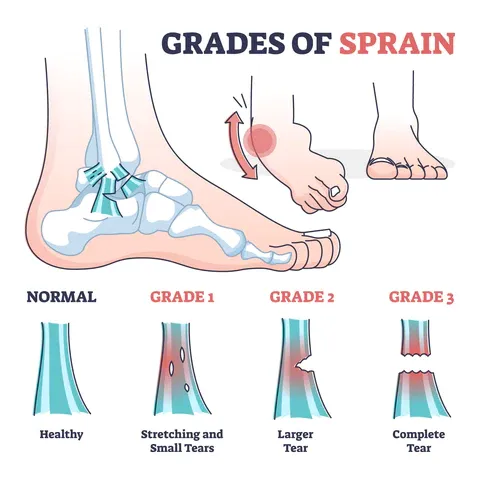
What considers grade 2 ligament sprain
Incomplete tear
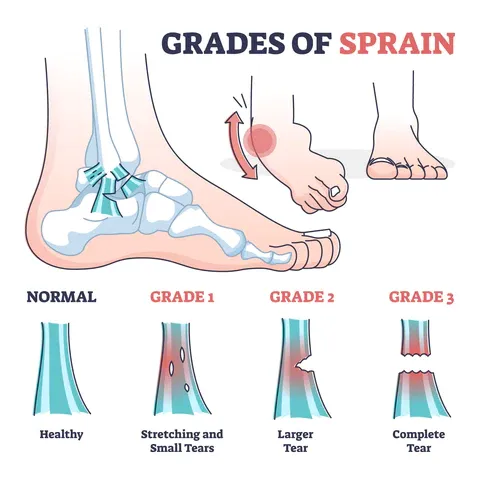
What considers grade 3 ligament sprain
Complete tear
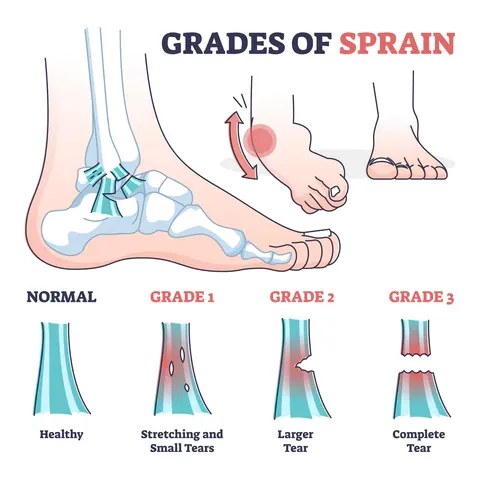
What does PRICE stands for
Protection
Rest
Ice
Compression
Elevation
Differences between strains and sprains
Strains: Muscles and tendons tear
Sprains: ligament tear
3 types of muscle
Skeletal muscle
Cardiac muscle
Smooth muscle
what is the name of the cells that make up muscle
Myocytes

What type of control are considered for cardiac and smooth muscles?
involuntary control
Where can smooth muscles be found?
viscera(inner organs)
blood vessels
skin
are smooth muscles striated
Not striated
are cardiac and skeletal muscles striated
Yes
Basic muscle properties
Electrical excitability
Contractility
Extensibility
Elasticity
order of the muscle terms
muscle → fascicle → muscle fiber(myocytes) → myofibril (repeating units of sarcomeres)
What are sarcomeres made of
Actin(thin filament) and myosin (thick filament)
Where do blood vessels and nerves locate in a muscle
fascia (connective tissue)
On top of the muscle
whats concentric contraction
Overlapping of actin and myosin
Shortening muscles
whats eccentric contraction
Lengthening muscles
Whats the contralateral control
left side of the brain controls right side of the body
vice versa
What is a motor unit
one motor neuron connects to several muscle fibers
Whats an origin
immobile attachment (usually proximal)
Whats an insertion
Mobile attachment (distal)
Isometric contraction
Muscle contracts but does not shorten
What does isotonic contraction means
the muscles are moving during contraction
Concentric contraction
Muscle shortens during contraction

Eccentric contraction
Muscle lengthens during contraction

Agonist
muscles that primarily drive the movement (concentric)
Antagonist
Controls, slows, or resists the agonist (eccentric)
Synergist
ASSIST THE AGONIST (concentric)
Muscle atrophy
Lose muscle progressively from the age of 30
Muscle mass is replaced by fibrous connective tissue and adipose(fat)
what causes muscle atrophy
loss of motor neurons, muscle fibers
slower conducting speeds
Benefits of exercising
increase muscle mass, bone density and neuron firing rate
Grade 1 muscle strain
stretching or sightly tearing
Grade 2 strain
incomplete tear
Grade 3 strain
Complete tear
DOESNT ALWAYS REQUIRE SURGERY!