Orgo Midterm 1
 Call Kai
 Learn
Learn Practice Test
 Spaced Repetition
 Match
Match Flashcards
 Knowt Play
1/81

There's no tags or description
Looks like no tags are added yet.
Name | Mastery | Learn | Test | Matching | Spaced | Call with Kai | Chat |
|---|
No analytics yet
Send a link to your students to track their progress
82 Terms
how would you draw a acid and base (the process of the electron getting accepted and like that)

does having a negative make something a strong base or acid
it makes it a strong base because it really wants to be neutral so it wants that hydrogen
does having a positive charge make something a stronger acid or base
it makes it a stronger acid because it wants to be neutral so it wants to get rid of that positive charge
when ARIO fails, look at formal charges and solvating effects
if you are given the base and told to see if it is a strong acid don’t change it and just look at it how it is
only what type of electrons can make bonds
UNPAIRED
what does an unhybridized p orbital mean
it isn’t being used
ex. sp2: _ _ _ (unhybridized one) p
_ s
always end up with what you start with in hybridization
more s character = held closer to the nucleus
the more dipole moments a molecule has the more polar it is
what type of bonds have linear geometry
triple
difference between valence bond theory and molecular orbital theory
valence bond looks at bonds separately but molecular orbital looks at it as a whole
what is the different between organic and inorganic compounds
organic ones have carbon
they make up everything (food, clothes)
when scientists did what experient did they find that organic compounds didn’t just come from human beings
heating up ammonium cyanate to make urea
how to say the number of bonds that can be made (4, 3,2, 1)
tetravalent
4
trivalent
3
divalent
2
monovalent
1
what is a constiutional isomer
compounds with the SAME molecular formula but different structures
what do you need for a molecule to do a reaction
a collision
bonds to break and form
for ex. melting is only a physical reaction because it is the same thing just separating
what electrons do we care about in orgo and why
VALENCE!
we care about electron flow
where they are going, why they give electrons, and why they accept them too
because they are the ones involved in bonding
when drawing a lewis dot structure give each bond 2 electrons
formal charge equation
valence - electrons around
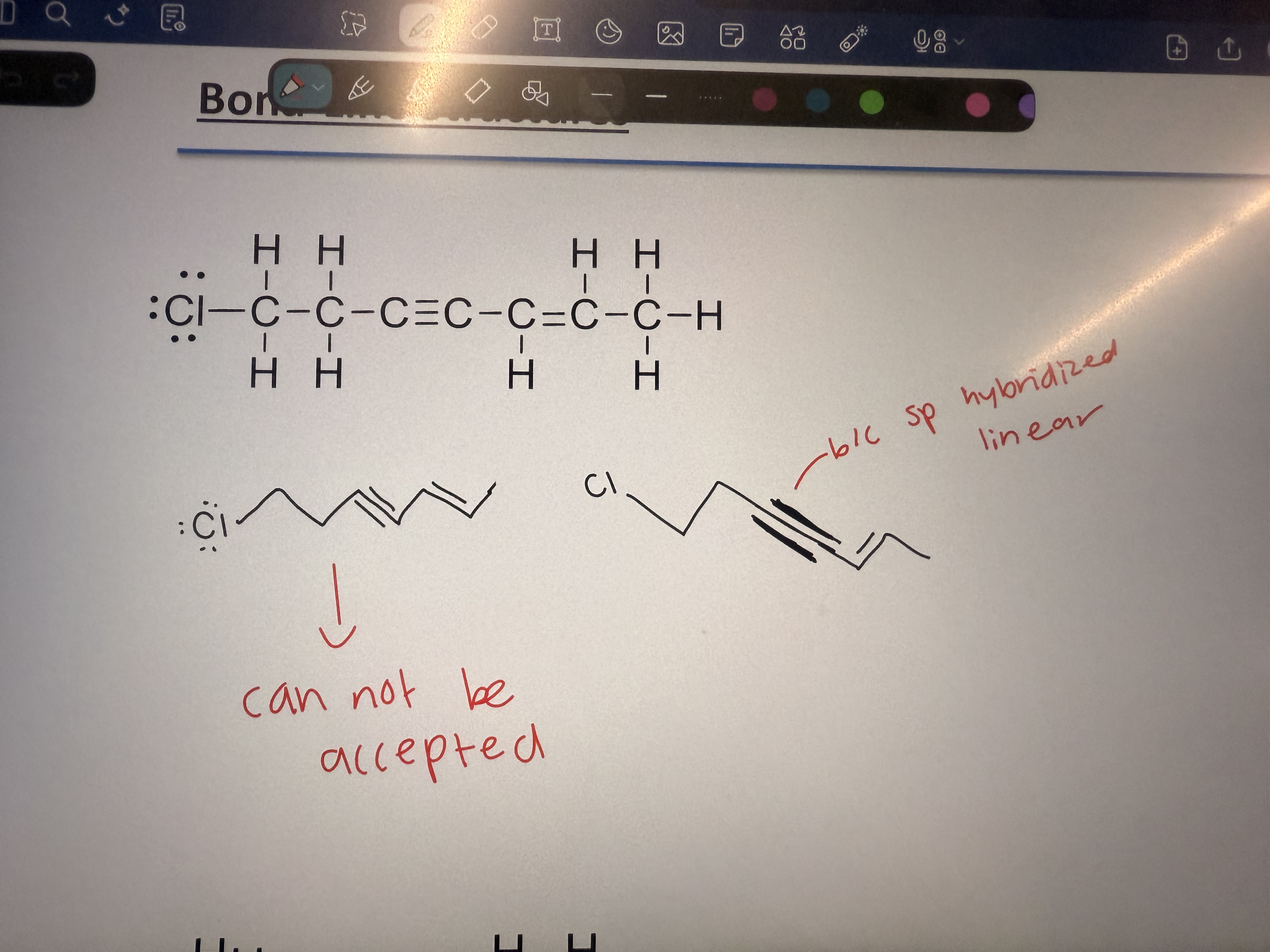
NEVER DRAW ANYTHING INSIDE THE V!!!!!!!!!!!

How to draw triple bonds so it will be accepted
MAKE SURE IT IS LINEAR
does constructive interference and destructive interference form a bond?
constructive does, destructive doesnt
what MOs interact to create bonds
HOMO and LUMO
molecular orbital vs valence bond (definition, electron location)
MO theory: when two atomic orbitals combine to make MOs that extend across the whole molecule
electrons are DELOCALIZED
Valence Bond theory
when bonds form from 2 atomic orbitals overlapping
electrons are LOCALIZED
carbons normal electron configuration doesn’t show how it can make four bonds and even after exciting it it is like that so then you have to hybridize
when drawing the pi bonds make it have one electron

bond angle for a tetrahedral
0 lone pairs: 109.5
1 lone pair: 107
2 lone pairs: 105
difference between electron and molecular geometry
molecular geometry ignores the lone pairs
dipole moment equation
charge x distance
have to conver tfrom esu to d
how to find out how ionic a bond is
take the actual mean and divide it by the mean that represents the full separation of charges
to find the mean for the full separation of charges do charge x distance (and convert to D)
what does a double bond mean in relation to orientation
the atoms cant move or rotate around it
define protic and aprotic
protic = when solvents are able to engage in hydrogen bonding
aprotic = when not able to do hydrogen bonding
but can still have polar substances
sigma bonds occur on the bond axis but pi bonds dont

lone pairs go into hybridized orbitals unless there is resonance and they go into unhybridized ones
why you have to have sp2 or below, need that p open
5 patterns of resonance
allylic lone pair
allylic positive charge
atoms of differing electronegativity
lone pair next to a positve charge
around the ring
vinylic vs allylic position
vinlyic is ON the double bond
allylic is on one bond away from the double bond
What is allylic and vinyllic for
ONLY for CARBON DOUBLE BONDS
conjugated
pi bonds split by a sigma bond
allylic lone pair
2 arrows
first is from lone pair to pi bond, second is from pi bond to lone pair
one gets positively charged another negatively
allylic positive charge
one curved arrow
take a pi bond and form a new pi bond
switch where the positive is

lone pair adjacent to positive charge
move lone pair to the positive charge
pi bond between 2 atoms of differing EN
give the more EN one the lone pair
most important to least for resonance signficiance
filled octets
fewer formal charges
negative charge on more EN atom and positive on less EN
IF IN RESONANCE THE HYBRIDIZATION HAS TO BE SP2 OR LOWER
if there is a p orbital already being used then you can’t delocalize an electron
what types of orbitals form single, double, and triple bonds
hybrid orbitals make single bonds
double and triple bonds are made from unhybridized p orbitals
out of the ways to represent a molecule, which one doesn’t give information about its structure
molecular formula
difference between partially condensed structure and condensed

how to draw hydrogens when there is a bond line structure

bicyclic wedge dash notation

resonance structures COEXIST and dont jump from one to another
what do you always do first when assesing resonance
OCTETSSS
avoid drawing resonance structures where the carbons have two different charges
one carbon has a positive one and then another has a negative one
electrons that don’t move during resonance are LOCALIZED
trigonal pyramidal is not planar
if there is a pi bond and a lone pair they both CANT participate in resonance
if same number of atoms and looks the same
SAME compound
bronsted lowry definition of acid and base
acid donates a proton
bases accept a proton
lewis acid and base definition
lewis acid accepts and shares electrons
lewis base donates and shares electrons
bronsted lowry bases and acids are always lewis bases and acids but lewis bases and acids aren’t always bronsted lowry bases and acids
resonance structures are hypothetical
what is the way we quantatively assess strength
pka
what is the Ka equation
Ka= [H3O+] [A-]
———————-
[HA]
strong acids have weak conjugate bases
you want equilibrium to move to the WEAKER acid and base
when it is a huge difference in pka’s then it is a straight arrow and it isn’t equilibrium ones anymore
how do we qualitatively analyze acidity
by looking at conjugate bases
ARIO
when going down the column and then going across a row on the periodic table what is more imporant
row = electronegativity
left to right = increase in EN = more stable = weaker
column = size
bigger size = more stable conjugate base = weaker
for induction it refers to atoms that are not immediately involved in the lone pairs
describe the O in ARIO
the closer the electrons are held to the nucleus the more stable they are
the smaller the atomic orbital the more stable and then the weaker the base the stronger the acid
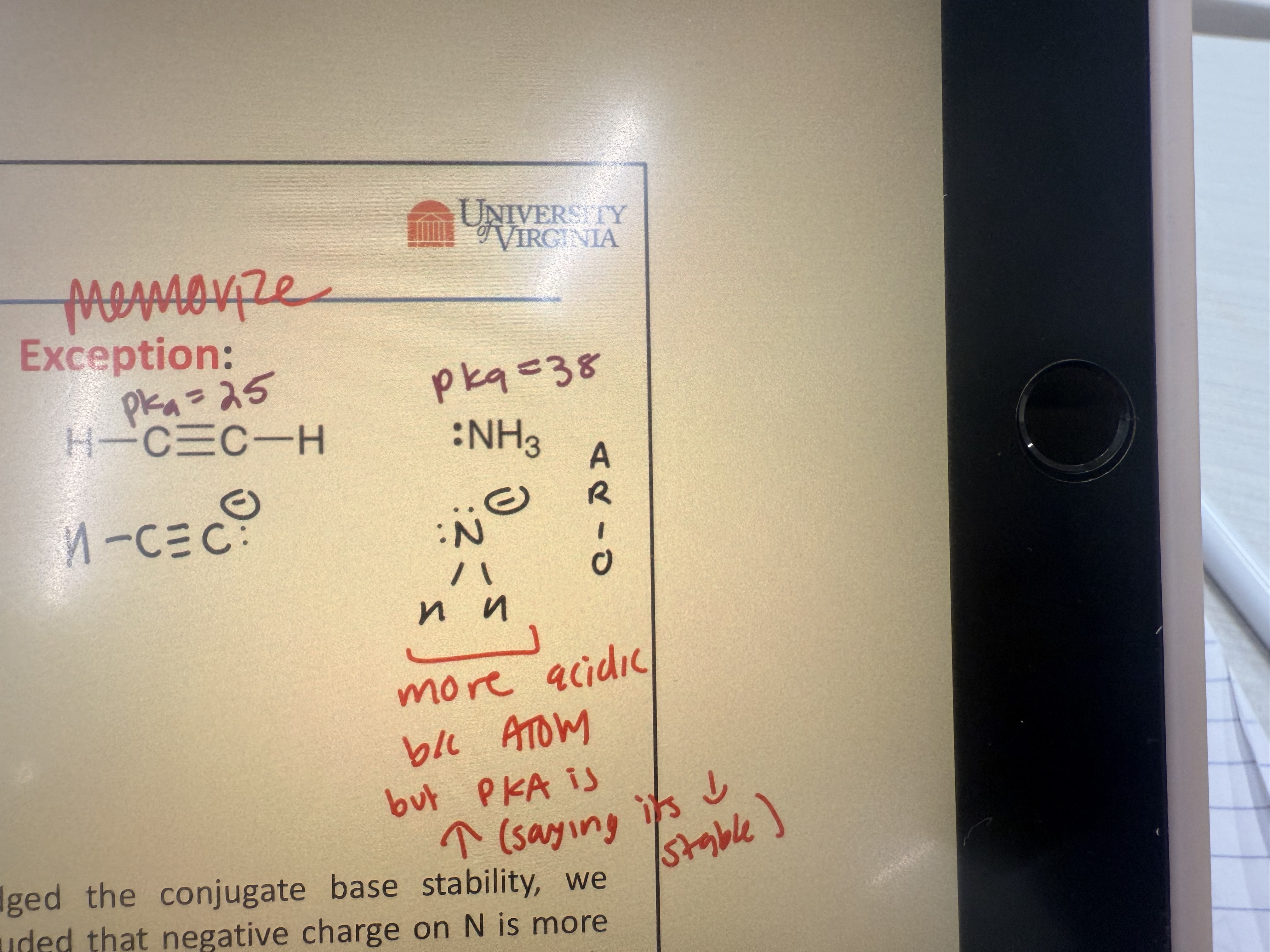
what is the EXCEPTION in Orgo
EVEN THOUGH THE NH3 SHOULD BE MORE ACIDIC IT ISNT
pka’s just prove they don’t work
why is equilibrium shifted to the weaker base
this is because it is MORE stable and you are always shifting to the most stable state
what do we compare when trying to determine equilibrum
base and conjugate base
when will an acid/base not be strong enough to depronante
when its creating something that is less stable
leveling effect
you have to choose the solvent that won’t react with your reaction
dont want something to make everything equally strong
but need something that can effectively deprotonate/protonate
what acids and bases can we not overcome
we can’t have an acid stronger then H3O+ be used in water
we can’t have a base stronger than OH- used in water
this is because it would always be making H3O+ and OH-
because water will always be taking or removing that hydrogen
if a molecule is more branched or less branched will it be more soluable
less branched because that means it can better surround it
because its smaller
bases need what and acids need what
bases need a lone pair and acids need an H
counterions
always there because they balance the charge
just dont include sometimes

CHECK if a proton is being donated/accepted because itf not it is a LEWIS ACID or BASE and not bronsted
if there are carbons in a conjugated pi system the carbons will alternate between partially positive and partially negative
if ka is greater than one what is favored and when ka is less than one what is favored
greater than one = products
less than one = reactants