Class 19- Energy Balance, Body composition
 Studied by 0 people
 Call with Kai
 Learn
Learn Practice Test
 Spaced Repetition
 Match
Match Flashcards
 Knowt Play
1/56

There's no tags or description
Looks like no tags are added yet.
Name | Mastery | Learn | Test | Matching | Spaced | Call with Kai |
|---|
No study sessions yet.
57 Terms
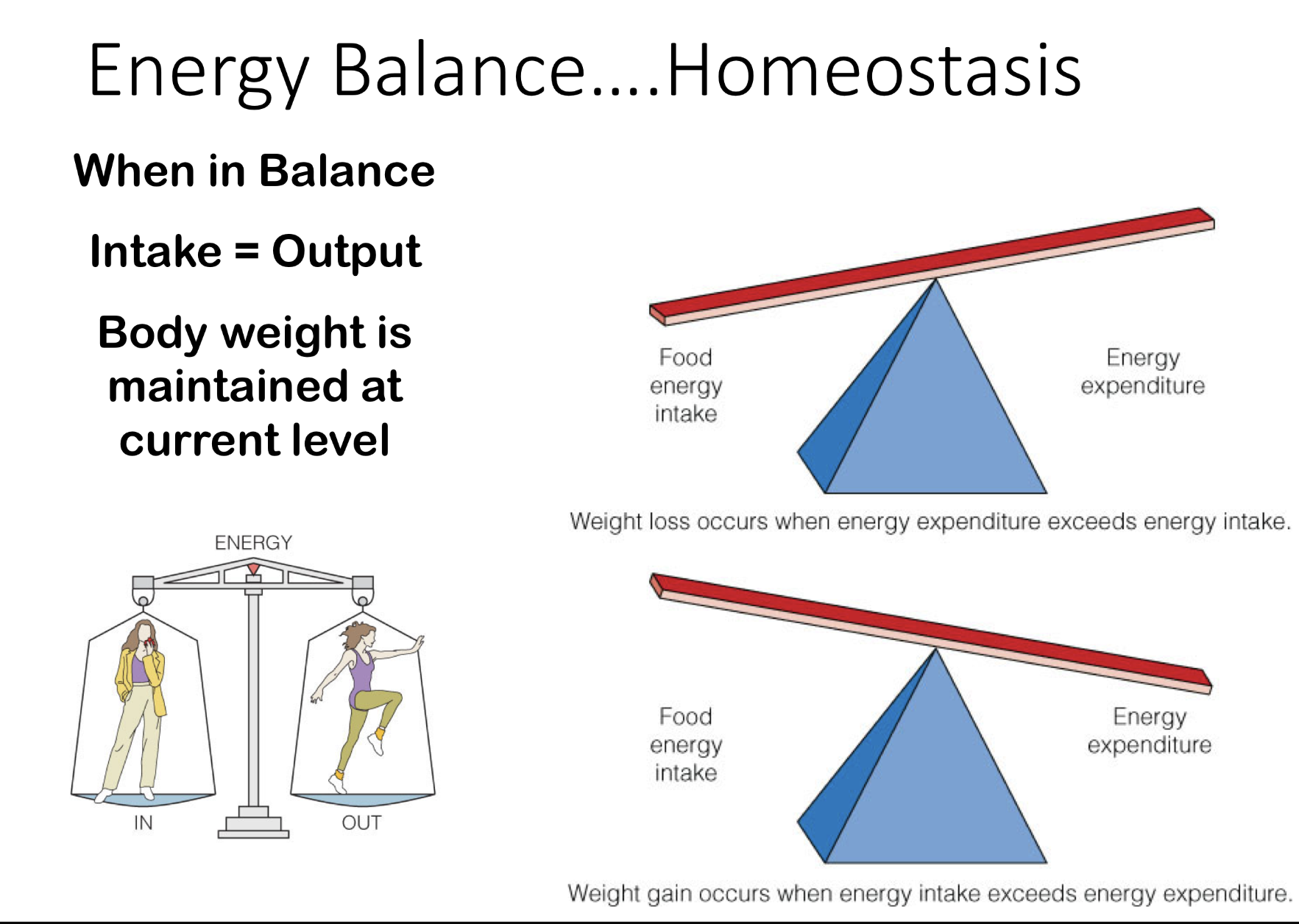
what happens to BW when intake=output vs unbalanced
what does classic 3500 rule tell u? how could you gain or lose 1lb fat/week ? but what are the disclaimers about the rule
• Classic “3500” rule—> 1 lb of fat = 3500 kcal
LOSE/GAIN:
− Reduce by 500 kcal per day to lose one pound
per week or increase by 500 kcal per day to
gain 1 lb (500 x 7 = 3500)
− Example: A person eats about 2500 kcal per
day and wants to lose 1 lb fat per week, in
theory: decrease by 500 kcals x 7 days = overall
decrease of 3500 kcals in one week
DISCLAIMER:
Classic 3500 rule is not exactly correct because…
− With time (extended restriction of intake) or repeated dieting, there can be individual adaptation to restrictive intake (may see a plateau, metabolism may slow…)
− Metabolic differences between individuals, so some may lose more and others less
− It may not necessarily be fat being lost (could be water, muscle, fat…)
where did classic 3500 rule come from
A pound of body fat is mainly only fat (plus
small amount of water/protein)
• 454 g (1 lb) body fat is about 87% fat
• 454g x (0.87%) = 395 g fat
• 395g x 9 kcal/g = 3555 kcal
how does water affect BW (what % of BW) ? how do water gains/losses differ from fat?
Water is about 60% of body weight
ex:
– 70 kg person has 42 kg of water
– 1 litre of water weighs about 1 Kg
• Retention or loss of water can greatly
influence body weight
• Rapid weight loss or weight gain changes are
often due to shifts in % water.
• Changes in fat occur more gradually
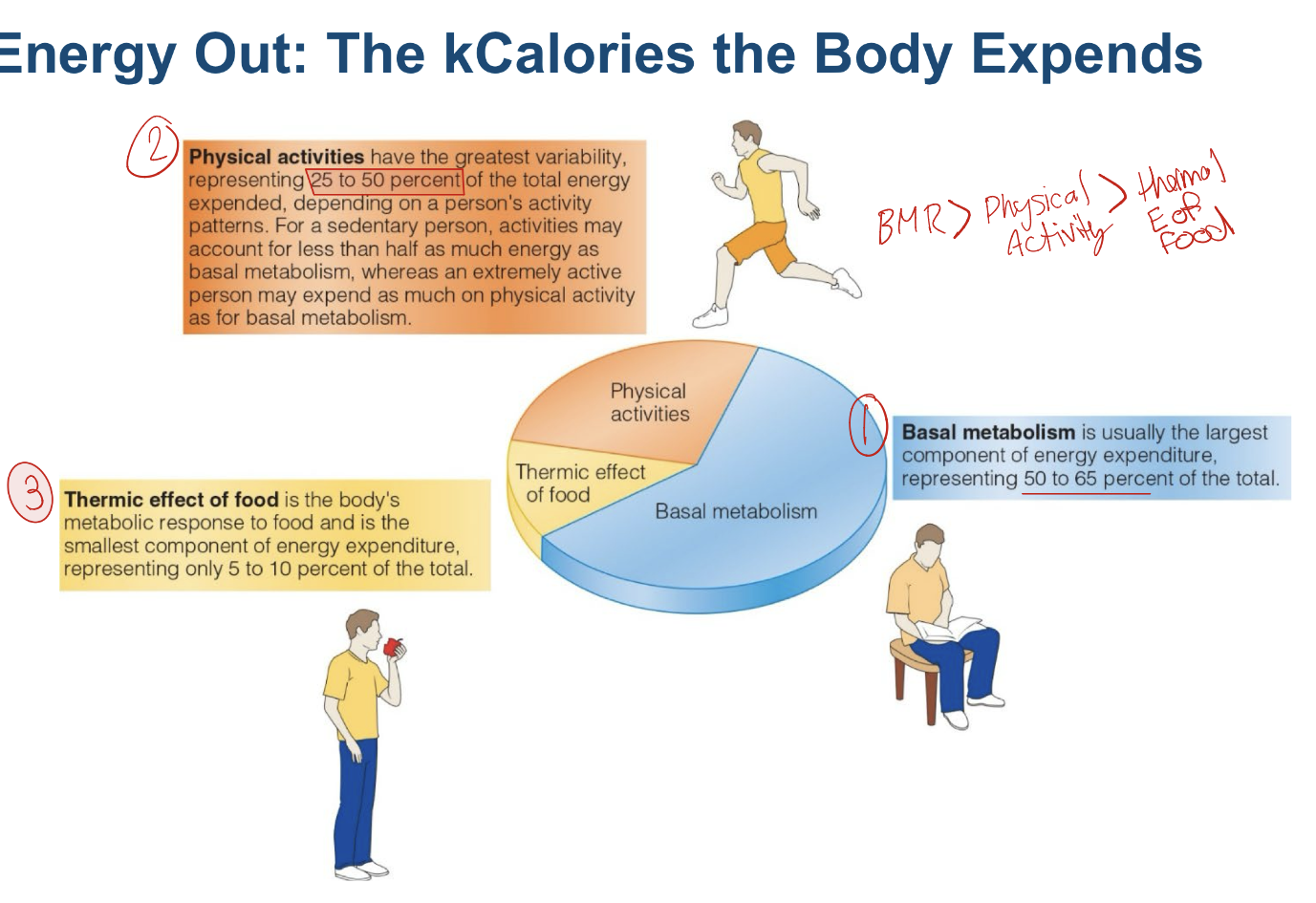
what are the three basic ways body expends calories, what % of total energy expenditure do they represent ? what are they alll influenced by?
Influenced by:
• Gender
• Growth
• Age
• Physical activity
• Body composition and body size
explain “muscle weighs more then fat” myth
• 1 pound of muscle = 1 pound of fat
• Both are one pound !
• But muscle is denser and takes up less space
(less volume).
• Fat is less dense and takes more volume for
the same weight.
will muscle lead to faster or slower metabolism? why?
Is it true than muscle is more
metabolically active than fat?
• Yes, muscle tissue burns calories to maintain
itself, even when not exercising (and obviously
even more when exercising).
• Because of its higher energy expenditure at
rest, having more muscle mass can lead to a
faster metabolism.
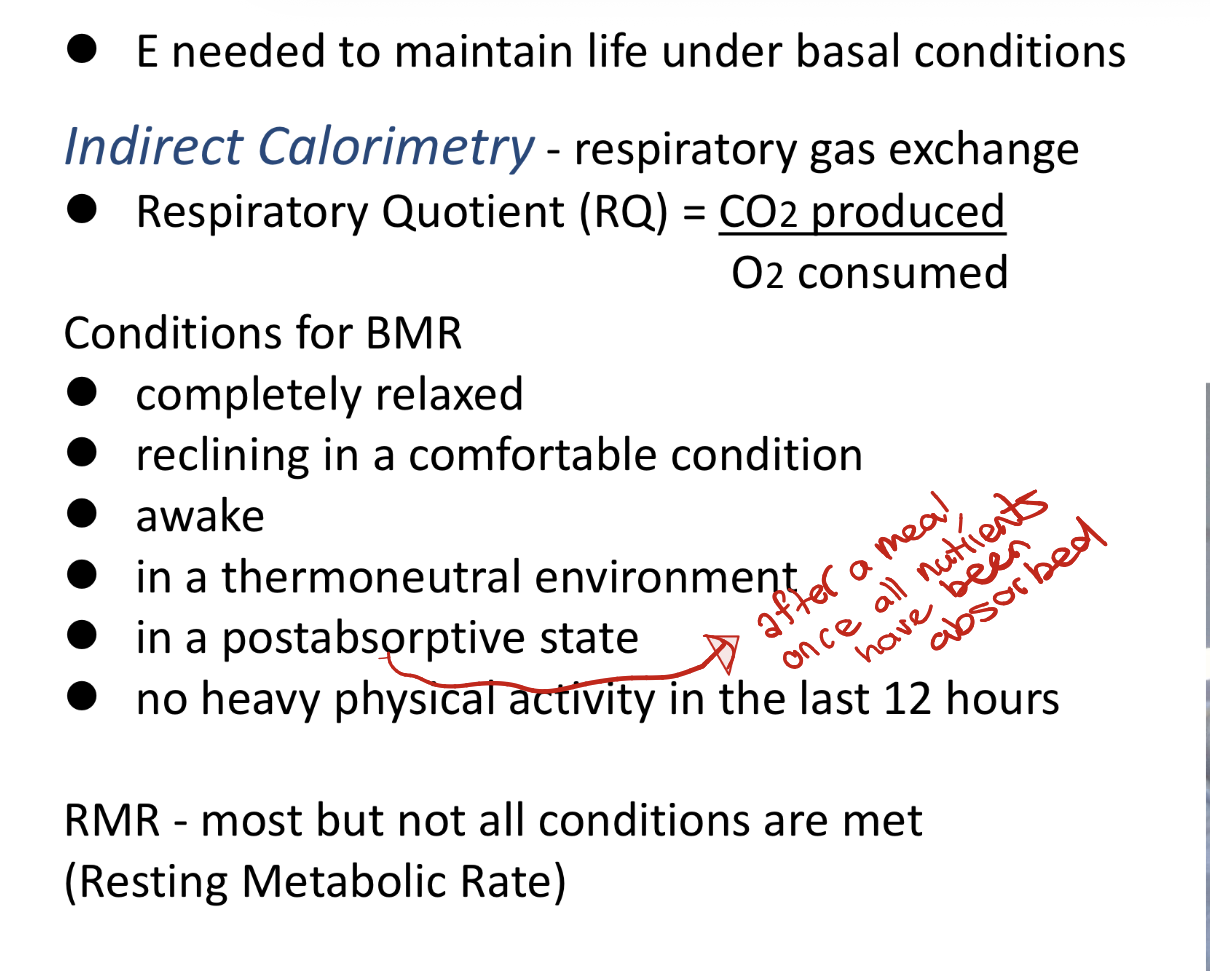
What is BMR? how is it calculated? what are the conditions to test it? how does it differ from RMR
What are factors that increase of dec BMR?
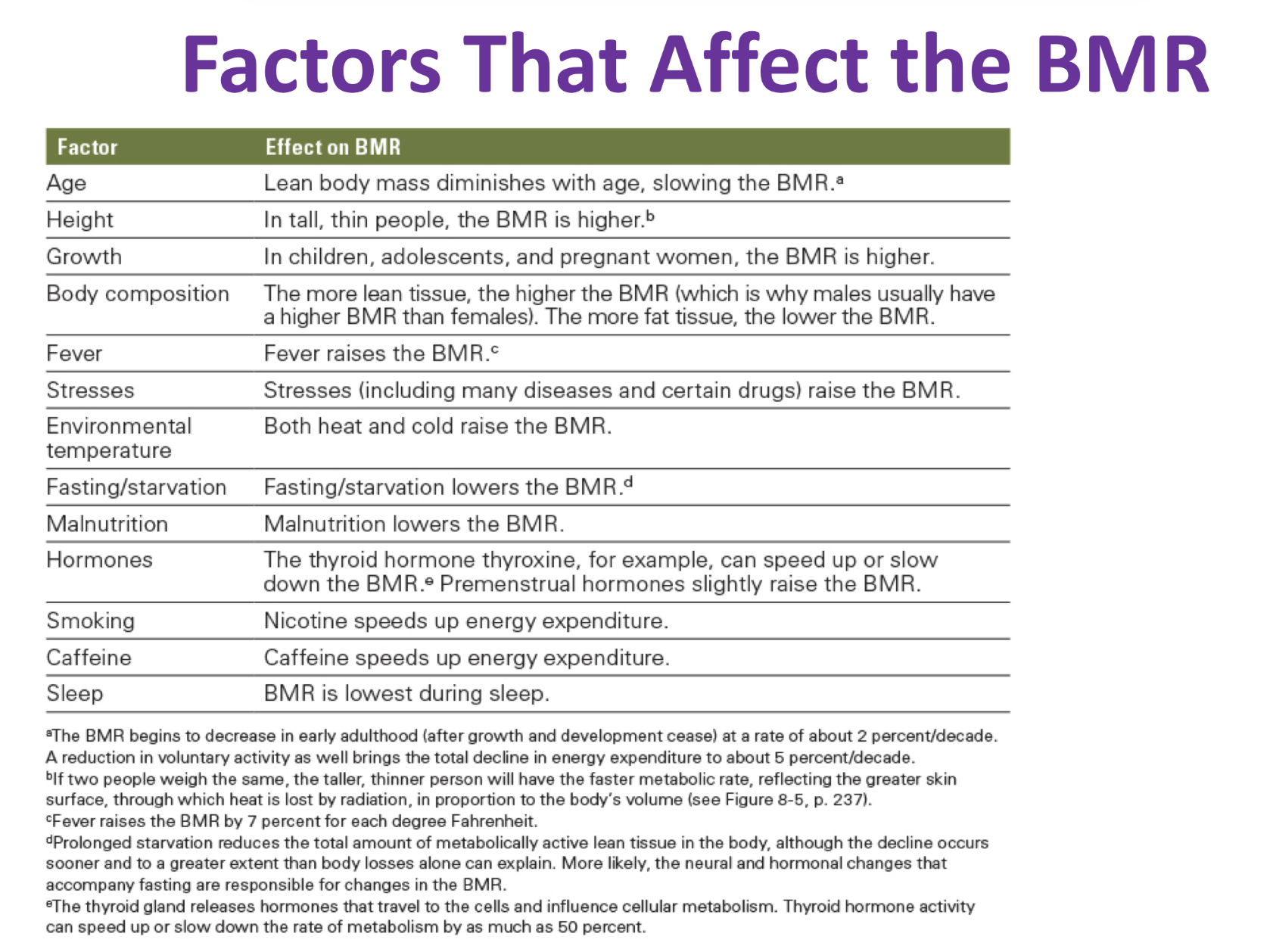
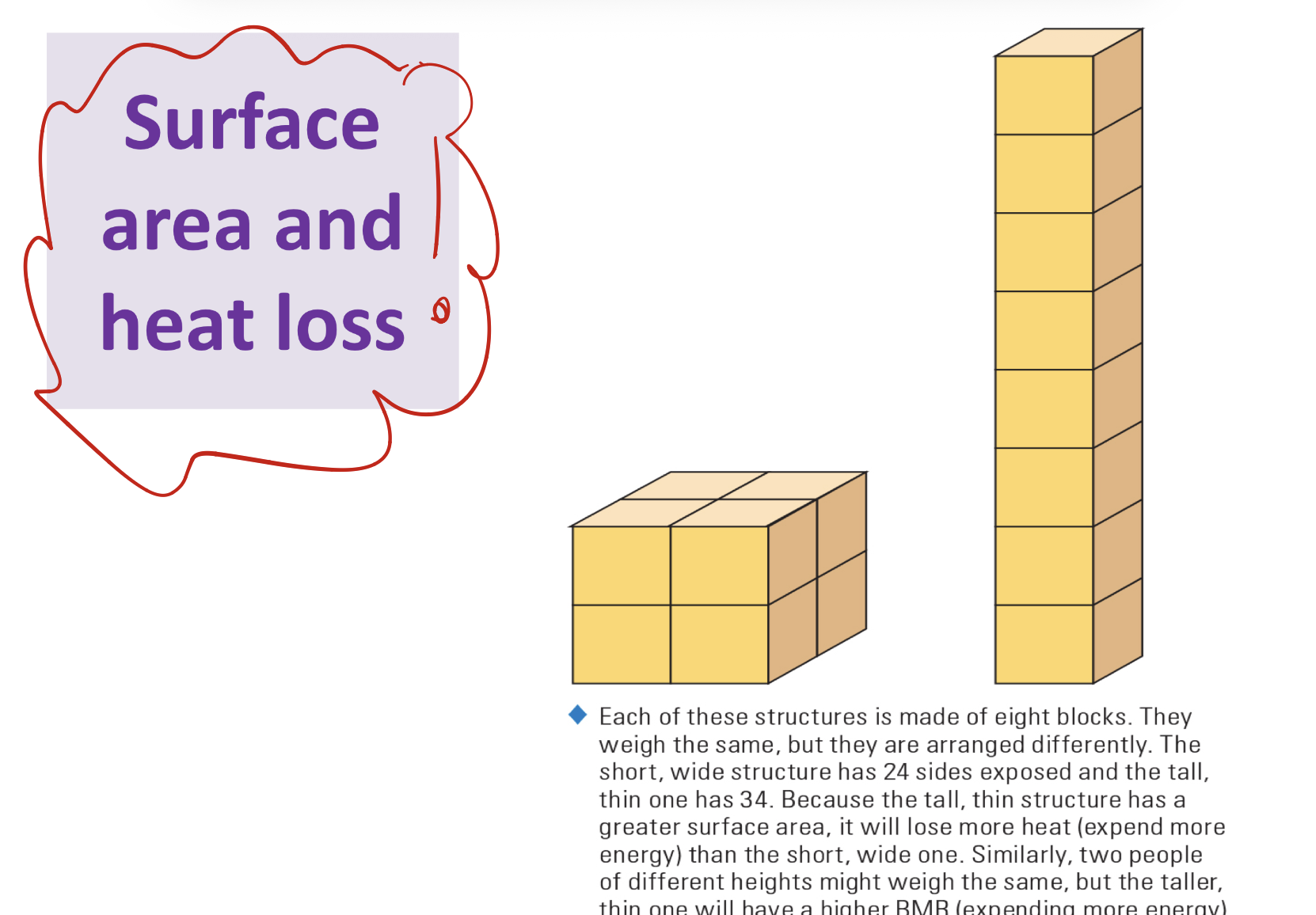
between 2 people who weigh the same but diff heights, who has greater BMR and why?
what is the most variable and readily
influenced component of weigh gain/loss
= physical activity —>Voluntary muscle movement
• Weight, lean muscle, and the type of
activity impact the amount of energy
needed.
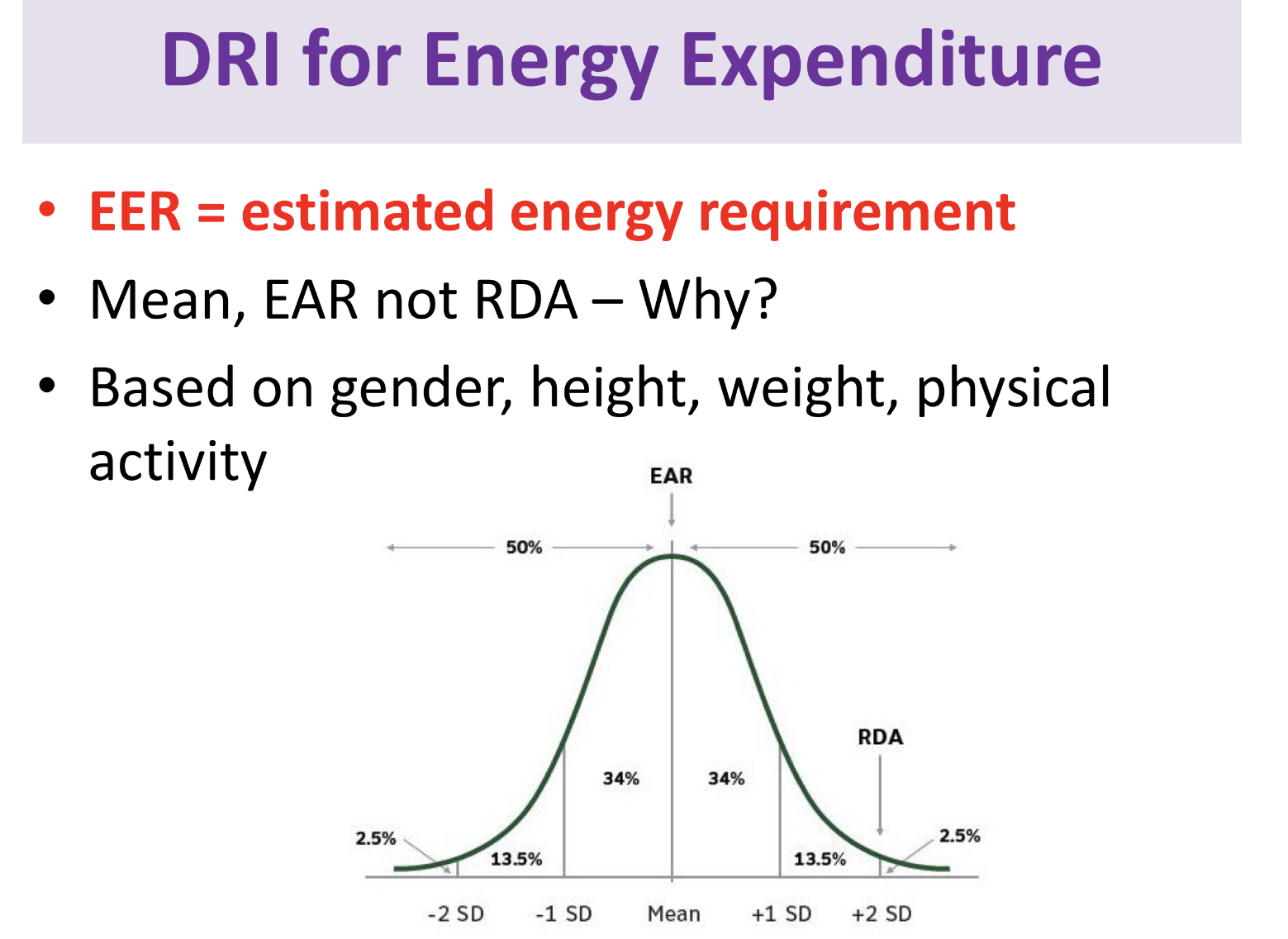
why is there EAR, not RDA for DRI of energy expenditure? how much of an error could there be?
• National Academies Press, Institute of Medicine
• Dietary Reference Intakes (DRIs)
– Accounts for age, gender, weight, height, and
physical activity
– There may be as much as a 20% error or more,
but typically we expect about a 10% error:
• For most people , the actual energy
requirement falls within these ranges:
– For men, EER ± 200 kcal
– For women, EER ± 160 kcal
– Less accurate for elderly individuals and various ethnic groups
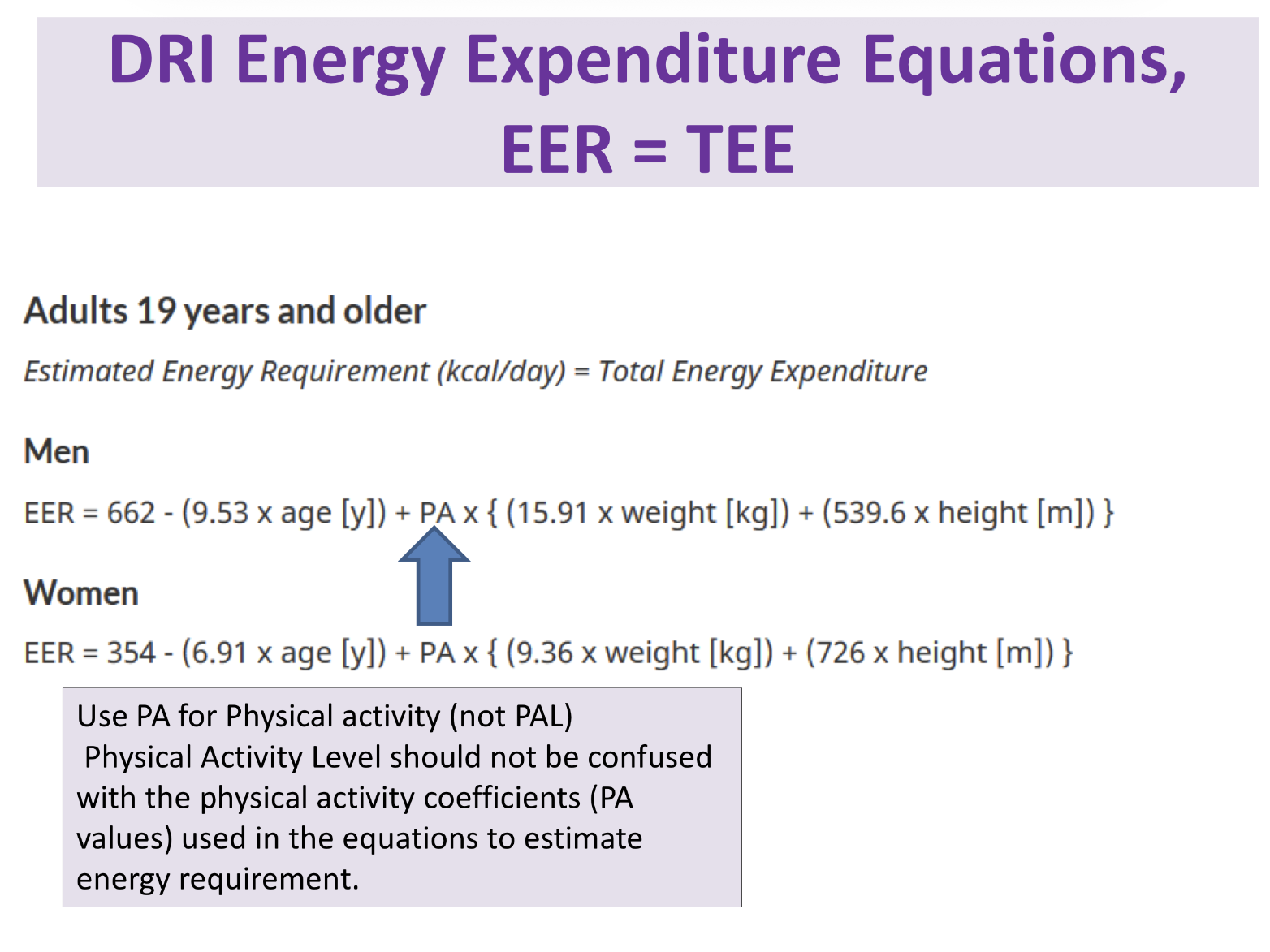
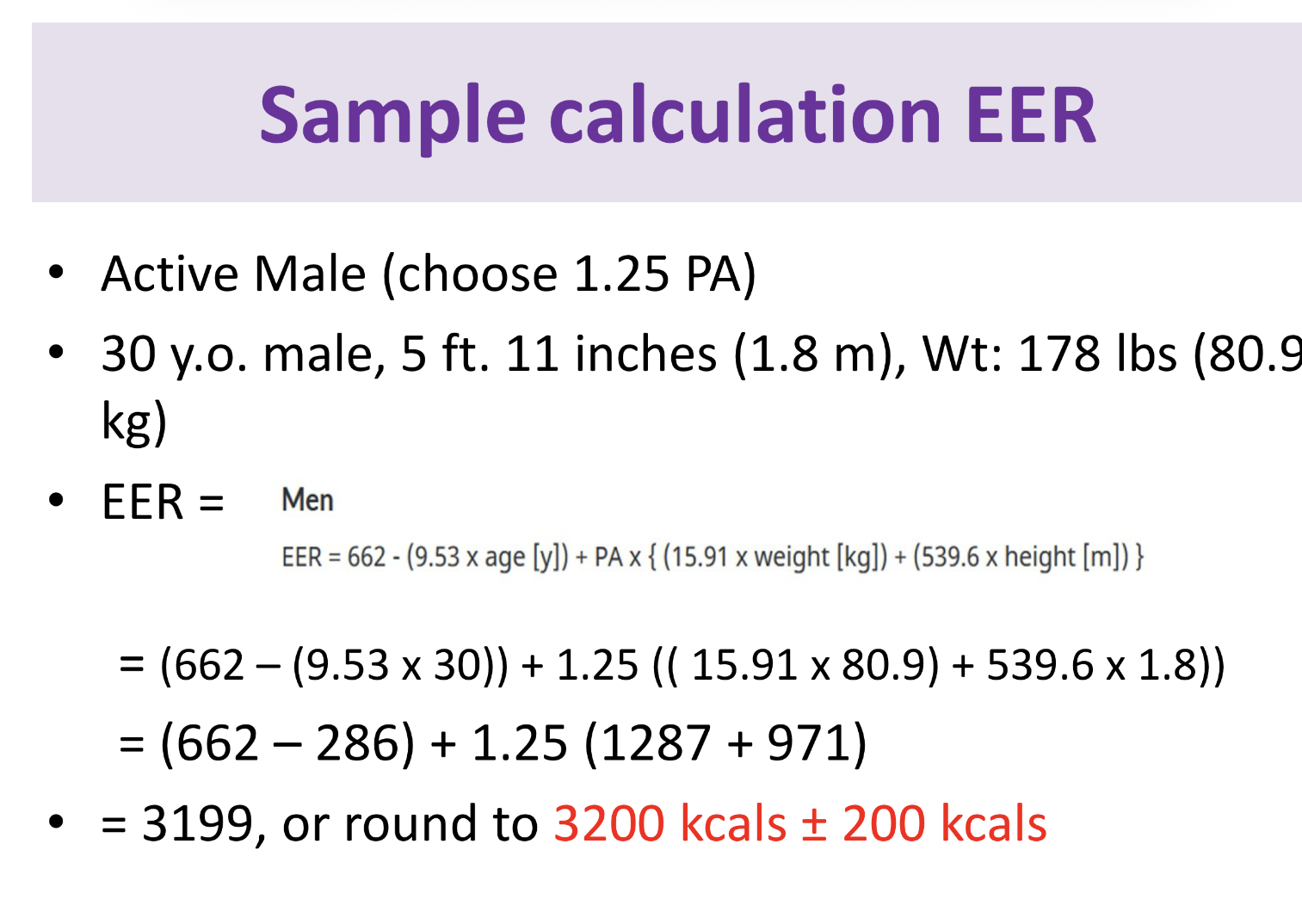
what is EER energy expenditure equations? what’s EER equal too?
estimated energy requirement EER= Total Energy Expenditure TEE
what % of Canadians are sedentary of low active?
80%
what are 4 PA categories -NOT PAL
sedentary
low active
active
very active
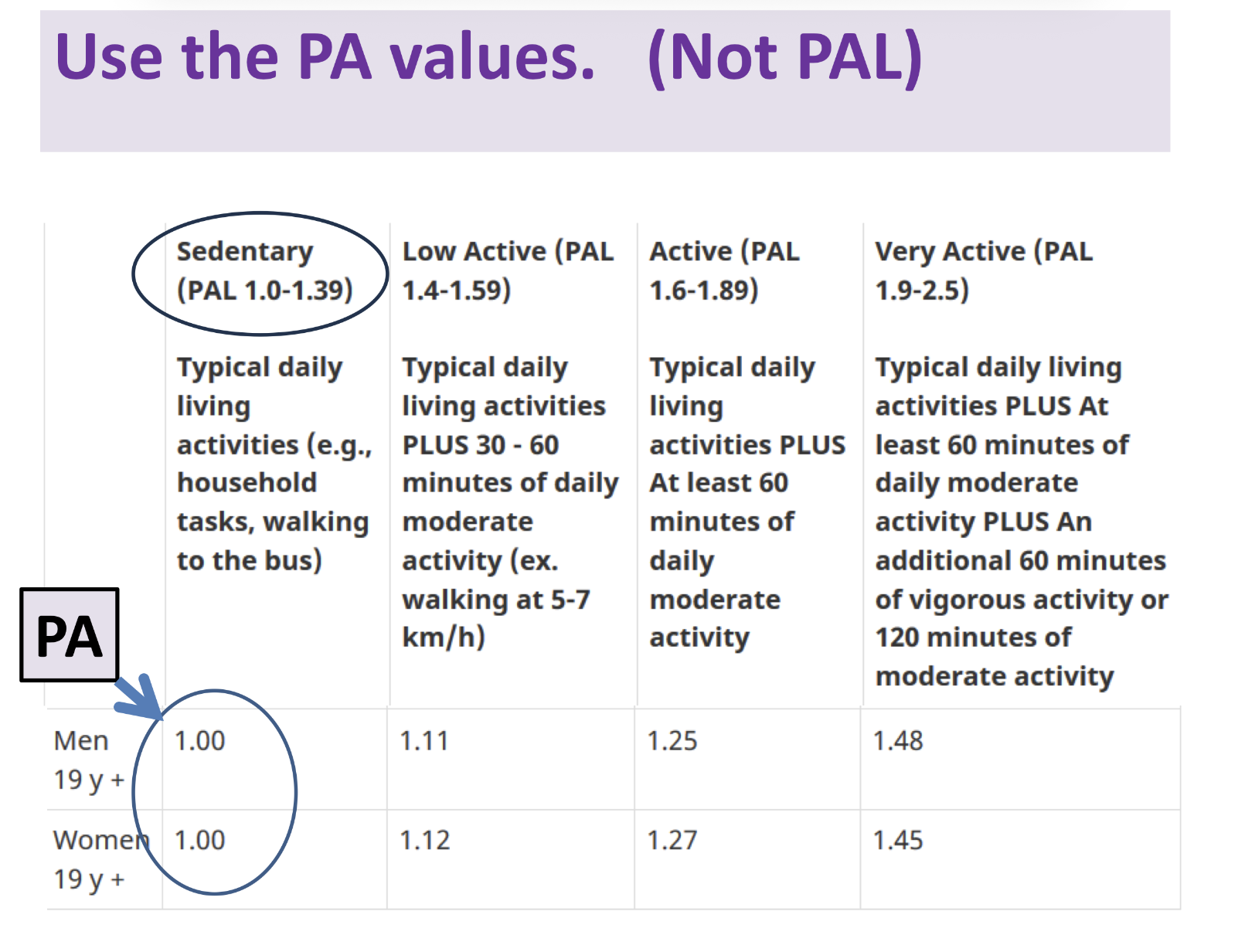
example sample EER calculation, what must you ‘add’ to compensate for differences?
in practice, why would we want to calculate EER?
• Its actually not that common to need to calculate
someone’s EER for most persons living in their
home and being reasonably
healthy/autonomous.
• Often we look more at whether the person is
gaining or losing weight, and finding out what
they are eating.
• Not everyone wants to or needs to count
kcalories. If someone does want to monitor their
caloric intake and compare the requirements,
there are a lot of apps that will do that.
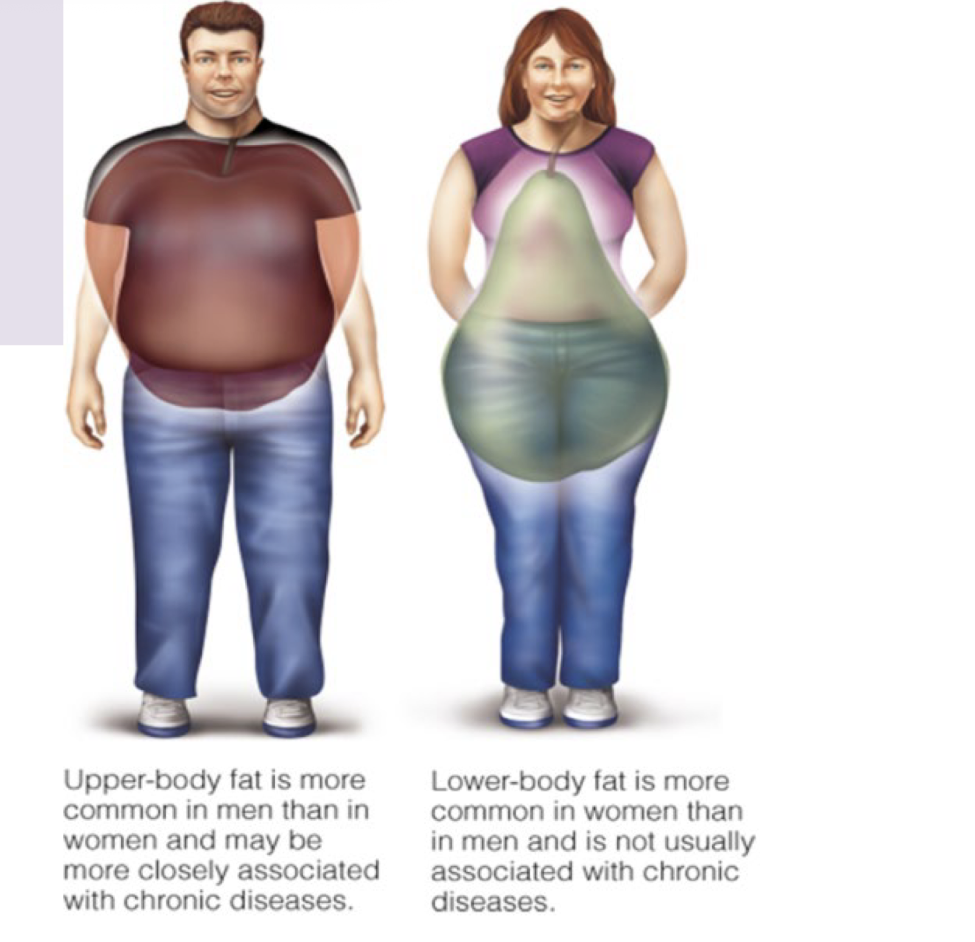
lower vs upper body fat contributions to chronic disease
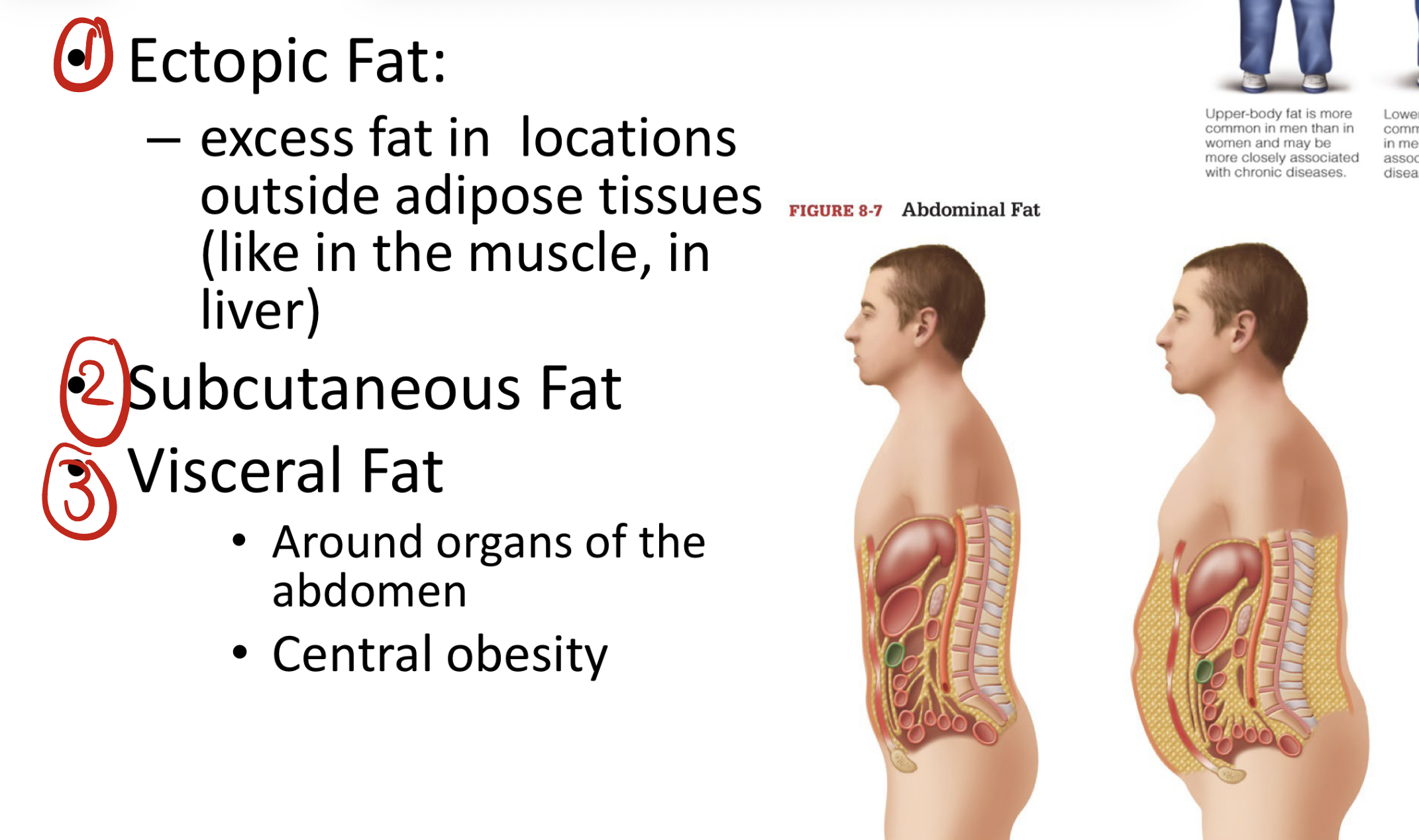
subcutaneous vs visceral vs ectopic fat health risk and location
Type | Location | Health Risk | Example |
|---|---|---|---|
Subcutaneous | Under the skin | Low | Fat on hips or thighs |
Visceral | Around organs | High | Belly fat around liver/intestines |
Ectopic | Inside organs/muscles | Very high | Fatty liver, fat in heart or muscle |
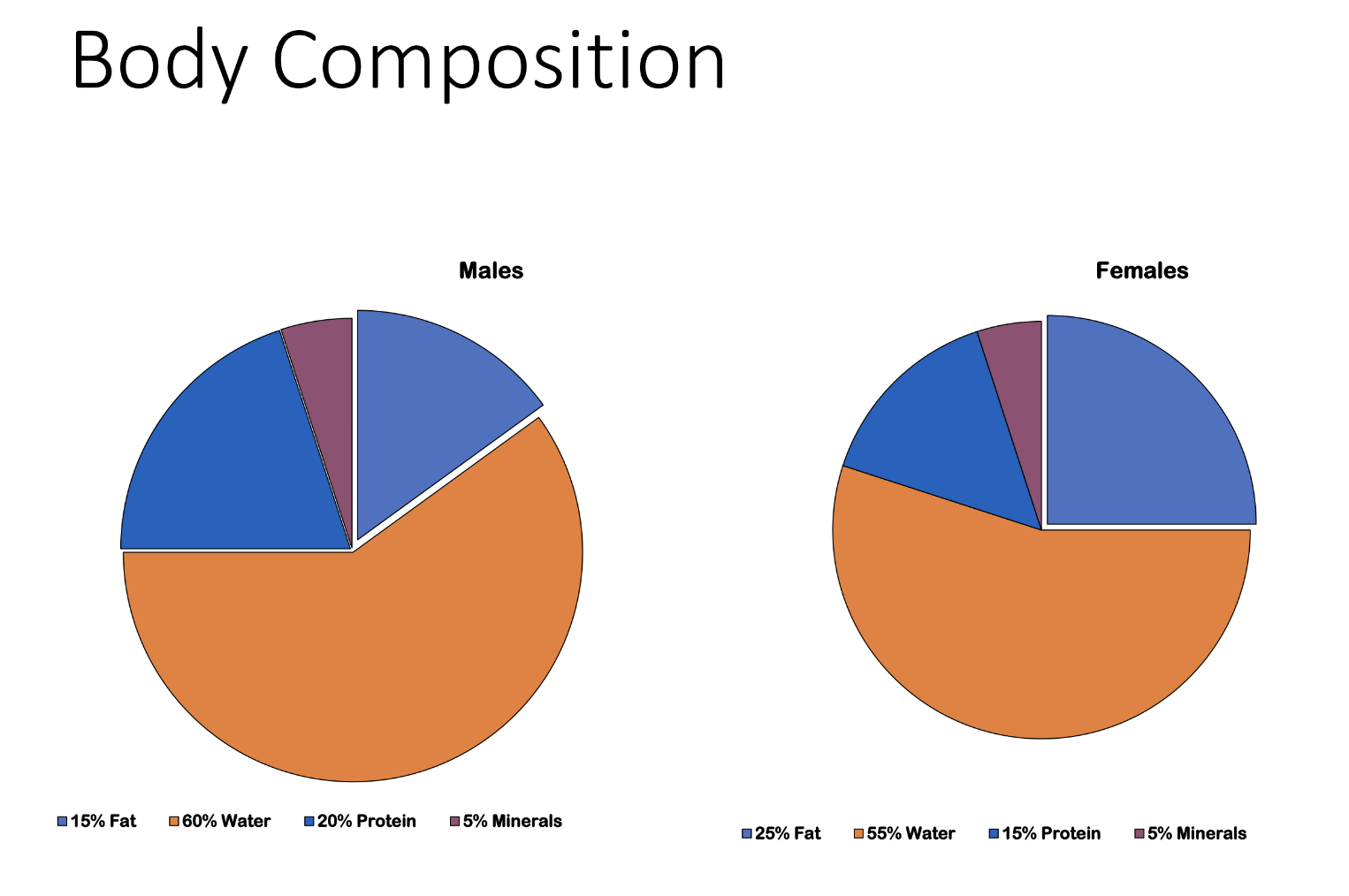
body composition differences in males vs females for average water, fat, protein, minerals
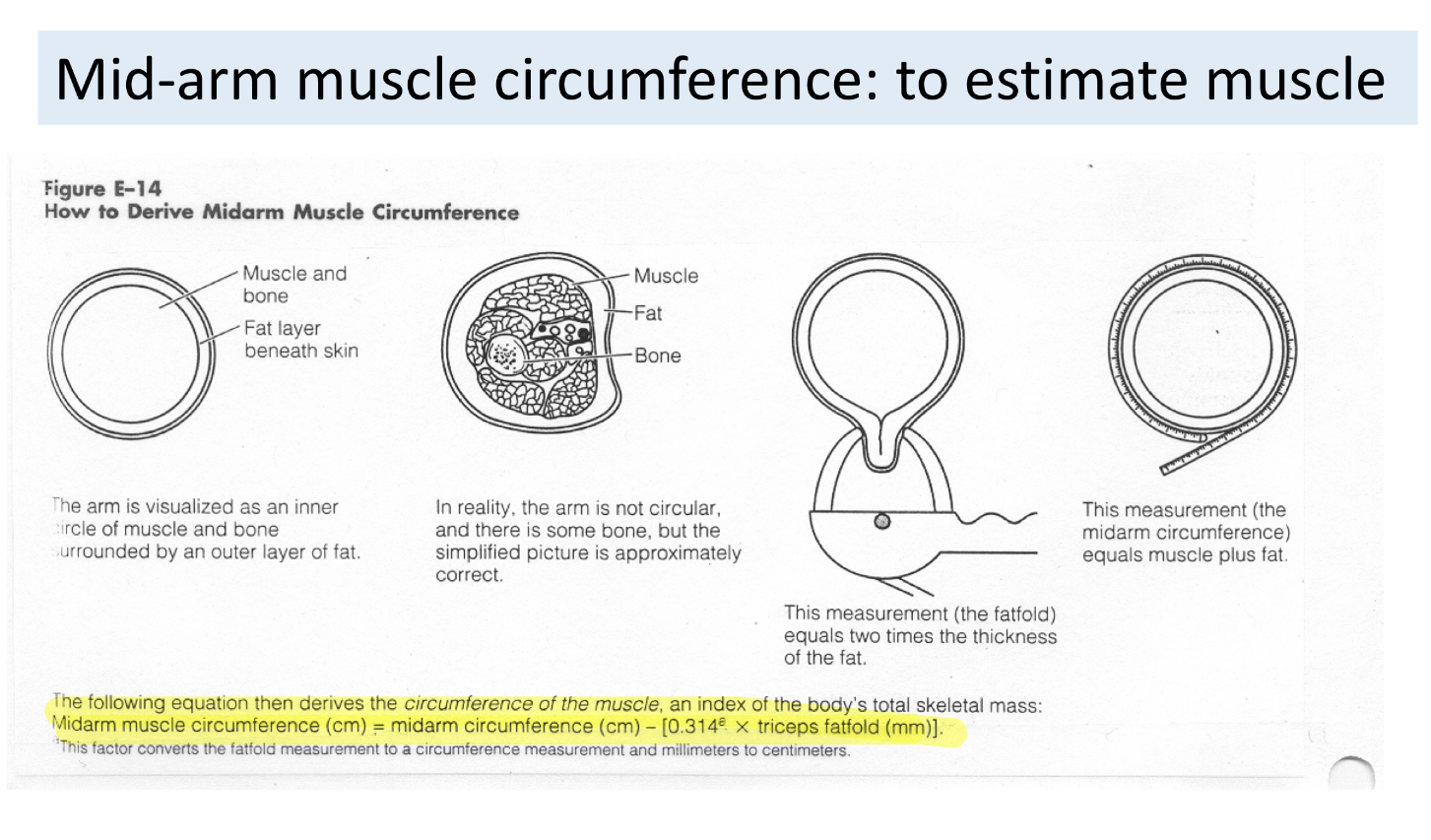
how is tricep skin fold thickness used ?
calculated by:
first finding the mid-upper arm circumference and the triceps skinfold thickness
then using a formula to subtract the fat layer from the total circumference, leaving the muscle and bone mass.
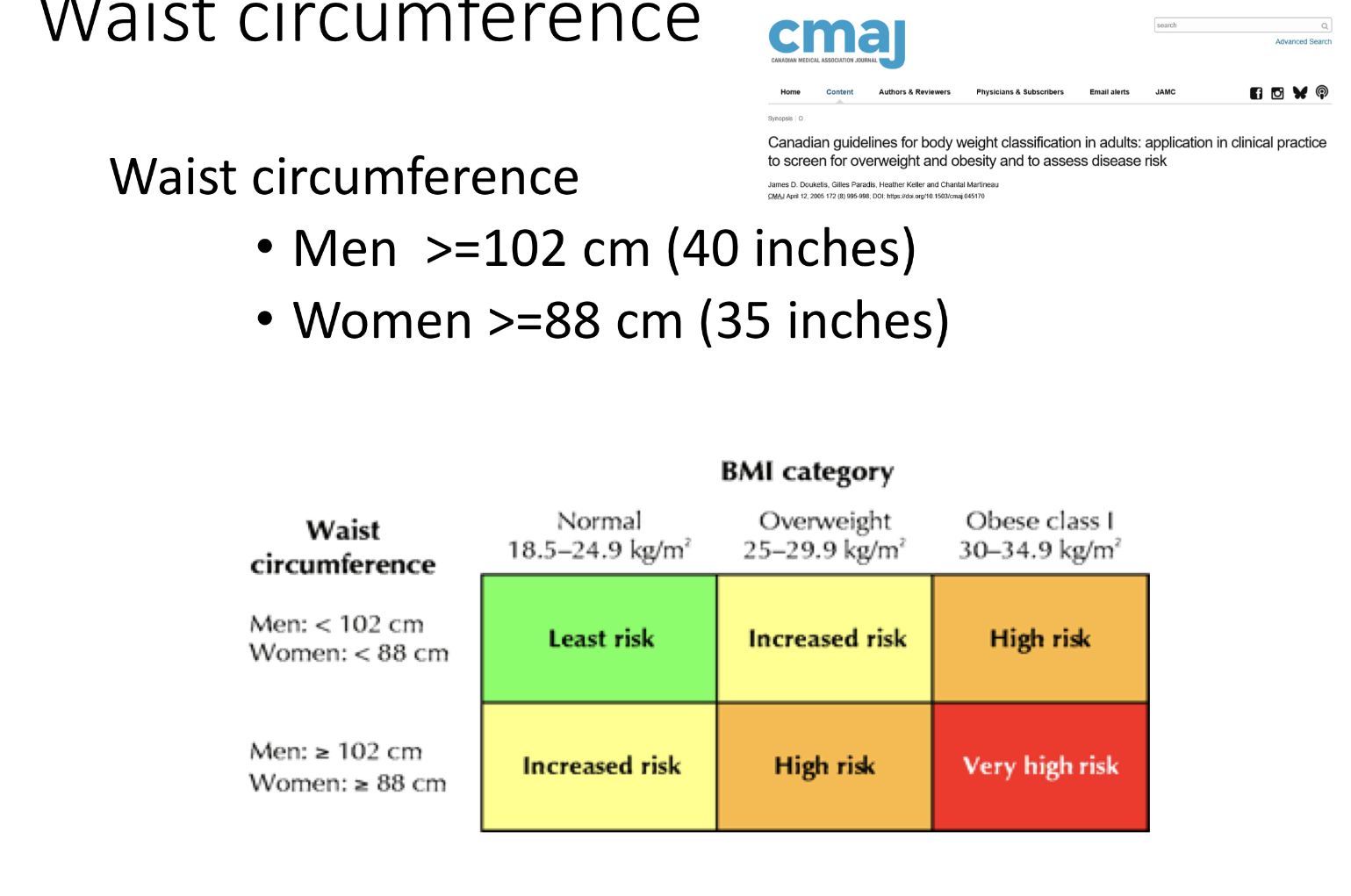
relationship between waist differences and BMI in terms of health risks for M and F, what are the standard #s
M= 102 cm-40icnhes
F= 88cm-35inches
what is bioelectrical impedance analysis?
measures BF by using low-current electrical current
bc electrolyte-containing fluids (which readily conduct a current) are found primarily in LEAN tissues, the LEANER the person, the LESS resistant to the current
usually used in math equation to estimate bf%
how does underwater weighing work?
When an object is placed in water,—>
displaces a volume of water equal to its
own volume. The upward buoyant
force from the water is equal to the
weight of this displaced water.
NOTE: Fat is less dense than
muscle and bone, Your body’s density can be determined by how much water you displace.
Since fat floats (less dense) and muscle/bone sink (more dense), your overall density reflects your body composition.
what is plethysmography?
Air displacement plethysmography estimates body composition by having a person sit inside a chamber while computerized sensors determine the amount of air displaced by the person's body.
how does DEXA scans work? who doe sit NOT work for
Dual energy X-ray absorptiometry (DEXA) uses two low-dose X-rays that differentiate among fat-free soft tissue (lean body mass), fat tissue, and bone tissue, providing a precise
measurement of total fat and its distribution
EXCLUSION: world well except extremely obese subjects.
what is BMI equation?
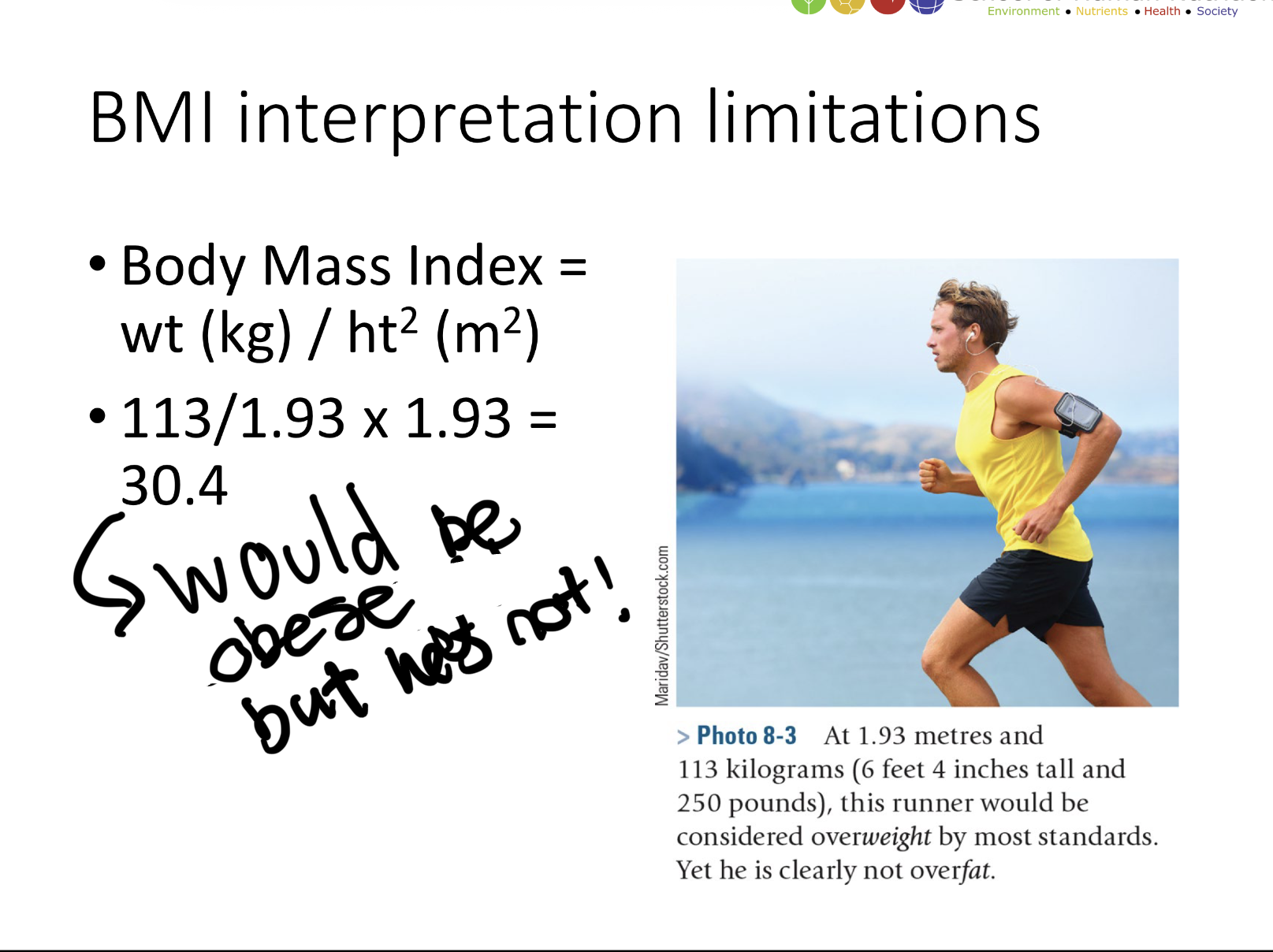
BMI= (weight -kg)/ (height m)²
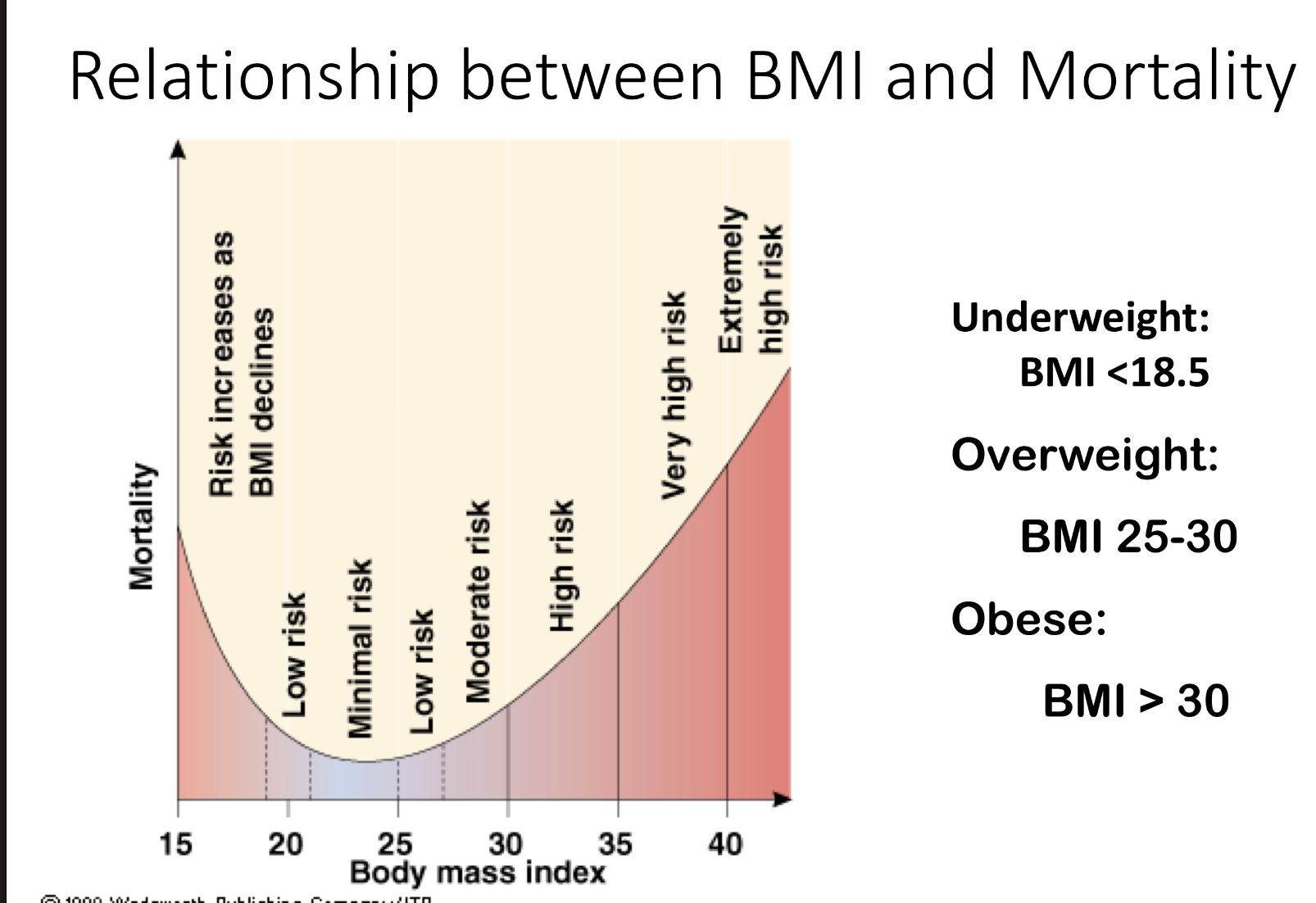
what are 4 Classes of BMI?
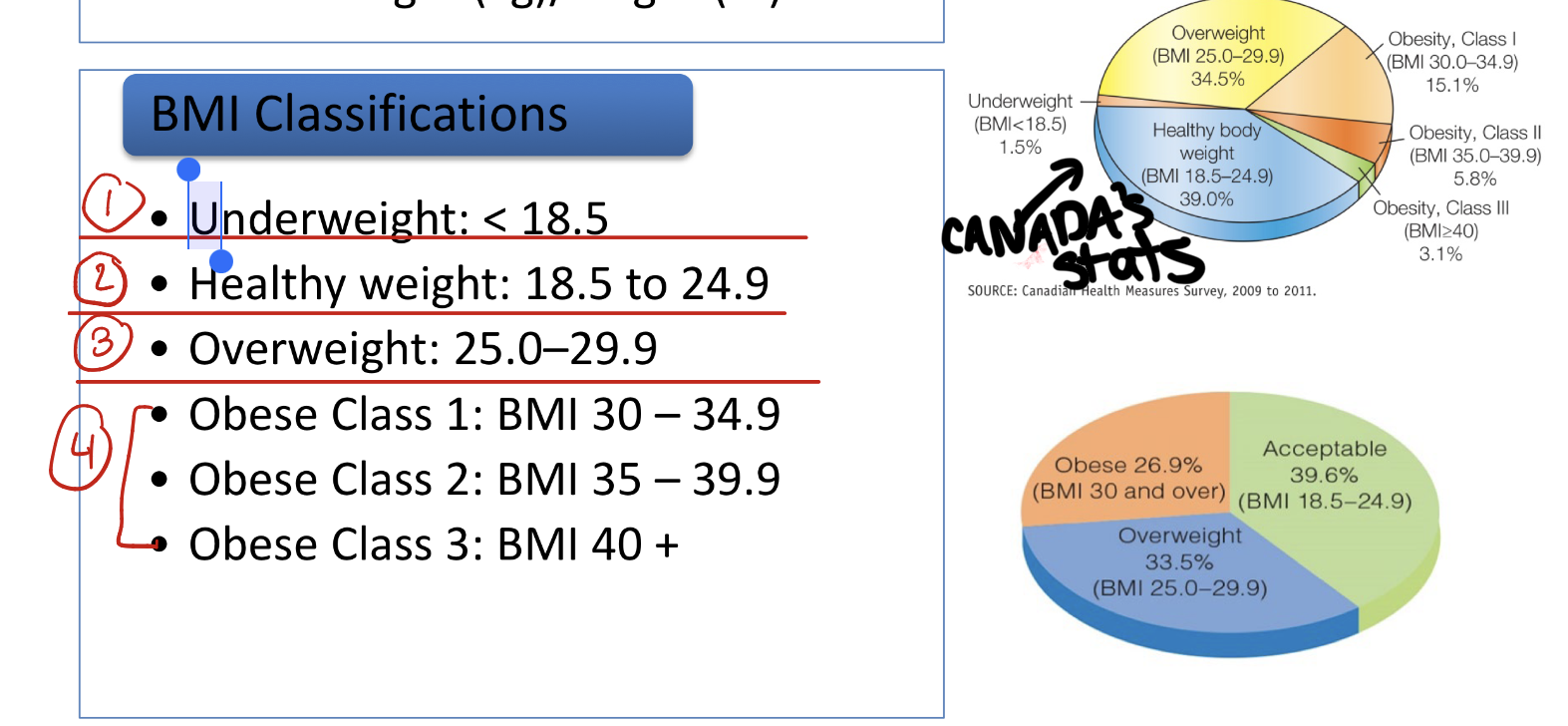
relationship between BMI and mortality
what are normal ‘healthy’ BF% in men VS women
Male= 12-20%
Female= 20-30%
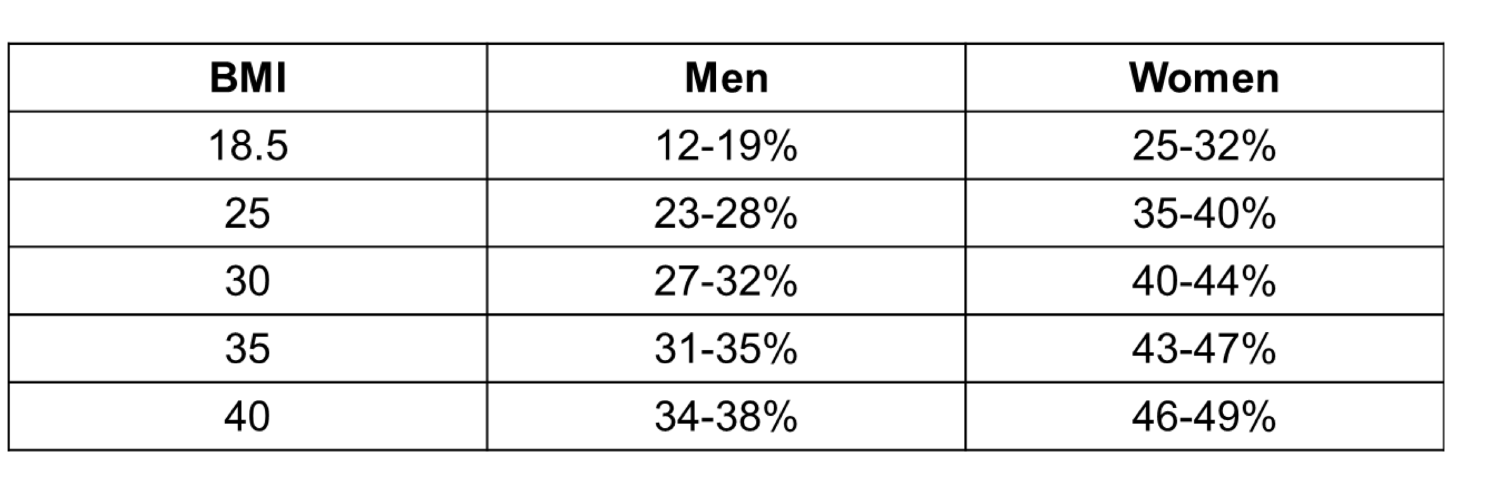
What are avg. BF% @ various BMI in Male vs Female, what’s one thing to note of a % difference @ same BMI?
NOTE: In general, women have roughly 12%
more body fat than men at the same BMI
what happens to BMI ranges for ppl over 65 yrs old
Range begins higher (above BMI 18.5) and extends
into overweight
• Many references suggest that a higher range is
protective over the age of 65 (example: BMI of 22 to 27), and 27 woulnt’t be considered overweight in this case
• Frail elderly lacks reserve during time of illness.
how is healthy body weight defines?
defined as a weigh that does NOT increase risk of disease
proportional of muscle lean body mass
What are some limitations of BMI? (4)
Does not distinguish between different body composition (lean vs overfat, and location of fat in upper/lower body)
Focusses on weight (weight could be affected by water/fluid retention)
Does not account for Age, Ethnicity differences
Does not consider level of health risk that increases with increased number of risk factors (smoking, family history,…)
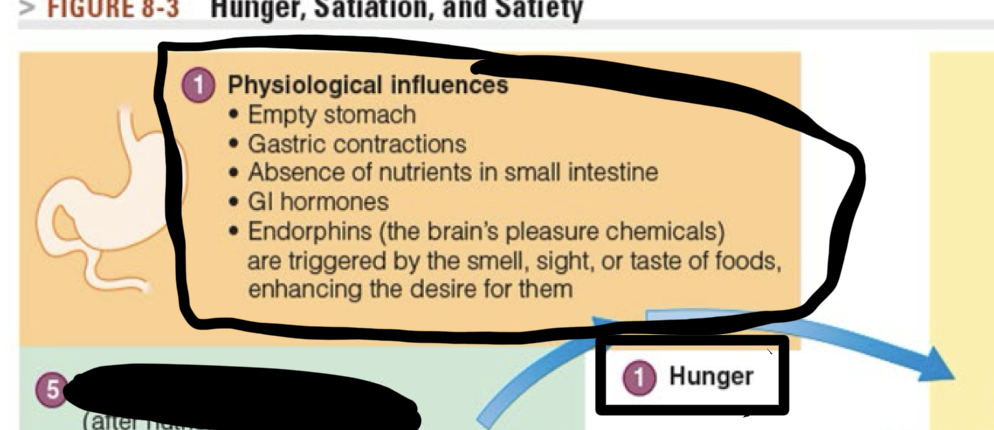
what type of influences are linked to HUNGER?
What influences are linked to seeking food and starting a meal?
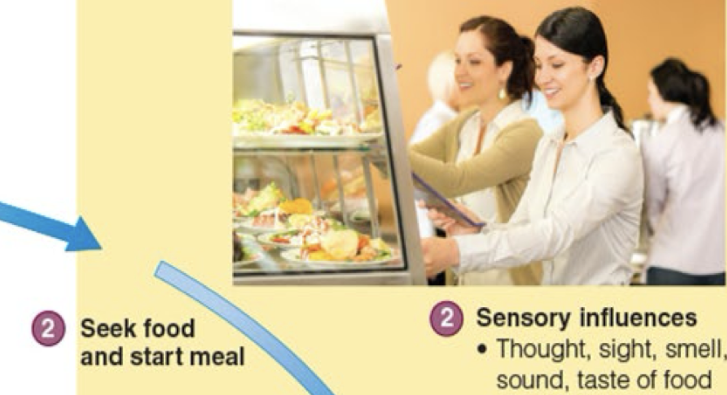
what influences are linked to ‘keeping eating’
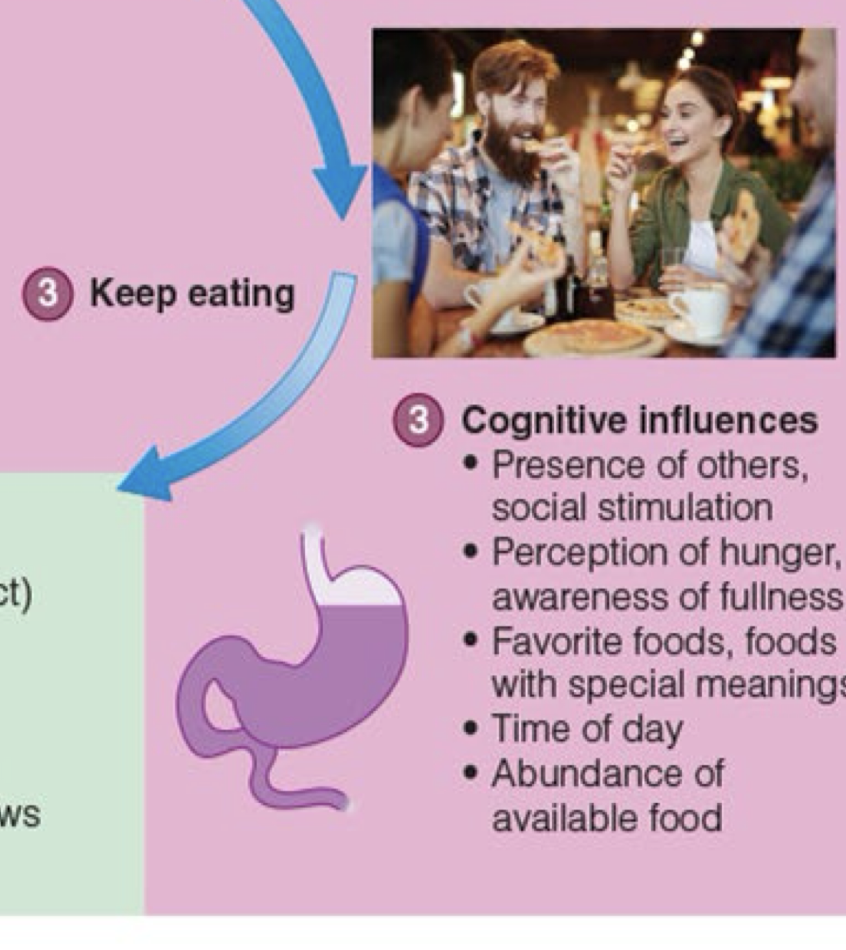
what influences are linked to “satiation and ending meal’
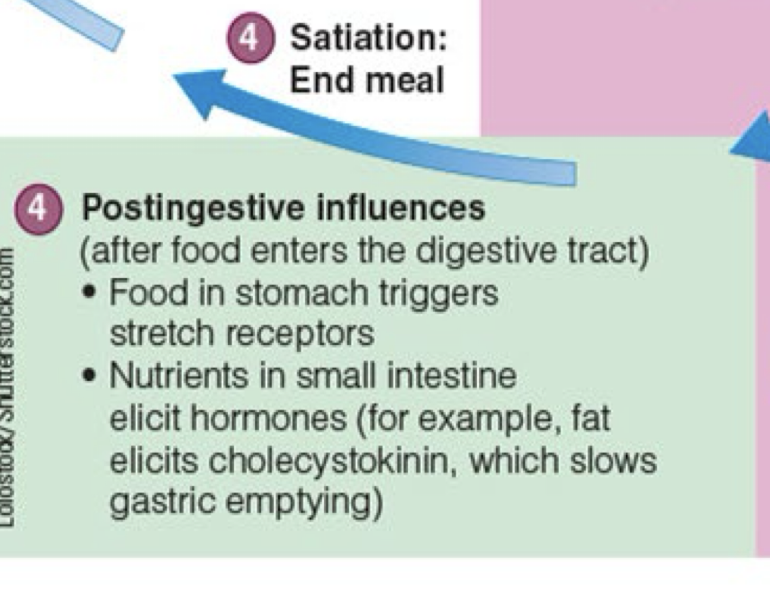
what influences are linked to ‘satiety: several hours later’
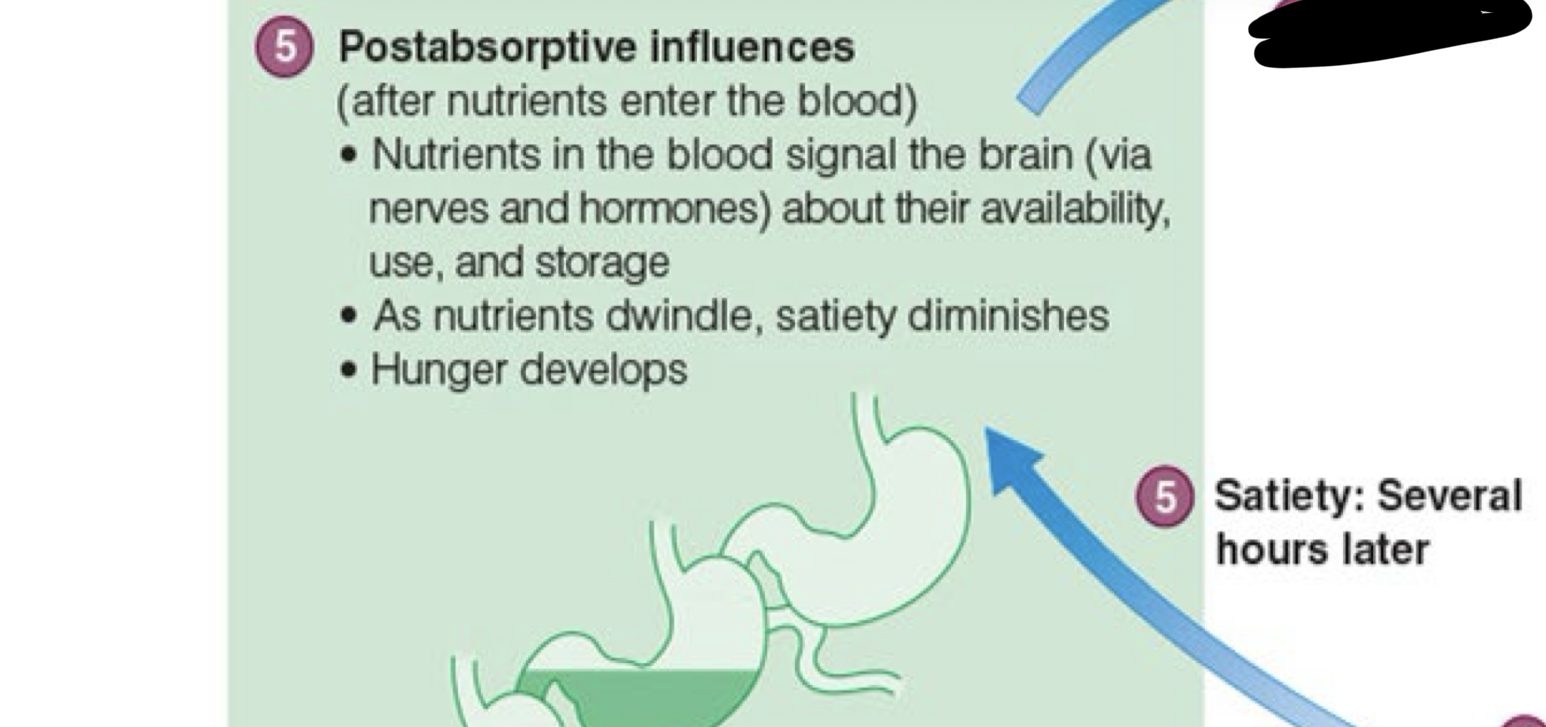
what is the difference between satiation and satiety ?
Satiation= the feeling of fullness that stops
you from eating during a meal,
satiety= the feeling of fullness that prevents you from feeling hungry between meals.
• satiation is what ends a single meal,
and satiety is what keeps you full afterward
and before the next meal.
1) How does fat VS protein differ in satiating-ness?
2)how do they differ during the meal VS once in intestine?
3) what hormone is released by fat entering intestine and what does it do?
4) what other foods give sense of fullness?
Both fat and/or protein in a meal results in slowed stomach
emptying and a feeling of fullness.
Research has identified that protein is the most satiating of the macronutrients. Fat has a weaker effect on satiation during the meal (compared to protein); Fat produces strong satiety signals once it enters the intestine.
Fat triggers the release of cholecystokinin, a hormone that signals satiety and inhibits food intake.
Other foods that give sense of fullness:
– High in dietary fibre
– High in water
– Puffed up with air, lots of volume, eg. popcorn or carbonated drinks
what does appetite, vs hunger vs satiation vs satiety CAUSE/INDUCE?
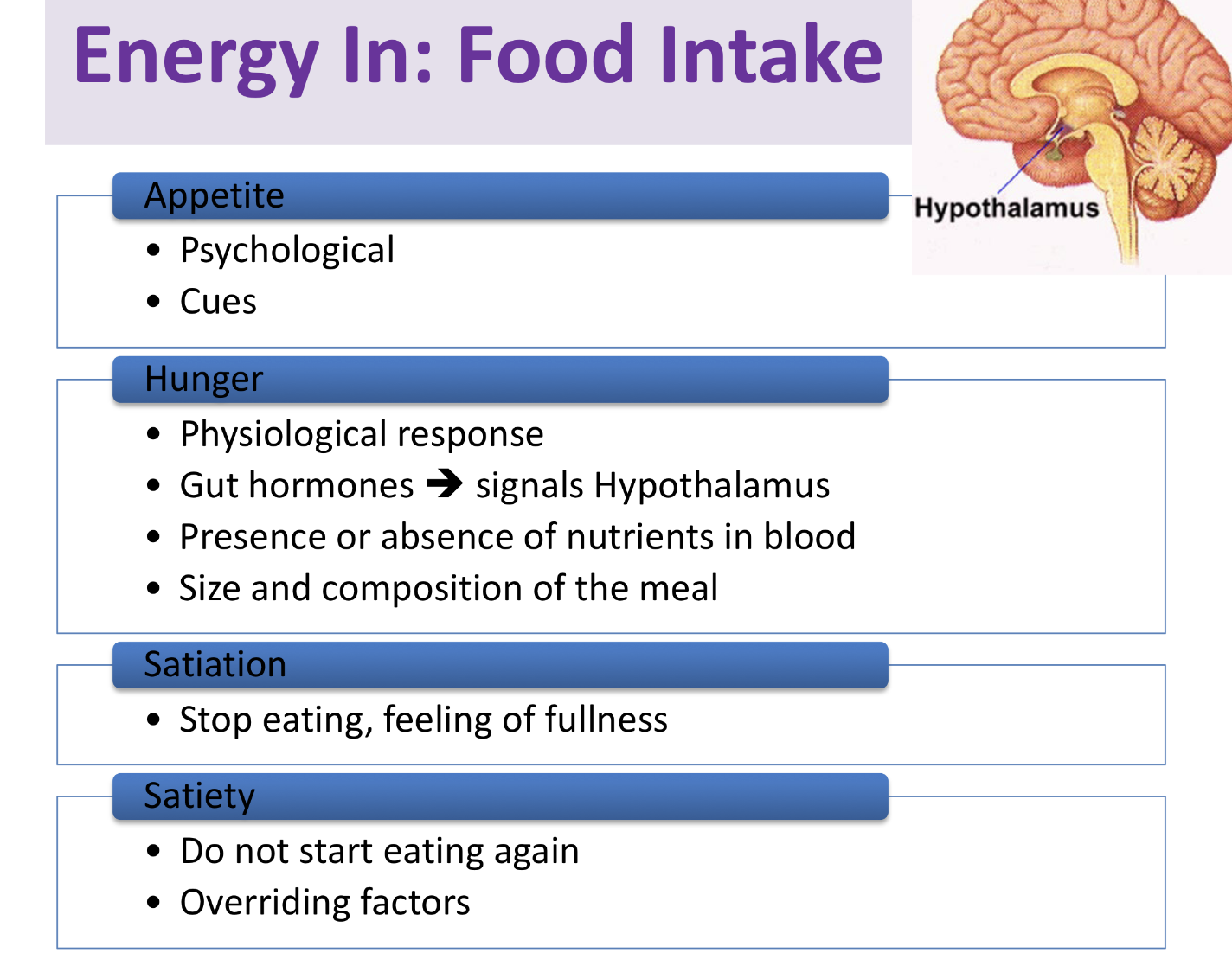
what are some external cues that could lead to overeating? (3) , what are some environmental factors?
EXTERNAL CUES:
available foods
human sensations and emotions
stress
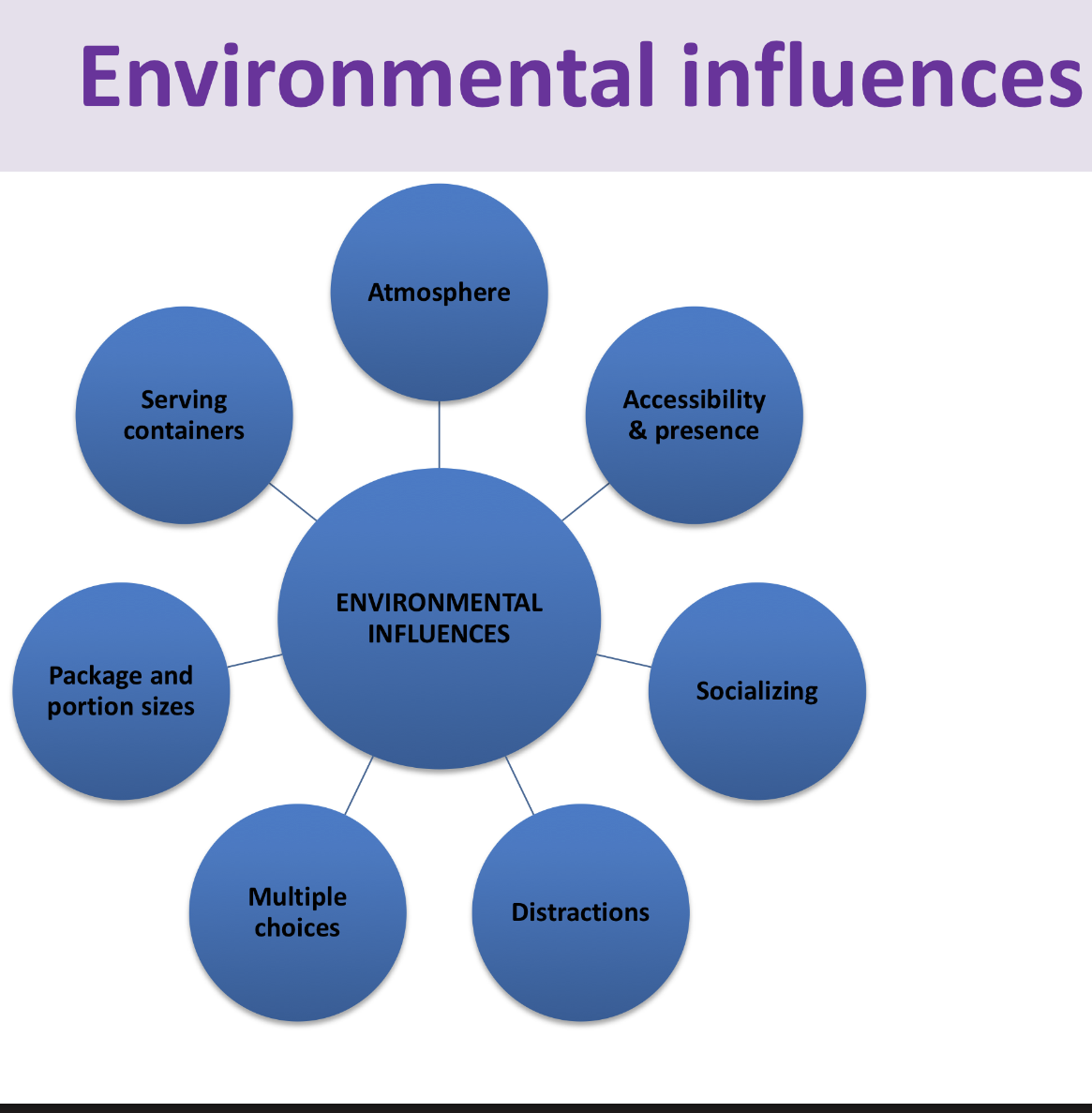
what is adipose tissue? what types of cells is is composed of, what doe these cells produce?
Adipose tissue = body’s fat-storing connective tissue.
It’s made up mostly of fat cells (adipocytes) that store energy in the form of triglycerides.
- not just storage — it’s also a metabolically active organ that helps regulate energy balance, hormones, and inflammation.
composed of cells named adipocytes —> that produce cytokines named
adipokines.
adipokines vs cytokine? what do adipokines act like? what is best know adipokines?
cytokine =Small signaling proteins released by many cells
adipokies = type of cytokine secreted by adipose tissue
act like hormones to regulate
many body functions, including metabolism,
appetite, and inflammation.
• Leptin was discovered in 1994 and is one of
the best known adipokines.
what are adipokines roles in metabolism, appetite,inflamations, immune response, other?
• Metabolism: Adipokines play a key role in regulating glucose and fat metabolism.
• Appetite: They help control hunger and food intake.
• Inflammation: They can be pro-inflammatory or anti-inflammatory, and the balance between them is critical for health. In obesity, there is often a shift toward a more pro-inflammatory state.
• Immune response: They have a significant impact on immune function.
• Other roles: They also influence blood pressure, blood clotting (hemostasis), and blood vessel function (endothelial function).
what are PRO vs ANTI inflammatory adipokins?
• Pro-inflammatory adipokines: Leptin, IL-6, and TNF-alpha
• Anti-inflammatory: Adiponectin, Omentin
where is leptin produces, what is it linked with? what does it do to appetite?
– Mainly produced made by adipose tissue, AND smaller amount produced in the stomach
– Linked with appetite control and body fatness
– Suppresses appetite and food intake between meals
how does negative feedback loop work for leptin? what happens during high vs low leptin levels ? what about for obese people?
• A gain in body fatness stimulates leptin production
• A loss in body fatness suppresses leptin production
High levels of leptin tell your brain that you have plenty of fat stored, acts on the hypothalamus to decrease food intake, body weight and increase energy expenditure
low levels tell your brain that fat stores are low and that you need to eat.
OBESITY: Persons living with obesity are not deficient in leptin; they have plenty, but it is thought that leptin sensitivity decreases so that the negative feedback loop does not respond as well.
what happens when you have to many adipokines?
Overabundance of certain adipokines (like
leptin) due to excess adipose tissue can lead
to a chronic low-grade inflammation,
contributing to potential development of
metabolic syndrome, type 2 diabetes,
cardiovascular disease, and atherosclerosis.
what is metabolic syndrome classifies with?
A cluster of at least 3 of the following:
– High blood pressure
– High blood glucose
– High blood triglycerides
– Low HDL cholesterol
– High waist circumference
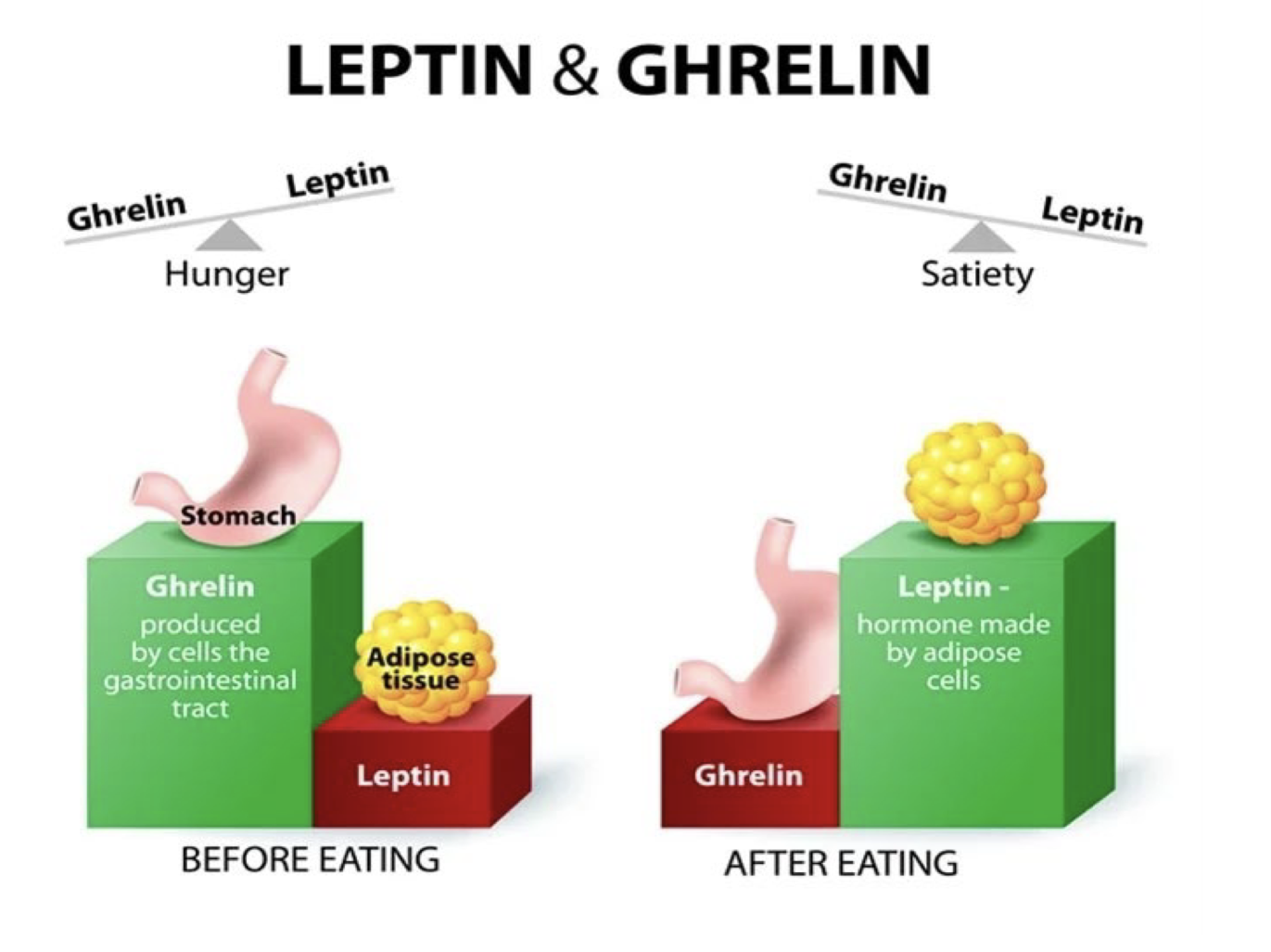
what is ghrelin?produces by what? what does it do? when is it high in xxx?
Ghrelin is both a peptide hormone
produced by stomach and an adipokine because it is also produced by adipose (fat) tissue.
• It is mainly produced by the stomach.
• Often called a "hunger hormone" because it
increases food intake.
• Blood levels of ghrelin are highest before meals when hungry, returning to lower levels after
mealtimes.
relationship between leptin and ghrelin before vs after eating, hoes does sleep affect them?
Lack of sleep increases ghrelin and decreases
leptin.
• Link between lack of sleep and increased food
intake and weight gain.
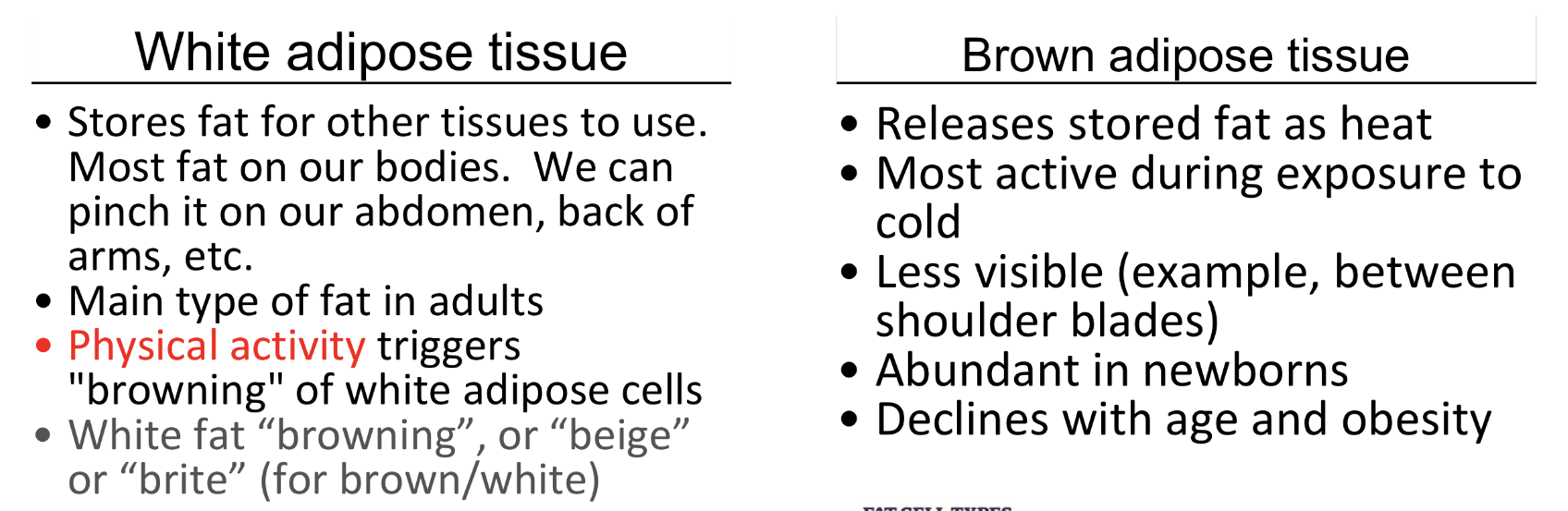
white vs brown adipose tissue, what are main uses for each? what do hibernating animals have more of and why? what do obese ppl tend to have less of
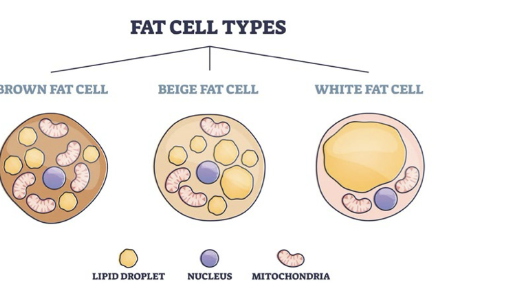
Humans have mostly white fat. White fat stores are used for energy.
• Brown fat is brownish due to more mitochondria/iron. Brown fat used to defend against cold by producing heat (before we
start to shiver).
• Animals that hibernate have a large proportion of brown fat to stay warm through winter.
• Persons living with obesity tend to have less brown fat activity, they have plenty of fat to stay warm
explain white vs brown fat differences in stores, , when is it ‘active’ , age groups its present in?
what are some dietary factors that would promote brown fat activity/browning of white fat?
Dietary factors that promote brown fat activity
or the “browning” of white fat are considered to be:
• omega-3 fatty acids, and vitamin A
•some research suggests that pre- and probiotics that improve the GI microbiota
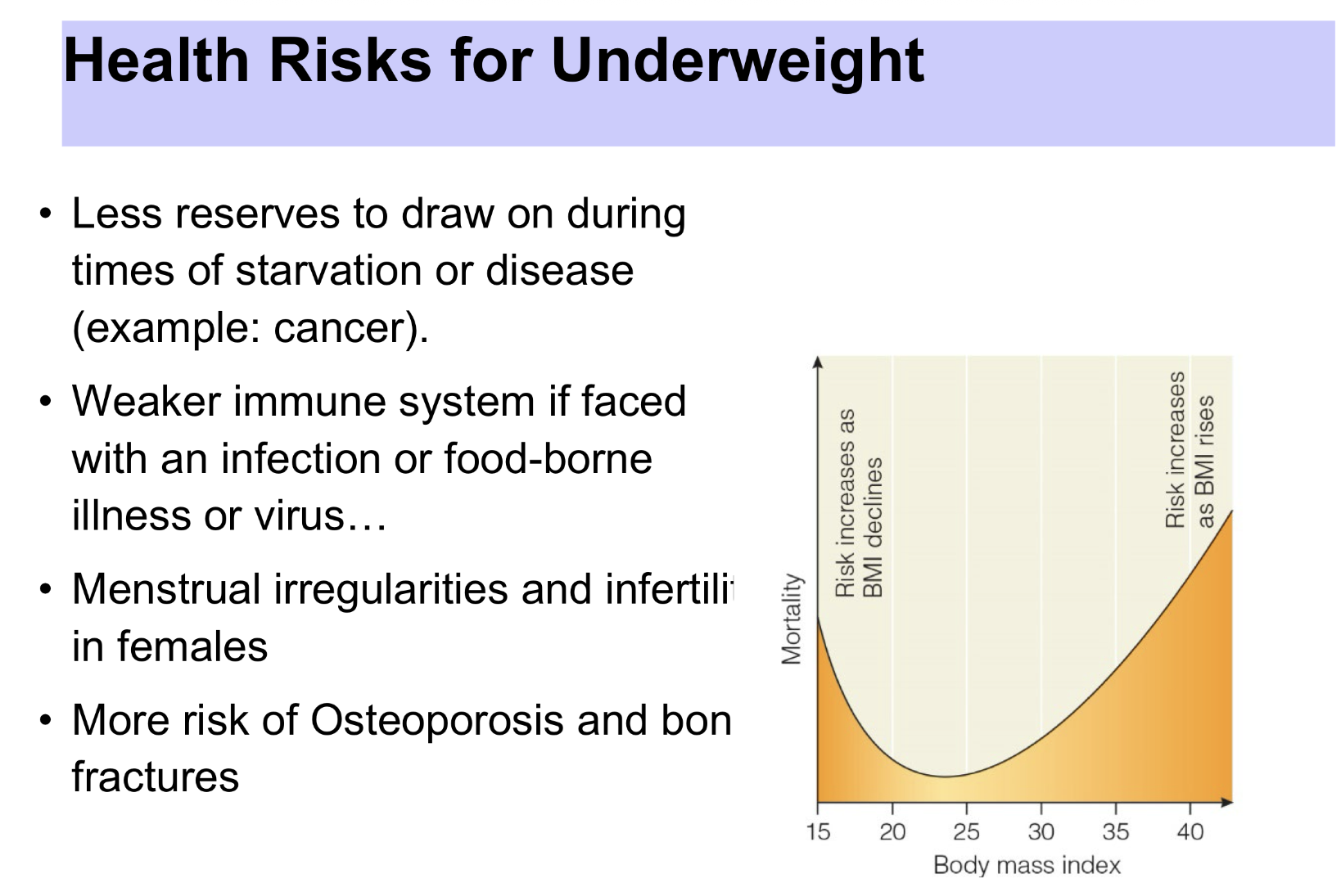
what are sone health risk associated with being underweight?