Nonpolar amino acids and all characteristics
 Call Kai
 Learn
Learn Practice Test
 Spaced Repetition
 Match
Match Flashcards
 Knowt Play
1/17

There's no tags or description
Looks like no tags are added yet.
Name | Mastery | Learn | Test | Matching | Spaced | Call with Kai | Chat |
|---|
No analytics yet
Send a link to your students to track their progress
18 Terms
nonpolar, aliphatic
Methionine Valine Alanine Glycine Leucine Isoleucine Proline
aromatic
Phenylalanine, Tyrosine, Tryptophan
polar, uncharged
Serine, Threonine, Cysteine, Asparagine, Glutamine
positively charged
Lysine, Histidine, Arginine
negatively charged
aspartate, Glutamate
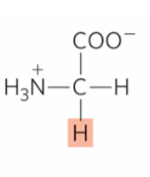
Glycine, Gly, G
characteristic: no optical activity, symmetrical
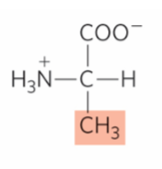
Alanine, Ala, A
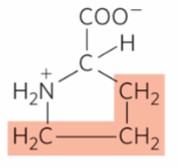
Proline, Pro, P
characteristics: only cyclic structure, 2nd amine
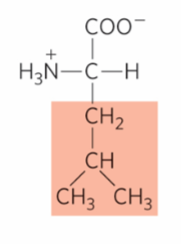
Leucine, Leu, L
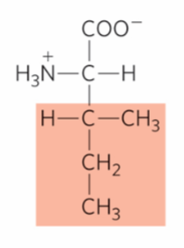
Isoleucine, Ile, I
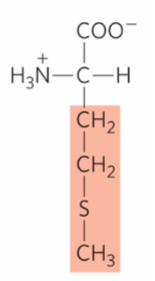
Methionine, Met, M
Characteristics of Nonpolar, aliphatic R groups
The hydrophobic effect stabilizes protein structure
• These amino acids are found clustered in the internal portions of proteins
Characteristics of Aromatic R Groups
absorb UV light at 270 – 280 nm
Characteristic of Polar, Uncharged R Groups
Polar R groups make H-bonds with water
Characteristics of Cysteine/Cystine
readily oxidized to form a disulfide bond
with another cysteine. The covalently linked amino
acids = cystine. This bond is hydrophobic
Characteristics of Positively Charged R Groups
basic amino acids (remove H+ from
solution)
Characteristics of Negatively Charged R Groups
acidic (donate H+ ions to
solution)
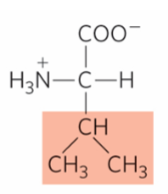
Valine, Val, V