Comp Phys: Fluxes
0.0(0)
Studied by 3 people Call Kai
 Learn
Learn Practice Test
 Spaced Repetition
 Match
Match Flashcards
 Knowt Play
Card Sorting
1/30

Earn XP
Last updated 4:44 AM on 12/14/22
Name | Mastery | Learn | Test | Matching | Spaced | Call with Kai | Chat |
|---|
No analytics yet
Send a link to your students to track their progress
31 Terms
1
New cards
Reading
Read Chapter 12. Pages 312-319 examine the role of ions (Third Ed. 301-308), gradients and the role of transport and diffusion for generating electrochemical potentials. Pages 320-326 explore action potentials and role of ionic flow (Third Ed. 309-313). Finally, pages 330-335 focus on the propagation of action potentials (Third Ed. 320-324).
2
New cards
Group Activity 1
\
1) Last night I was preparing a soup stock with my daughter, and we \n started arguing if we should cut the meet in smaller or bigger pieces \n in order to make a flavorful soup in a reduced time. \n Use Fick's law to explain how would you cut the pieces in order to \n make a flavorful soup in a reduced time.
\
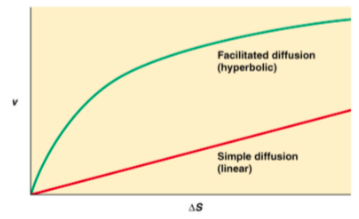
2) a. Using the information in the table, would you be able to determine what type of \n diffusion (simple or facilitated) use solute 1 and 2 to enter the cell?
\
b. What criteria did you use for this decision? Briefly explain in terms of differences \n between simple and facilitated diffusion.
\
1) Last night I was preparing a soup stock with my daughter, and we \n started arguing if we should cut the meet in smaller or bigger pieces \n in order to make a flavorful soup in a reduced time. \n Use Fick's law to explain how would you cut the pieces in order to \n make a flavorful soup in a reduced time.
\
2) a. Using the information in the table, would you be able to determine what type of \n diffusion (simple or facilitated) use solute 1 and 2 to enter the cell?
\
b. What criteria did you use for this decision? Briefly explain in terms of differences \n between simple and facilitated diffusion.
1 - By increasing the area of the food-water interface, a greater \n number of molecules can diffuse into the stock per unit time; \n the larger interface and smaller dice effectively increases J, \n which means that the stock achieves the same level of flavor \n within a shorter period of time.
\
2a - Solute 1 crosses the membrane with a facilitated diffusion \n Solute 2 crosses the membrane with a simple diffusion
\
2b - The fluxes of many organic solutes that across the cell membrane with simple \n diffusion vary linearly with their concentration differences across the \n membrane as predicted by Fick’s law (the rate of diffusion is proportional to the \n concentration gradient across the membrane, and dependent on their \n permeability coefficients). \n The fluxes of compounds that cross the membrane using facilitated diffusion is \n not linear with the solute concentration differences across the membrane, but \n will vary hyperbolically. Because the solute will cross the membrane in \n complex with a transport molecule the solute permeability coefficient is much \n larger than is expected on the basis of their partition coefficient; the speed of \n diffusion is faster than a simple diffusion; the transport can be saturated \n depending on the number of sites on the membrane that are available for \n transport.
\
2a - Solute 1 crosses the membrane with a facilitated diffusion \n Solute 2 crosses the membrane with a simple diffusion
\
2b - The fluxes of many organic solutes that across the cell membrane with simple \n diffusion vary linearly with their concentration differences across the \n membrane as predicted by Fick’s law (the rate of diffusion is proportional to the \n concentration gradient across the membrane, and dependent on their \n permeability coefficients). \n The fluxes of compounds that cross the membrane using facilitated diffusion is \n not linear with the solute concentration differences across the membrane, but \n will vary hyperbolically. Because the solute will cross the membrane in \n complex with a transport molecule the solute permeability coefficient is much \n larger than is expected on the basis of their partition coefficient; the speed of \n diffusion is faster than a simple diffusion; the transport can be saturated \n depending on the number of sites on the membrane that are available for \n transport.
3
New cards
How does the cell membrane control the transport of \n glucose molecules?
Absorption of glucose across the intestinal epithelial cells:
\
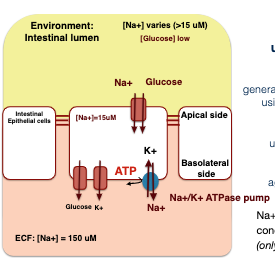
The intestine must maintain a large flux of glucose from the intestinal lumen to the blood \n even if the concentration of glucose in the lumen may be lower than in the blood.
\
Active transport \n uses energy from ATP
Na+/K+ ATPase pump \n generates a Na+ concentration gradient \n using energy in the form of ATP. \n Na+/Glucose transporter \n uses Na+ concentration gradient \n generated by ATPase pump \n to move glucose \n against its concentration gradient \n Na+/K+ pump generates \n concentration gradient= stored energy \n (only found in basolateral side of cells)
\
The intestine must maintain a large flux of glucose from the intestinal lumen to the blood \n even if the concentration of glucose in the lumen may be lower than in the blood.
\
Active transport \n uses energy from ATP
Na+/K+ ATPase pump \n generates a Na+ concentration gradient \n using energy in the form of ATP. \n Na+/Glucose transporter \n uses Na+ concentration gradient \n generated by ATPase pump \n to move glucose \n against its concentration gradient \n Na+/K+ pump generates \n concentration gradient= stored energy \n (only found in basolateral side of cells)
4
New cards
How are the fluxes through cell membrane combined \n to form a framework for the treatment of diarrheal diseases?
Oral Rehydration Therapy
\
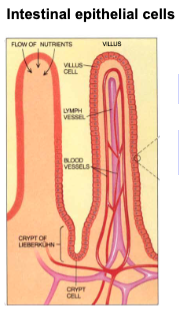
Villus cells absorb nutrients from \n the intestinal lumen. \n At the base of the villi there are \n crypt cells which participate in \n digestion as well.
\
Villus cells absorb nutrients from \n the intestinal lumen. \n At the base of the villi there are \n crypt cells which participate in \n digestion as well.
5
New cards
Crypt Cell Activity
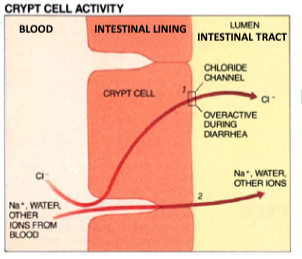
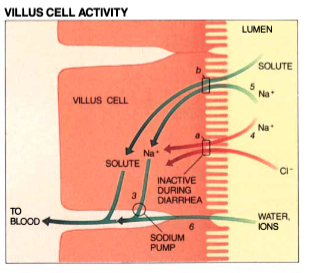
Chloride channel builds high \n concentration of Cl‐in lumen. \n This pulls Na+ passively along \n due to electrochemical \n gradient. \n Diarrheal diseases often make \n the chloride channel \n overactive. \n What is the consequence? \n DEHYDRATION – water flows \n out of blood and into intestine \n due to osmotic gradient.
6
New cards
Villus Cell Activity
Sodium pump moves \n Na+ out of cell, creating a \n concentration gradient: \n high \[Na+\] in intestine \n low \[Na+\] in cell \n high \[Na+\] in blood \n Diarrheal diseases do not \n affect the Na/Glucose \n cotransport system! \n This means that with the \n exactly formulated \n solution of Na +/glucose \n we can effectively \n rehydrate and nourish \n extremely ill \n people....sometimes \n within minutes.
7
New cards
Glucose Transporters
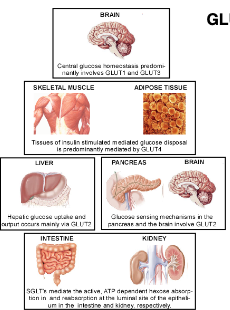
Intestine and Kidney use the \n same transport system. \n Sodium-glucose \n cotransporter (SGLT) \n In the kidney glucose is first \n release into the primary urine \n and then reabsorbed into the \n body by using SGLT.
\
GLUT: facilitated diffusion
SGLT: active transport
\
GLUT: facilitated diffusion
SGLT: active transport
8
New cards
Facilitated Diffusion and Active Transport of Glucose
Whether a cell uses facilitated diffusion or active transport \n depends on the specific needs of the cell. \n For example, the sugar glucose is transported \n by active transport from the gut into intestinal epithelial cells, \n but by facilitated diffusion across the membrane of red blood cells.
\
Why does glucose require two different transport systems? \n Consider how different the two environments are.
\
Epithelial cells lining the gut need to bring glucose made available from digestion into \n the body and must prevent the reverse flow of glucose from body to gut. We need a \n mechanism to ensure that glucose always flows into intestinal cells and gets \n transported into the bloodstream, no matter what the gut concentration of glucose. \n By contrast, most other tissues in your body move glucose by facilitated diffusion \n carriers because the environment is different. Whereas the gut experiences a constantly \n fluctuating concentration of glucose that can be either higher or lower than the glucose \n concentration inside gut cells, glucose concentration in the blood is carefully regulated \n so that it is normally higher than intracellular concentrations.
\
Why does glucose require two different transport systems? \n Consider how different the two environments are.
\
Epithelial cells lining the gut need to bring glucose made available from digestion into \n the body and must prevent the reverse flow of glucose from body to gut. We need a \n mechanism to ensure that glucose always flows into intestinal cells and gets \n transported into the bloodstream, no matter what the gut concentration of glucose. \n By contrast, most other tissues in your body move glucose by facilitated diffusion \n carriers because the environment is different. Whereas the gut experiences a constantly \n fluctuating concentration of glucose that can be either higher or lower than the glucose \n concentration inside gut cells, glucose concentration in the blood is carefully regulated \n so that it is normally higher than intracellular concentrations.
9
New cards
What is diabetes (type 1 or type 2) or mellitus?
The term diabete “mellitus” refers to “sweetened with honey” This reflects the traditional diagnostic method of tasting the urine.
10
New cards
Why a diabetic patient does not reabsorb all their glucose like a normal person? Answer this question in terms of glucose transporters involved in the process.
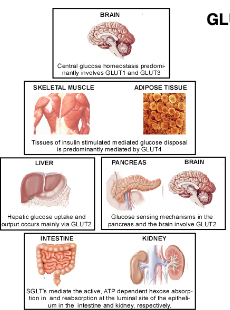
With Glucose present in high concentration in the blood the SGLT co-transporter in the renal tubules would work at maximum capacity, it would be completely saturated and it would not be able to reabsorb most of the glucose in the filtrate, and so most of it will be excreted in the urine.
\
Sodium-glucose cotransporter 2 (SGLT2) proteins are expressed in the proximal convoluted tubule of the kidneys. These transporters are an ideal target for the treatment of diabetes because they are responsible for roughly 90% of filtered glucose reabsorption.
\
Sodium-glucose cotransporter 2 (SGLT2) proteins are expressed in the proximal convoluted tubule of the kidneys. These transporters are an ideal target for the treatment of diabetes because they are responsible for roughly 90% of filtered glucose reabsorption.
11
New cards
How do ion fluxes generate and maintain the Membrane Potential?
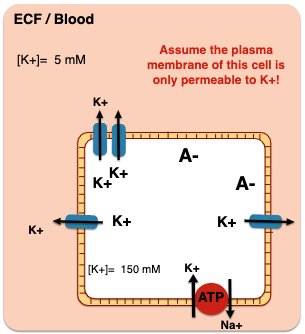
Pumping for life \n Na+/K+ pump generates \n concentration gradient \n = stored energy \n concentration gradients \n are potential energy \n that can drive other solutes to move \n against their concentration gradient.
\
Concentration Gradients = Potential Energy
Gibbs Free Energy
\
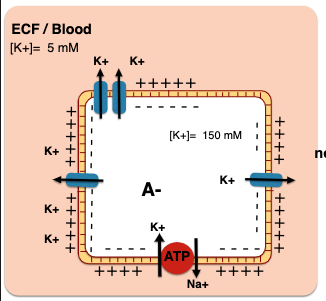
There is a net movement of K+ outside, \n leaving negative anions inside.
\
Concentration Gradients = Potential Energy
Gibbs Free Energy
\
There is a net movement of K+ outside, \n leaving negative anions inside.
12
New cards
Separation of charges = Electrical potential difference
When an ion moves \n there are two forces \n of potential energy \n (chemical and electrical)
\
K+ leaks out = surplus of \n negative charges inside the cell
\
If there is a difference in charges \n across the membrane, then \n there is an electrical potential \n across the membrane.
\
K+ leaks out = surplus of \n negative charges inside the cell
\
If there is a difference in charges \n across the membrane, then \n there is an electrical potential \n across the membrane.
13
New cards
When is the membrane potential at equilibrium?
Assuming the cell \n membrane of this cell is only \n permeable to K+. \n What happens to the \n potassium ions?
\
\[K\] in = \[K\] out equilibrium potential (Eq)
\
Equilibrium potential (Eq) for K+ is reached when there is almost no difference of ion concentration on the two sides of the membrane.
\
\[K\] in = \[K\] out equilibrium potential (Eq)
\
Equilibrium potential (Eq) for K+ is reached when there is almost no difference of ion concentration on the two sides of the membrane.
![Assuming the cell \n membrane of this cell is only \n permeable to K+. \n What happens to the \n potassium ions?
\
\[K\] in = \[K\] out equilibrium potential (Eq)
\
Equilibrium potential (Eq) for K+ is reached when there is almost no difference of ion concentration on the two sides of the membrane.](https://knowt-user-attachments.s3.amazonaws.com/1742676aa232417096742717794d877d.jpeg)
14
New cards
Can we quantitatively measure Equilibrium potential?
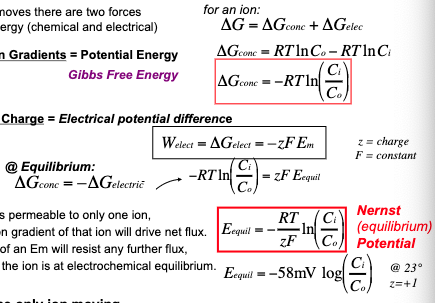
When an ion moves there are two forces of potential energy (chemical and electrical)
Concentration Gradients = Potential Energy / Gibbs Free Energy
Separation of Charge = Electrical potential difference
at Equilibrium deltaGconc=-deltaGelectric
Id a membrane is permeable to only one ion, the concentration gradient of that ion will drive net flux. The generation of an Em will resist any further flux, and at that point the ion is at electrochemical equilibrium
If the K+ is the only ion moving…the membrane potential would be mostly equal to the equilibrium potential for K+
Concentration Gradients = Potential Energy / Gibbs Free Energy
Separation of Charge = Electrical potential difference
at Equilibrium deltaGconc=-deltaGelectric
Id a membrane is permeable to only one ion, the concentration gradient of that ion will drive net flux. The generation of an Em will resist any further flux, and at that point the ion is at electrochemical equilibrium
If the K+ is the only ion moving…the membrane potential would be mostly equal to the equilibrium potential for K+
15
New cards
Can we calculate the Equilibrium potential for K+?
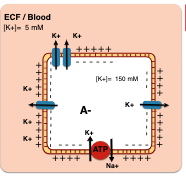
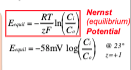
The Equilibrium potential of an ion influence the membrane potential of a cell. For a cell mostly permeable to only K+ we can expect \n a membrane potential (Em) similar to the Equilibrium potential of K+
\
If the electrical gradient is around \n -50mV the concentration gradient \n will be the greater force, and the ions \n will move following the chemical \n gradient (move outside the cell). \n If the voltage is around -100mV the \n electrical gradient will be greater \n than the concentration gradient and \n the ions will move following the \n electrical force (move inside the cell).
\
If the electrical gradient is around \n -50mV the concentration gradient \n will be the greater force, and the ions \n will move following the chemical \n gradient (move outside the cell). \n If the voltage is around -100mV the \n electrical gradient will be greater \n than the concentration gradient and \n the ions will move following the \n electrical force (move inside the cell).
16
New cards
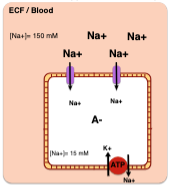
What happens if the cell is permeable to only Na+?
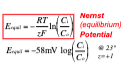
The Equilibrium potential of an ion influence the membrane potential of a cell
\
\
17
New cards
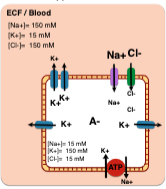
What happens if the cell allows all the ions to move freely?
\
What information would you \n need in order to calculate the \n membrane potential (Em) of \n the a cell permeable to \n multiple ions?
\
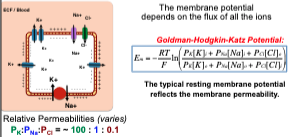
What is the significance of the Goldman-Hodgkin-Kats potential?
\
What information would you \n need in order to calculate the \n membrane potential (Em) of \n the a cell permeable to \n multiple ions?
\
What is the significance of the Goldman-Hodgkin-Kats potential?
The membrane potential \n depends on the flux of all the ions
\
The typical resting membrane potential \n reflects the membrane permeability.
\
Cells are dominated by K+ leaks and therefore there is \n a negative membrane potential (Em). We can expect a Em not as negative as the \n Equilibrium potential of K+, \n because the influx of Na+ makes the Em more positive.
\
The typical resting membrane potential \n reflects the membrane permeability.
\
Cells are dominated by K+ leaks and therefore there is \n a negative membrane potential (Em). We can expect a Em not as negative as the \n Equilibrium potential of K+, \n because the influx of Na+ makes the Em more positive.
18
New cards
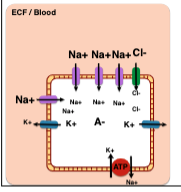
What happens to the membrane potential if the cell changes the \n permeability for the ions?
The resting membrane \n potential of a cell \n depends on its \n membrane permeability \n to the different ions. \n If the permeability \n changes, the membrane \n potential will change!
19
New cards
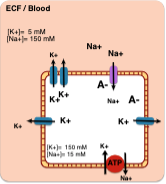
How do ion fluxes generate and maintain the Membrane Potential?
1. Concentration gradient
2. Selective ionic permeability
20
New cards
How does an electric wire work? What is an electric circuit?
Flow of electrons in a circuit (electric current=I), \n through conductor with resistance (R). \n An electromotive force (electric potential \n energy=V, separation of charges) \n pushes electrons along the wire.
\
Just like an electrical circuit a biological circuit has 4 fundamental components: \n Battery - Membrane \n Wire \n Switch > Ion channels \n Lamp
\
Just like an electrical circuit a biological circuit has 4 fundamental components: \n Battery - Membrane \n Wire \n Switch > Ion channels \n Lamp
21
New cards
What is the difference between the two equations? Nernst and Goldman
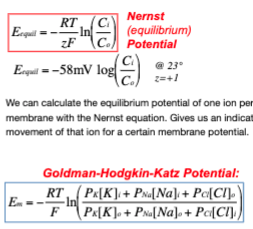
We can calculate the equilibrium potential of one ion permeable to the cell \n membrane with the Nernst equation. Gives us an indication of the direction of \n movement of that ion for a certain membrane potential.
\
We can calculate the membrane potential of a cell with the Goldman equation. The membrane \n potential it is generated by the separation of charges across the membrane and it depends on \n the permeability of multiple ions.
\
We can calculate the membrane potential of a cell with the Goldman equation. The membrane \n potential it is generated by the separation of charges across the membrane and it depends on \n the permeability of multiple ions.
22
New cards
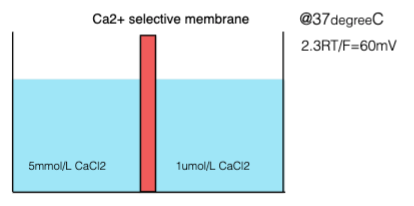
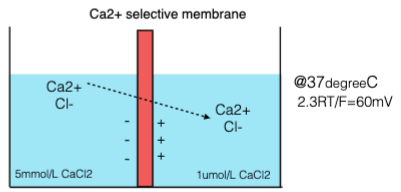
A solution of 5mmol/L is separated from a solution of 1umol/L \n CaCl2 by a membrane that is selectively permeable to Ca2+, \n but is impermeable to Cl-. \n What is the magnitude of the potential difference that is \n generated across the membrane?
ECa2+ = 60mV/2 x log 5 x 10⁻³ / 1 x 10⁻⁶ \n = 30 mV x log 5 x 10⁻³ mol/L \n = 30 mV x 3.699 \n = 111 mV
23
New cards
If the Na+ equilibrium potential is +60mV and the membrane potential is 0mV, in \n what direction will Na+ move through open channels?
Na+ will tend to move inside the cell following only the concentration \n gradient because equilibrium potential difference is 0.
24
New cards
If the K+ equilibrium potential is -90mV and the membrane potential is \n -70mV, in what direction will the K+ move through open channels?
K+ will tend to move out of cell until equilibrium potential difference \n will be equal and opposite to concentration gradient
25
New cards
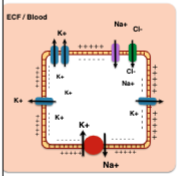
All cells have a resting membrane potential. \n Neurons can alter it for signal transduction.
The overall charge neutrality in the center of the cell \n would be maintained independently of the membrane \n potential
\
... only a very small number of \n negative and positive ions need \n to be separated by the \n membrane to create the resting \n membrane potential. \n The ICF concentrations of \n Na+ and K+ \n do not change much.
\
... only a very small number of \n negative and positive ions need \n to be separated by the \n membrane to create the resting \n membrane potential. \n The ICF concentrations of \n Na+ and K+ \n do not change much.
26
New cards
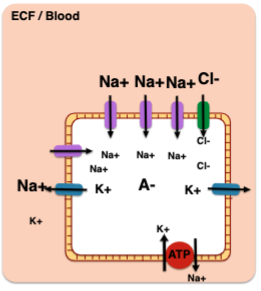
The Na+/K+ ATPase pump maintains the intracellular concentrations overall
The Na/K pump’s big contribution \n to the membrane potential \n is to maintain steady Na and K \n gradients, which give rise to the \n membrane potential as Na and K \n move through leaky channels.
27
New cards
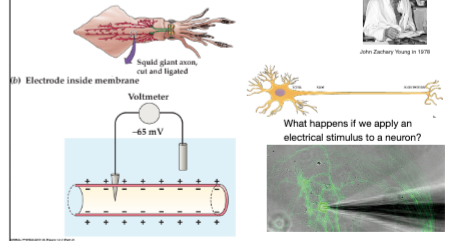
How would you record a membrane potential?
A voltmeter measure the differential potential \n between the inside of the cell and the outside
28
New cards
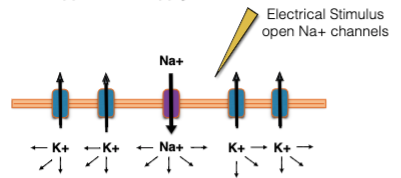
What happens if we apply an electrical stimulus to a neuron?
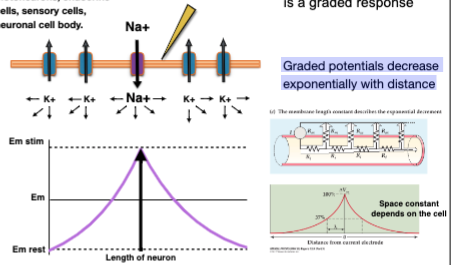
When a stimulus is applied to a neuron the equilibrium is disturbed \n by the opening of Na+ channels. The membrane potential will change. \n If we change membrane potential in one place in the cell, it will propagate. \n The magnitude of the change in potential depends on the strength of the stimulus.
\
An electrical stimulus opens Na+ channels and generates a graded potential.
present in invertebrate and \n smooth muscle, axons \n motoneurons, endocrine \n cells, sensory cells, \n neuronal cell body.
Graded potential is fast but it doesn’t spread \n over long distance \n is a graded response
Graded potentials decrease \n exponentially with distance
\
An electrical stimulus opens Na+ channels and generates a graded potential.
present in invertebrate and \n smooth muscle, axons \n motoneurons, endocrine \n cells, sensory cells, \n neuronal cell body.
Graded potential is fast but it doesn’t spread \n over long distance \n is a graded response
Graded potentials decrease \n exponentially with distance
29
New cards
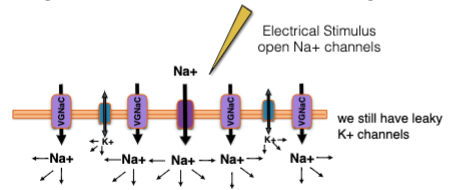
Voltage Gated Ion Channels are used to conduct over long distance
Local depolarization of the membrane opens the VGNaC causing the inward of Na+ ions. \n Some of the local current generated by the action potential will flow passively down the \n axons. \n The flow of ions depolarizes the membrane in the adjacent region opening more VGNaC.
\n When a local depolarization of the membrane opens VGNaC \n an action potential is generates
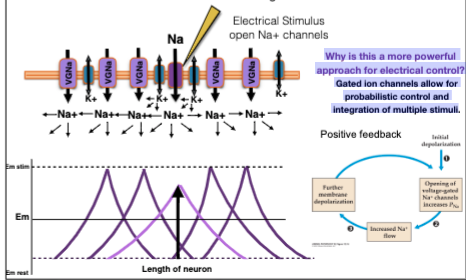
Action potential is not graded ‘All-or-Nothing’ \n conducts over long distances
\
Why is this a more powerful \n approach for electrical control? \n Gated ion channels allow for \n probabilistic control and \n integration of multiple stimuli.
\n When a local depolarization of the membrane opens VGNaC \n an action potential is generates
Action potential is not graded ‘All-or-Nothing’ \n conducts over long distances
\
Why is this a more powerful \n approach for electrical control? \n Gated ion channels allow for \n probabilistic control and \n integration of multiple stimuli.
30
New cards
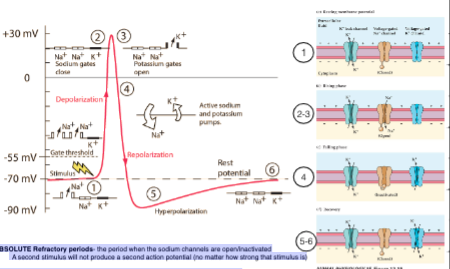
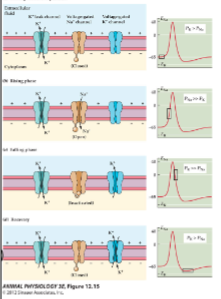
Membrane permeability changes that produce an action potential
The generation of an action potential (AP) \n involves the temporal opening and closing \n of several channels within the cell \n membrane. \n Alteration of these ion channels by the \n administration of toxins can change the \n AP's shape in a specific way, which can be \n a valuable tool for toxin classification and \n the measurement of drug effects based on \n their mechanism of action.
\
ABSOLUTE Refractory periods- the period when the sodium channels are open/inactivated \n A second stimulus will not produce a second action potential (no matter how strong that stimulus is) \n RELATIVE Refractory periods- the period when the potassium channels are open \n Another action potential can be produced, but only if the stimulus is greater than the threshold stimulus
\
ABSOLUTE Refractory periods- the period when the sodium channels are open/inactivated \n A second stimulus will not produce a second action potential (no matter how strong that stimulus is) \n RELATIVE Refractory periods- the period when the potassium channels are open \n Another action potential can be produced, but only if the stimulus is greater than the threshold stimulus
31
New cards
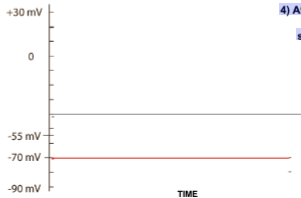
1) Draw a graph of the membrane potential over time after the generation and propagation of an AP in normal conditions and:
2) with a toxin that inhibits the VGNaC;
3) with a toxin that prevents VGKC channels from opening.
4) After a toxin blocks the VGNaC \n or the VGKC, would the \n stimulus be able to generate \n and propagate an action \n potential?
2) with a toxin that inhibits the VGNaC;
3) with a toxin that prevents VGKC channels from opening.
4) After a toxin blocks the VGNaC \n or the VGKC, would the \n stimulus be able to generate \n and propagate an action \n potential?
After a toxin blocks VGNaC the stimulus \n won’t be able to generate and propagate \n an action potential (AP). \n After a toxin blocks VGKC, the stimulus \n will generate an AP, because VGKC only \n participate in the repolarization of the \n excitably membrane after the AP \n depolarization. Blocking the VCKC \n might slow down the rate of recovery to \n rest, but they are not required for \n producing an AP. \n Yes, propagation will occur because \n increase of \[Na+ \] will activate neighbor \n VGNaC
Opening of each \n VGNaC \n will generate a new \n peak in the Em
This is called a \n Positive feedback
\
The effect will be only on the repolarization of \n the membrane...it will take longer to fire \n again!
Opening of each \n VGNaC \n will generate a new \n peak in the Em
This is called a \n Positive feedback
\
The effect will be only on the repolarization of \n the membrane...it will take longer to fire \n again!
![After a toxin blocks VGNaC the stimulus \n won’t be able to generate and propagate \n an action potential (AP). \n After a toxin blocks VGKC, the stimulus \n will generate an AP, because VGKC only \n participate in the repolarization of the \n excitably membrane after the AP \n depolarization. Blocking the VCKC \n might slow down the rate of recovery to \n rest, but they are not required for \n producing an AP. \n Yes, propagation will occur because \n increase of \[Na+ \] will activate neighbor \n VGNaC
Opening of each \n VGNaC \n will generate a new \n peak in the Em
This is called a \n Positive feedback
\
The effect will be only on the repolarization of \n the membrane...it will take longer to fire \n again!](https://knowt-user-attachments.s3.amazonaws.com/052ab5174b7341518054e4094bf7ef1f.jpeg)