11.1 Rolling, Torque, and Angular Momentum
 Call Kai
 Learn
Learn Practice Test
 Spaced Repetition
 Match
Match Flashcards
 Knowt Play
1/6

There's no tags or description
Looks like no tags are added yet.
Name | Mastery | Learn | Test | Matching | Spaced | Call with Kai | Chat |
|---|
No analytics yet
Send a link to your students to track their progress
7 Terms
Rigid Body
A rigid body is a collection of particles that act as a single-mass system; each component in a rigid body move, rotate, roll, etc all in sync with one another. Think of a series of LEGO blocks connected to one another: in the same way how LEGO blocks are connected and move/stick together, so too does a rigid body move in a similar capacity.
Translational Motion
Motion that moves purely in a linear fashion — either in the x, y, or z direction. There is no angular component attached to translational motion. For example, the center of mass of a wheel will ALWAYS move in a straight, linear path; therefore, the center of mass of a wheel follows translational motion.
Angular Motion
Motion that moves with respect to a change in the central angle of a circular object; for example, any point on the rim of a wheel will always move in a circular path as the central angle changes with respect to time.
Arc Length
The arc length made is the proportion of a total circle that has been swept out as a result of the central angle and the radius of the circle; for example, if the central angle has been swept out by 2pi, then the arc length is 2pi*r (the circumference of an entire circle).
Velocity of Center of Mass
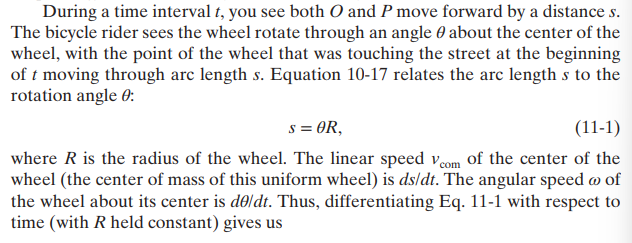
Differentiating the formula s = (theta)(R) provides us with the velocity of the center of mass; recall that s represents the distance traversed, so its derivative must be velocity.
Vcom = w * R
W = angular speed (the d(theta)/dt)
R = radial length
Translational AND Rotational Motion
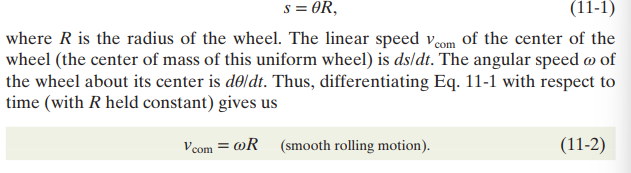
Whenever an object rolls, its motion can be described as a combination of both translational and rotational motion.
We figure out the net effect (the combination) by identifying the instances in which we have a PURE rotational effect and when we have a PURE translational effect; combining these two produces a rolling motion.
Pure Rotation: The velocities of the particles on the edges of a circle will always be in the opposite direction of one another. The direction changing is what results in the opposing sign.
Pure translation: Assuming pure translation, then the entire wheel moves as a rigid body, so EVERY point on the circle will have the same velocity. If we know that the center of the circle has velocity VCom, then so too do the points on the circumference have a translational velocity of Vcom.
Effects of Rolling
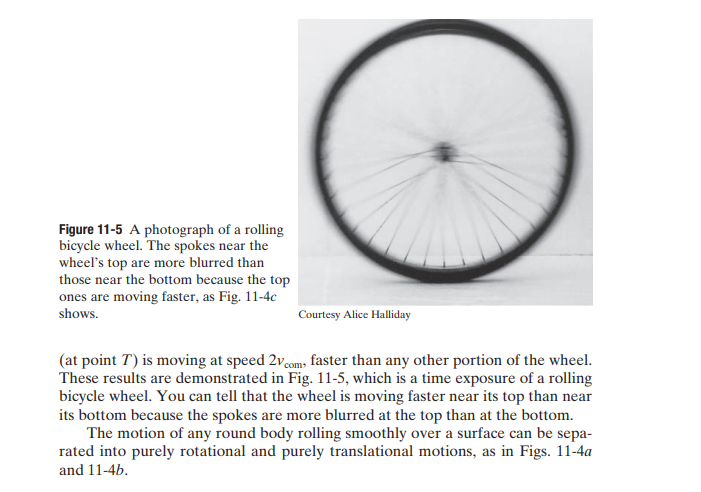
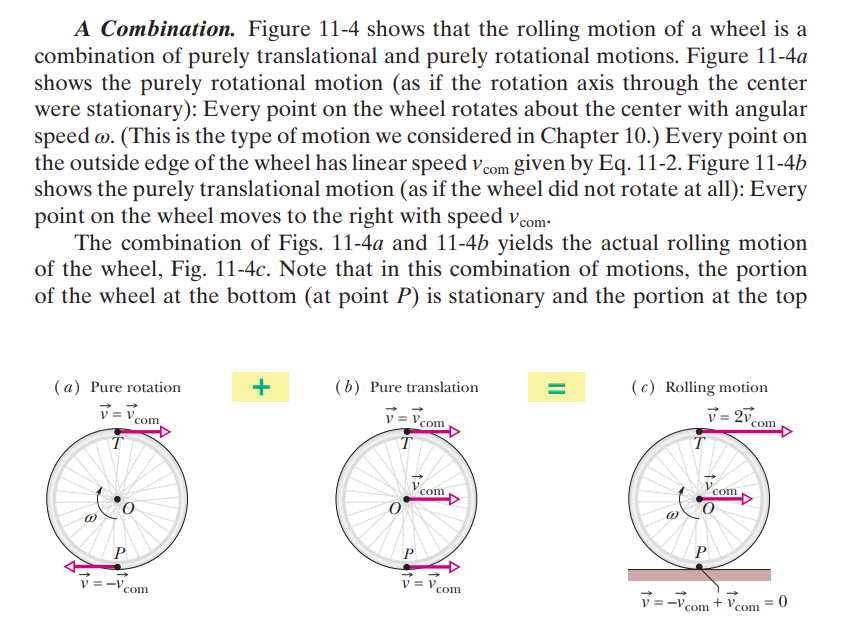
The fact that the velocity at the top of a rolling wheel is twice the velocity in the center is why blurs are generated at the top of a wheel and the bottom is clearer.