Patterns of Macroevolution
 Call Kai
 Learn
Learn Practice Test
 Spaced Repetition
 Match
Match Flashcards
 Knowt Play
1/14

There's no tags or description
Looks like no tags are added yet.
Name | Mastery | Learn | Test | Matching | Spaced | Call with Kai | Chat |
|---|
No analytics yet
Send a link to your students to track their progress
15 Terms
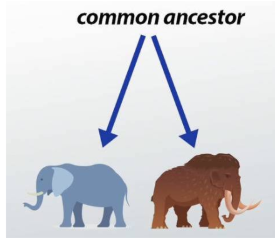
Divergent Evolution
a pattern of evolution in which species that were once similar to an ancestral species diverge, or become increasingly distinct
Ex. Elephants and mammoths originally have a common ancestor – similar structures but have evolved according to their environments!
Ex. Humans and apes
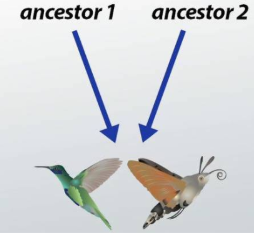
Convergent Evolution
a pattern of evolution in which similar traits arise because different species have independently adapted to similar environmental conditions
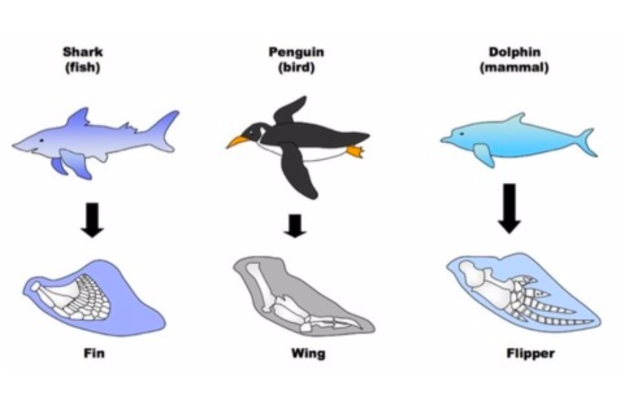
Ex. Sharks and Dolphins – very similarly adapted, but distantly related
Ex. A shark’s fin and a dolphin’s flipper are completely different structures!
Convergent Evolution - Analogous Structures
Because different animals have similar environmental needs, they have adapted similar structures – even from across the world
This is why we can see structures that are similar in un-related organisms, otherwise called analogous structures
This is evidence of convergent evolution
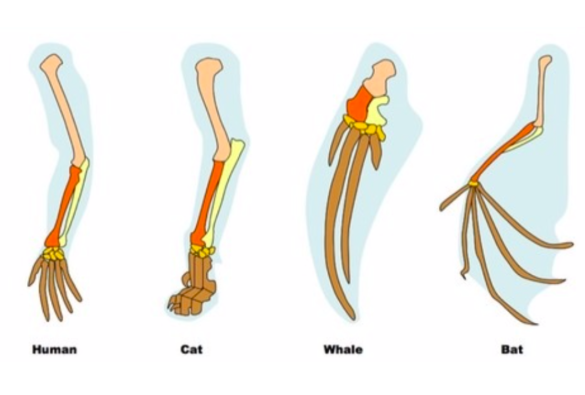
Divergent Evolution - Homologous Structures
On the other hand, some animals start out with a common ancestor, but their environments become quite different
We can now see homologous structures – which have different functions but similar anatomical structures
This suggests divergent evolution has occurred
Adaptive Radiation
Adaptive Radiation: a form of divergent evolution where a common ancestral species diversifies into a variety of differently adapted species
Islands are a great place to study this – “living laboratories”
Islands give animals the opportunity to change in response to new environmental conditions while being isolated from the parent population
Ex. The Hawaiian Islands: originally had no life at all, but over time, gradually populated by species travelling through the ocean or winds. Now one of the most biologically diverse places, with species not found anywhere else in the world!
Ecological Niche
the ecological role and physical distribution of a species in its environment
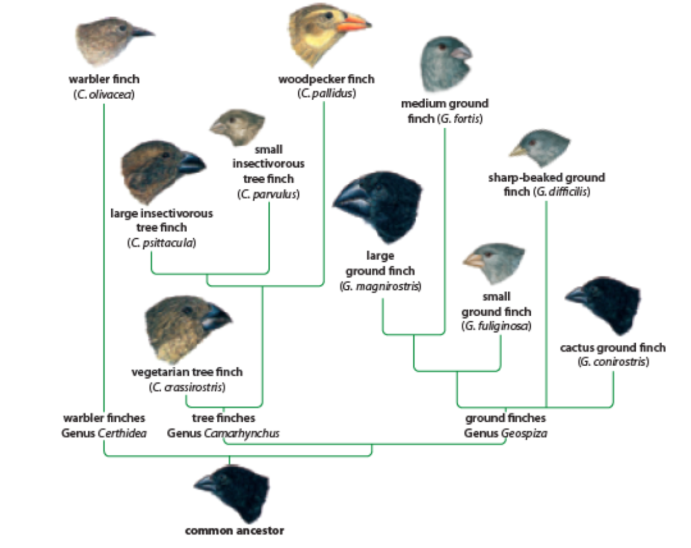
Darwin’s Finches
A population of finches in the Galapagos
In the past, members of the ancestral species reached one of the islands
There were many unoccupied ecological niches for this species to move into
Finches on different islands faced different selective pressures – divergent speciation took place!
By looking at DNA and individual characteristics (such as beak length), scientists have been able to organize a phylogenetic tree showing the evolution of 14 different finch species
Co-Evolution
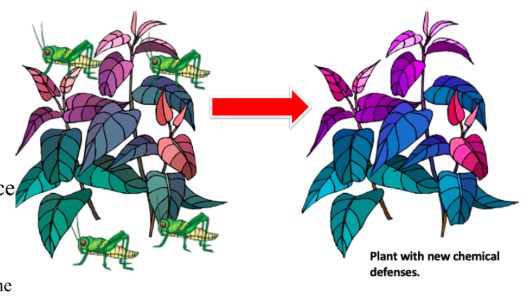
Co-Evolution: The process by which two species evolve in response to changes in each other.
An Evolutionary change in one organism may be followed by a corresponding change in another organism.
Example: Insects have been feeding on plants since insects evolved.
In response, many plants developed toxins or poisons to prevent insects from feeding on them.
Natural selection favored any insect that could withstand the effects of the toxin.
Those insects then survived and produced a population of offspring who could also withstand the effect of the toxin or poison.
Extinctions
Reasons of Extinction:
Species have to complete for similar resources – often one species is better than the other. The competitor is driven to extinction.
The Environment changes and some species have genes which allow them to adapt, while others perish.
Gradual Extinctions occur due to natural selection.
Mass Extinction
Caused by catastrophic events in Earth’s history, which wipe out entire ecosystems.
Species become extinct due to the environmental collapse occurring around them rather than the inability to complete for resources.
Ex. A huge asteroid hit the Earth when the dinosaurs were alive, causing a large amount of dust and water to be released into the atmosphere. This caused rapid climate change, an environment which most species could not survive in.
5 recorded mass extinctions
Speech of Evolution
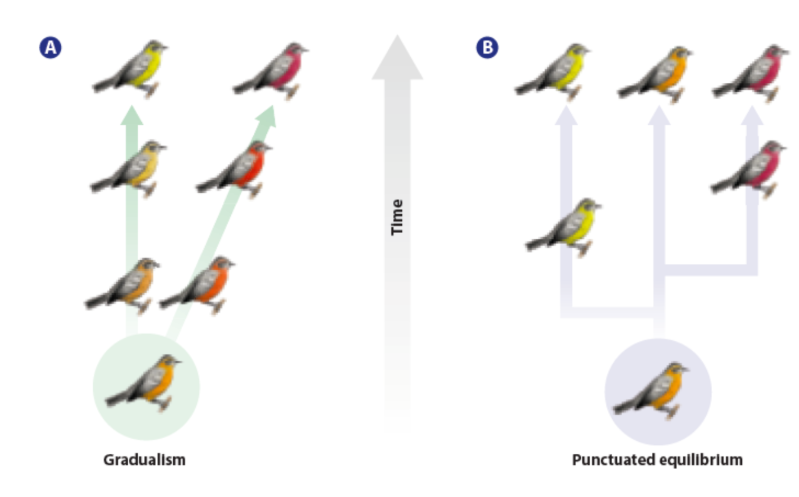
There are two models that attempt to explain evolutionary speed.
Gradualism
Punctuated Equilibrium
Gradualism
Views evolution as slow and steady until a divergence takes place. Big changes occur by the accumulation of many small changes.
Note: Fossil records do not always support this theory! New species appear and disappear suddenly
Punctuated Equilibrium
Dr. Niles Eldredge and Stephen Gould came up with a new model. They said evolutionary history consists of long periods of equilibrium, where nothing changes. This is interrupted, or punctuated, by periods of divergence.
Note: When species first diverge from the parent, they go through a fast period of change – then stay stagnant until they give rise to other species
Hardy-Weinberg Equilibrium
A mathematical model used to calculate allele frequencies of traits with dominant and recessive alleles. The model assumes that the population:
Is large
Has random mating
Experiencing no selection
Has no mutations
Has no immigration or emigration
Aka NO MICROEVOLUTION. If these assumptions are met, the allele frequencies in a population will remain stable over time (no evolution).
Human Activity and Speciation
Habitats can be split, and populations isolated, when humans:
Convert large stretches of wilderness into croplands
Develop wilderness areas for recreation or tourism
Build roads and subdivisions
Floor large areas of land to build dams for hydroelectric power generation
Human-made barriers prevent gene flow between populations, causing adaptive radiation if their environments are different.
Severely fragmented populations may die out if there is not enough genetic diversity for adaptation to harsh conditions.