Bio 80 2 Exam
 Call Kai
 Learn
Learn Practice Test
 Spaced Repetition
 Match
Match Flashcards
 Knowt Play
1/109

There's no tags or description
Looks like no tags are added yet.
Name | Mastery | Learn | Test | Matching | Spaced | Call with Kai | Chat |
|---|
No analytics yet
Send a link to your students to track their progress
110 Terms
Prokaryotes
Single celled organisms that make up domains bacteria and archaea
Hypertonic environment
The net movement of water is out of the cell, due to the higher concentration of solutes outside the cell.
Hypotonic environment
The net movement of water is into the cell due to the higher concentration of solutes inside the cell
Isotonic environment
this condition the concentration of solutes is the same
inside and outside the cell, no net movement of water
Cell wall
maintains shape, protects the cell, and
prevents it from bursting in a hypotonic
environment
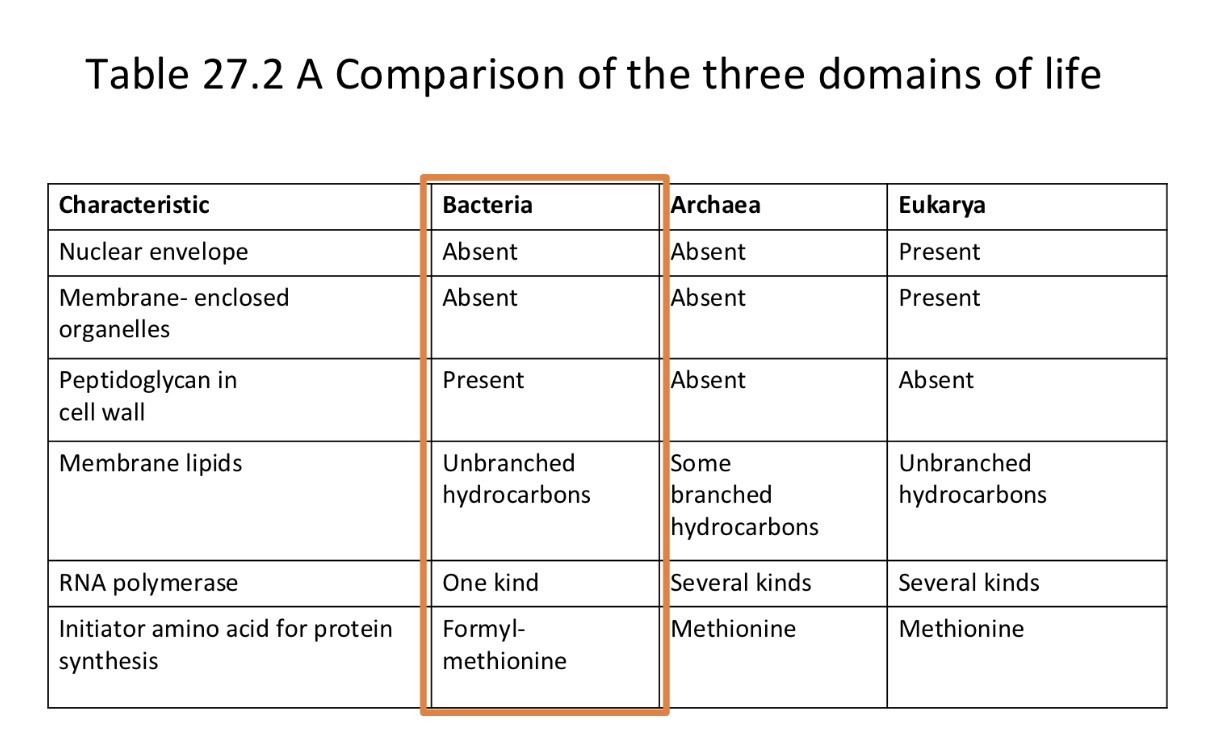
Most bacterial cell walls contain
______, a network of sugar polymers
cross-linked by polypeptides
peptidoglycan
Gram Stain
identifies bacteria by cell wall
composition
Gram-positive
simpler walls with a
large amount of peptidoglycan
Gram-negative
more complex walls
with outer membrane that contains
lipopolysaccharides and less
peptidoglycan
Many prokaryotes have a sticky layer of ______ or
protein surrounding the cell wall
polysaccharide
Capsule
if dense and well-defined
Slime layer
If not well organized
Endospores
Some bacteria form metabolically inactive endospores
when water or nutrients are lacking
Fimbriae
Hair like appendages that allow prokaryotes to stick to their substrates or other individuals in a colony
Pili
longer than
fimbriae and function to pull
cells together enabling the
exchange of DNA
Chemotaxis
is the movement toward or
away from a chemical stimulus
Flagella
are the most common structures
used by prokaryotes for movement
Prokaryotic cells lack
complex
compartmentalization
Nucleoid
region with no membrane that
holds chromosome
Plasmids
Prokaryotes may also have smaller
rings of independently replicating DNA
called
Genetic recombination
the combining of DNA from two sources, contributes to
prokaryote diversity
DNA from different individuals can be combined by
transformation,
transduction, or conjugation
horizontal gene transfer
Movement of genes between individual prokaryotes of different species
Transformation
: prokaryotic cells incorporate foreign DNA from surroundings
Transduction
phages (from “bacteriophages,”
viruses that infect bacteria) carry prokaryotic
genes from one host cell to another
Conjunction
DNA is transferred between two
prokaryotic cells
Antibiotics kill most bacteria, but not
those with _______, plasmids that
carry resistance genes
R plasmids
Proteobacteria
Gram negative, diverse in nutrition, and many of the heterotrophic bacteria are pathogens
Chlamydias
All species parasitize animal cells and
have gram-negative walls lacking
peptidoglycan
Spirochetes
Gram-negative heterotrophs
• Spiral through the environment by
rotating internal filaments
• Many are free-living, but others are
pathogens
Cyanobacteria
Gram-negative
photoautotrophs
• Plant chloroplasts likely
evolved from cyanobacteria
by the process of
endosymbiosis
Gram-positive bacteria
Diverse and gram-positive
Extremophiles
archaea that
live in extreme environments,
uninhabitable for most organisms
Extreme halophiles
tolerate
or require highly saline
environments
Extreme thermophiles
have
adaptations that make their
DNA and proteins stable at
high temperatures
Archaea and Eukarya are
Sister domains: most closely related
T A C K
A supergroup composed of the remaining,
closely-related clades of archaea
Methanogens
obligate anaerobes that
produce methane as a by-product of their
metabolism
Horizontal gene transfer (HGT) has
played a key role in the evolution of
prokaryotes
Significant portions of the genomes of
prokaryotes are mosaics of genes
imported from other species
metagenomics
used to
obtain entire prokaryotic genomes
from environmental samples
Prokaryotes
Oldest - 3.5 BYA. inhabits every environment to support life, new genomic advantages reveal extent of its diversity, originally classified by things like morphology, motility, gram staining, genetic analysis led to division of prokaryotes into bacteria and archaea
Biofilms
Cells of one or more
prokaryote species cooperate
to form surface-coating
colonies
common in
nature, but can cause many
problems for humans
including
Nitrogen fixation is isolated in
cells called
heterocysts
Facultative anaerobes
can use O2 if it is present or carry
out fermentation or anaerobic respiration if not
Obligate anaerobes
poisoned by O2 and live by
fermentation or use substances other than O2 for
anaerobic respiration
Obligate aerobes
require O2 for cellular respiration
Heterotrophs
require an organic nutrient to make other organic
compounds
Autotrophs
require CO2 or related compounds as a carbon source
Chemotropes
Obtain energy from chemicals
Phototrophs
Obtain energy from light
How do prokaryotes help recycle chemical elements?
Decomposers (chemoheterotrophic prokaryotes) break down dead organisms and waste.
This releases carbon and other elements back into the environment.
Other organisms reuse these elements (like oxygen and nitrogen).
symbiotic
relationships
an ecological
relationship in which two species
live in close contact
Commensalism
one benefits,
the other is Unaffected
Mutualism
Both benefit
Parasitism
One benefits the other is harmed
Only bacteria, not archaea, are
pathogenic
Prokaryotes can also be used
in bioremediation which is…
the use of
organisms to remove
pollutants from soil, air, or
water
What has a nucleus and other membrane-
enclosed organelles
Eukaryotic cells
Protist
informal term used to refer to all
eukaryotes that are not plants, animals, or
fungi
Mixotrophs
combine
photosynthesis and heterotrophic nutrition
relationship between two species in which one organism lives
inside the cell or cells of the other organism (the host)
Endosymbiosis
Plastids
a small organelle
containing pigment or food (e.g.
chloroplasts)
The engulfed cell contains a
vestigial nucleus called
A nucleomorph
Four membranes surround
plasmid of chlorarachniophytes Which include
• 2 from engulfed cyanobacteria
• 1 from engulfed alga’s plasma
membrane
• 1 from heterotrophic
eukaryote’s food vacuole
In other protists, plasmids only
have 3 membranes
Indicates one of original 4
membranes has been lost
Excavata
asymmetrical, single-celled organisms with a feeding groove “excavated” from one side
The excavates include:
Organisms with modified mitochondria: the
diplomonads & parabasalids
• Organisms with unique flagella: euglenozoans
Diplomonads
Have mitosomes: reduced mitochondria
that generate energy anaerobically
Euglenids
• Have 1 or 2 flagella that emerge from a pocket at one end of the cell
• Can also change entire shape of body to move
• Have pellicle - stiff structure that helps keep shape
SAR – Stramenopiles
• Some of the most important phototrophs on Earth
• Most have a “hairy” flagellum paired with a “smooth” flagellum
• 3 important groups: diatoms, brown algae, and oomycetes
Diatoms
unicellular algae with a unique glass-like wall
of silicon dioxide made of silica in an organic matrix
Brown algae
are the largest and most complex
multicellular algae
SAR – Alveolates
• Have membrane-
enclosed sacs (alveoli)
just under the plasma
membrane
• 3 clades
• Dinoflagellates
• Apicomplexans
• Ciliates
Dinoflagellates
aquatic phytoplankton with 2 flagella, cellulose armor plates, and can be photosynthetic, mixotrophic, or heterotrophic.
SAR – Alveolates
• Nearly all apicomplexans parasitize animals
• Spread through host as tiny infectious cells
called sporozoites
• One end contains apical complex
• Non-photosynthetic
• Most have intricate life cycles with both sexual
and asexual stages
• Often require 2+ host species for
completion
• Ex. Plasmodium (causes malaria)
Ciliates
are named for their use of cilia to move
around and feed
Macronuclei
contains multiple copies of
the genome
Micronuclei
: may be diploid or haploid,
depending on life stage
SAR – Rhizarians
• Include forams and radiolarians
• Many are amoebas: protists
that move and feed using
pseudopodia, extensions of the
cell surface
Radiolarians
• Have delicate, symmetrical internal
skeletons typically made of silica
• Use reinforced pseudopodia to engulf
microorganisms by phagocytosis
Forams
• Have porous, multi chambered,
calcium carbonate shells called tests
Chlorophytes
: live in fresh and saltwater,
some are terrestrial
Charophytes
: include the algae most
closely related to plants
Unikonta
Amoebozoans
• Amoebas with lobe- or tube-shaped pseudopodia • Include slime molds,
tubulinids, entamoebas
Opisthokonts
a diverse group
including animals, fungi, and several
groups of protists
Protists play two key roles in
their habitats:
symbiont and
photosynthesizer
Plants
Multicellular terrestrial
organisms that are characterized by
photosynthesis, cell walls, and unique
life cycles and that evolved from within
green algae
Plants share traits with protists
• Multicellular, eukaryotic, photosynthetic autotrophs
• Red, brown, and some green algae
• Cell walls made of cellulose
• Green algae, dinoflagellates, and brown algae
• Chloroplasts with chlorophyll a and b
• Green algae, euglenids, and a few dinoflagellates
Shared traits plants and charophytes
Peroxisome enzymes
Flagellated sperm structure
Forms phragmoplast
Rose shaped complexes creates cell walls
Similar DNA
Differed traits between plants and charophytes
1. Alternation of generations that includes multicellular,
dependent embryos
2. Walled spores produced in sporangia
3. Multicellular gametangia
4. Apical meristem
archegonium
Female archegonium produce
egg cells
antheridia
Male antheridia produce and
release sperm
Bryophytes
informal term
referring to all nonvascular
plants
Seta
conducts nutrients to capsule,
which produce spores
Byroohyta
Moss
Hepatophyta
Liverworts
Anthcerophyta
Hornworts
Xylem
conducts most of the water and
nutrients
Phloem
distributes organic products