Lecture 8 - Introduction to Plant Life
 Call Kai
 Learn
Learn Practice Test
 Spaced Repetition
 Match
Match Flashcards
 Knowt Play
1/37

There's no tags or description
Looks like no tags are added yet.
Name | Mastery | Learn | Test | Matching | Spaced | Call with Kai | Chat |
|---|
No analytics yet
Send a link to your students to track their progress
38 Terms
What is a plant?
Multicellular eukaryote that produces its own food through photosynthesis.
Mostly terrestrial (land dwelling).
Sessile (stay in one place).
Range from 1 millimeter to 380ft tall!
Evolutionary History of Plants
Diagram showing evolutionary relationships among organisms
What is more related to what?
Groups organized by their shared traits.
Common ancestry
Nonvascular Seedless Plants
Mosses, Liverworts, Hornworts.
Lack vascular tissue
Limited vertical growth
Rhizoids
Not true roots
Spores: asexual reproduction
Flagellated sperm
Wet environments
Vascular Seedless Plants
Ferns, Clubmosses & Horsetails
Vascular Tissue
Secondary growth
True Roots
Spores: asexual reproduction
Flagellated sperm
Wet environments
Vascular Tissue:
Tube life vessels that transport water & nutrients
Xylem: moves water up a plant
Phloem: Moves food up or down a plant
Vascular Bundles:
bundles of xylem & phloem within the roots, stems, and leaves of the plant.
Plant Morphology
Shoot System
Stem
Leaves
Buds
Root System
Shoot System:
photosynthesis & reproduction
Stem:
produce leaves, branches, and flowers, transports nutrients and water from roots to leaves
Leaves
primary location of photo synthesis
Buds
undeveloped shoot
Root System:
anchors plant, absorbs minerals & water, and stores carbohydrates
Roots
Taproot or fibrous root
Absorb water, minerals, nutrients
Root hairs
Increases surface area
Mycorrhizae:
Symbiotic relationship between a fungus and plant roots
Fungus receives sugars
Plant receives more water & nutrients
Vascular Seed Plants
Gymnosperms
Angiosperms
Gymnosperms
seed bearing vascular plants in which the seed is enclosed in an ovary
Naked seed
Cone bearing
Angiosperms
seed bearing vascular plant in which the seed is enclosed in an ovary
“Enclosed seed”
Flowering plants: fruits
Seed = protection and food supply
Protective layer (seed coat)
Longer life span
Cotyledon
seed leaves
Endosperm
energy rich tissue that nourishes developing embryo
Gymnosperms
Conifers, Ginkgos, and Cycads
Approximately 1000 species
Most 680 are conifers
Major ecological importance
Gymnosperm Dispersal
Wind dispersal of pollen and seeds
Angiosperms
300,000 species of flowering plants
Food crops (fruits, corn, vegetables, wheat)
Mostly trees, but a diverse array of life forms
Grasses
Forbs (wildflowers)
Succulents
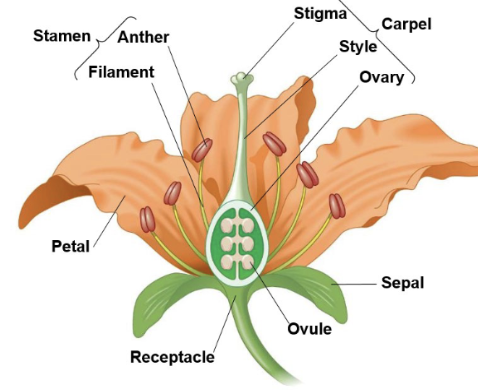
Flower Anatomy
Sepal: protects developing flower
Petals: attract pollinators
Carpel: female reproductive parts
Stigma
Style
Ovary
Stamen: male reproductive parts
Filament:stalk
Anther: pollen production
Pollination in Angiosperms
Each pollen grain contains two sperms cells & one tube cell
Tube cell forms pollen tube
Pollination: the transfer of pollen from the male anther to the female stigma
Double Fertilization: One sperm cell fuses with egg forming the zygote, while the other sperm cell fuses with nuclei within the ovule to form endosperm
Angiosperm Life Cycle
Microspores in anther develop into pollen grains, with one tube cell and two sperm cells.
Megaspore in the ovary develops into an embryo sac with egg.
Pollen grain contacts stigma (pollination) and pollen tube forms.
One sperm fertilizes egg forming zygote, one sperm fertilizes nuclei forming endosperm.
Embryo and endosperm develop into a seed.
Seed grows into a mature plant.
Simple Fruit:
develops from a single ovary
Aggregate Fruit:
Develops from several ovaries (carpels) in the same flower.
Multiple Fruit:
Develops from ovaries (carpels) of multiple flowers
Transpiration:
Loss of water from above ground plants parts by diffusion and/or evaporation
Cohesion-tension hypothesis
Transpiration provides the force that pulls water molecules bound by cohesion, from the roots to the leaves
Trade-off between Leaf Size and Transpiration
Larger leaf size = more light capture, but more water loss
Tropical environments
Small leaf size = less light capture, but less water loss
Dry, exposed environments
Deserts
Temperature forests
Adaptations to Reduce Transpiration
Small, thick leaves
Reduce water loss
Thick cuticle
sheltered/hairy stomata
Lose their leaves
Drought deciduous
C4 & CAM plants:
Grasses, cacti
Nutrient Transport in Plants
sugar- rich xylem sap rises up the trunk in late winter to fuel lead and flower production
“Real” maple syrup
Apical Meristem
Group of cells located in the root and shoot tips that give rise to all plant issues.
Regions of cell growth and differentiation
Vascular Bundle
Gives rise to secondary xylem & phloem
Secondary xylem = tree rings
Human use of Seed Plants
Wheat, corn, and rice provide nearly 60% of plant calories consumed
Potatoes, cassava, sweet potatoes also top crops
Medications
25% of medications come from plants
Oxygen
Wood
Paper
Deforestation:
14 million acres of tropical rain forest cleared every year
Causes:
Private farming
Commercial agriculture
Logging
Collective wood for fuel