orgo exam 1 PP2
 Call Kai
 Learn
Learn Practice Test
 Spaced Repetition
 Match
Match Flashcards
 Knowt Play
1/75

There's no tags or description
Looks like no tags are added yet.
Name | Mastery | Learn | Test | Matching | Spaced | Call with Kai | Chat |
|---|
No analytics yet
Send a link to your students to track their progress
76 Terms
What are curved arrows used for in organic chemistry?
Curved arrows are used to show the movement of electrons during a chemical reaction.
They tell you:
Where electrons start
Where electrons go
How bonds and formal charges change as a result
What does a full-headed curved arrow represent?
A full-headed curved arrow represents the movement of a pair of electrons (2 electrons).
It is sometimes called a two-electron arrow.
Where does a curved arrow begin?
The arrow begins at the source of the electrons.
Source = where the electrons are coming FROM.
Where does a curved arrow end?
The arrow ends at the sink of the electrons.
Sink = where the electrons are going TO.
What does the curved arrow tell us about formal charges?
Moving electrons can change the formal charges on atoms.
When electrons move:
An atom gaining electron density may become more negative
An atom losing electron density may become more positive
What happens during dissociation of a molecule AB?
A bond between A and B breaks, and the bonding electrons move to one of the atoms.
For example:
A—B → A⁺ + B⁻
if both bonding electrons go to B.
If both electrons in an A–B bond move onto B, what happens to the formal charges?
B gains the bonding electron pair and becomes more electron-rich, while A loses access to those electrons and becomes more electron-deficient.
The result is typically:
A⁺ + B⁻
What is the electron source when a bond breaks through a curved arrow?
The bond itself is the electron source.
The curved arrow starts at the bond and points toward the atom receiving the electrons.

If you're breaking a bond using a curved arrow:
START AT THE BOND → END AT THE ATOM
NOT:
❌ Start at the atom losing the bond
Instead:
✅ Start at the bonding electrons.
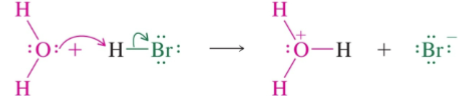
Why are multiple curved arrows sometimes needed in a reaction?
Multiple curved arrows are used when more than one pair of electrons moves during a reaction.
Each arrow represents the movement of one electron pair.
What does each full-headed curved arrow represent?
ach full-headed arrow represents the movement of 2 electrons.
Therefore:
2 arrows = 4 electrons moved
3 arrows = 6 electrons moved
What can happen when one electron source donates electrons to break a bond?
One electron pair can form a new bond, while another electron pair leaves an existing bond.
This means you may need multiple curved arrows to show the complete electron flow.
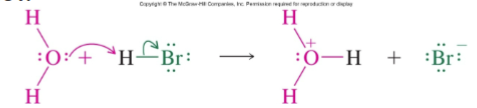
Does proton transfer involve electron movement?
Yes.
Although a proton (H⁺) is transferred from one atom to another, the electrons that form or break bonds move and are shown using curved arrows.
A curved arrow beginning at a multiple bond implies
movement of only
two of the electrons in the bond
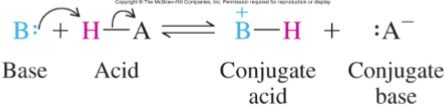
acid
donates a proton to a base
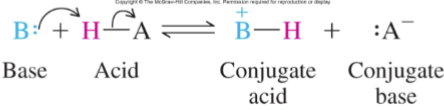
base
accepts a proton from an acid

conjugates
Species related by the addition or removal of a single proton

conjugate base
When an acid surrenders a proton in an acid-base reaction, its
conjugate base is formed
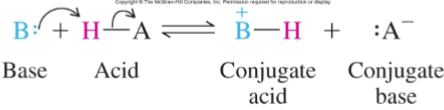
conjugate acid
When a base gains a proton in an acid-base reaction, its
conjugate acid is formed
What happens when an acid HA reacts with water?
Water reacts with the acid HA to form H₃O⁺ and A⁻.
HA + H₂O ⇌ H₃O⁺ + A⁻
What is the acid dissociation constant?
The acid dissociation constant, Ka, is the equilibrium constant for the reaction in which an acid HA reacts with water to form H₃O⁺ and A⁻.
What does Ka measure?
Ka measures the extent to which an acid dissociates in water.
A larger Ka means the equilibrium lies more toward the products, meaning more HA has dissociated.
What does a large Ka indicate about an acid?
A larger Ka indicates a stronger acid.
A strong acid has a greater tendency to donate its proton to water.
What does a small Ka indicate about an acid?
A smaller Ka indicates a weaker acid.
The equilibrium favors the undissociated acid HA more strongly.
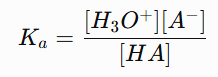
What is the Ka expression for HA reacting with water?
Water is not included in the expression because it is the solvent.
What is the relationship between Ka and acid strength?
Larger Ka → stronger acid
Smaller Ka → weaker acid
What is the conjugate base of HA?
The conjugate base is A⁻.
When HA donates H⁺, it becomes A⁻.
HA → H⁺ + A⁻
How is Ka related to Kb?
Ka for an acid is related to Kb for its conjugate base.
For a conjugate acid-base pair in water:
KaKb=Kw
At 25 °C:
KaKb=1.0×10⁻¹⁴
What is Kb?
Kb is the base dissociation constant. It describes the equilibrium associated with a base accepting a proton from water.
If an acid is very strong, what can you say about its conjugate base?
Its conjugate base is very weak.
Strong acid ↔ weak conjugate base
Weak acid ↔ stronger conjugate base
Why do chemists use pKa instead of Ka?
Ka values can span a very large range and are often much less than 1. Using the negative logarithm makes the numbers easier to work with.
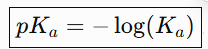
What is pKa?
pKa is the negative logarithm of the acid dissociation constant.
What is the relationship between pKa and acid strength?
Smaller pKa → stronger acid
Larger pKa → weaker acid
This is the opposite trend from Ka.
What does a very low pKa indicate?
A very strong acid that readily donates its proton.
What should you look for when comparing the structures of strong acids?
Look for common structural features that help stabilize the conjugate base after the acid loses H⁺.
A more stable conjugate base generally corresponds to a stronger acid.
How does acidity change when the structure of an acid changes?
Changes in molecular structure can change the stability of the conjugate base, which changes the acid's strength and therefore its Ka and pKa.
What determines acid strength structurally?
The key question is:
How stable is the conjugate base after the acid loses H⁺?
More stable conjugate base → stronger acid → larger Ka → smaller pKa.
What are the major structural factors that influence the acidity of a proton?
The important factors discussed here are:
Strength of the H–A bond
Electronegativity of atom A
Inductive effects
Electron delocalization/resonance in the conjugate base
When comparing two acids, focus on how their structures differ in these factors.
What is the most important general idea for predicting acidity?
How stable is the conjugate base after the proton is removed?
A more stable conjugate base → stronger acid → larger Ka → smaller pKa.
How does H–A bond strength affect acidity?
A weaker H–A bond makes it easier for the proton to be removed, so acidity increases.
Therefore:
Weaker H–A bond → stronger acid
Stronger H–A bond → weaker acid
What happens to H–A bond strength as the size of atom A increases?
As the atom bonded to H becomes larger, the H–A bond generally becomes weaker.
Therefore, acidity increases as the size of A increases in this comparison.
Why does a larger atom form a weaker H–A bond?
A larger atom has a larger valence shell, so the bonding electrons are farther from the nuclei. The H–A bond is therefore generally longer and weaker.
How does polarizability affect acidity?
Larger atoms are generally more polarizable, meaning their electron clouds can be distorted more easily.
A larger conjugate-base anion can better accommodate and spread out its negative charge, contributing to greater acidity.
What family of acids illustrates the effect of H–A bond strength particularly well?
The hydrohalic acids illustrate this effect.
As the halogen atom gets larger down the group, the H–X bond becomes weaker and acidity increases.
For hydrohalic acids:
HF < HCl < HBr < HI
in acid strength.
How does the electronegativity of atom A affect the acidity of H–A?
As the electronegativity of A increases, the H–A bond becomes more polarized and acidity increases.
Why does increasing electronegativity increase acidity?
A more electronegative atom pulls electron density away from H, giving H a larger partial positive charge (δ⁺).
This makes H more likely to be transferred as H⁺.
What happens to the partial charge on H when A becomes more electronegative?
The H atom becomes more partially positive (δ⁺).
Greater δ⁺ on H makes proton transfer more favorable.
What periodic trend illustrates the effect of electronegativity on acidity?
For covalent hydrides of second-row nonmetals, acidity increases as you move to the right across the periodic table because electronegativity increases.
How do Factors 1 and 2 differ?
Factor 1 — Bond strength:
Look at how strong the H–A bond is.
Weaker H–A bond → stronger acid
Factor 2 — Electronegativity:
Look at how electronegative A is.
More electronegative A → stronger acid
What is an inductive effect?
An inductive effect is the pulling or pushing of electron density through σ bonds caused by electronegative atoms or groups.
How do nearby electronegative atoms affect acidity?
Nearby electronegative atoms pull electron density away, increasing the partial positive charge on H and making the proton easier to remove.
Therefore:
More nearby electronegative atoms → greater acidity
What happens when the number of nearby electronegative atoms increases?
Acidity increases because the additional electronegative atoms pull more electron density away from the acidic proton.
What is the key idea behind induction?
Electronegative atoms act like an electron-withdrawing influence through bonds.
They "pull" electron density toward themselves.
Why is trifluoroethanol much more acidic than ethanol?
Trifluoroethanol contains three fluorine atoms, which are highly electronegative and strongly withdraw electron density through inductive effects.
This stabilizes the conjugate base and increases acidity.
What happens when electronegative atoms are farther away from the acidic proton?
Their inductive effect generally becomes weaker with increasing distance.
The closer the electron-withdrawing group is to the acidic site, the stronger its inductive effect tends to be.
What happens when an acid loses a proton?
Loss of H⁺ leaves behind a lone pair on the conjugate base.
That lone pair may or may not be stabilized by resonance.
How does resonance affect the conjugate base?
If the lone pair on the conjugate base can participate in resonance delocalization, the conjugate base is stabilized.
How does resonance stabilization of the conjugate base affect acid strength?
A more resonance-stabilized conjugate base means the acid can lose H⁺ more easily.
Therefore:
More resonance stabilization → stronger acid → lower pKa
Why does resonance stabilization make proton loss more favorable?
Removing H⁺ creates a negatively charged conjugate base. If that negative charge can be delocalized over multiple atoms, the conjugate base becomes lower in energy and more stable.
What does it mean to say that acid–base equilibria "favor the weak"?
Acid–base equilibria generally favor the side containing the weaker acid and weaker base.
The equilibrium tends to move toward the more stable acid/base pair.
What determines which side of an acid–base equilibrium is favored?
Compare the strengths of the acids on each side.
The equilibrium favors the side containing the weaker acid.
How can pKa values be used to predict the favored side of an acid–base equilibrium?
Compare the pKa values of the acids.
Higher pKa = weaker acid
Therefore, equilibrium generally favors the side with the higher-pKa acid.
If the acid on the reactant side has pKa = 5 and the acid on the product side has pKa = 10, which side is favored?
The product side is favored because the product acid has pKa = 10 and is therefore the weaker acid.
What does K > 1 mean for an equilibrium?
K > 1 means products are favored.
K < 1 means reactants are favored.
Lewis Acid =
Electron-pair Acceptor
How does Lewis acid–base theory differ from Brønsted–Lowry theory?
Brønsted–Lowry:
Acid = proton donor
Base = proton acceptor
Lewis:
Acid = electron-pair acceptor
Base = electron-pair donor
In the reaction BF₃ + OEt₂, which molecule is the Lewis base?
Diethyl ether (OEt₂) is the Lewis base because the oxygen atom donates a lone pair of electrons.
Why is diethyl ether a Lewis base?
Its oxygen atom has lone pairs of electrons that can be donated to another species.
What is another name for a Lewis base in organic chemistry?
A nucleophile.
A nucleophile is an electron-rich species that donates an electron pair.
What is another name for a Lewis acid in organic chemistry?
An electrophile.
An electrophile is an electron-deficient species that accepts an electron pair.
What does "nucleophile" mean?
Literally, it means "nucleus-loving." In practice, a nucleophile is an electron-pair donor that attacks an electron-deficient center.
What does "electrophile" mean?
Literally, it means "electron-loving." An electrophile is an electron-pair acceptor.
What types of atoms often act as nucleophiles?
Atoms with partial or full negative charges often act as nucleophiles because they are electron-rich.
Common examples include atoms bearing:
Negative charges
Lone pairs
Electron-rich π bonds
What types of atoms often act as electrophiles?
Atoms with partial or full positive charges often act as electrophiles because they are electron-deficient.
What happens in a typical polar organic reaction?
ou can think of it as an exchange of electrons between a nucleophile and an electrophile.
The nucleophile donates an electron pair.
The electrophile accepts that electron pair.