AQA GCSE Physics Energy
 Studied by 0 people
 Call Kai
 Learn
Learn Practice Test
 Spaced Repetition
 Match
Match Flashcards
 Knowt Play
1/56

There's no tags or description
Looks like no tags are added yet.
Name | Mastery | Learn | Test | Matching | Spaced | Call with Kai |
|---|
No study sessions yet.
57 Terms
A system
An object or a group of objects
Kinetic energy
What is the energy associated with movement?
Elastic potential energy
What type of energy is stored in stretched objects
Nuclear energy
What type of energy is found in the nuclei of atoms?
Gravitational Potential Energy
What type of energy is found in objects raised off the ground?
Thermal energy
What type of energy is stored as heat?
Chemical energy
What type of energy is found in bonds between substances?
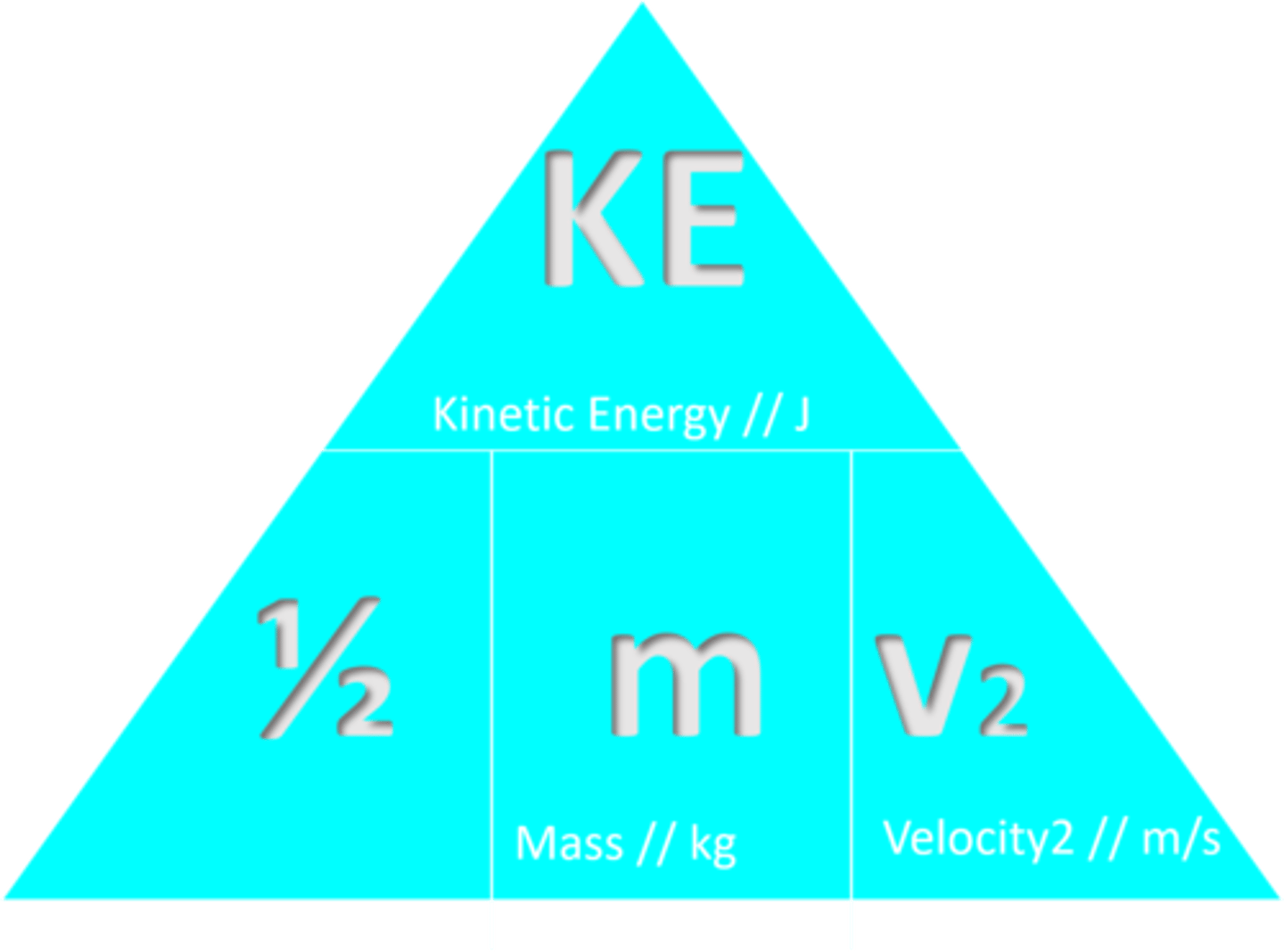
Kinetic energy = 0.5 x mass x speed^2
What is the equation to work out the kinetic energy of a moving object?
Elastic potential energy = 0.5 x spring constant x extension^2
What is the equation to work out the elastic potential stored in a spring?
Joules (J)
What is the unit for energy?
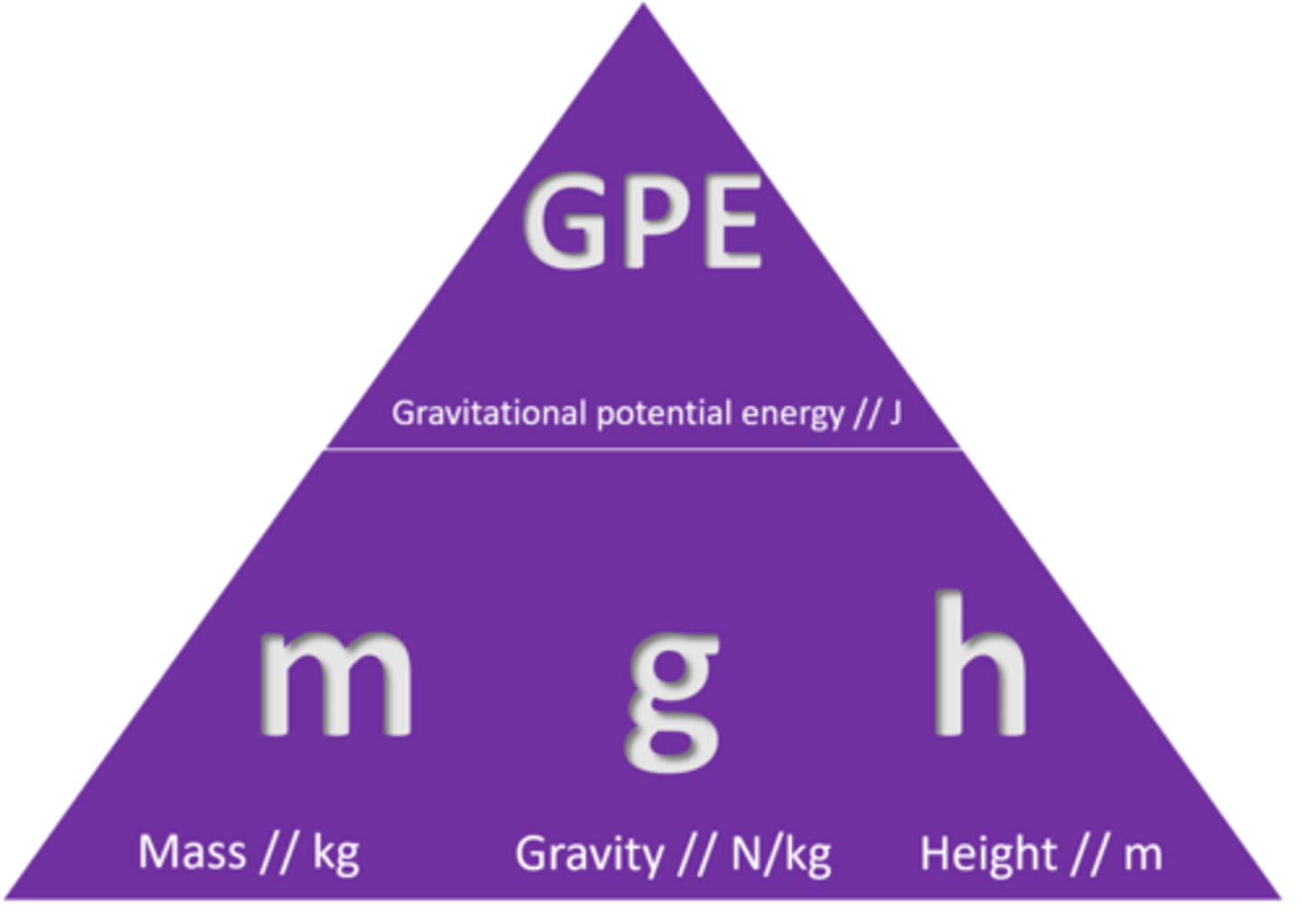
G.P.E = mass x gravitational field strength x height
What is the equation to work out gravitational potential energy of an object raised off the ground?
kg
What is mass measured in?
m/s
What is speed measured in?
N/m
What is spring constant (Ek) measured in?
m
What is extension measured in?
0.2m
If an object started at 5cm long and stretched to 25cm then what would be the value for extension?
N/kg
What is gravitational field strength measured in?
Change in thermal energy = mass x specific heat capacity x temperature change
How can you calculate the change in thermal energy?
The amount of energy required to increase the temperature of 1kg of a substance by 1 degree celsius
What is specific heat capacity?
Power
The rate at which energy is transferred or the rate at which work is done
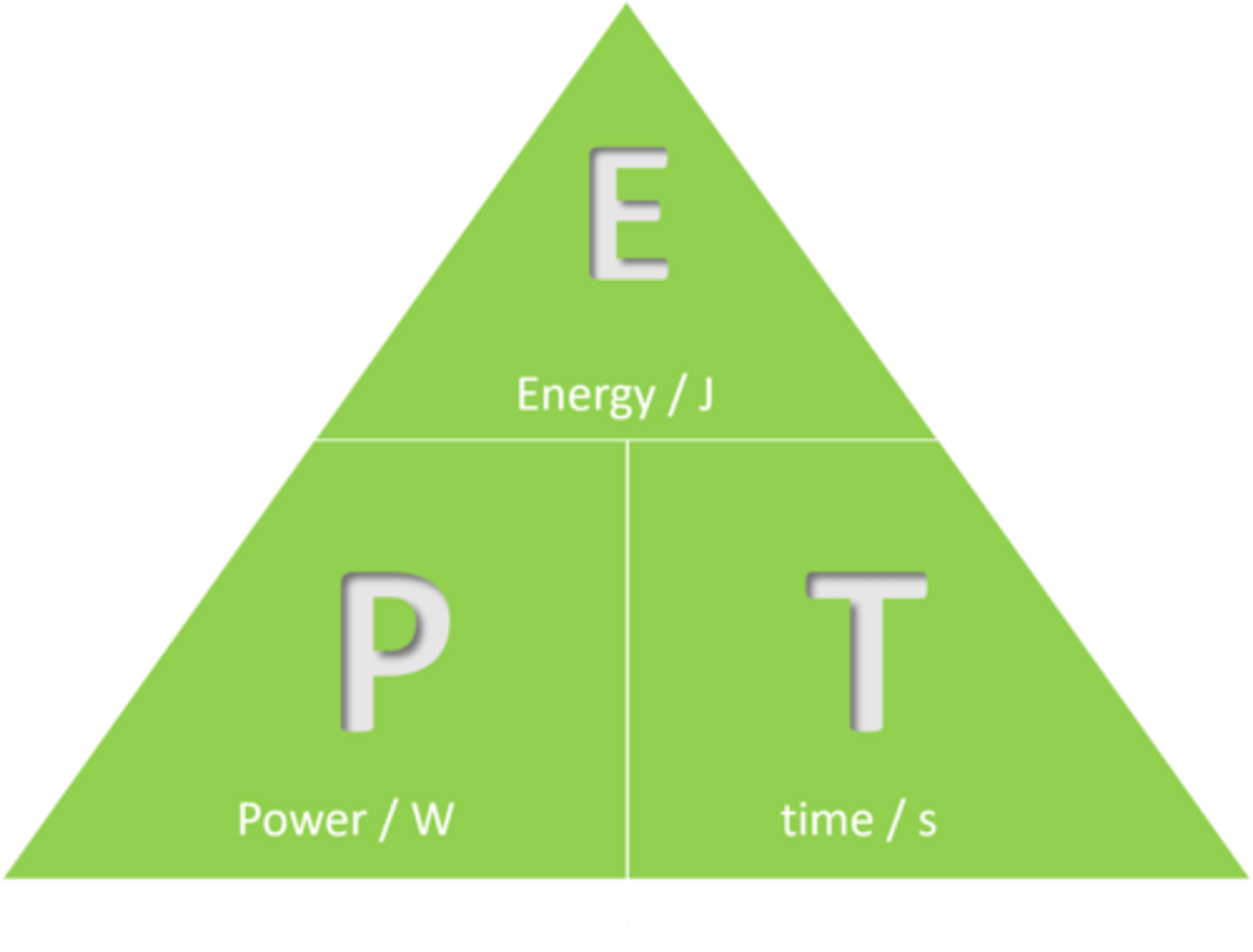
Power = Energy transferred / time
How do you calculate power using energy transferred?
Power = work done / time
How do you calculate power using work done?
Watts (W)
What is power measured in?
1J
How much energy is transferred each second if the power is 1W?
The higher the power, the faster the object would be lifted.
If you have two motors lifting a weight to the same height but one has more power, then what will be the difference between the rate at which they are lifted?
Energy can be transferred usefully, stored or dissipated, but cannot be created or destroyed
What is the law of the conservation of energy?
Wasted energy
What do we call energy that is dissipated?
There will be no net change in the total energy
In a closed system what will happen to the total energy?
Use lubricants or insulation to reduce energy being wasted as heat
How can we reduce the amount of waste energy in a system?
The higher the conductivity, the faster the rate of conduction
How does thermal conductivity of a material affect the rate of conduction across the material?
The thicker the wall, and the lower its conductivity, the slower it will lose heat.
How does the thickness of a wall affect the rate of cooling of a building?
Efficiency = Useful output energy transfer/total input energy transfer
How do you calculate efficiency using energy output?
Efficiency = useful power output/total power input
How do you calculate efficiency using power?
Fossil fuels (coal, oil and natural gas) and nuclear fuel
What are the main non-renewable energy resources on Earth?
Bio-fuel, wind, hydroelectric, geothermal, tidal, solar and wave
What are the main renewable energy resources on Earth?
Transport, electricity generation and heating
What are the main uses of energy resources?
Wind
Which energy resource depends on the wind, and is very changeable?
Solar
Which energy resource isn't great in the UK as we don't get much Sun?
Hydroelectric
Which energy resource depends on falling water in dams?
Tidal
Which energy resource depends on the movement of water as a result of the pull of the moon?
Geothermal
Which energy resource depends on the heat of the Earth?
Wave
Which energy resource depends on the sea being rough?
Bio-fuel
Which energy resource depends on organic material being burned?
They won't run out and do not release greenhouse gases
Why are renewable resources preferable to non-renewable resources?
They will run out
What is the problem with non-renewable resources?
It deals with radioactive material and if there is a meltdown then the radioactive environment is uninhabitable
What is the problem with nuclear energy?
It release huge amounts of energy
What is the good thing about nuclear energy?
They are running out and release greenhouse gases such as carbon dioxide. Gases such as sulfur dioxide and nitrogen oxides can also lead to acid rain.
What is the problem with fossil fuels?
Kinetic
Gravitational potential
Elastic potential
Chemical
Thermal
Nuclear
Electrostatic
Magnetic
What are the 8 energy stores?
Heating
Radiation - sound and light
Electrically
Mechanically - forces
What are the 4 energy transfers?
The Conservation of Energy Law
Energy cannot be created or destroyed. It can only be transferred, stored or dissipated.
How is efficiency presented?
Presented as a ratio - it has no units
Work done
When a force moves an object through a distance, energy is transferred.
Power
How quickly you can transfer energy, or the rate of energy transfer
Since energy transferred and work done are the same, it can also be the rate at which work is done.
Power = Energy transferred / time
P = E/t
Kinetic Energy = 0.5 x mass x velocity squared
KE = 0.5 x m x v^2
Gravitational Potential Energy = mass x gravitational field strength x hieght
GPE = mgh