Neuroscience Lecture Review - Neurons, Glia, Anatomy, Development, and Neurotransmission
 Call Kai
 Learn
Learn Practice Test
 Spaced Repetition
 Match
Match Flashcards
 Knowt Play
1/59

Earn XP
Description and Tags
Vocabulary flashcards covering foundational neuroscience concepts including cell structure, brain anatomy, neural development, electrophysiology, and neurotransmitter systems.
Name | Mastery | Learn | Test | Matching | Spaced | Call with Kai | Chat |
|---|
No analytics yet
Send a link to your students to track their progress
60 Terms
Dualism
The philosophical position that the mind and body are separate entities.
Monism
The philosophical position that the mind and body are the same, viewing the mind as a product of the brain.

Nissl stain
A cell-staining method used to visualize cell bodies in neural tissue.
Golgi stain
A cell-staining technique using silver chromate to highlight complete cellular structures in nervous tissue.
Immunohistochemistry
A visualization technique using a primary antibody against a specific protein followed by a fluorescent secondary antibody that binds to the primary antibody.
Neuron doctrine
The concept discovered by Santiago Ramón y Cajal stating that the brain is composed of distinct individual cells that communicate via synapses.
Reticular theory
The disproven theory proposed by Camillo Golgi asserting that brain cells form a continuous, fully connected network.
Phrenology
A historical field that attempted to identify personality traits by skull shape, which introduced the concept of functional localization despite being incorrect in its methodology.
Broca's aphasia
A condition discovered by Paul Broca where speech impairment occurs due to damage in the left temporal lobe.
Unipolar neuron
An anatomical classification of a neuron featuring a single extension that branches in two directions, forming a receptive pole and an output zone.
Bipolar neuron
A neuron with one axon and one set of dendrites, typically serving sensory functions such as sight and touch.
Multipolar neuron
The most common anatomical type of neuron in the brain, characterized by a single axon and many dendrites.
Astrocytes
Star-shaped neuroglial cells in the CNS that maintain the blood-brain barrier, regulate neurotransmitter and ion levels around synapses, and provide metabolic support to neurons.
Microglia
The brain's immune cells that clear out dead cells and pathogens via phagocytosis following injury.

Oligodendrocytes
Glial cells that form the myelin sheath around axons within the Central Nervous System (CNS).
Schwann cells
Glial cells that produce myelin for neurons in the Peripheral Nervous System (PNS) and assist in neuronal regeneration.
Ependymal cells
Glial cells lining the fluid-filled spaces, ventricles of the brain, and spinal cord that produce cerebrospinal fluid (CSF).
Satellite cells
Glial cells in the PNS that surround neuron cell bodies in ganglia and regulate neurotransmitter levels around those cell bodies.
Somatic Nervous System
A division of the Peripheral Nervous System (PNS) that connects the brain to major sensory and motor systems, controlling voluntary movement and skeletal muscles.
Autonomic Nervous System
A division of the Peripheral Nervous System (PNS) containing nerves that connect to internal organs (viscera).
Afferent
Refers to neural flow or nerve impulses directed inward toward a region of interest.
Efferent
Refers to neural flow or nerve impulses directed outward away from a region of interest.

Gyri
The raised ridges of tissue located on the surface of the cerebral cortex.
Sulci
The valleys or furrows separating gyri on the cerebral cortex.

Sylvian fissure
The lateral fissure that divides the temporal lobe from the frontal and parietal lobes.
Precentral gyrus
A prominent structure located in the frontal lobe responsible for motor control.
Postcentral gyrus
A prominent structure located in the parietal lobe responsible for processing touch sensory information.
Sympathetic Nervous System
A branch of the autonomic nervous system that prepares the body for immediate fight-or-flight action.
Parasympathetic Nervous System
A branch of the autonomic nervous system that promotes relaxation, rest, and digestion.
Ectoderm
The outermost cell layer of an embryo, which eventually develops into the nervous system and skin.

Prosencephalon
The primary embryonic division corresponding to the forebrain, which further divides into the telencephalon and diencephalon.
Mesencephalon
The primary embryonic division corresponding to the midbrain.
Rhombencephalon
The primary embryonic division corresponding to the hindbrain, which further divides into the metencephalon and myelencephalon.
Radial glial cells
Specialized glial cells that act as guides for migrating neurons moving away from the ventricular zone during embryonic development.
Growth cone
A specialized sensory structure at the tip of a growing axon that senses environmental signals to direct the axon to its target cell.
Apoptosis
Programmed neuronal cell death that occurs naturally to prune excess overproduced cells.
Neurotrophic factors
Target-derived chemical signals that developing neurons compete for in order to survive.
Hebbian synapse
A synapse that increases in strength when presynaptic activity successfully drives activity in the postsynaptic cell.
Epigenetics
Modifications to the genome that alter gene expression without changing the underlying DNA sequence.
Diffusion
The passive movement of ions along a concentration gradient from an area of higher concentration to lower concentration.
Electrostatic pressure
The force driving charged particles toward opposite charges and away from like charges.
Resting potential
The difference in electrical charge across a neuron's membrane when it is inactive, typically measured at −65mV.
Sodium-potassium pump
A membrane protein mechanism that uses ATP to transport 2K+ into the cell and 3Na+ out of the cell against their concentration gradients.
Action potential threshold
The critical membrane depolarization level (approximately −40mV) required to fire an all-or-none action potential.
Absolute refractory period
The time frame following an action potential during which no further action potential can be generated due to closed Na+ inactivation gates.
Relative refractory phase
The period following the absolute refractory phase during which only an unusually strong stimulus can evoke a new action potential.
Excitatory Postsynaptic Potential (EPSP)
A localized depolarization of the postsynaptic membrane caused by Na+ influx (typically via glutamate) that pushes the neuron closer to threshold.
Inhibitory Postsynaptic Potential (IPSP)
A localized hyperpolarization of the postsynaptic membrane caused by Cl− influx (typically via GABA) that pushes the neuron farther from threshold.
Spatial summation
The integration of postsynaptic potentials originating from distinct physical locations across the dendrites and soma at the axon hillock.
Temporal summation
The integration of postsynaptic potentials arriving at the axon hillock at different points in time.
Electrical synapses
Direct connections between adjacent neurons mediated by gap junctions that allow fast, direct ion passage without neurotransmitter release.
Mesostriatal pathway
A dopaminergic pathway originating in the substantia nigra and projecting to the basal ganglia, playing a critical role in motor control.
Mesolimbocortical pathway
A dopaminergic pathway originating in the ventral tegmental area (VTA) and projecting to the nucleus accumbens and cortex, central to reward processing.
Tonic-clonic seizure
A seizure disorder featuring widespread abnormal brain activity marked by slow movements (tonic) followed by rhythmic jerking (clonic), leaving the patient confused and sleepy.
Absence seizure
A short, non-convulsive seizure characterized by rhythmic brain activity during which the individual stops current actions and stares into space.
Ionotropic receptors
Fast-acting, ligand-gated ion channels that open directly upon neurotransmitter binding.
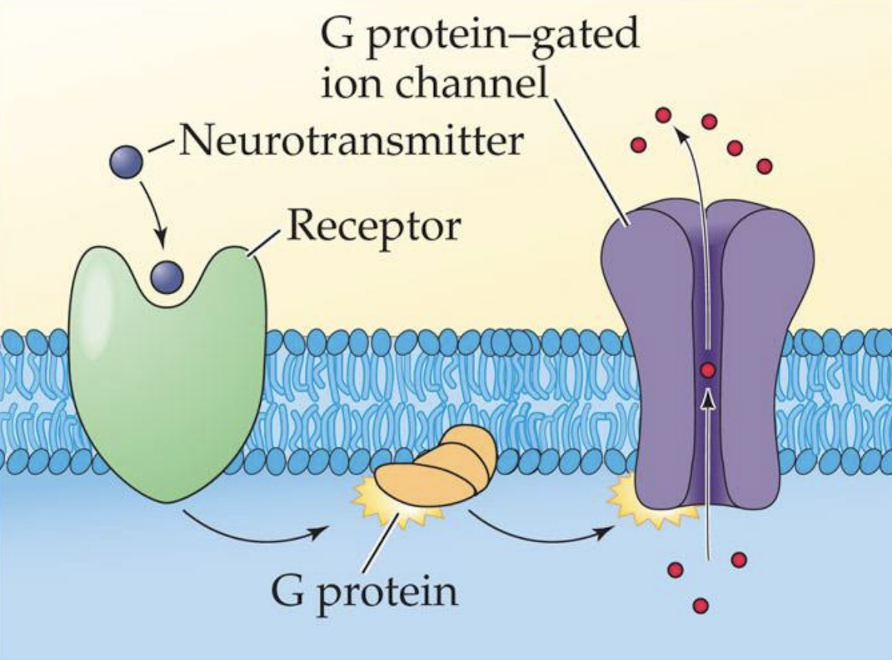
Metabotropic receptors
Slow-acting receptors featuring 7 transmembrane domains coupled to intracellular G-proteins that indirectly open ion channels or activate second messenger pathways.
AMPA receptor
An ionotropic, rapid-acting glutamate receptor subtype widely distributed throughout the brain.
NMDA receptor
An ionotropic glutamate receptor subtype critical for synaptic plasticity and memory formation.

Yerkes-Dodson Law
An empirical rule stating that task performance varies with arousal level, where simple tasks benefit from high arousal and complex tasks require moderate arousal, correlating with norepinephrine levels.