OC Test #6
 Call Kai
 Learn
Learn Practice Test
 Spaced Repetition
 Match
Match Flashcards
 Knowt Play
1/13

There's no tags or description
Looks like no tags are added yet.
Name | Mastery | Learn | Test | Matching | Spaced | Call with Kai | Chat |
|---|
No analytics yet
Send a link to your students to track their progress
14 Terms
Which compound is more likely to undergo elimination in the presence of methoxide?

A.
Compound 1
B.
Compound 2
C.
Both are equally likely to undergo elimination
D.
Compound 1 due to a decreased change for substitution
E.
Compound 2 due to hydrogen bonding
A.
Compound 1
compound 2 is too sterically hindered
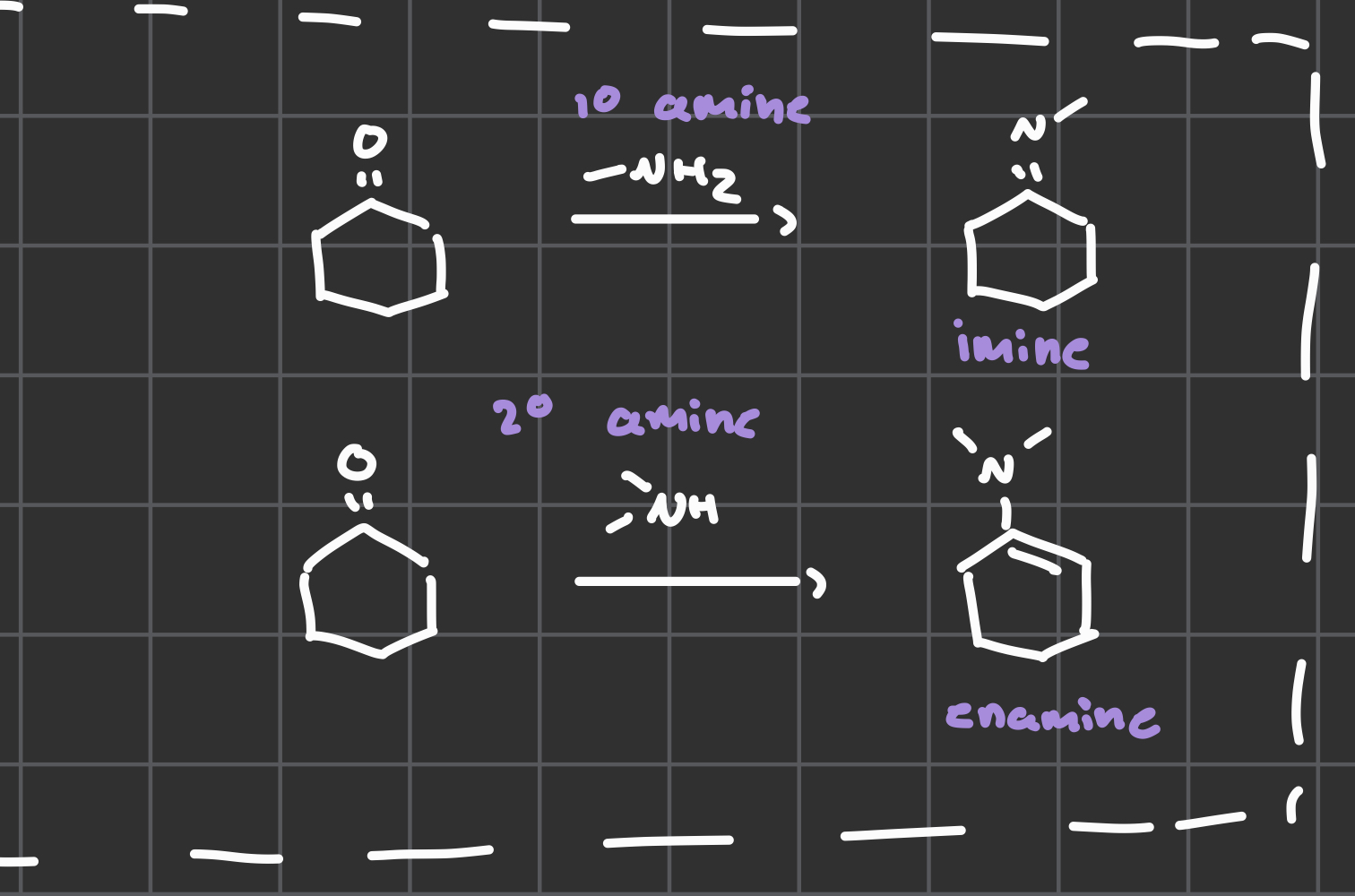
Methylamine is reacted with cyclohexanone in the presence of catalytic H2SO4. What is the final product of the reaction?
A.

B.

C.

D.

E.

B.

What are the partial charges on chlorine and bromine in the following pentavalent transition state?

A.
Chlorine: δ+ ; Bromine: δ+
B.
Chlorine: δ- ; Bromine: δ+
C.
Chlorine: δ- ; Bromine: δ-
D.
Chlorine: δ+ ; Bromine: δ=
E.
There should be no partial charges
C.
Chlorine: δ- ; Bromine: δ-
A separatory funnel contains water and dichloromethane. Dichloromethane is denser than water. If NH3 were added into this funnel, where would it be found?
A.
The top layer (organic)
B.
The top layer (aqueous)
C.
The middle at the interface between the organic and aqueous layers
D.
The bottom layer (organic)
E.
The bottom layer (aqueous)
B.
The top layer (aqueous)
In chemistry labs, the separatory funnel allows chemists to separate immiscible liquids. We are told that dichloromethane is denser than water, so the organic DCM layer will be found below the aqueous water layer. NH3and water are both capable of donating and accepting hydrogen bonds, and thus ammonia will be located in the aqueous (top) layer. On the other hand, dichloromethane is incapable of hydrogen bonding, so it will be confined to the organic layer. Be careful — usually, the organic layer is above the aqueous layer, however, DCM is denser than water (the density was stated in the question). Ammonia will be found at the top of the aqueous layer.
iven the following reactant and product, predict the arrow-pushing mechanism.

A.

B.

C.

D.

E.

B.
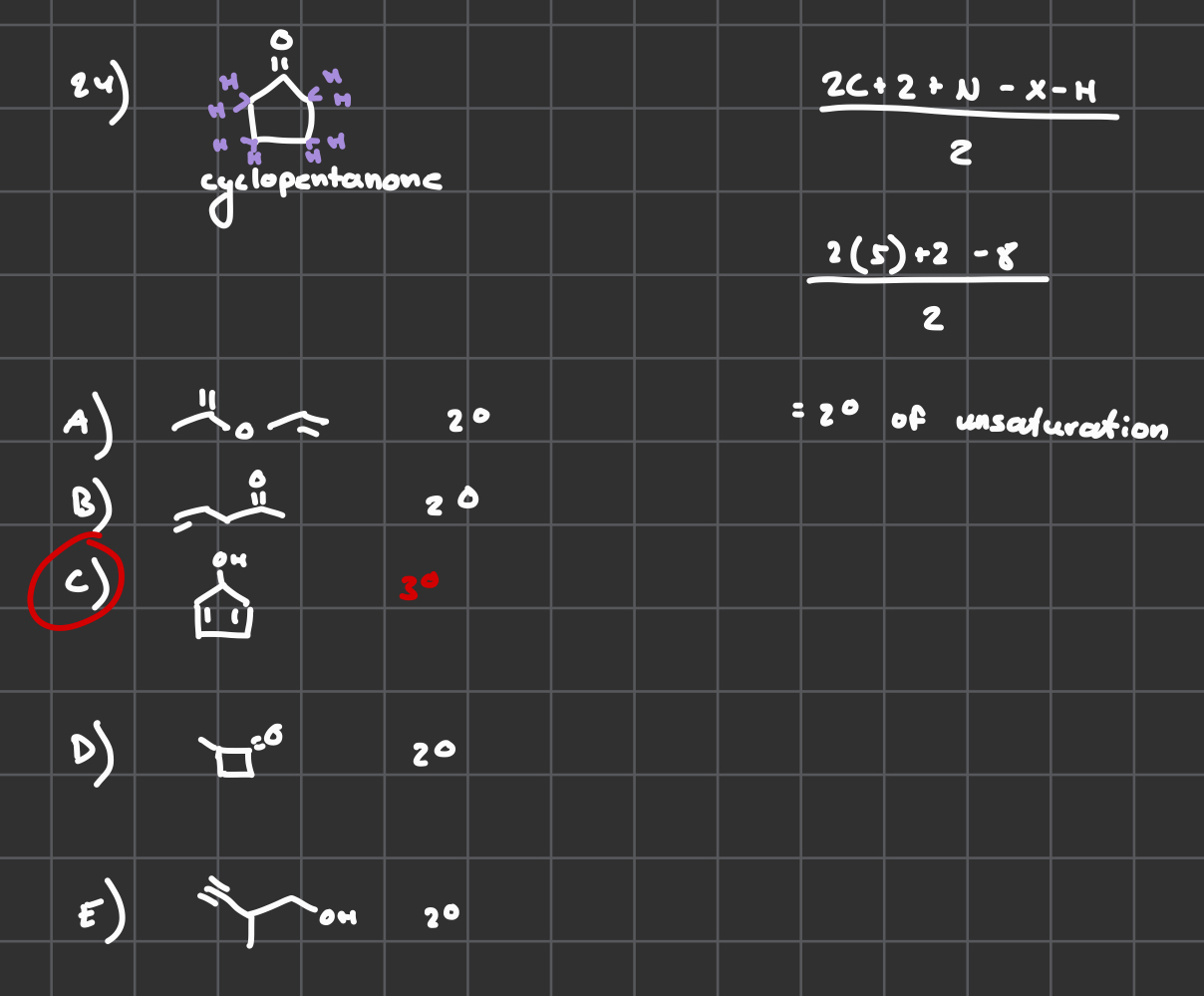
Each of the following compounds is a constitutional isomer of cyclopentanone EXCEPT one. Which is the EXCEPTION?
A.

B.

C.

D.

E.

C.
An aldol condensation is performed in an experiment. What is a possible name for a product?
A.
2-methyl-4-pentenal
B.
3-ethyl-3-hexenal
C.
3-hydroxypropanal
D.
2-hydroxybutanal
E.
3-methyl-2-pentenal
E.
3-methyl-2-pentenal

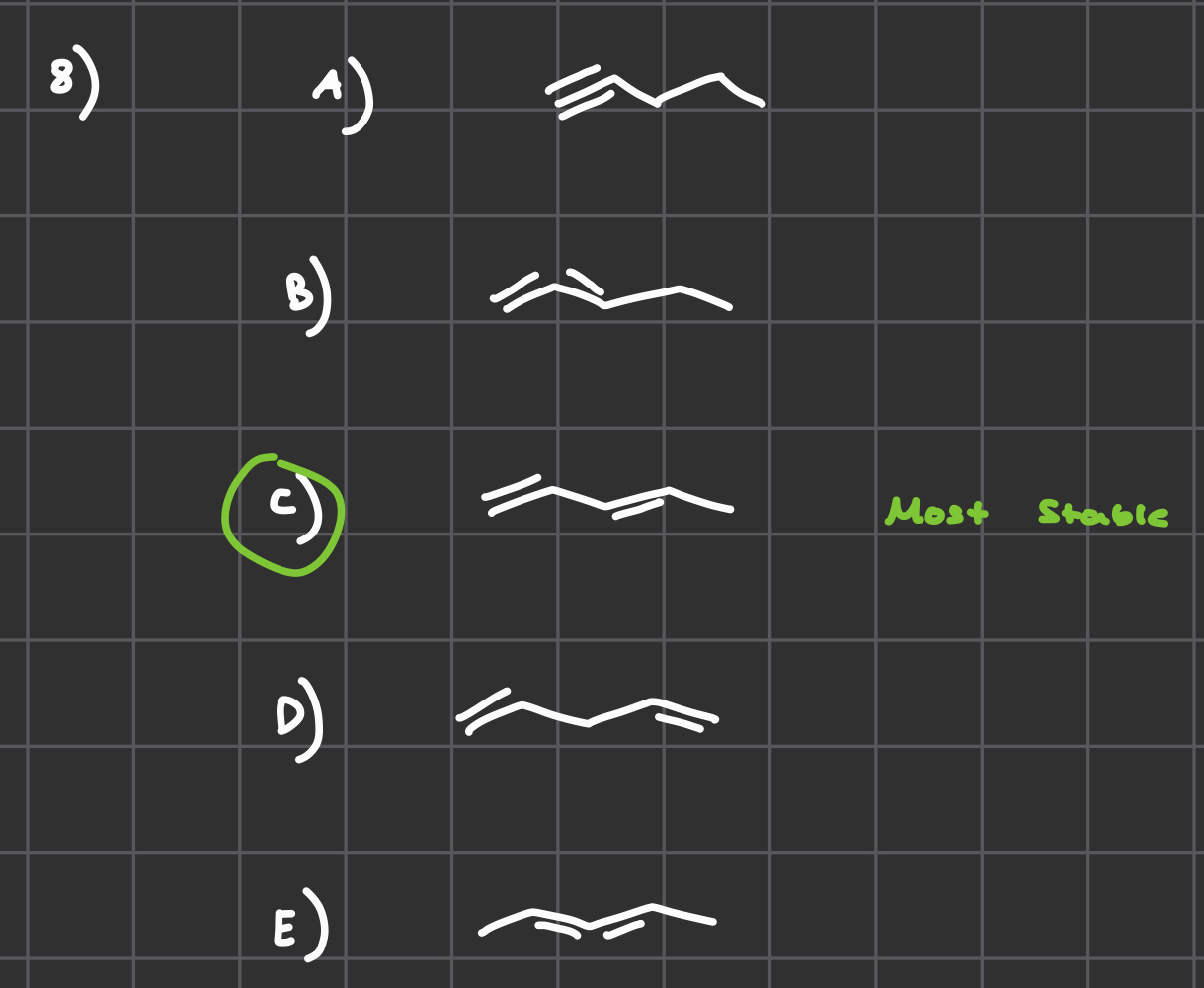
Which of the following compounds is the most stable form of C5H8?
A.
HCCCH2CH2CH3
B.
CH2CCHCH2CH3
C.
CH2CHCHCHCH3
D.
CH2CHCH2CHCH2
E.
CH3CHCCHCH3
C.
CH2CHCHCHCH3
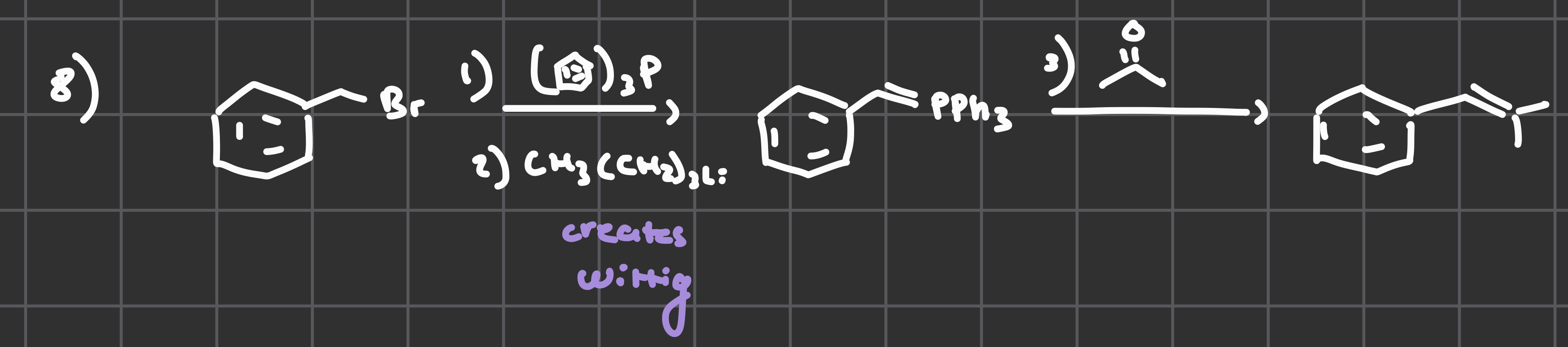
Identify the product of the following reaction sequence.

A.

B.

C.

D.

E.

A.
Identify the least acidic hydrogen.

A.
B.
C.
D.
E.
C.
Aldehyde H cannot be deprotonated so its the least acidic
What is the name of the reaction that occurs?

A.
Self aldol condensation
B.
Crossed aldol condensation
C.
Self Claisen condensation
D.
Crossed Claisen condensation
E.
Dieckmann condensation
E. Dieckmann Condensation
Dieckman condensation is an intramolecular ester thing (Claisen condensation)
Which of these radical structures is the most stable?
A.

B.

C.

D.

E.

A.
Radical stability is the same as carbocation stability
Which reagent would transform the following molecule to a molecule that does not rotate plane-polarized light?

A.
CH3OH
B.
NaBH4, EtOH
C.
KMnO4
D.
FeBr3
E.
H2O
C.
KMnO4
WIll make it achiral

Which of the following dissolves better in water: CH3CH2OH or CH3(CH2)4OH?
A.
Ethanol due to a shorter hydrocarbon chain
B.
Ethanol due to stronger Van der Waals interactions with water
C.
Pentanol due to a longer hydrocarbon chain
D.
Pentanol due to stronger hydrogen bonding with water
E.
Must be determined experimentally
A.
Ethanol due to a shorter hydrocarbon chain
Longer hydrocarbon chains disrupt H bonding