Spectroscopy and Lab techniques
 Call Kai
 Learn
Learn Practice Test
 Spaced Repetition
 Match
Match Flashcards
 Knowt Play
1/35

There's no tags or description
Looks like no tags are added yet.
Name | Mastery | Learn | Test | Matching | Spaced | Call with Kai | Chat |
|---|
No analytics yet
Send a link to your students to track their progress
36 Terms
Alcohol (OH)
3200-3500 cm-1
Large, broad peak
Amine (N-H)
3200-3500 cm-1
Sharp peak
Secondary amine (-NR2H): 1 peak
Primary amine (-NRH2): 2 peaks
Carboxylic Acid
(-COOH)
2500-3500 cm-1
Broad jagged peak
Nitrile (C≡N)
2200-2250 cm-1
Medium peak
Carbonyl (C=O)
1700-1750 cm-1
Large, sharp peak
Aromatic (C=C)
1450-1600 cm-1
Medium peak
Fingerprint Region
400-1500 cm-1
Complicated pattern of peaks
H NMR
Carboxylic acid (RCO₂H)
11–14 ppm
Aldehyde (RCHO)
9–10 ppm
Aromatic H
6.5–8.5 ppm
Phenol (PhOH)
6–8 ppm
sp² C–H (alkene H)
5–6.5 ppm
Amide N–H (RCONH)
5–9 ppm
Amine N–H (R₂NH)
1–5 ppm
Alcohol O–H (ROH)
1–5 ppm
sp³ C–H
0.5–4 ppm
C NMR
Ketone / Aldehyde C — RCOR, RCHO
190–235 ppm
Ester / Amide / Acid chloride / Carboxylic acid C — RCOOR, RCONH₂, RCOCl, RCOOH
150–180 ppm
sp² C — C=C
100–160 ppm
Aromatic C
90–150 ppm
sp³ C — C–C
0–100 ppm
Degrees of Unsaturation =
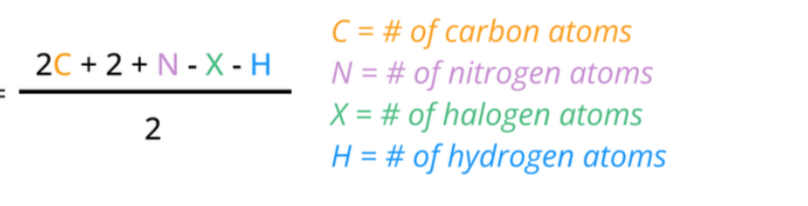
each pi bond is
1 degree of unsaturation
each ring is
1 degree of unsaturation
m/z ratio
mass to charge ratio
molecular ion peak is
the rightmost peak
it represents the compounds molecular mass
base peak is
the most stable molecular fragment
if M+ and M+2 peak are in a 1:1 height ratio
Br is present
if M+ and M+2 peak are in a 3:1 height ratio
cl is present
greater conjugation in uv vis
means longer wavelengths will be absorbed
higher max absorption (λmax)
more conjugated pi bonds
the larger the Rf value
the less polar it is
Rf =
