ch 10 unfin fuller draft
 Call Kai
 Learn
Learn Practice Test
 Spaced Repetition
 Match
Match Flashcards
 Knowt Play
1/14

There's no tags or description
Looks like no tags are added yet.
15 Terms
CONCEPT 10.1: Catabolic pathways yield _____ by ______ organic fuels
CONCEPT 10.1: Catabolic pathways yield energy by oxidizing organic fuels
– Photosynthesis uses CO2 and H2O to make organic molecules and O2
– Cellular respiration uses O2 and organic molecules to make ATP; CO2 and H2O are produced as waste
processes central to cellular respiration:
Catabolic pathways release stored energy by breaking down complex molecules
Electron transfer from food molecules to other molecules plays a major role in these pathways
Catabolic Pathways and Production of ATP
exergonic process of organic molecule breakdown, not directly powering work in the cell; linked to work by ATP
Fermentation (anaerobic):
partial degradation of sugars that occurs without oxygen
Aerobic respiration
consumption of organic molecules and oxygen to yield ATP
(Anaerobic respiration is similar to aerobic respiration but consumes compounds other than oxygen)
Catabolic = breaks down complex molecules = exergonic (releases energy)— cellular respiration
Anabolic = builds complex molecules = endergonic (absorbs)— photosynthesis
Cellular respiration
a redox process; energy is released as hydrogen and electrons are transferred to O atoms (w a lower energy state) (fuel molecules (such as glucose) are oxidized, and O2 is reduced)
includes both aerobic and anaerobic respiration but often refers to the former— traced by the sugar glucose, although carbohydrates, fats, and proteins are also fuelC6H12O6 + 6 O2 → 6 CO2 + 6 H2O + Energy (ATP + heat)
Redox Reactions
electron transfer during chemical reactions releasing energy stored in organic molecules used ultimately to synthesize ATP (aka oxidation-reduction reactions)
OILRIG: loss of electrons from a substance is called oxidation and
addition of electrons to a substance is reduction (the amount of positive charge is reduced)
reducing agent: electron donor which reduces the electron acceptor
oxidizing agent: electron acceptor which oxidizes the electron donor
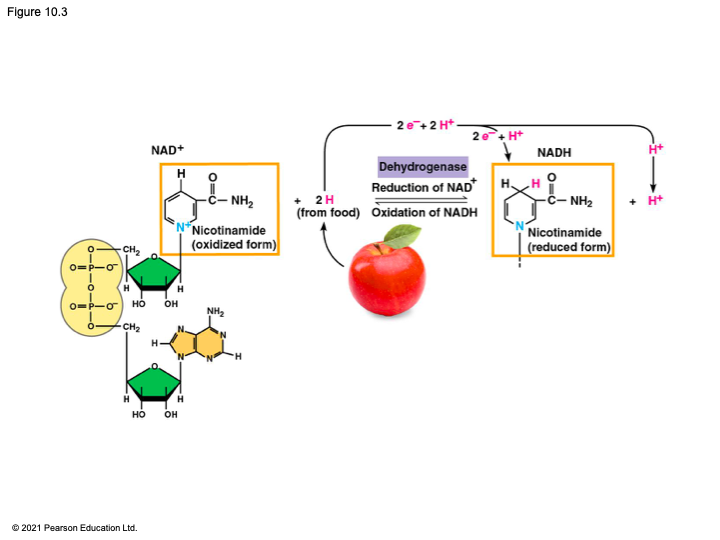
NAD+
nicotinamide adenine dinucleotide
coenzyme that functions as an electron carrier and an electron acceptor, functioning as an oxidizing agent during cellular respiration
NADH
the reduced form of NAD+ that represents stored energy tapped to synthesize ATP, formed when 2 electrons and 1 proton is transferred to NAD+ when enzyme dehydrogenase removes a pair of hydrogen atoms (2 electrons and 2 protons) from the substrate w the other proton released as a hydrogen ion (H+)
electron transport chain
a series of molecules built into the inner membrane of the mitochondria (or plasma membrane of prokaryotes) used in cellular respiration to break the fall of electrons to O2 into several energy-releasing steps
(If NADH transferred electrons directly to oxygen, energy would be released in one explosive reaction) (Fig. 10.4)
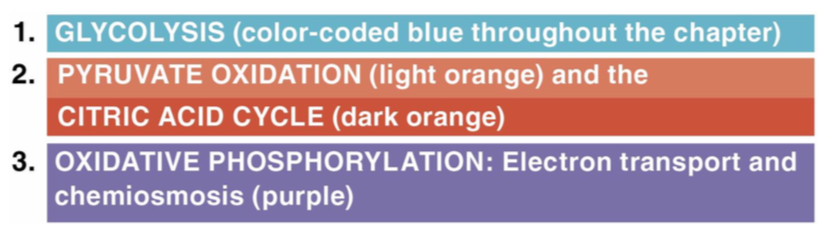
The 3 Stages of Cellular Respiration
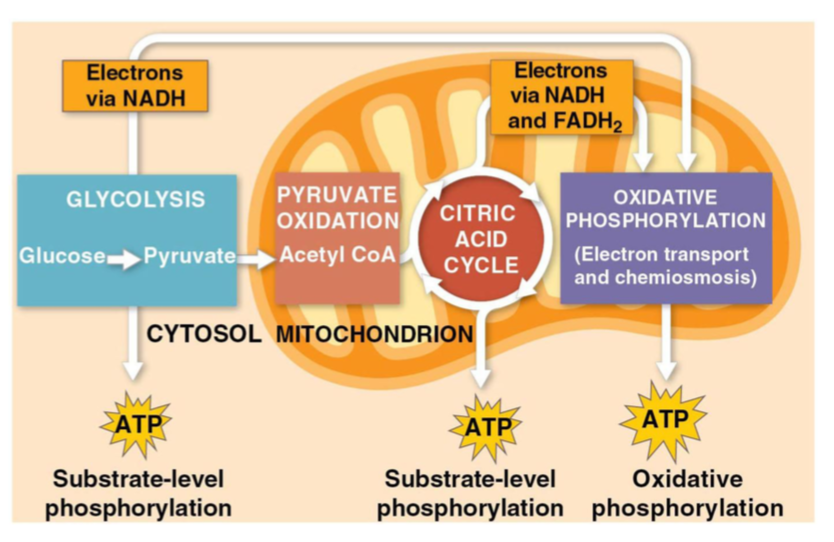
Glycolysis breaks down glucose into two molecules of pyruvate
Pyruvate oxidation* and the citric acid cycle complete the breakdown of glucose to CO2
During oxidative phosphorylation the electron transfer chain and chemiosmosis facilitate synthesis of most of the cell’s ATP
Glycolysis and the Citric Acid Cycle are the upstream rivers gathering the water (electrons). The Electron Transport Chain is the physical dam structure that blocks the water to build up a massive, high-pressure reservoir of water (H+). Chemiosmosis is the water spinning the physical turbine (ATP synthase) to finally generate electricity (ATP)
oxidative phosphorylation
process that generates almost 90% of the ATP, powered by redox reactions with two main steps: the ETC (the generator) and chemiosmosis
substrate-level phosphorylation
ATP forming in glycolysis and the citric acid cycle when an enzyme transfers a phosphate group directly from a substrate to ADP