human genetics
 Call Kai
 Learn
Learn Practice Test
 Spaced Repetition
 Match
Match Flashcards
 Knowt Play
1/23

There's no tags or description
Looks like no tags are added yet.
Name | Mastery | Learn | Test | Matching | Spaced | Call with Kai | Chat |
|---|
No analytics yet
Send a link to your students to track their progress
24 Terms
what are somatic cells?
non reproductive cells (most cells)
dont produce gametes, diploid, cell division 2 copies of each chromosome
describe human chromosomes (number, pairs, autosomes)
46 human chromosomes - 23 homologous pairs
22 are autosomes(nonsex) 1 thourgh 22
23rd pair is s ex chromosomes
what is the point of the cell cycle
series of events, cell growth, dna replication and cell division
result in 2 daughter cells - genetically identical to parent cell
interphase and mitotic phase
what happens in interphase?
normal process, preparing for cell division tho
three stages
G1 - first gap, no visible change but cell accumulates building blocks DNA and energy
S - DNA replication - 2 copies of chromosomes(sister chromatids), centrosome duplicates - mitotic spindle - movement of chromosomes
G2 - second gap, cell replenish energy, organelles duplicated, mitotic spindle dismantled, grows in size to prepare for mitotic phase
what is the secret g0 stage?
some cells will exit cell cycle and enter g0, inactive stage, can br triggered by cellular cues to reenter cycle
whats the difference between sister chromatids and homologous chromosomes
sister chromatids are joined to its copy by centromere(kinetochore)- identical replicated copies
homologus chromosomes - pair of seperate chromosomes, one from each parent
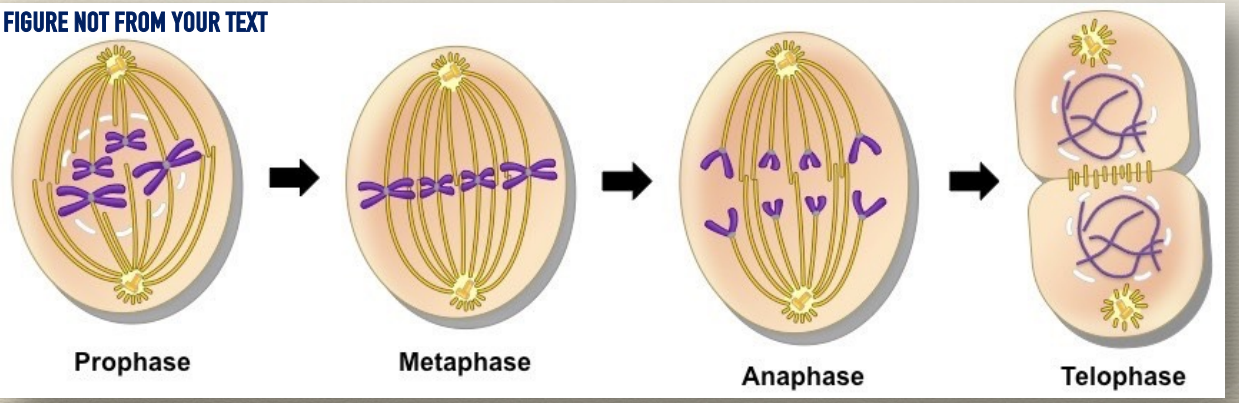
describe the mitotic phase
make two daughter cells
prophase - condensing of chromosomes, spindle fibers merge, movement
metaphase - lined up at metaphase plate, sister chromatids attach to spindle fiber
anaphase - centromeres split, pulled towards opposite poles
telophase - at opposite poles, begin decondense, mitotic spindle breaks down
cytokinesis - filaments constrict, form cleavage seperates daughter cells
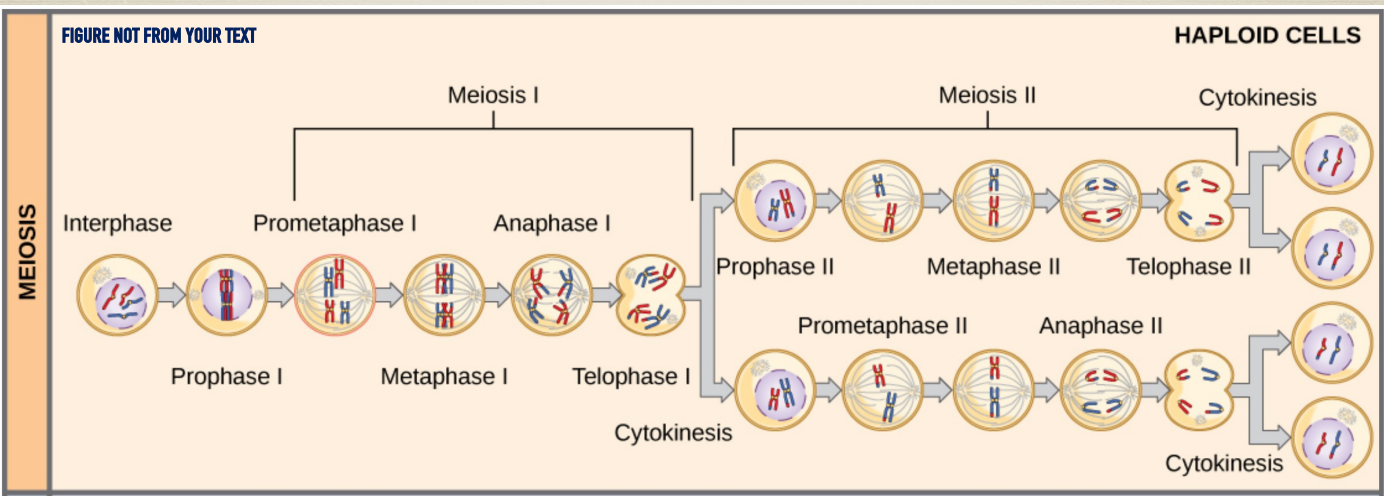
what is meiosis (meiosis I)
human germ cells form gametes - produce 4 daughte cells (1n) haploid/half # of chromies
in meiosis 1: 2 haploid daughter cells
prophase 1 = condense, CROSSING OVER(homologous pairs exchange genetic material)
metaphase 1 - move to equator
anaphase 1 - move to opposite poles SEPERATION OF HOMOLOGOUS CHROMOSOMES
telophase 1 - gather at poles, divide
what happens and outcome of meiosis II
prophase II - sindle forms around chromosomes
metaphase II - line up at equator
anaphase II - centromeres divide, move to opposite poles of cell SEPERATION OF SISTER CHROMATIDS
telophase/cytokinesis - envelope forms, cytoplasm divides
result in 4 daughter cells total,
define genotype, gene, phenotype, allele
genotype - genetic makeup
gene - code for amino acifd sequence - make protein
phenotype - characteristic code
allele - code for variation of characteristic - trait
homozygous vs heterozygous
humans are diploid 2 alleles for each gene
homozygous - two identical alleles
heterozygous - two different alleles (one may be dominant)
human traits can be much more complex (50 genes for eye colour) - 2 alleles each
who was mendel, what were his hybridization experiments
scientist, uses pea plants as primary model system to study inheritance patterns
30,000 pea plants, demonstrates that traits are transmitted from parents to offspring in specific patterns
hybridizations - mating two individuals with two different traits for a single characteristic
in pea plants, would be colour of flower petals - character trait would be white colour
what is the law of segregation
paired genes must seperate equallty into gametes, so offspring have an equal likelihood of inherting each gene -
ANAPHASE of meiosis I - homologoud pairs seperate
whats the difference between autosomal dominant and recessive
autosomal dominant - dominant allele on autosome
autosomal recessive - allelle causes a disorder on an autosome
what is X linked, x linked dominant and recessive
x linkage - when gene examined is present only on X chromosome
dominant - when its on the x chromosomes - more females affected
recessive - more males affected can only have it or not, females can be homozygous or heterozygous
what are lethal alleles?
alleles that result in failure of development in utero/shortening of lifespan
2 receeive lethal alleles - death, 1 dominant - death
huntingtons disease - nerve cell degeneration but not noticable till reproductive age
how do mutations arise
DNA copying errors, environmental causes like radiation or toxic chemcals
impact sequence of amino acids that make a protein
what are some chrosomal disorders
occur during metaphase I or II of meiosis, fail to seperate, move to opposite poles, nondisjunction!
downsyndrome - extra copy of chromie #21
turnder syndrome - 1 X chromosome
kleinfelter - 2 X 1 Y
can do a DNA test - small dvolume of blood to determine if person carries defect allele