B. Absorption
 Call Kai
 Learn
Learn Practice Test
 Spaced Repetition
 Match
Match Flashcards
 Knowt Play
1/104

There's no tags or description
Looks like no tags are added yet.
Name | Mastery | Learn | Test | Matching | Spaced | Call with Kai | Chat |
|---|
No analytics yet
Send a link to your students to track their progress
105 Terms
b. Absorption
Pharmacologically refers to the movement of a drug from its site of administration into the systemic circulation.
a. Distribution
b. Absorption
c. Metabolism
d. Excretion
c. Absorption
Physiologically defined as the rate of disappearance of the drug from the site of administration.
a. Distribution
b. Liberation
c. Absorption
d. Elimination
Simple, passive diffusion
Carrier-mediated transport
Convective transport
Ion transport
Pinocytosis
Different transport process (5)
c. Passive diffusion
Most common but slowest transport process for drug absorption.
a. Active transport
b. Facilitated diffusion
c. Passive diffusion
d. Endocytosis
b. Passive diffusion
Occurs from a region of high solute concentration to a region of low solute concentration.
a. Active transport
b. Passive diffusion
c. Pinocytosis
d. Filtration
b. Passive diffusion
Occurs along the concentration gradient.
a. Active transport
b. Passive diffusion
c. Endocytosis
d. Exocytosis
c. Passive diffusion
Does not require ATP or a carrier protein.
a. Active transport
b. Facilitated diffusion
c. Passive diffusion
d. Secondary active transport
d. Fick's Law of Diffusion
Governs the rate of passive diffusion.
a. Michaelis-Menten Equation
b. Henderson-Hasselbalch Equation
c. Noyes-Whitney Equation
d. Fick's Law of Diffusion
b. Increased diffusion coefficient
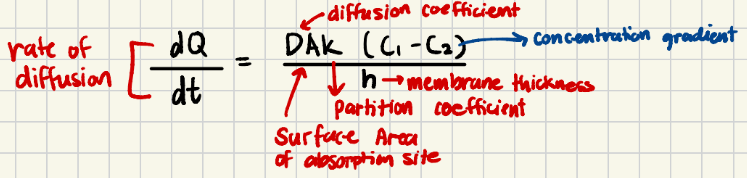
Increases the rate of diffusion according to Fick's Law.
a. Increased membrane thickness
b. Increased diffusion coefficient
c. Decreased surface area
d. Decreased concentration gradient
c. Increased
Increase in surface area of the absorption site results in a ________ rate of diffusion.
a. Decreased
b. Unchanged
c. Increased
d. Variable
a. Decreased
Increase in membrane thickness results in a ________ rate of diffusion.
a. Decreased
b. Unchanged
c. Increased
d. Variable

Factors that increase or decrease the rate of diffusion
b. Carrier-mediated transport
Transport process that is stereospecific.
a. Passive diffusion
b. Carrier-mediated transport
c. Filtration
d. Pinocytosis
a. D-glucose is transported whereas L-glucose is not.
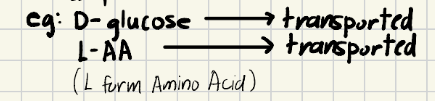
Example demonstrating stereospecificity in carrier-mediated transport.
a. D-glucose is transported whereas L-glucose is not.
b. Both D-glucose and L-glucose are transported.
c. Water is transported through carriers.
d. Sodium ions diffuse freely across membranes.
c. Competitive
Characteristic of carrier-mediated transport in which drugs compete for the same carrier.
a. Saturability
b. Stereospecificity
c. Competitive
d. Pinocytosis
c. Isoniazid
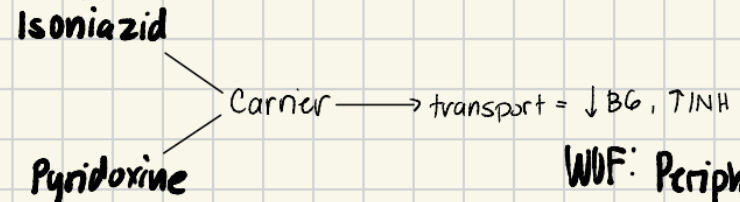
Antitubercular drug that competes with pyridoxine for the same carrier.
a. Rifampicin
b. Ethambutol
c. Isoniazid
d. Pyrazinamide
b. Peripheral neuropathy
Major adverse effect of isoniazid due to pyridoxine deficiency.
a. Hepatitis
b. Peripheral neuropathy
c. Optic neuritis
d. Ototoxicity
b. Vitamin B6 (Pyridoxine)
itamin routinely supplemented during isoniazid therapy.
a. Vitamin B1
b. Vitamin B6 (Pyridoxine)
c. Vitamin B12
d. Vitamin C
No
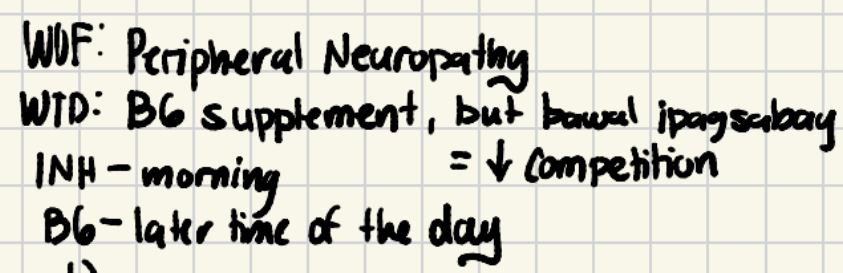
Can isoniazid and pyridoxine be taken together?
d. Saturability
Characteristic of carrier-mediated transport due to the limited number of carrier proteins.
a. Competition
b. Filtration
c. Selectivity
d. Saturability
c. Facilitated diffusion
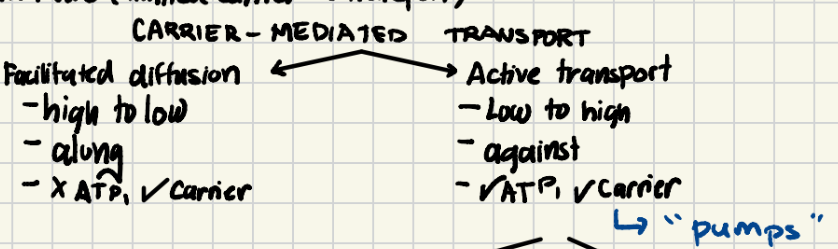
Carrier-mediated transport that occurs down the concentration gradient without ATP.
a. Primary active transport
b. Secondary active transport
c. Facilitated diffusion
d. Endocytosis
c. Active transport
Carrier-mediated transport that occurs against the concentration gradient and requires ATP.
a. Facilitated diffusion
b. Passive diffusion
c. Active transport
d. Filtration
Active transport
Facilitated
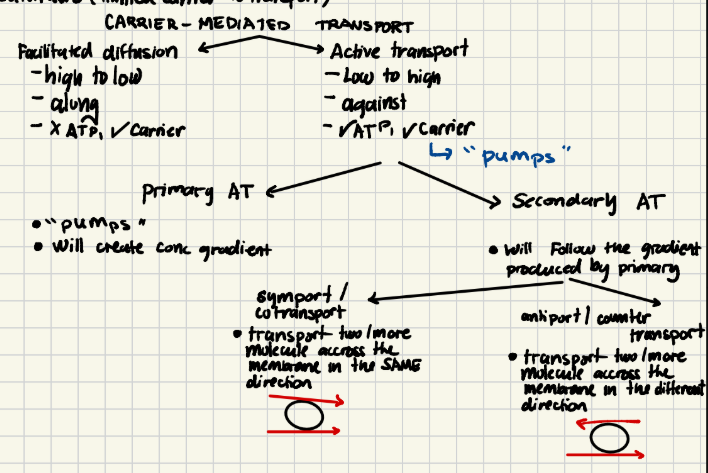
Carrier-mediated transport types (2)
Primary AT
Secondary AT
Active transport types (2)
Symport
Antiport
Secondary active transport types (2)
b. Primary active transport
Type of active transport that directly utilizes ATP through membrane pumps.
a. Facilitated diffusion
b. Primary active transport
c. Secondary active transport
d. Pinocytosis
c. Secondary active transport
Type of active transport that utilizes the concentration gradient generated by primary active transport.
a. Facilitated diffusion
b. Primary active transport
c. Secondary active transport
d. Passive diffusion
c. Symport
Transport mechanism in which two molecules move across the membrane in the same direction.
a. Antiport
b. Uniport
c. Symport
d. Passive diffusion
b. Antiport
Transport mechanism in which two molecules move across the membrane in opposite directions.
a. Symport
b. Antiport
c. Uniport
d. Facilitated diffusion
b. Na⁺/K⁺-ATPase pump
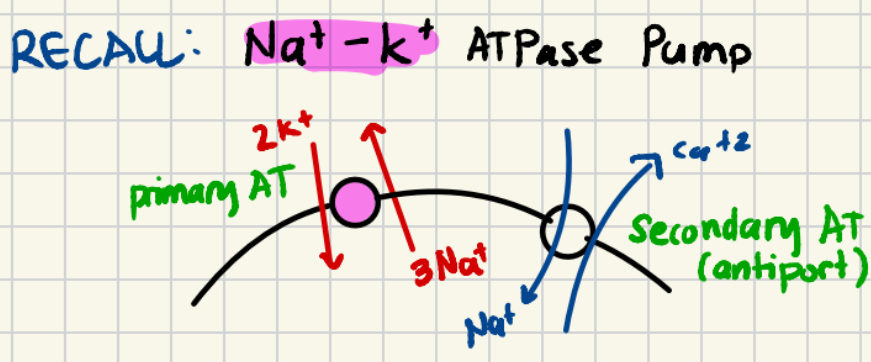
Classic example of a primary active transport pump.
a. Sodium-glucose cotransporter
b. Na⁺/K⁺-ATPase pump
c. GLUT4 transporter
d. Aquaporin
a. Na⁺/Ca²⁺ antiporter
Secondary active transport mechanism coupled to the Na⁺/K⁺-ATPase pump.
a. Na⁺/Ca²⁺ antiporter
b. GLUT1 transporter
c. Chloride channel
d. Aquaporin
a. Convection transport
Refers to the transport of drugs through pores in the cell membrane.
a. Convection transport
b. Passive diffusion
c. Pinocytosis
d. Ion transport
b. Solvent drag
mnemonic: OSA
Opposite charge
Solvent drag
Along the concentration gradient
Characteristic of convective transport in which the drug moves with the solvent.
a. Active transport
b. Solvent drag
c. Facilitated diffusion
d. Ion pairing
b. Along the concentration gradient
mnemonic: OSA
Opposite charge
Solvent drag
Along the concentration gradient
Characteristic of convective transport in which movement occurs along the concentration gradient.
a. Against the concentration gradient
b. Along the concentration gradient
c. Independent of the concentration gradient
d. Against the electrochemical gradient
b. Opposite charge
mnemonic: OSA
Opposite charge
Solvent drag
Along the concentration gradient
Characteristic of convective transport in which the transported substance has an opposite charge.
a. Same charge
b. Opposite charge
c. Neutral charge
d. Positive charge only
a. Urea
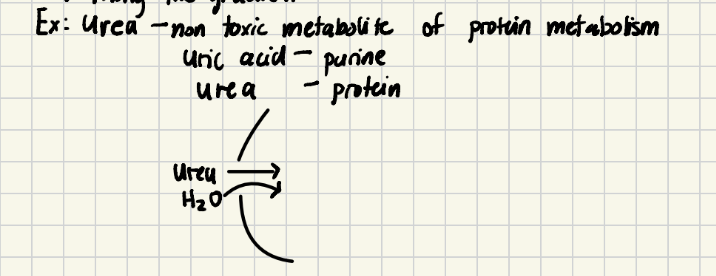
Example of a compound transported by convection.
a. Urea
b. Digoxin
c. Warfarin
d. Morphine
a. Urea
Refers to the non-toxic metabolite of protein metabolism.
a. Urea
b. Digoxin
c. Warfarin
d. Morphine
c. Uric acid
Purine metabolism primarily produces this compound.
a. Urea
b. Creatinine
c. Uric acid
d. Ammonia
c. Ion transport
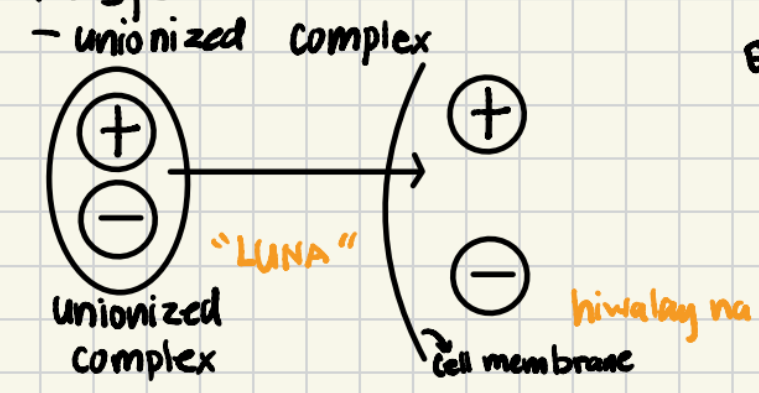
Refers to the transport of an unionized complex across the cell membrane.
a. Facilitated diffusion
b. Pinocytosis
c. Ion transport
d. Filtration
b. Unionized complex
Complex formed to facilitate membrane transport in ion transport.
a. Ionized complex
b. Unionized complex
c. Micelle
d. Vesicle
c. Propranolol

β-Blocker that forms an ion pair with oleic acid to enhance absorption.
a. Atenolol
b. Metoprolol
c. Propranolol
d. Carvedilol
b. Oleic acid
Fatty acid commonly used to form an ion pair with propranolol.
a. Linoleic acid
b. Oleic acid
c. Palmitic acid
d. Stearic acid
b. Pinocytosis
Refers to vesicle-mediated uptake of extracellular fluid by cells.
a. Phagocytosis
b. Pinocytosis
c. Exocytosis
d. Filtration
b. Cell drinking
Another term for pinocytosis.
a. Cell eating
b. Cell drinking
c. Cell secretion
d. Cell diffusion
Vesicle-mediated
Micelle formation
Requires ATP
Characteristic feature of pinocytosis. (3)
b. Liposomal Amphotericin B
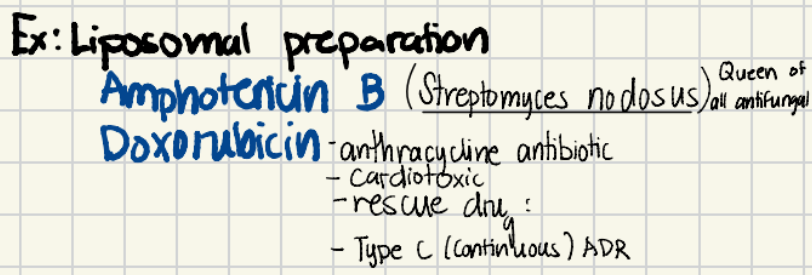
Liposomal formulation commonly used as an antifungal agent.
a. Liposomal Doxorubicin
b. Liposomal Amphotericin B
c. Liposomal Vancomycin
d. Liposomal Ciprofloxacin
b. Doxorubicin
Liposomal preparation commonly used as an antineoplastic agent.
a. Amphotericin B
b. Doxorubicin
c. Fluconazole
d. Gentamicin
b. Cardiotoxicity
Major dose-limiting adverse effect of doxorubicin.
a. Nephrotoxicity
b. Cardiotoxicity
c. Hepatotoxicity
d. Ototoxicity
Dexrazoxane ba to? pa search nga sa notes mo
Doxorubicin rescue drug?
a. Bioavailability
Refers to the fraction of an administered drug that reaches the systemic circulation.
a. Bioavailability
b. Bioequivalence
c. Bioaccumulation
d. Biotransformation
b. F
Symbol used to represent bioavailability.
a. AUC
b. F
c. Cmax
d. Tmax
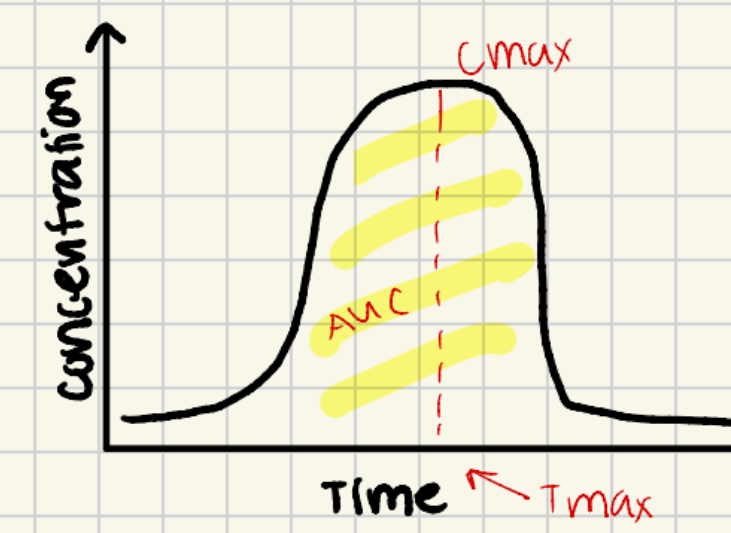
a. Cmax
Parameter that evaluates both the rate and extent of drug absorption.
a. Cmax
b. Tmax
c. AUC
d. Clearance
c. Tmax
Parameter that evaluates only the rate (time) of drug absorption.
a. Cmax
b. AUC
c. Tmax
d. Half-life
c. AUC
Parameter that primarily evaluates the extent of drug absorption.
a. Cmax
b. Tmax
c. AUC
d. Volume of distribution
b. Absolute bioavailability
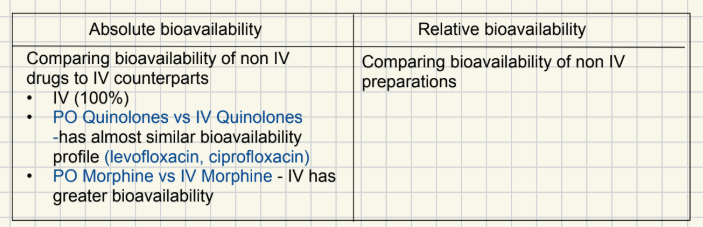
Bioavailability that compares the bioavailability of a non-intravenous dosage form with its intravenous counterpart.
a. Relative bioavailability
b. Absolute bioavailability
c. Therapeutic equivalence
d. Pharmaceutical equivalence
c. Intravenous
Route of administration considered to have 100% bioavailability.
a. Oral
b. Intramuscular
c. Intravenous
d. Subcutaneous
b. Relative bioavailability
Bioavailability that compares two non-intravenous preparations.
a. Absolute bioavailability
b. Relative bioavailability
c. Therapeutic equivalence
d. Pharmaceutical equivalence
b. Intravenous
Oral quinolones have bioavailability that is most similar to which route?
a. Intramuscular
b. Intravenous
c. Subcutaneous
d. Intradermal
b. Oral levofloxacin vs IV levofloxacin
Which drug pair demonstrates nearly identical oral and intravenous bioavailability profiles?
a. Oral amoxicillin vs IV amoxicillin
b. Oral levofloxacin vs IV levofloxacin
c. Oral digoxin vs IV digoxin
d. Oral propranolol vs IV propranolol
b. Intravenous morphine has greater bioavailability than oral morphine.
Which statement correctly describes morphine bioavailability?
a. Oral morphine has greater bioavailability than intravenous morphine.
b. Intravenous morphine has greater bioavailability than oral morphine.
c. Oral and intravenous morphine have identical bioavailability.
d. Morphine cannot be administered intravenously.
b. Bioequivalence
Refers to the comparison of the bioavailability of a generic product with that of the innovator product.
a. Bioavailability
b. Bioequivalence
c. Therapeutic drug monitoring
d. Biotransformation
b. Generic counterpart
After patent expiration, which product is allowed to be manufactured by other companies?
a. Innovator product only
b. Generic counterpart
c. Investigational drug
d. Compounded preparation
b. Generic product and innovator product
Bioequivalence studies compare the bioavailability of which two products?
a. Two intravenous formulations
b. Generic product and innovator product
c. Two topical preparations
d. Oral product and transdermal patch
c. 80–125%
Accepted reference range for bioequivalence.
a. 70–110%
b. 75–120%
c. 80–125%
d. 90–110%
c. 90%
Confidence interval required for bioequivalence studies.
a. 80%
b. 85%
c. 90%
d. 95%
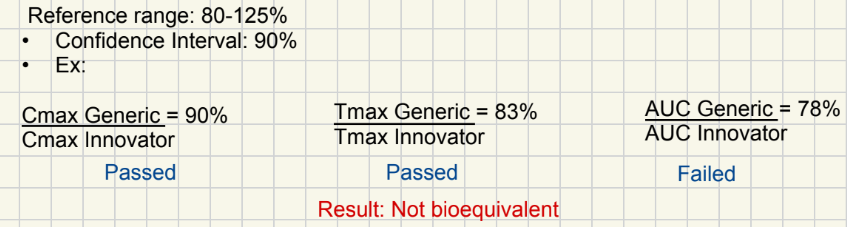
Is this bioequivalent or not?

Pharmaceutical equivalent
Pharmaceutical alternatives
Therapeutic equivalent
Therapeutic alternatives
4 types of drug substitution
b. Pharmaceutical equivalents
same lahat except excipient and brand
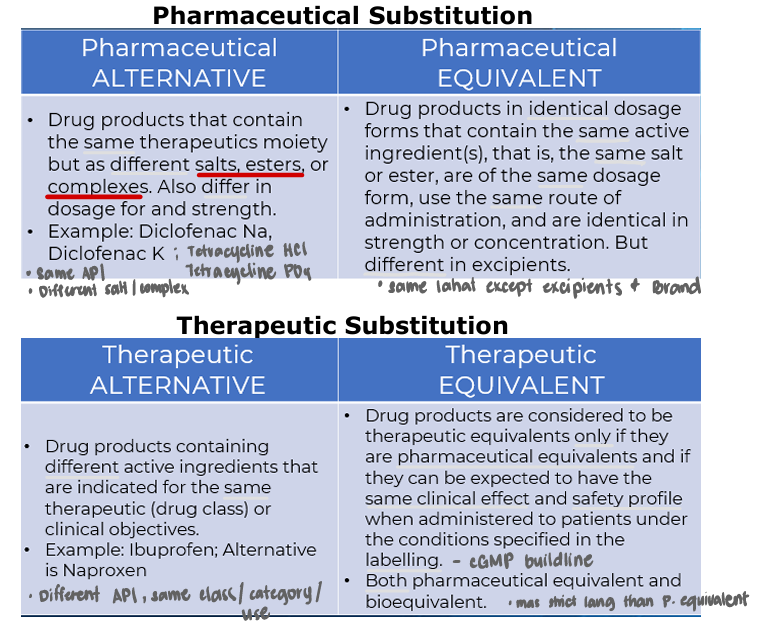
Refers to drug products that contain the same active pharmaceutical ingredient, salt form, dosage strength, and dosage form.
a. Pharmaceutical alternatives
b. Pharmaceutical equivalents
c. Therapeutic alternatives
d. Therapeutic equivalents
b. Pharmaceutical alternatives
Metoprolol succinate and metoprolol tartrate are classified as:
a. Pharmaceutical equivalents
b. Pharmaceutical alternatives
c. Therapeutic equivalents
d. Therapeutic alternatives
c. Active pharmaceutical ingredient (API)
Pharmaceutical alternatives contain the same:
a. Dosage strength
b. Dosage form
c. Active pharmaceutical ingredient (API)
d. Salt form
d. Salt, ester, or complex
Pharmaceutical alternatives may differ in:
a. Active pharmaceutical ingredient
b. Therapeutic indication
c. Pharmacologic class
d. Salt, ester, or complex
a. Dosage strength
Which characteristic may differ between pharmaceutical alternatives?
a. Dosage strength
b. Active pharmaceutical ingredient
c. Mechanism of action
d. Drug class
b. Dosage form
Pharmaceutical alternatives may differ in their:
a. Bioavailability
b. Dosage form
c. Mechanism of action
d. Therapeutic effect
b. Bioequivalent
Therapeutic equivalents are pharmaceutical equivalents that are also:
a. Pharmaceutical alternatives
b. Bioequivalent
c. Different in dosage strength
d. Different in dosage form
d. Share the same clinical profile proven by research
Therapeutic equivalents are expected to:
a. Differ in clinical response
b. Have different indications
c. Have different active ingredients
d. Share the same clinical profile proven by research
d. Therapeutic alternatives
Different active pharmaceutical ingredients but belong to same drug class
a. Pharmaceutical equivalents
b. Pharmaceutical alternatives
c. Therapeutic equivalents
d. Therapeutic alternatives
Lipophilic
Unionized (uncharged)
Nonpolar
= Absorption
Features of absorption
c. Increased
Increasing the dose generally results in a(n) ________ rate of drug absorption.
a. Decreased
b. Unchanged
c. Increased
d. Variable
c. Increase
Increasing the surface area of the absorptive membrane generally causes the rate of absorption to:
a. Decrease
b. Remain unchanged
c. Increase
d. Stop completely
c. Small intestine
ileum, duodenum, jejunum
• microvilli = SA
• primary site for drug absorption
Which part of the gastrointestinal tract is the primary site of drug absorption?
a. Stomach
b. Colon
c. Small intestine
d. Esophagus
b. Blood flow to organs
Perfusion refers to:
a. Drug metabolism in the liver
b. Blood flow to organs
c. Renal elimination
d. Plasma protein binding
b. Increases
Increasing blood flow to an organ generally ________ the rate of drug absorption.
a. Decreases
b. Increases
c. Eliminates
d. Delays
c. Decreased
Digestive system→ blood flow is redirected to exercising muscle = low perfusion = slow absorption
During strenuous exercise, drug absorption from the gastrointestinal tract is generally:
a. Increased
b. Unchanged
c. Decreased
d. Doubled
b. Unionized

An acidic drug is predominantly ________ in an acidic environment.
a. Ionized
b. Unionized
c. Protein-bound
d. Metabolized
b. Ionized
An acidic drug is predominantly ________ in a basic environment.
a. Unionized
b. Ionized
c. Protein-bound
d. Lipophilic
b. Ionized
A basic drug is predominantly ________ in an acidic environment.
a. Unionized
b. Ionized
c. Lipophilic
d. Nonpolar
a. Unionized
A basic drug is predominantly ________ in a basic environment.
a. Unionized
b. Ionized
c. Protein-bound
d. Water-insoluble
c. Deliver the drug to the small intestine for absorption
The primary goal of gastric emptying is to:
a. Increase gastric metabolism
b. Increase gastric residence time
c. Deliver the drug to the small intestine for absorption
d. Promote renal excretion
b. Increased drug absorption
Increased gastric emptying RATE generally results in:
a. Decreased drug absorption
b. Increased drug absorption
c. No change in absorption
d. Increased metabolism
a. Decreased drug absorption
Increased gastric emptying TIME generally results in:
a. Decreased drug absorption
b. Increased drug absorption
c. No change in absorption
d. Increased metabolism
decrease
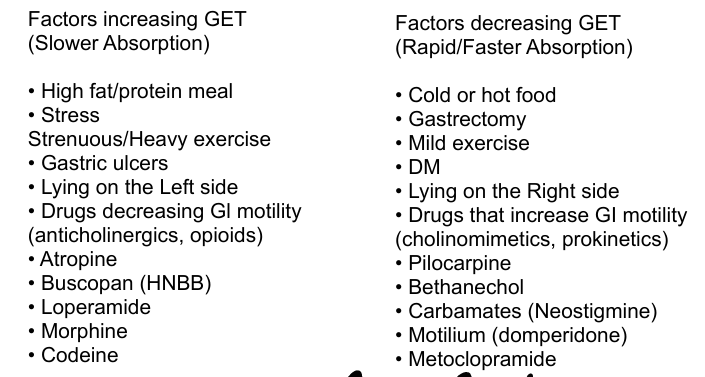
Increased GET [increase or decrease] absorptions
increase
Increased GER [increase or decrease] absorptions
decrease
High-protein or high-fat meal [increase or decrease] absorptions
decrease
Strenuous activity [increase or decrease] absorptions
decrease
Gastric ulcers [increase or decrease] absorptions
decrease
decreased motility = decreased peristalsis
Anticholinergics [increase or decrease] absorptions
decrease
decreased motility = decreased peristalsis
Opioids [increase or decrease] absorptions
decrease
Lying on the left [increase or decrease] absorptions
increase
Very hot/ very cold or extreme meals [increase or decrease] absorptions
increase
Mild activities [increase or decrease] absorptions