Physics: Scalars, Vectors, Motion Graphs, and Kinetic Energy
 Call Kai
 Learn
Learn Practice Test
 Spaced Repetition
 Match
Match Flashcards
 Knowt Play
1/42

There's no tags or description
Looks like no tags are added yet.
Name | Mastery | Learn | Test | Matching | Spaced | Call with Kai | Chat |
|---|
No analytics yet
Send a link to your students to track their progress
43 Terms
What is the difference between scalar and vector quantities?
Scalars are described by magnitude alone, while vectors have both magnitude and direction.
Give an example of a scalar quantity.
Distance (e.g., 25m) or speed (e.g., 10m/s).
Give an example of a vector quantity.
Displacement (e.g., 25m North) or velocity (e.g., 10m/s East).
What does the gradient of a displacement-time graph represent?
The gradient represents the velocity of the object.
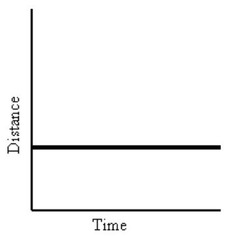
What does a flat line on a displacement-time graph indicate?
It indicates no velocity (the object is at rest).
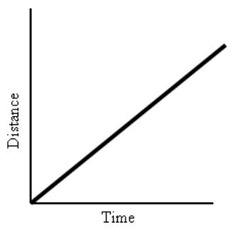
What does a diagonal line on a displacement-time graph indicate?
It indicates constant velocity.
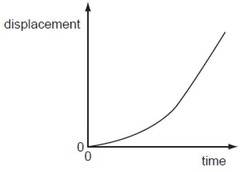
What does a curved line on a displacement-time graph indicate?
It indicates acceleration.
Define distance in the context of motion.
Distance is a scalar quantity that refers to how far an object travels during its entire motion.
Define displacement in the context of motion.
The straight-line change in position from the starting point to the ending point.
How is energy efficiency calculated in the context of a tennis serve?
Energy efficiency = (useful energy output / total energy input) x 100%.
What is the formula to calculate acceleration?
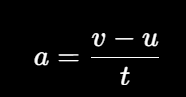
What is the difference between speed and velocity?
Speed is a scalar quantity that refers to how fast an object is moving, while velocity is a vector that includes direction.
What is the SI unit for speed?
Meters per second (m/s).
How do you convert km/h to m/s?
Divide by 3.6.
How do you convert m/s to km/h?
Multiply by 3.6.
What is the formula for calculating average speed?
Average speed = total distance / total time.
What is the formula for calculating average velocity?
Average velocity = total displacement / total time.
What is the significance of the frame of reference in physics?
It establishes the point of view from which motion is observed and can affect the perceived direction of movement.
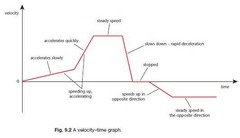
What does a negative gradient on a velocity-time graph indicate?
Negative acceleration.
What is the relationship between distance and displacement in a round trip?
Distance is the total path traveled, while displacement is zero if the start and end points are the same.
What does a steeper gradient on a displacement-time graph indicate?
A larger velocity.
In the context of motion, what does 'acceleration' refer to?
The rate of change of velocity over time.
How would you calculate the final velocity of a car that accelerates from rest at 3.5 m/s² for 4 seconds?
Final velocity = initial velocity + (acceleration x time) = 0 + (3.5 m/s² x 4 s) = 14 m/s.
What does the area under a velocity-time graph represent?
The area under a velocity-time graph represents displacement.
What is the SI unit of acceleration?
m/s²
What does a negative gradient on a displacement-time graph indicate?
Negative velocity (the object is moving back toward the starting point).
What does a flat line on a velocity-time graph indicate?
No acceleration, constant velocity.
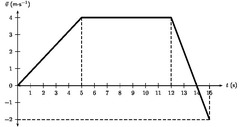
What does a diagonal line on a velocity-time graph indicate?
Constant acceleration.
What does a steeper gradient on a velocity-time graph represent?
Larger acceleration.
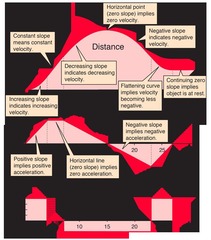
What does a flatter gradient on a velocity-time graph represent?
Lower acceleration.
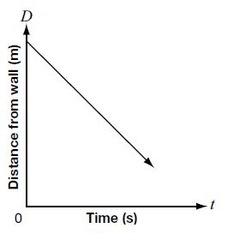
What does it mean to accelerate?
Acceleration is the rate of change of velocity. It can mean speeding up, slowing down, or changing direction.
What does it mean to decelerate?
Deceleration occurs when acceleration acts opposite to the direction of motion, causing the object's speed to decrease.
What is the purpose of constructing a displacement-time graph?
To visualize the object's position over time.
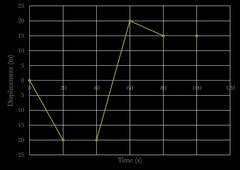
How do you convert a displacement-time graph to a velocity-time graph?
Calculate the gradient of the displacement-time graph.
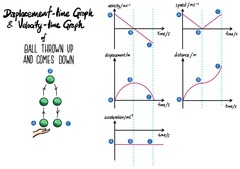
How do you convert a velocity-time graph to an acceleration-time graph?
Calculate the gradient of the velocity-time graph.
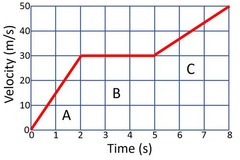
What is the relationship between the graphs in motion analysis?
The s-t graph shows position, the v-t graph shows velocity, and the a-t graph shows acceleration.
What does a curved line in a s-t graph indicate?
The velocity is changing due to acceleration.
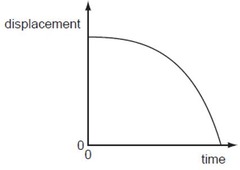
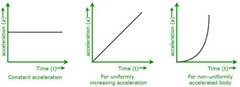
What does a flat line on an acceleration-time graph indicate?
Constant acceleration.
What is the first step in converting graphs forward?
Separate the gradient into different sections where it changes.
What should you do when converting graphs backward?
Calculate the area of each section and add it to the previous value.
What does a negative area under a velocity-time graph represent?
Negative displacement (movement in the opposite direction).
What is the equation for final velocity?
v= u + at
What do the SUVAT symbols mean?
u = initial velocity
v = final velocity
a = acceleration
t = time
s = displacement