BIOL 221 Lecture 10
 Call Kai
 Learn
Learn Practice Test
 Spaced Repetition
 Match
Match Flashcards
 Knowt Play
1/40

There's no tags or description
Looks like no tags are added yet.
Name | Mastery | Learn | Test | Matching | Spaced | Call with Kai | Chat |
|---|
No analytics yet
Send a link to your students to track their progress
41 Terms
1. A non-competitive (allosteric) enzyme inhibitor _______________.
A. must resemble the substrate at least partially
B. binds to an enzyme’s active site
C. induces a shape change in the active site
D. must be present in large excess to inhibit an enzyme effectively
E. affects only the allosteric site where it binds
C. induces a shape change in the active site
2. Oxidative decarboxylation occurs during three separate reactions in central catabolism. The main purpose of these reactions is to ___________________.
A. produce reducing power
B. oxidize CO2
C. make glucose
D. donate electrons to pyruvate
E. produce ATP by substrate-level phosphorylation
A. produce reducing power
3. Amino acids are NOT synthesized from ______________.
A. TCA cycle intermediates
B. pyruvate
C. glycolytic intermediates
D. pentose phosphate pathway intermediates
E. fermentation products
E. fermentation products
4. A competitive inhibitor of an enzyme _______________________.
A. must structurally resemble the substrate of the enzyme it inhibits
B. binds to an allosteric site on the enzyme
C. works by denaturing or modifying the shape of the active site
D. inhibits an enzyme even at a much lower concentration than the substrate
E. can only inhibit enzymes in anabolic pathways
A. must structurally resemble the substrate of the enzyme it inhibits
5. The main purpose of the TCA cycle in central catabolism is __________________.
A. to produce additional ATP
B. to regenerate NAD+from NADH
C. to produce carboxylic acids for metabolism
D. to produce additional reducing power
E. to feed compounds from the Pentose Phosphate Cycle into central catabolism
D. to produce additional reducing power
6. This molecule is one of the most versatile in central catabolism. It can be oxidized or reduced. It is a point at which side reactions feed into central catabolism and is also a starting material for anabolic reactions.
A. Glucose
B. ATP
C. Acetyl-CoA
D. Pyruvate
E. CO
D. Pyruvate
7. What form of energy is directly generated by the oxidative decarboxylation of pyruvate?
A. ATP
B. A H+ gradient
C. Rotary motion
D. Acetyl-CoA
E. NADH
E. NADH
8. Some bacteria can catabolize lipids as carbon and energy sources. How do lipids enter central metabolic pathways?
A. They are decarboxylated and enter glycolysis as sugar.
B. They are first deaminated and then enter central catabolism in many places.
C. They are reduced and then fermented to ethanol and CO2.
D. They are first hydrolyzed, then oxidized, and enter glycolysis and the TCA cycle.
E. They are first oxidized, then enter glycolysis and the pentose phosphate pathway.
D. They are first hydrolyzed, then oxidized, and enter glycolysis and the TCA cycle.
9. In a chemotrophic bacterial reaction, electrons are donated from glucose to NAD+, forming 2 molecules of pyruvate plus NADH. Which of the following must also be true?
A. Pyruvate is at a higher energy level than NAD+.
B. Glucose is at a higher energy level than NADH.
C. Glucose is being reduced during this reaction.
D. If this reaction were reversed, NAD+ would donate electrons to glucose.
E. This bacterium must be either aerobic or facultatively anaerobic.
B. Glucose is at a higher energy level than NADH.
10. Which of the following statements about enzyme inhibitors is correct?
A. A noncompetitive inhibitor must resemble the substrate at least partially.
B. Competitive inhibitors are usually for anabolic pathways.
C. An allosteric inhibitor binds to an enzyme's active site.
D. A competitive inhibitor induces an irreversible shape change in the active site.
E. An allosteric inhibitor functions even at a much lower concentration than the substrate.
E. An allosteric inhibitor functions even at a much lower concentration than the substrate.
11. The main purpose of fermentation reactions in a typical bacterial cell is ________________.
A. to generate a little bit more energy than just glycolysis does
B. to prepare pyruvate to enter the TCA cycle
C. to oxidize NADH
D. to carry out the first step in anabolic reactions that make new cell material
E. to make a PMF in the absence of an electron transport chain
C. to oxidize NADH
12. Why is pyruvate an especially important molecule in central catabolism?
A. It is a high-energy molecule that can serve as an energy source for auxotrophs.
B. It is an important intermediate in the TCA cycle.
C. All carbohydrates are converted to pyruvate before glycolysis can begin.
D. It can either accept electrons from NADH or donate electrons to NAD+.
E. It is the starting material for anabolic reactions that make nucleic acids.
D. It can either accept electrons from NADH or donate electrons to NAD+.
13. Which of the following statements about enzymes is INCORRECT?
A. RNA and DNA molecules can have catalytic activity.
B. Enzymes lower the free energy of a reaction.
C. Enzymes lower the activation energy of a reaction.
D. Enzyme pathways require each reaction to occur in order to form the end product.
E. An induced fit enzyme model involves a subtle change in the tertiary structure when binding a substrate.
B. Enzymes lower the free energy of a reaction.
14. Bacterial central catabolism includes all of the following EXCEPT _____________.
A. glycolysis
B. respiratory electron transport
C. TCA cycle
D. formation of reducing power
E. substrate-level phosphorylation
B. respiratory electron transport
15. Much of the bacterial cell membrane is made of lipids. Where do lipids come from during bacterial metabolism?
A. From fermentation of pyruvate.
B. They are made by oxidative phosphorylation.
C. Bacteria must ingest lipids in their diet; they cannot be synthesized.
D. By catabolic reactions from glucose.
E. They are built from glycerol and acetyl-CoA.
E. They are built from glycerol and acetyl-CoA.
16. Molecule A donates electrons to molecule B. Which of the following is true?
A. Molecule A is being reduced during this reaction.
B. Molecule B has higher energy than molecule A at the beginning of the reaction.
C. During the reaction, molecule B loses more energy then molecule A gains.
D. During the reaction, molecule A loses more energy than molecule B gains.
E. During the reaction, molecule B loses some energy, but not as much as molecule A gains.
D. During the reaction, molecule A loses more energy than molecule B gains.
17. The main product of the TCA cycle is _____.
A. ATP
B. glucose
C. NADH
D. NAD+
E. pyruvate
C. NADH
18. From which central metabolic pathway(s) is DNA synthesized by the cell?
A. from TCA cycle intermediates
B. from the oxidative decarboxylation of pyruvate
C. from glycolytic intermediates
D. from the pentose phosphate pathway
E. from glycolytic intermediates condensed with a product of acetyl-CoA
D. from the pentose phosphate pathway
19. Which of the following is the most highly oxidized molecule?
A. C6H12O6
B. C2H8
C. CO2
D. H2S
E. CH3COOH
C. CO2
20. How many oxidation reactions occur in the biochemical
pathway shown on the right?
A. 5
B. 3
C. 2
D. 1
E. none
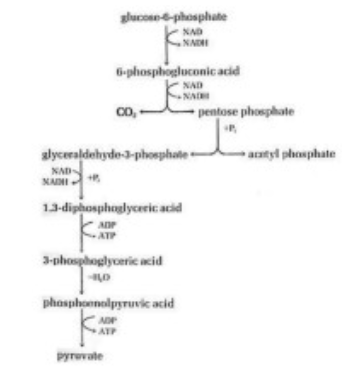
B. 3
21. Bacteria that can use lipids as a carbon source typically have what type of metabolism?
A. Strictly respiratory since oxidation of fatty acids generates lots of NADH
B. Strictly anaerobic, since fatty acids are fermented
C. Facultatively anaerobic since lipids have both hydrophilic and hydrophobic parts
D. Entirely oxidative, since fatty acids are oxidized rather than reduced
E. A lithotrophic one, since lipids are the electron source as well as the carbon source
A. Strictly respiratory since oxidation of fatty acids generates lots of NADH
22. A pharmacist wants to develop a drug that inhibits a bacterial enzyme. He has an option to develop either a competitive inhibitor (CI) or a non-competitive inhibitor (NCI). All other things (toxicity, cost, etc.) being equal, which one would he prefer to develop? Why?
A. The NCI, because it still allows the substrate to bind to the enzyme's active site.
B. The CI, because it can inhibit the enzyme by several different mechanisms.
C. The NCI, because it does not have to be present in large concentration excess.
D. The CI, because it will specifically target allosteric enzymes.
E. The NCI, because he can design it by derivatizing the enzyme's normal substrate.
C. The NCI, because it does not have to be present in large concentration excess.
23. The reaction NADH → NAD^+ + H+ occurs in BOTH ______________.
A. glycolysis and the TCA cycle
B. the TCA cycle and respiration
C. respiration and fermentation
D. glycolysis and pyruvate oxidation
E. respiration and photosynthesis
C. respiration and fermentation
24. Glucose is "broken down" in glycolysis. What does "broken down" mean in this case?
A. Glucose is reduced
B. Glucose is first reduced, and then hydrolyzed
C. Glucose is first condensed, and then oxidized
D. Glucose is first oxidized, and then reduced
E. Glucose is first hydrolyzed, and then oxidized
E. Glucose is first hydrolyzed, and then oxidized
25. What is the purpose of lactic acid fermentation in bacterial metabolism?
A. to produce reducing power
B. to oxidize NADH
C. to produce ATP anaerobically
D. to produce a PMF anaerobically
E. to make lactate, an important growth factor
B. to oxidize NADH
26. What is the metabolic purpose of beta oxidation?
A. It is a way to break down protein secondary structures.
B. It is a way to feed cellulose monomers into the pentose phosphate pathway.
C. It is a way to turn fatty acids into TCA cycle precursors.
D. It is a way to make bacterial cell wall precursors.
E. It is a type of bacterial secondary metabolism.
C. It is a way to turn fatty acids into TCA cycle precursors.
27. In the following spontaneous reaction: Aox + Bred → Ared + Box
A. A gives electrons to B
B. A gives energy to B
C. B loses energy
D. Bred must have lower energy than Aox
E. A loses both H+ and electrons
C. B loses energy
28. Which of the following is true about an allosteric inhibitor?
A. The inhibitor binds to the substrate rather than to the enzyme.
B. The inhibitor alters the active site without binding to it.
C. The inhibitor must be present in large excess over the substrate.
D. The inhibitor must at least partially resemble the substrate.
E. There is no way to predict the shape of such an inhibitor.
B. The inhibitor alters the active site without binding to it.
29. Whether a eukaryotic cell will use the TCA cycle depends on how much O2 is present in the environment. What determines whether a bacterium will use its TCA cycle or not?
A. Still the amount of O2in the environment
B. Whether there is excess glucose in the cell
C. The need the cell has for ATP
D. An excess of NADH in the cell
E. The need the cell has for reducing power
D. An excess of NADH in the cell
30. All of the following reactions release energy EXCEPT _____.
A. pyruvate → lactate
B. glucose → pyruvate
C. pyruvate → acetyl-CoA
D. glucose → CO2
E. NADH → NAD+
A. pyruvate → lactate
31. Which biochemical pathway is correctly matched with a macromolecular product it produces?
A. Lipids are derived from the Pentose Phosphate pathway.
B. Carbohydrates are produced by beta-oxidation.
C. Proteins come from TCA cycle intermediates.
D. Nucleic Acids are produced from glycolysis.
E. Lipids are derived from TCA cycle intermediates.
C. Proteins come from TCA cycle intermediates.
What is the difference between anabolic and catabolic reactions? How is redox energy transferred by electrons? Know that a reduction reaction requires energy that can be provided by the energy released by an oxidation reaction.
Catabolism “breaks down”, Releases energy
Anabolism “builds up”, Requires energy
Lose electrons (from a covalent bond), oxidize
Gain electrons (into a covalent bond), reduce
Oxidation: increasing bonds to oxygen; decreasing bonds to hydrogen
Reduction: decreasing bonds to oxygen; increasing bonds to hydrogen
How does an enzyme function as a biological catalyst? What is the difference between competitive and noncompetitive (allosteric) enzyme inhibitors? How does the denaturing of enzymes cause organisms to die?
Enzymes decrease activation energy, making it easier for the substrate to react and form a product
COMPETITIVE INHIBITORS structurally resemble the substrate and interact with the ACTIVE SITE
NONCOMPETITIVE (ALLOSTERIC) INHIBITORS do NOT resemble the substrate at all, and interact with ANOTHER PART of the enzyme to cause a shape change by INDUCED FIT
Denatured enzymes means reactions slow down too much to support life
Can you draw an overview diagram of bacterial metabolism including glycolysis, pentose phosphate pathway, fermentation, pyruvate oxidation, TCA cycle and the respiratory chain? What is the concept of bacterial central catabolism, with modular additions?
consists of glycolysis and the krebs cycle and intermediates, contains plug-ins for "non-sugars"
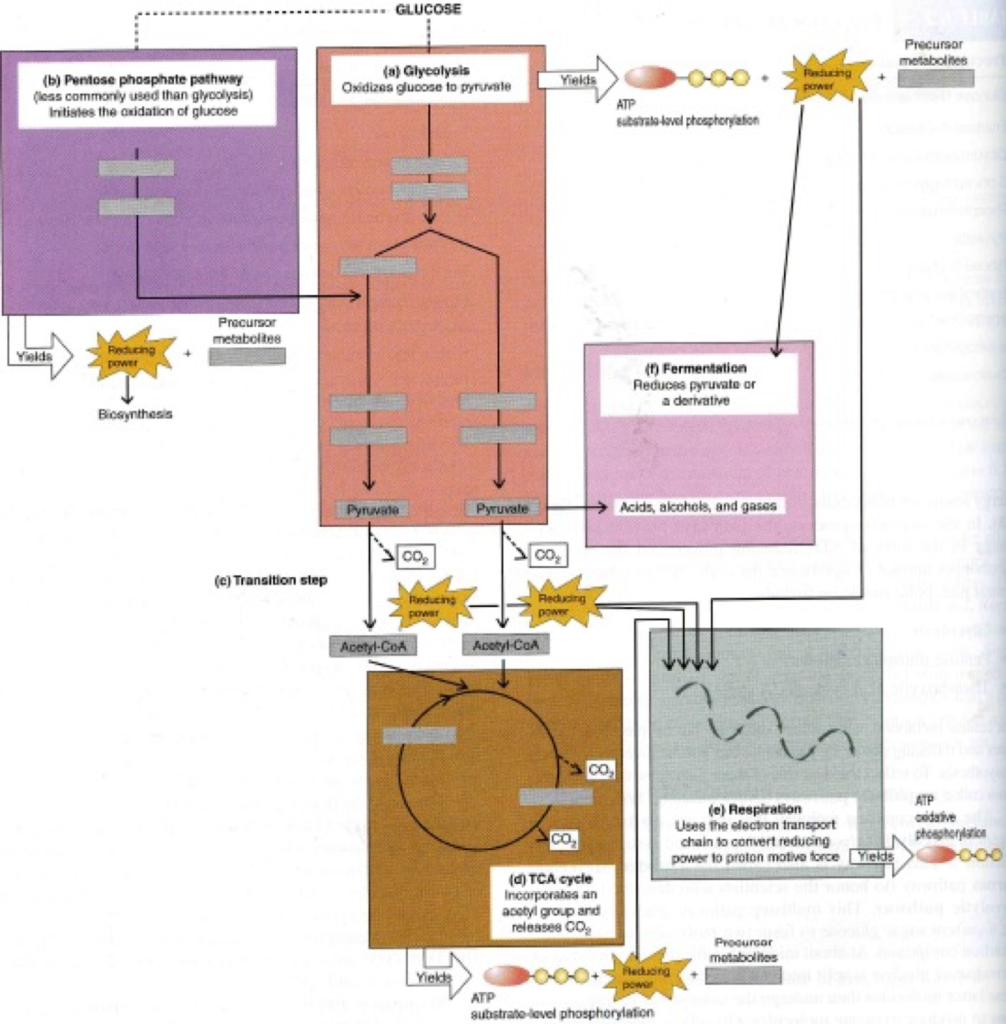
What is the purpose and the three main products of glycolysis?
oxidizes Glucose and produces ATP, pyruvate, and NADH (electrons) [by reducing NAD]
How does the oxidative decarboxylation of pyruvate produce energy?
Pyruvate is oxidatively decarboxylated to release CO2 and produce electrons
What is the purpose and the three main products of the TCA cycle?
oxidizes acetyl CoA to produce more CO2 , ATP, and electrons (NADH and FADH2)
What are two ways to metabolically recycle NADH back to NAD?
Fermentation = NADH must be recycled into new NAD+
Alcoholic Fermentation = Pyruvate is converted to acetaldehyde, and CO2 is lost as a by-product.
What is the difference between acid fermentation and alcoholic fermentation? What are some of the main commercial products of microbial fermentation reactions?
Alcoholic Fermentation = Pyruvate is converted to acetaldehyde, and CO2 is lost as a by-product.
Lactic Acid Fermentation = The NADH generated during glycolysis is used to reduce pyruvate to lactate by enzyme called lactate dehydrogenase.
Acetone
Isopropyl alcohol
Ethyl alcohol
Acetic Acid
Lactic Acid
Using the metabolic diagram drawn for a previous objective, how does bacteria catabolize carbohydrates, lipids, and proteins?
Carbohydrates are converted to glucose or fructose and enter glycolysis
Lipids are converted to glycerol (glycolysis) + fatty acids (to acetateacetyl CoA, to TCA)
Proteins broken to amino acids , which are deaminated and enter central catabolism at various points
Using the metabolic diagram drawn for a previous objective, where do the precursors come from for the anabolism of polysaccharides, lipids, nucleic acids, and amino acids?
Polysaccharides (including LPS and PG) from glycolytic intermediates
Lipids from glycerol and acetate (built up to fatty acids)
Nucleic Acids from Pentose Phosphate Shunt
Amino Acids from various places