Geophysical Hazards
 Studied by 3 people
 Call Kai
 Learn
Learn Practice Test
 Spaced Repetition
 Match
Match Flashcards
 Knowt Play
1/35

There's no tags or description
Looks like no tags are added yet.
Name | Mastery | Learn | Test | Matching | Spaced |
|---|
No study sessions yet.
36 Terms
Hazard
A threat (natural or human) that has the potential to cause loss of life, injury, property, socio-economic disruption, or environmental degradation.
Hazard Event
The occurrence of a hazard (e.g. an earthquake) and its effects, which will change demographic, economic, and/or environmental conditions.
Disaster
A major hazard event that the affected community is unable to deal with adequately unless it receives outside help.
Characteristics of Volcanoes
Shield
Composite
Cinder
Shield Volcanoes
Built up when there is no explosive activity, there are no ejected fragments. It is formed from hot, flowing basaltic lava. They are characterized by gently sloping slides, shallow craters, and a large circumference.
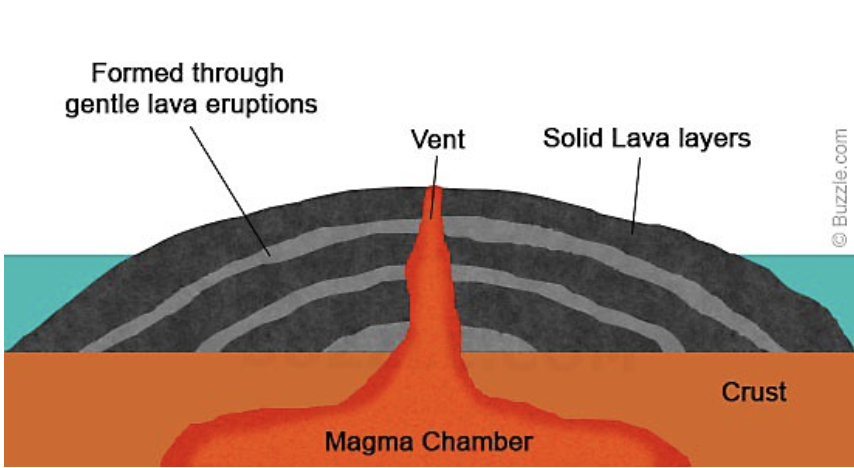
Composite (strato) Volcano
Formed by alternating eruptions of fragmental material followed by lava outflows. The cone consists of layers of ash and lava accumulating in the center. Inactive volcanoes can suffer violent eruptions because of the accumulated pressure of gas under cool lava.
Cinder Volcanoes
Formed by fragments of solid material that accumulate into the shape of a cone. It’s usually concave; however, it is dependent on the material, and usually it’s not very high. The eruptions are violent as lava ejects into the atmosphere and breaks up into cinder, ash, and other stuff.
Primary Hazards
The direct impacts of the hazard.
Secondary hazard
The indirect impacts of the hazard.
Volcano’s Primary Hazard
Lava eruptions
Lava flow
Pyroclastic flow
Ash fallout and gas emissions
Pyroclastic flow
Materials ejected by volcanoes in a fragmented form. It is a most moving current of hot gas and volcanic matter (tephra) moving at high speed. Ash and debris is heavy, causing buildings to collapse.
Volcano’s Secondary Hazard
Landslide
Lahar
Jokulhlaup (glacial outburst flood)
Lahar
A type of landslide/mudflow composed of a slurry of pyroclastic material, rock debris, and water (snow-capped mountains). The material flows down like a river.
Focus (earthquake)
The location where the earthquake begins within the curst.
Epicenter
The point on the Earth’s surface located directly above the focus of an earthquake.
Seismic waves
Waves of energy caused by the sudden breaking of rock within the earth and travel long the surface and body of the earth. There are two main types of shock waves known as body waves and surface waves.
Body waves
Transmitted upwards and towards the surface from the focus. Body waves arrives before surface waves.
Two Types of Body Waves
P waves (primary waves)
S waves (secondary waves)
P waves
The fastest type of seismic waves and first to be detected at a seismic station. It can move through solid rock and fluids.
S waves
Slower than a P-wave and can only move through solid rocks. As they move to the ground horizontally, they can cause more damage (buildings have low horizontal stress tolerance)
Surface waves
When body waves reach the surface, some are transformed into surface waves. It is this type of wave that is entirely responsible for the damage and destruction in earthquakes.
Two types of surface waves
Love waves
Rayleigh waves
Love waves
The fastest surface wave moves the ground side-to-side. Confined to the surface of the crust and produce entirely horizontal motions.
Rayleigh waves
Rolls along the ground, causing it to move up and down. Most of the shaking felt in earthquakes is due to this wave, and can be much larger than other waves.
Human Triggers For Earthquakes
Dam building → increase loads on stable surfaces, building pressure to reactivate dormant faults.
Resources extraction → fracking: exploding rocks to release gas.
Earthquake’s Primary Hazard
Ground shaking → ground vibrating.
Earthquake’s Secondary Hazard
Tsunamis
Landslides
Liquefaction
Transverse faults
Liquefaction
The way soil liquefies during the ground shaking. When the shaking causes certain surfaces to become quicksand-like and weaken foundations that support buildings, bridges, pipelines, roads, causing them to sink, dissolve, collapse.
Transverse faults
Occurs where movement is horizontal but the fracture is vertical. This can cause fracture of gas pipes, transport route damage, and loss of communication lines.
Mass movement
Includes any large-scale movement of Earth’s surface that is not accompanied by a moving agent such as a river, glacier, or ocean wave. It includes soil creep, avalanches, rock falls, and mudflows.
Different Classification of Mass Movements
Speed (onset and duration)
Liquidity (water content)
Material
Extent
Frequency
Causes of Mass Movement
Physical (natural)
gravity
slope angle
pore pressure (increasing the ability of the material to move)
Soil type
Human
Blasting
Traffic vibration
Deforestation
Risk
The probability of a hazard event causing harmful consequences (expected losses in terms of death, injuries, property damage, economy and environment)
Recurrence interval/return period
The expected frequency of occurrence in years for an event of a particular size.
Vulnerability
The geographical conditions that increases the susceptibility of a community to a hazard or to the impact of a hazard event.