PSY389 Lecture week 8: Treatment of Alcohol and Other Drug Disorders Part I: Conditioning Theories
 Call Kai
 Learn
Learn Practice Test
 Spaced Repetition
 Match
Match Flashcards
 Knowt Play
1/21

There's no tags or description
Looks like no tags are added yet.
Name | Mastery | Learn | Test | Matching | Spaced | Call with Kai | Chat |
|---|
No analytics yet
Send a link to your students to track their progress
22 Terms
Classical and Operant Conditioning
• Acquisition of drug-taking behaviour: How does drug use begin and become established?
• Cessation of drug use: What factors can help reduce or stop drug use?
• Craving: What cues or triggers can elicit craving and drugseeking behaviour?
• Tolerance and withdrawal: How can learning and environmental cues influence tolerance and withdrawal responses?
• Overall, these models provide a psychological understanding of drug-taking behaviour and can also be applied to the prevention and treatment of substance use problems.
Classical Conditioning
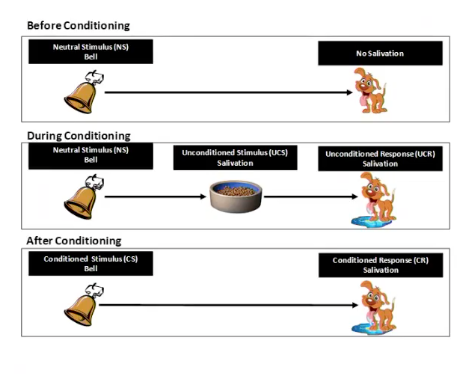
• Pavlov’s dogs: Dogs learned to salivate to a bell that had previously been paired with food—even when food was no longer present.
• Many everyday responses involve learned associations:
Feeling hungry at a particular time of day
Feeling the need to use the bathroom soon after waking
Feeling happy or excited when going to a party
Feeling nervous or anxious before a job interview
• These examples reflect our ability to learn regularities and associations—“what goes with what.”
• Through experience, previously neutral cues can become associated with particular emotional, physiological or behavioural responses.
• Conditioning involves learning regularities: Antecedent/cue → Behaviour or response
• We learn to recognise cues that predict important outcomes, such as:
Seeing or smelling food or water → seeking or consuming it
Cues associated with enjoyable activities → anticipation and approach
Seeing a dangerous animal → fear and escape
• These learned associations are generally adaptive, because they help us respond quickly to important opportunities and threats. • The same learning processes can condition urges, cravings and emotional responses. • For example, cravings for drugs, food, gambling or gaming can become associated with particular places, times, people, objects or emotional states.
Classical Conditioning Paradigm
Three Conditioning Theories of Dependence
• Tolerance and withdrawal involve homeostatic mechanisms: The body works to maintain a relatively stable internal state by compensating for physiological changes produced by a drug.
• Stimulants: If a drug increases CNS activity, the body may compensate by reducing physiological activity.
• Depressants: If a drug decreases CNS activity, the body may compensate by increasing physiological activity.
• Example: Alcohol is a CNS depressant. In response to its effects, the body may activate compensatory processes that increase physiological arousal.
• Tolerance: These compensatory responses can reduce the drug's effects over time, meaning more of the drug may be needed to produce the same effect.
• Conditioned responses: Through repeated drug use, these compensatory responses can become associated with environmental cues (e.g., a particular place, time or situation).
• These learned compensatory responses can contribute to conditioned tolerance and withdrawal when the usual drug-related cues are encountered without the drug.
1. Positive Appetitional Model (Stewart, De Wit & Eikelboom, 1984)
• Before drug use: Environmental cues (e.g., the sight, smell or location associated with alcohol) are initially neutral stimuli (NS).
• Drug effect: Alcohol produces a pleasant emotional state (e.g., pleasure or euphoria), which is an unconditioned response (UCR).
• During repeated drug use: Environmental cue (NS) + drug effect (UCS) → pleasurable response (UCR)
• After repeated pairings: The environmental cue becomes a conditioned stimulus (CS) and can elicit an appetitive conditioned response (CR), such as anticipation, pleasure or craving.
• Craving: These conditioned responses can contribute to a subjective desire or craving for the drug.
• When does this model apply? This model may be particularly relevant to the early stages of drug use, when the rewarding effects of the drug play an important role in establishing drug-related associations.

2. Compensatory Response Model (Hinson & Seigel, 1983)
• Tolerance: Homeostatic mechanisms produce compensatory physiological responses that reduce the effects of a drug, so more of the drug may be needed to produce the same desired effect.
• Compensatory response: The body counteracts the physiological effects of the drug to maintain internal balance.
• Tolerance can increase drug intake: As the drug becomes less effective, the person may increase the dose or frequency of use to achieve the desired effect.
• Conditioned tolerance: With repeated drug use, the compensatory response can become associated with environmental cues (CS) that reliably predict drug administration.
• Environmental cues can trigger the compensatory response (CR) before the drug is taken.
• Key point: Tolerance is not purely pharmacological—it can also be learned and triggered by environmental cues.
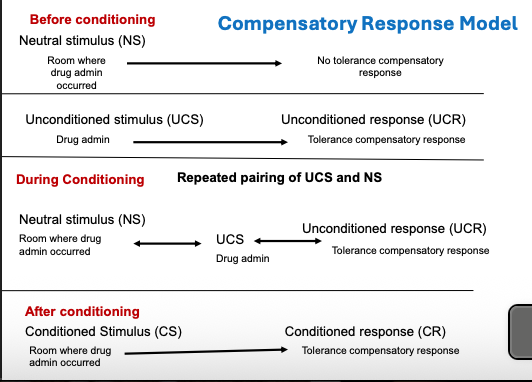
Compensatory Responses
The body and the brain maintains a state of homeostasis. When people use drugs, the body and brain attempts to counteract the effects of the drug and produces reactions that are opposite to that of the drug.

3. Conditioned withdrawal Model (Wikler, 1973)
• Focuses on withdrawal: Physiological reactions associated with withdrawal can become important cues for continued drug use.
• Internal–external associations: Internal withdrawal states can become associated with external cues, such as the room, location or physical setting where drinking or drug use previously occurred.
• Conditioned withdrawal: After repeated pairings, these environmental cues can become conditioned stimuli (CS) that elicit conditioned withdrawal responses (CR) and craving
• Withdrawal without the drug: Encountering these cues later may trigger withdrawal-like responses and craving, even when the drug is not present.
• Relapse: Using the drug can temporarily reduce these unpleasant withdrawal-related states, providing negative reinforcement and increasing the likelihood of further use.
• Who does this model apply to? This model may be particularly relevant to people with established dependence, where withdrawal and relief from withdrawal become important drivers of drug use.

Withdrawal Effects
The experience of strong reactions opposite to those produced by the drug. Compensating responses that are becoming active in the absence of the drug.

What is Relapse? Could it be learned?
• The three conditioning models help explain relapse as a learned process.
• Conditioned responses such as craving, drug tolerance and withdrawal-like feelings can be triggered by drug-related cues and may promote renewed drug use.
• Extinction does not necessarily erase the original learning: Conditioned responses may reappear even after a long period of abstinence.
• Key point: Conditioned stimuli (CS) can continue to elicit conditioned responses (CR) after prolonged abstinence, particularly when a person encounters familiar drug-related cues.
Practical Implications of Classical Conditioning Models
• Withdrawal: Conditioned withdrawal responses can be strongest in familiar drug-taking environments, where cues have become associated with drug use.
• Relapse: Relapse risk may be greater in environments that resemble the person’s previous drug-taking environment, because familiar cues can trigger craving and drug-seeking behaviour.
• Drug effects: Drug effects may be stronger in a novel environment, where conditioned compensatory responses have not been activated and tolerance is therefore reduced.
• Overdose risk: This helps explain why overdose may be more likely in an unfamiliar or novel environment, particularly when the usual environmental cues are absent.
• Siegel’s conditioning model: Familiar drug-taking environment → conditioned compensatory response → greater tolerance
• Novel environment → weaker/no compensatory response → stronger drug effect → greater overdose risk
Treatment Implications - All 3 theories are probably true and can act singly or interact to produce dependence
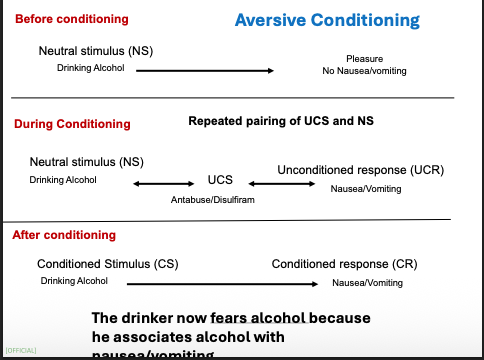
Aversive conditioning: Repeatedly pair alcohol with an unpleasant consequence to reduce its reinforcing value.
Disulfiram (Antabuse): When a person taking disulfiram consumes alcohol, it can cause an unpleasant reaction, including nausea, vomiting, flushing and headache.
- Conditioning process:
Before conditioning: Alcohol → pleasurable/reinforcing effects
Pairing: Alcohol + disulfiram → unpleasant physical reaction
After repeated pairings: Alcohol (CS) → conditioned aversion/unpleasant response (CR)
• Goal: Alcohol becomes associated with an unpleasant response rather than its usual rewarding effects, reducing the motivation to drink.
• Passive role: The individual plays a relatively passive role in the conditioning process, compared with approaches that require active engagement and behavioural change.
Phobias / Anxiety – Little Albert
Albert now fears the white toy because he associated the toy with the loud metal ‘clang’ sound
Aversive Conditioning
Treatment Implications - Cue Exposure/ Extinction
• Cue exposure is effective for some anxiety-related problems, particularly when combined with response prevention.
• Examples:
Arachnophobia: Exposure to spiders without avoiding them.
• OCD: Exposure to feared contamination cues while preventing the usual compulsive behaviour, such as repeated handwashing.
• Challenge in substance use: Drug cues can trigger strong craving, making it difficult to expose individuals to these cues without increasing the risk of drug use.
Differences between drug and phobic problems
• Appetitive problems are more common than phobias: Substance use involves seeking a rewarding or reinforcing experience, whereas phobias involve avoiding an aversive stimulus.
• Substance use involves two types of reinforcement:
Positive reinforcement: Seeking pleasurable effects such as pleasure or excitement.
Negative reinforcement: Seeking relief from unpleasant states such as stress, anxiety or withdrawal.
• Phobias primarily involve negative reinforcement: Avoiding the feared stimulus reduces anxiety or distress.
• Different types of cues: Phobic triggers are usually external, whereas substance use can be triggered by both external cues (people, places, objects) and internal cues (thoughts, emotions and physical states).
• Internal cues are harder to identify and target, making substanceuse problems more complex to treat.
• Cue exposure has had mixed success: It may reduce craving or substance use in the short term, but effects are often limited compared with some other treatments.
• A key challenge: Exposure to drug-related cues can itself trigger craving, potentially increasing the risk of substance use.
Limitations of the classical conditioning models
• Passive view of the individual: Focus on the relationship between stimuli and responses, with less emphasis on the individual as an active decision-maker.
• Limited attention to motivation: Do not fully explain conscious processes, such as wanting, intentions and motivation to use drugs, that influence instrumental behaviour.
• Reliance on self-report: Craving and responses to drug-related cues are often assessed through self-report.
• Cue exposure has had limited success: Exposure to drug-related cues alone has not consistently reduced craving or substance use, suggesting that learning involves more than simple stimulus– response associations.
Operant conditioning (Instrumental Learning)
• Thorndike: In the late 1890s, Thorndike studied how cats learned to escape from puzzle boxes. He proposed the Law of Effect: behaviours followed by satisfying consequences are more likely to be repeated.
• Skinner: In the 1930s–1940s, Skinner developed operant conditioning, building on Thorndike’s work and showing how consequences shape behaviour.
• Bandura: Later, Bandura extended behavioural learning approaches through Social Learning Theory, emphasising learning through observation and modelling.
• Central principle: Behaviours followed by rewarding consequences are more likely to occur again.
• Consequences influence behaviour: What happens after a behaviour affects the likelihood that the behaviour will be repeated.
• Antecedent → Behaviour → Consequence
How is operant conditioning applied to dependence?
• Dependence can be learned: Drug use can become a learned behaviour through reinforcement.
• Two ways drugs can act as reinforcers:
Positive reinforcement: Produces pleasurable or rewarding effects (e.g., pleasure, excitement).
Negative reinforcement: Relieves an unpleasant state (e.g., anxiety, stress, depression or withdrawal symptoms).
• Immediate reinforcement: The effects of drugs are often immediate, whereas the negative consequences of continued use may occur much later.
• Why continue despite the consequences? Immediate rewards can outweigh delayed negative consequences, helping to explain continued drug use.
Treatment based on Operant conditioning
• Reinforcement is contingent on behaviour: Rewards are provided when clients engage in target behaviours.
• Users play an active role: Their behaviour determines whether they receive the reward.
• Substance use can be reinforcing: Alcohol and other drugs can produce positive effects that reinforce continued use.
• Change the contingencies: Substance use may decrease when abstinence or other recovery behaviours are associated with meaningful rewards
• Petry et al. (2000): 42 alcohol-dependent individuals were assigned to either:
Contingency group: Earned money for providing a negative BAC sample
Control group: No contingency for negative BAC
• Treatment retention: 84% of the contingency group completed the 8-week treatment, compared with 24% of the control group.
• Abstinence: At the end of treatment, 69% of the contingency group remained abstinent, compared with 39% of the control group.
• Tangible reinforcers: Vouchers can be exchanged for goods or services when clients remain abstinent, attend meetings, meet treatment goals, or adhere to medication.
• Social reinforcers: Social support and encouragement can also reinforce recovery-related behaviours.
• Lit et al. (2007): Alcohol users were assigned to three groups:
Network support
Network support + contingency management • Control (no network support or contingency management)
• Network support increased: Behavioural and attitudinal support for abstinence, as well as involvement in AA.
• Treatment outcomes: Both network support groups had better outcomes than the control group.
• Structure rewards to support sobriety: Reinforce behaviours that support abstinence and recovery.
• Increase alternative sources of reinforcement: Reduce substance use by making healthy alternatives—such as satisfying relationships, employment and enjoyable activities—more rewarding.
• Rearrange contingencies: Make the rewards associated with maintaining sobriety greater than those associated with drinking or drug use.
• Build a rewarding lifestyle: Help individuals develop sources of reinforcement that compete with the rewards of substance use.
Garcia-Rodriguez et al. (2009) - Cocaine dependence
• Experiment involved 3 groups:
standard outpatient treatment
CRA plus low monetary value vouchers (CRA-LOW)
CRA plus high monetary value vouchers (CRA-HIGH)
• Maintaining negative drug test:
88.45% in standard treatment group,
96.09% in CRA-LOW
97.07% in CRA-HIGH.
• Retention rate at 6 months:
36.5% standard treatment group,
53.3% CRA-LOW
69.0% CRA-HIGH.
better results in CRA group than the standard program.
Problems of Contingency Management Programs
• Costly: Requires financial support, counselling and other resources
• Spontaneous remission: Some people reduce or stop use without treatment; however, this may depend on recognising the benefits of sobriety
• Reliance on self-report: Outcomes are often based on participants’ self-reported behaviour
• Limited reinforcement: Many people lack alternative sources of reinforcement within their broader social environment
• Environmental cues: People are continually exposed to drug-related cues in everyday life, making it difficult to maintain reduced use and sustain treatment gains