WGU C949 Exam Review C949 WGU C949 - Data Structures and Algorithms Pre-Assessment | FREQUENTLY TESTED QUESTIONS WITH CORRECT ANSWERS | BRAND NEW!
 Call Kai
 Learn
Learn Practice Test
 Spaced Repetition
 Match
Match Flashcards
1/159

There's no tags or description
Looks like no tags are added yet.
Name | Mastery | Learn | Test | Matching | Spaced | Call with Kai | Chat |
|---|
No analytics yet
Send a link to your students to track their progress
160 Terms
Algorithm
A set of instructions followed step by step to solve a problem
Characteristics of an Algorithm
1. Clear & unambiguous
2. Well-defined inputs
3. Well-defined outputs
what will be produced?
4. Finite-ness
5. Feasible
6. Language independent
Factors of an Algorithm
1. Modularity (can be broken down)
2. Correctness
3. Maintainability (no major changes when redefining the algorithm)
4. Functionality
5. Robustness (ability to define problem clearly)
6. User friendly
7. Simplicity
8. Extensibility (Future developers can understand it & build upon it)
Which factor takes the ability to easily update an algorithm into consideration?
maintainability
What is a high-level consideration in an algorithm’s design?
simplicity
Prior analysis
things you'd consider before implementing an algorithm, such as processing speed
Post analysis
happens after implementation
Types of Algorithms
-Brute-force algorithm
-Searching algorithm
-Sorting algorithm
-Recursive algorithm
-Backtracking algorithm
-Divide & conquer algorithm
-Greedy algorithm
-Dynamic programming algorithm
-Randomized algorithm
Brute Force Algorithm
an algorithm that tries all possible solutions in order then chooses the best one
Example of searching algorithms
linear search and binary search
Linear Search Algorithm
Starts from the beginning of a list & checks each element until the search key is found or the end of the list is reached.
Data can be sorted or unsorted
Binary Search Algorithm
starts at the middle of a sorted data set of numbers and eliminates half of the data; this process repeats until the desired value is found or all elements have been eliminated
Sorting Algorithms
Bubble Sort
Selection Sort
Insertion Sort
Quick Sort
Merge Sort
RADIX
Bubble Sort Algorithm
Compares elements that are side by side & determine if the left element is greater than the right element. If so, it swaps them and continues to compare elements until it reaches the end of the list. The largest # is "bubbled" to the top of the list
Selection Sort Algorithm
finds the lowest value in an array & moves it to the front of an array
Uses a sorted & unsorted list
*nested loop
Insertion Sort Algorithm
Takes 2 elements & moves them to a sorted list, sorts them least to greatest, then goes back to the unsorted list & keeps moving elements down to the sorted list, making swaps 1 at a time until the list is fully sorted.
Quicksort Algorithm
Quicksort divides the array into 2 parts low & high)
All values in the low partition are <= to the pivot value
All values in the high partition are >= to the pivot value
Merge Sort Algorithm
Breaks data into small groups, puts the groups in order, then combines groups until all are in order
*divide & conquer algorithm
What function is used with a merge sort?
recursion
Radix Sort
distributes the elements into buckets based on each digit's value. By repeatedly sorting the elements by their significant digits, from the least significant to the most significant, Radix Sort achieves the final sorted order.
greedy algor
finds the best solution at a give moment
Data structure
A way of storing, organizing, and performing operations on data
Nonlinear Data Structures
Elements are not in sequential order
Ex: tree & graph
Linear Data structure
Elements are in sequential order and adjacent elements are attached
List examples of data structures
1. Record
2. Array
3. Linked list
4. Binary Tree
5. Hash table
6. Heap
7. Graph
Record
a data structure that stores subitems
Array
a data structure that is ordered and indexed. It's elements are mutable, but must be of the same data type. Duplicates are allowed
Linked list
ordered list of items stored in nodes
each node stores data & pointer to (or the address of) the next node
elements are linked using pointers
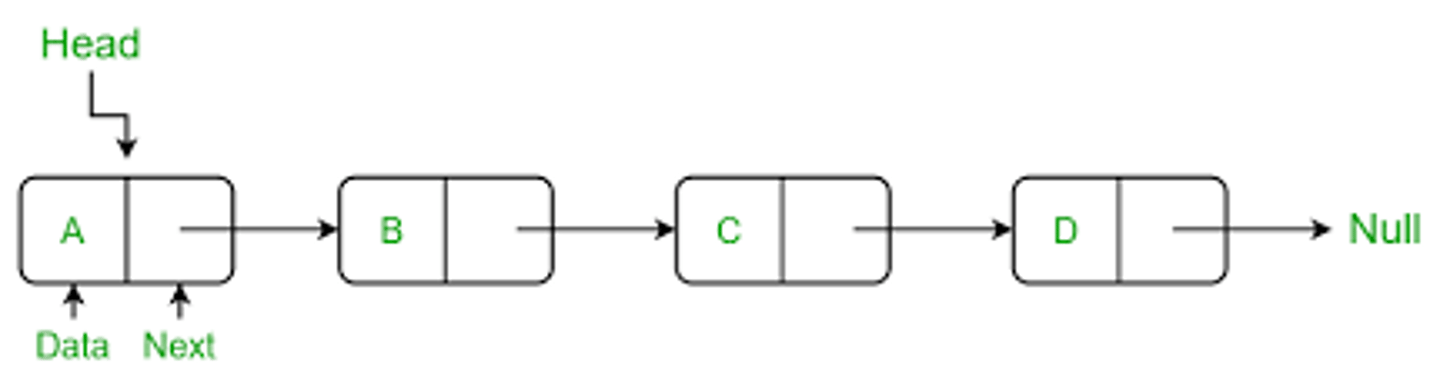
T/F: Linked list have slower access times than arrays
True because they are not indexed
Binary Tree
a data structure in which each node stores data and has up to two children
the top node is the root
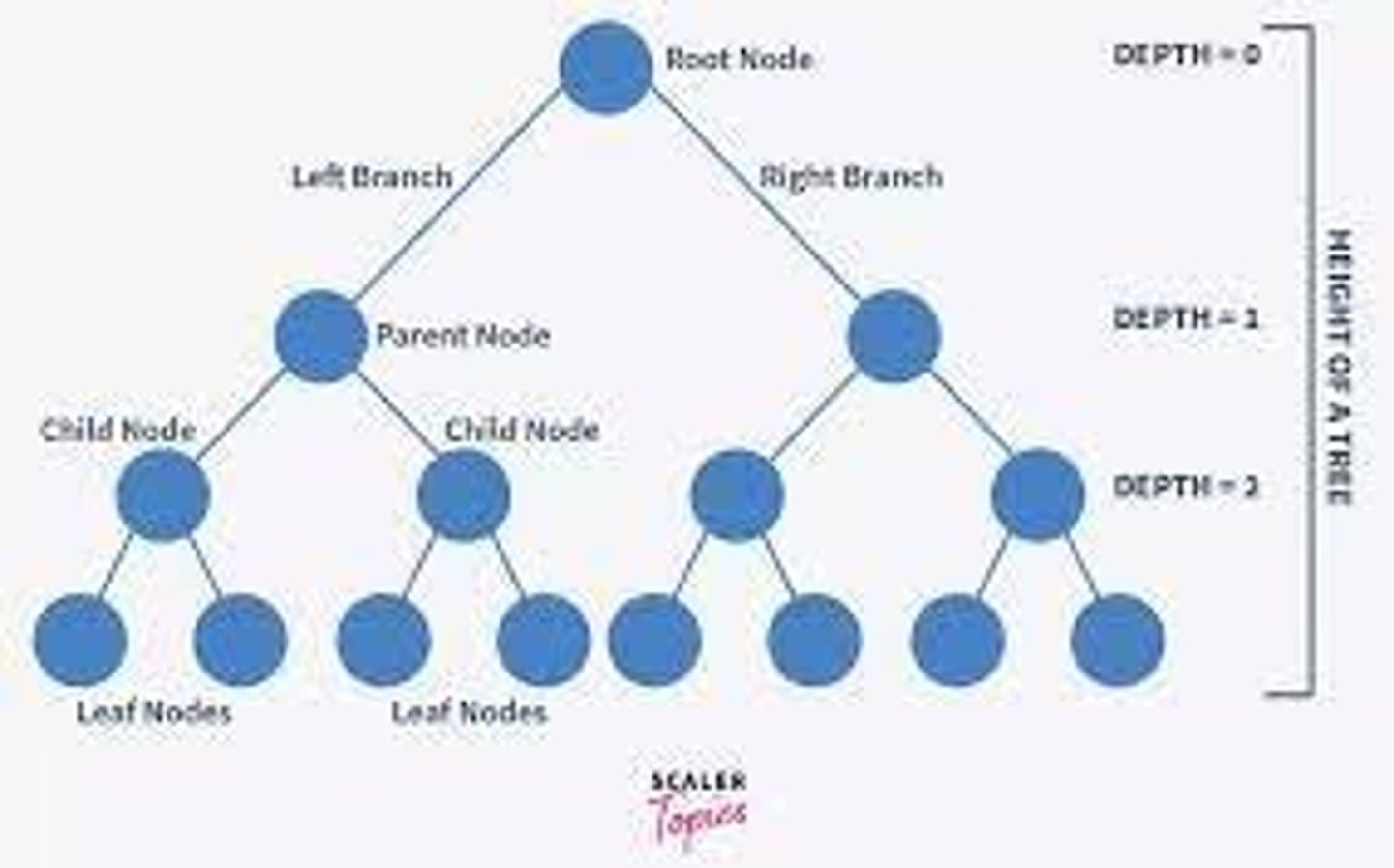
parts of a binary tree
root - the top node (no parent)
node - each child
leaf - a node with no child
internal node - has at least 1 child
edge
The link (line) from a node to a child in a graph
depth
The # of edges on the path from the root to the node
The root node has depth 0
level
Nodes with the same depth form a tree level
height
The largest depth of any node
A tree w/ 1 node as height 0
Hash Table
a data structure that stores unordered items by mapping (or hashing) each item to a location in an array
what are elements in a hash table called?
bucket
how long does it take to search a well-designed hash table on average?
O(1)
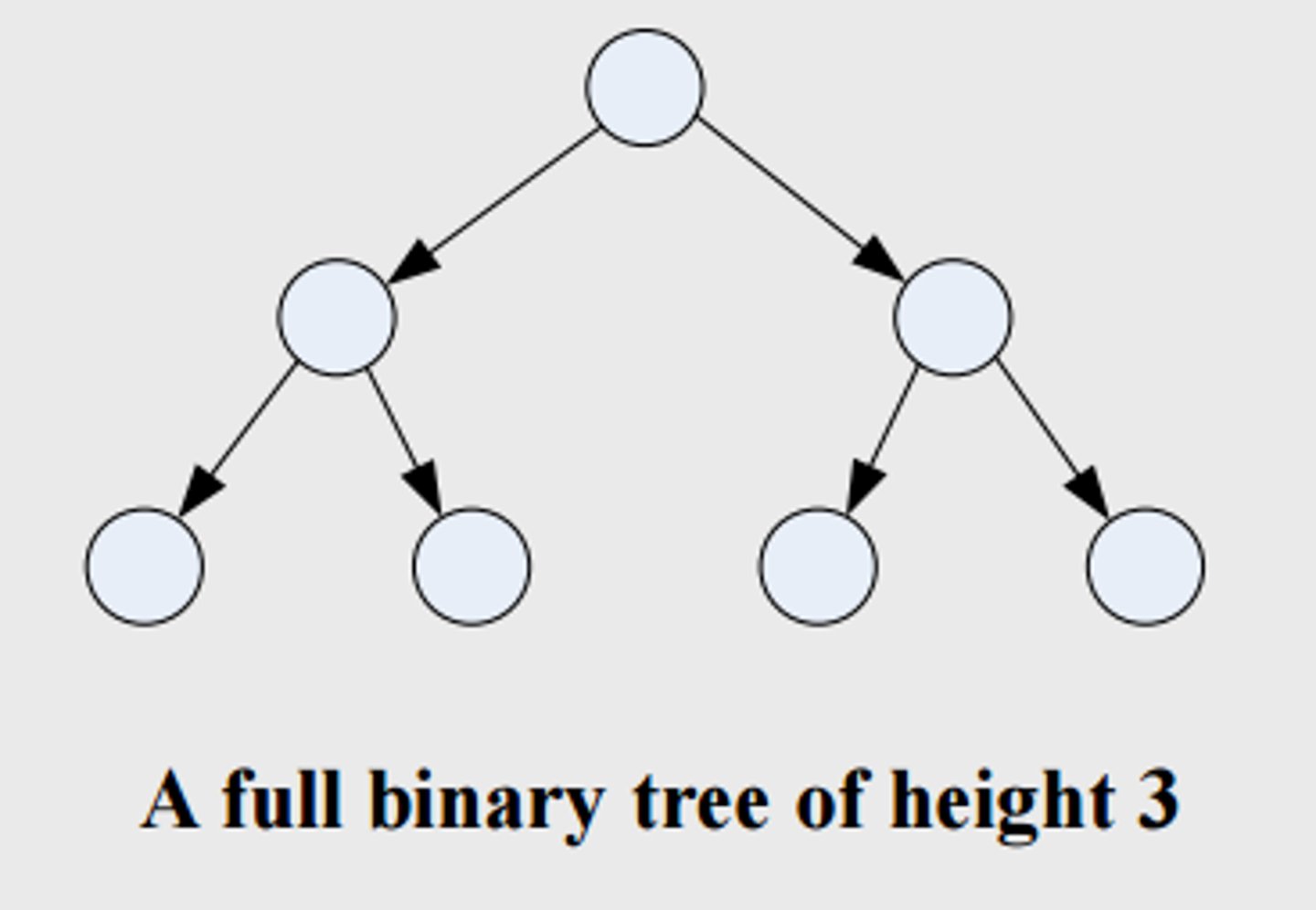
Full Binary Tree
Each node has 0 or 2 children
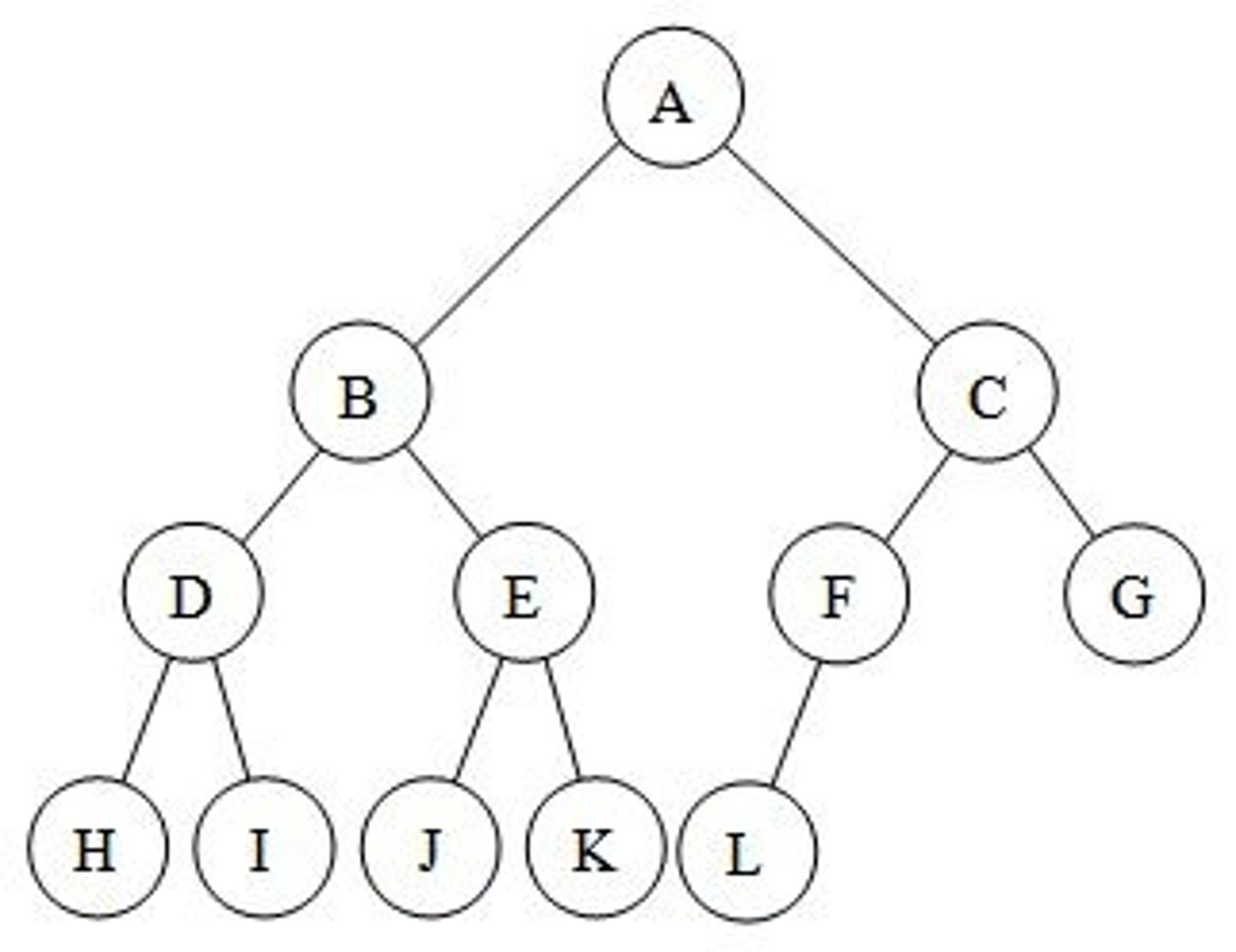
Complete Binary Tree
a binary tree in which every level, except possibly the last, is completely filled, and all nodes are as far left as possible
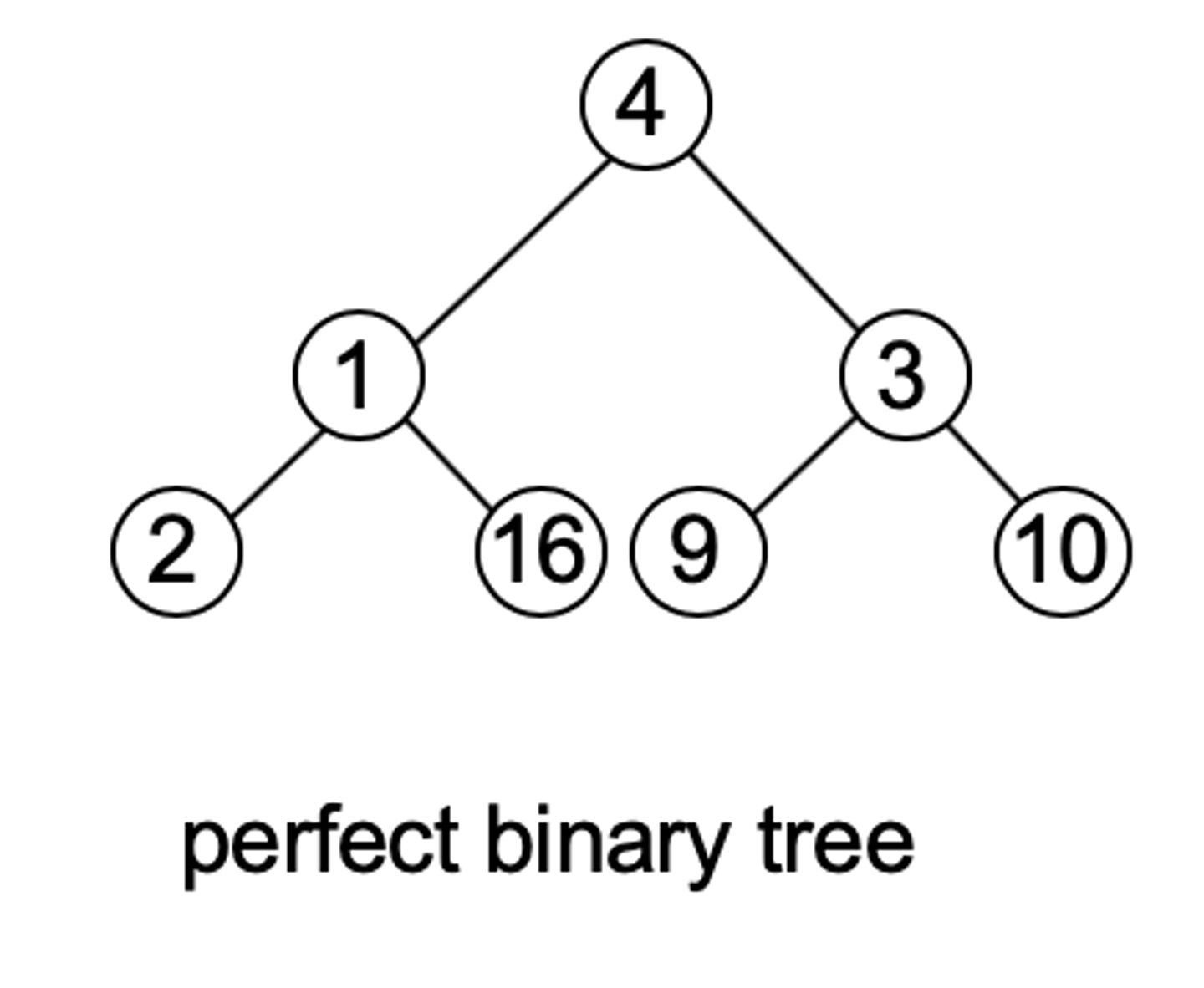
Perfect Binary Tree
all internal nodes have 2 children and all leaf nodes are at the same level
Max Heap
a tree that maintains the simple property that a node's key is greater than or equal to the node's childrens' keys
Min Heap
a tree that maintains the simple property that a node's key is less than or equal to the node's childrens' keys
graph
a data structure for representing connections among items
A vertex (or node) represents an item in a graph
An edge represents a connection b/w vertices
What operations are performed on a data structure?
accessing or updating stored data
searching for specific data
inserting new data
removing data
What is a class in OOP?
A blueprint for creating objects(instances)
Which characteristic of an algorithm is independent in nature?
Uses an agnostic code repository
Means it is language independent (multiple programming languages can implement it)
Time complexity
amount of time needed to execute code
includes an algorithms worst case
Space complexity
Quantity of space (in memory) required to solve a problem & produce an output
auxiliary space complexity
the space complexity not including the input data
What is the best case time complexity?
O(1)
element is at the beginning of list
what is the average case time complexity?
O(n)
element is in the middle
what is the worst case time complexity?
O(n)
element is at the end or not in the list
Abstract Data Type (ADT)
A data type whose properties are specified without prior knowledge of how they'll work
What is a high-level consideration in an algorithm’s design?
simplicity
What is the primary method used to search for an item in a sorted array?
binary search
Which algorithm requires data sorting as its first step?
binary search
Which data type do heap sorts work with?
tree-based structure
Which search algorithm has the best performance when the data set is sorted?
interval search
What is the advantage that a linked list has over an array?
grows and shrinks as needed
What would be the best data structure for a hash table with simple chaining?
doubly linked list
Which characteristic of a class allows it to be used as an abstract data type (ADT)?
It consists of variables and methods.
what does .pop() do for a stack
removes the 1st element from the top of the list
what does .pop() do for a queue
Popfront - Remove the list item from the front of the list
Pop back - Remove the list item from the back of the list
inorder traversal
left subtree, root, right subtree
preorder traversal
root, left subtree, right subtree
What uses the first in first out method
queue
what uses the last in first out method
stack
stack
Linear data structure where insertions & deletions are allowed only at the end (the top)
queue
Items are inserted at the end of the queue and removed from the front of the queue
Priority Queue
a queue in which the highest-priority elements are removed first; within a priority value, the earliest arrival is removed first.
what does the dequeue operation do
Removes & returns the item at the front of the queue
what does the enqueue operation do
Adding to the back (the end) of the line (queue)
what function removes all items from a list?
clear()
what function removes the 1st instance of a specified element?
remove()
what tool is used to implement a deque ADT
collections
Time complexity for bubble sort
O(n^2)
what kind of function would you see with bubble sort?
nested loop
Time complexity for merge sort
O(n log n)
Time complexity for selection sort
O(n^2)
Big O Notation
describes how the runtime of an algorithm grows as the input size grows
Determining big O: when adding terms what order term is kept?
Highest
Determining big O: when multiplying terms what happens to constants?
They are omitted
What runtime is O(1)
Constant
What runtime is O(log n)
Logarithmic
What runtime is O(n)
Linear
What runtime is O(n log n)
Loglinear
What runtime is O(n^2)
Quadratic
What runtime is O(c^n)
Exponential
Which tool in Python is used to implement a deque ADT?
collections
Which data structure is used to implement a dictionary data type?
hash table
Which operator is a type of assignment operator?
+=
3 multiple choice options
how do you determine the runtime of nested loops in big-O notation?
summing the runtime of the inner loop over each outer loop iteration
compression
transforms data to use fewer bits
set abstract data type
collection of distinct elements
what happens if you try to add an element to a set that already exists in the set?
there is no effect
T/F: Every set is a subset of itself.
true
T/F: For all elements in set X to also be in set Y, Y must have at least the same number of elements in X.
true
set - difference
The difference of sets X and Y, denoted as X \ Y, is a set that contains every element that is in X but not in Y, and no additional elements.
set - intersection
The intersection of sets X and Y, denoted as X ∩ Y, is a set that contains every element that is in both X and Y, and no additional elements.