Chapter 18 Study Guide
 Call Kai
 Learn
Learn Practice Test
 Spaced Repetition
 Match
Match Flashcards
 Knowt Play
1/314

There's no tags or description
Looks like no tags are added yet.
Name | Mastery | Learn | Test | Matching | Spaced | Call with Kai | Chat |
|---|
No analytics yet
Send a link to your students to track their progress
315 Terms
What does CVD stand for?
Cardiovascular Disease

What is coronary heart disease (CHD)?
A disease of the coronary arteries.
What does AMI stand for?
Acute Myocardial Infarction

What causes myocardial tissue death?
Narrowing or blockage of a coronary artery.
How often does someone in the United States experience an AMI?
Every 40 seconds.
What is cardiac arrest?
The cessation of cardiac mechanical activity.

Where do most out-of-hospital cardiac arrests (OHCAs) occur?
In a home or residence.
What are the main components of the cardiovascular system?
The heart and blood vessels.

What is the function of the cardiovascular system?
Delivers oxygenated blood and nutrients to cells, hormones, and transports waste products.
How many chambers does the heart have?
Four chambers.
What are the names of the heart's chambers?
Right atrium, left atrium, right ventricle, left ventricle.
What does the right atrium receive blood from?
The superior vena cava, inferior vena cava, and coronary sinus.
What does the left atrium receive blood from?
Oxygenated blood from the lungs via the right and left pulmonary veins.
What is the function of the right ventricle?
Pumps deoxygenated blood to the lungs.
What is the function of the left ventricle?
Pumps oxygenated blood throughout the body.
What separates the heart into two functional pumps?
The septa.
What is the myocardium?
The middle layer of the heart wall, responsible for cardiac contraction.
What does the left main coronary artery supply?
The left ventricle and interventricular septum.
What does the right coronary artery supply?
The right atrium, right ventricle, part of the left ventricle, and portions of the conduction system.
What are the four properties of cardiac cells?
Automaticity, excitability, conductivity, contractility.

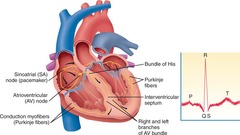
What are the six parts of the cardiac conduction system?
SA node, AV node, bundle of His, right and left bundle branches, Purkinje fibers.
What effect does sympathetic nerve stimulation have on the heart?
Strengthens the force of contraction and increases heart rate.
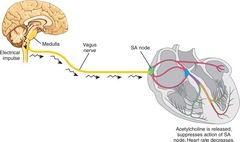
What effect does parasympathetic nerve stimulation have on the heart?
Slows the rate of discharge of the SA node and conduction through the AV node.
What is the primary survey order for patient assessment?
ABCDE (Airway, Breathing, Circulation, Disability, Exposure).

What changes in primary survey order if the patient is unresponsive?
Changes to CABDE (Circulation, Airway, Breathing, Disability, Exposure).
What are acute coronary syndromes (ACSs)?
A series of cardiac conditions caused by an abrupt reduction in blood flow through a coronary artery.
What are common chief complaints in cardiovascular emergencies?
Chest pain, dyspnea, fainting, palpitations, fatigue.
What should be determined if a patient faints?
Whether the cause is cardiac or noncardiac.
What are palpitations?
A sensation of an abnormally fast or irregular heartbeat.
What should be inquired about regarding palpitations?
Onset, frequency, duration, and previous episodes.
What additional symptoms may patients report in cardiovascular emergencies?
Feelings of impending doom, nausea or vomiting, trauma involvement, hypoxia or poor perfusion.
What should be asked about a patient's medical history?
Previous diagnoses including aneurysm, CAD, diabetes, and others.
What types of medications should be inquired about?
Prescription, over-the-counter drugs, herbal supplements, and recreational drugs.
What skin color changes may indicate circulation problems?
Pale, mottled, or cyanotic skin; flushed, warm skin.
What should be inspected during a secondary assessment of the neck?
Neck and tracheal position, adjacent structures, and jugular pressure.
What does bilateral pitting edema indicate?
Right ventricular failure (RVF).
What is a sign of blockage in the body?
One-sided pitting edema.
What are the normal values for systolic and diastolic blood pressure?
Normal SBP: less than 120 mm Hg; Normal DBP: less than 80 mm Hg.
What indicates stage 2 hypertension?
SBP of 140 mm Hg or higher; DBP of 90 mm Hg.
What is the significance of a pulse deficit?
It indicates a difference between apical and peripheral pulse.
What is pulsus paradoxus?
A beat-to-beat difference in the strength of a pulse.
What is the first heart sound (S1) associated with?
Closure of the tricuspid and mitral valves.
What can decreased heart sounds indicate?
Fibrotic or calcified mitral valve, obesity, emphysema, or cardiac tamponade.
What does the second heart sound (S2) indicate?
Closure of the pulmonary and aortic valves.
What can a loud S2 indicate?
Chronic high blood pressure or pulmonary hypertension.
What does S3 indicate?
Ventricular wall vibrations associated with heart failure.
What does S4 indicate?
Turbulent filling of a stiff ventricle, often in hypertrophy or myocardial infarction.
What causes a heart murmur?
Turbulent blood flow through the valves.
What is the role of the SA node?
It is the dominant pacemaker located in the right atrium.
What happens at the AV node?
Impulse conduction is delayed to allow atria to empty into ventricles.
What are secondary pacemakers?
Any component of the conduction system that can act as a pacemaker if the SA node is damaged.
What are accessory conduction pathways?
Extra heart muscle tissue connecting the atria and ventricles, which can trigger tachydysrhythmias.
What is depolarization in cardiac physiology?
Muscle fibers are stimulated to contract through changes in electrolyte concentrations across cell membranes.
What occurs during repolarization?
Sodium and calcium channels close, sodium is pumped out, and potassium is pumped in.
What are the phases of cardiac action potential?
Phase 0: depolarization; Phase 1: initial repolarization; Phase 2: plateau; Phase 3: final repolarization; Phase 4: resting phase.
What are refractory periods in cardiac physiology?
Periods during which the cell is depolarized or repolarizing, including absolute and relative refractory periods.
What is the significance of jugular pressure estimation?
It helps assess the central venous pressure and fluid status.
What does a widened pulse pressure indicate?
Later stages of shock.
What does narrowed pulse pressure suggest?
Tachycardia or cardiac tamponade.
What is the purpose of cardiac monitoring?
To assess heart rhythm and detect abnormalities.
What is waveform capnography used for?
To monitor the concentration of carbon dioxide in exhaled air.
What does a pulse oximeter measure?
The oxygen saturation level in the blood.
What type of nerves are responsible for accelerating the heart rate?
Sympathetic nerves
What neurotransmitter is released by sympathetic nerves to increase heart rate?
Norepinephrine
Which nodes in the heart do sympathetic nerves primarily affect?
SA node and AV node
What is the effect of sympathetic nerve stimulation on cardiac output?
It increases cardiac output.
What type of nerves decrease heart rate?
Parasympathetic nerves
Through which nerve do parasympathetic signals travel to the heart?
Vagus nerve
What physiological response stimulates parasympathetic nerve activity?
Increased pressure on carotid sinus
What neurotransmitter is released by the vagus nerve to slow the heart rate?
Acetylcholine (ACh)
What is the role of baroreceptors in the autonomic nervous system?
They detect changes in blood pressure and generate reflex responses.
What do chemoreceptors detect in the blood?
Changes in hydrogen ions (pH), oxygen, and carbon dioxide concentrations.
What is the primary purpose of the electrocardiogram (ECG)?
To provide a detailed electrical snapshot of the heart's conduction system.
What are the three standard limb leads in an ECG?
Lead I, Lead II, Lead III

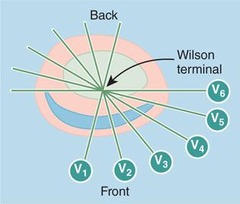
What is the function of precordial leads in an ECG?
To monitor the electrical activity of the heart from the chest.
What is Einthoven's theory regarding limb leads?
Every time the heart contracts, electrical energy is emitted.
How are augmented voltage (aV) leads created?
Using four limb electrodes to combine two limb leads with another lead as the pole.

What is the significance of contiguous leads in an ECG?
They view geographically similar areas of the myocardium.

What is the purpose of posterior leads in an ECG?
To evaluate the electrical activity of the left ventricle posterior wall.

What does the ECG baseline represent?
Electrical silence in the myocardium.

What does a deflection above baseline in an ECG indicate?
An electrical impulse moving toward a positive electrode.

What does a deflection below baseline in an ECG indicate?
An electrical impulse moving toward a negative electrode.
What is the role of the vagus nerve in heart rate regulation?
It transmits impulses to the SA node to decelerate heart rate.
What happens to heart rate when acetylcholine is released?
The heart rate decreases.
What is the function of the vagus nerve in relation to the AV node?
ACh blocks additional impulses from the AV node.
What are the standard lead placements for continuous monitoring?
White on right upper chest, Black on left upper chest, Red on left lower abdomen, Green on right lower abdomen.
What additional leads are included in a 15-lead ECG?
Leads V4R, V7, and V8.
What is the purpose of a 12-lead ECG?
To provide a comprehensive view of the heart's electrical activity.
What does perpendicular movement toward a positive electrode produce?
Either a perfectly flat line or biphasic waves.
At what speed does ECG paper move past the stylus?
25 mm/s.

How long is one 1-mm box on ECG paper?
0.04 seconds.
How long is one large box on ECG paper?
0.20 seconds.
What does the vertical axis on ECG paper represent?
Amplitude.
What is the standard amplitude calibration for ECG?
10 mm/mV.
What does the PR interval (PRI) represent?
The time required for an impulse to traverse the atria and AV junction.
What is the normal duration of the PR interval?
0.12 to 0.20 seconds.
What does the P wave represent in an ECG?
Atrial depolarization.
What is the normal duration of a P wave?
Less than 0.11 seconds.
What is the normal amplitude of a P wave?
Less than 2.5 mm tall.
What does the QRS complex represent?
Ventricular depolarization.