PHARM EXAM 1
 Call Kai
 Learn
Learn Practice Test
 Spaced Repetition
 Match
Match Flashcards
 Knowt Play
1/21

There's no tags or description
Looks like no tags are added yet.
Name | Mastery | Learn | Test | Matching | Spaced | Call with Kai | Chat |
|---|
No analytics yet
Send a link to your students to track their progress
22 Terms
Which of the following statements is TRUE regarding the pharmacokinetics of a drug under first-order elimination kinetics:
A. CL is proportional to Cp
B. Re becomes faster as the Cp gets lower
C. Clearance (CL) is constant
D. Rate of elimination (Re) is constant
E. Both Re and CLare constant
C. Clearance (CL) is constant
B2-adrenergic receptors are GPCRs that couple to Gas. Ventolin®/albuterol, an agonist at this receptor used for the treatment of acute asthma attacks, would most likely result in which of the following:
A. Increased Gas-GDP level
B. Decreased Gai-GTP level
C. Increased intracellular calcium (Ca2+) concentration
D. Increased PLC activity
E. Decreased Adenylyl cyclase activity
F. Increased intracellular cyclic AMP (cAMP) accumulation
G. Decreased B2-adrenergic receptor activation
F. Increased intracellular cyclic AMP (cAMP) accumulation
Which of the following is TRUE regarding a drug with a log value of 2:
A. The drug is equally concentrated in octanol and water phases
B. The drug is 2x more concentrated in the octanol phase
C. The drug is 100x more concentrated in the octanol phrase
D. The drug is 2x more concentrated in the aqueous phase
E. The drug is 100x more concentrated in the aqueous phrase
F. The drug would be in violation of Lipinski's rule regarding logP
C. The drug is 100x more concentrated in the octanol phrase
Loading doses are typically administered to quickly obtain an initial Cp near the desired maintenance Cpss. Which of the following is TRUE regarding the utility of loading dose administration?
A. Particularly useful when the desired Cpss is very high
B. Particularly useful for drugs with low F values
C. Particularly useful for drugs with high F values
D. Particularly useful for drugs with long t1/2 values
E. Particularly useful for drugs with short t1/2 values
D. Particularly useful for drugs with long t1/2 values
Generally speaking, which of the following statements is TRUE regarding drug absorption following oral administration?
A. Drugs with moderate lipophilic character (within an ideal logP range) are best suited for oral administration.
B. The larger the drug, the better it is absorbed
C. The more charged/ionized the drug, the better it is absorbed
D. When switching from IV to oral administration, it is common for the oral dose to be less than that IV dose to achieve an equivalent Cp level
A. Drugs with moderate lipophilic character (within an ideal logP range) are best suited for oral administration.
Lipophilic (hydrophobic) drugs typically have a volume of distribution (VD):
A. Equal to the plasma volume
B. Greater than plasma volume
C. Less than plasma volume
D. Lipophilicity of a drug has nothing to do with Vo
B. Greater than plasma volume
You have conducted an experiment with a new antagonist you are studying and determined its IC50 value to be 200nM in an experiment in which you used 100nM of an agonist having a Kd = 100nM. What is the Ki of your antagonist?
A. 200nM
B. 400nM
C. 100nM
D. 1nM
E. 2nM
C. 100nM
Which of the following statements is/are TRUE regarding weak acids?
A. Their protonated form predominates (>50%) when pH < pKa
B. Their protonated form predominates (>50%) when pH < pKa
Their ionized form predominates (>50%) when pH < pKa
C. Their neutral form predominates (>50%) when pH < pKa
D. Both (A) and (B) are true Both
E. Both (A) and (B) are true Both
E. Both (A) and (B) are true Both
Which of the following statements regarding common receptor targets of drugs, GPCRs and RTKs, is TRUE?
A. GPCRs and RTKs are both kinases that phosphorylate G-proteins
B. GPCRs directly activate Ga-proteins coupled to them, whereas RTKs indirectly lead to activation of the G-protein Ras
C. RKs typically regulate second messenger molecules such as cAMP and calcium to exert their biological effects
D. GCRs couple directly with the G-protein Ras and activate MAPK signaling
E. GPCRs and RKs are both cytoplasmic proteins that translocate to the nucleus upon agonist binding
B. GPCRs directly activate Ga-proteins coupled to them, whereas RTKs indirectly lead to activation of the G-protein Ras
You are investigating the effects of a new receptor agonist on calcium levels in cultured cells. You know that the affinity of the agonist-receptor interaction is 10nM and that 40% of receptors are spare. In this situation, what could you predict about the potency of this new agonist?
A. The potency will be =10nM
B. The potency will be <10nM
C. The potency will be > 10nM
B. The potency will be <10nM
Benzodiazepine drugs differ in their pharmacokinetic profiles, particularly in half-life. For example, Halcion®/triazolam has a t1/2 = 2h, whereas Valium®/diazepam has a t1/2 = 50h. Based on this, how would the time to reach pss differ between these two drugs (if administered to the same hypothetical patient)?
A. Halcion would reach pss ~48h faster
B. Halcion would reach Cpss ~240h faster
C. Valium would reach Cpss ~48h faster
D. Valium would reach Cpss ~240h faster
E. Not enough information; it would depend on the dose administered
B. Halcion would reach Cpss ~240h faster
Which of the following best describes the conclusions of Lipinski's Rule of 5'?
A. Orally active drugs are typically small, highly charged molecules
B. Orally active drugs are typically large, highly charged molecules
C. Orally active drugs are typically small, moderately non-polar molecules
D. Orally active drugs are typically large, extremely hydrophobic molecules
C. Orally active drugs are typically small, moderately non-polar molecules
An agonist is found to elicit its Emax at a concentration that occupies only 30% of the total receptors (e.g. Emax occurs at f= 0.3). How would this affect the activity of a competitive antagonist for this agonist at its receptor?
A. The antagonist would lack effects below 71% receptor occupancy
B. The antagonist would lack effects above 71% receptor occupancy
C. The antagonist would have effects once it reached 31% receptor occupancy
D. The antagonist would only have effects when it is between 31-70% receptor occupancy
A. The antagonist would lack effects below 71% receptor occupancy
Which of the following is TRUE regarding the structure and function of Receptor Tyrosine Kinases (RTKs)?
A. RTKs are also called '7TM' receptors due to the bundle of 7 transmembrane helices that constitute their core structure
B. RTK agonists diffuse into the cell to bind to the intracellular kinase region of the RTK structure
C. Activated RKs are dimers, where each receptor trans-phosphorylates the C-terminal tail of the other receptor within the dimer
D. RTKs are directly coupled to heterotrimeric G-proteins
E. Upon agonist activation, RKs directly phosphorylate MAP kinases to activate a kinase cascade inside the cell
C. Activated RKs are dimers, where each receptor trans-phosphorylates the C-terminal tail of the other receptor within the dimer
Partial agonism results from which of the following?
A. A drug binding only a partial fraction of the total available receptors
B. A drug stabilizing only a partial fraction of total receptors in the active conformation (RA), resulting in a lower efficacy compared to full agonists
C. A drug having a low affinity for the receptor
D. A drug having a low potency
E. A drug having poor bioavailability resulting in partial absorption
B. A drug stabilizing only a partial fraction of total receptors in the active conformation (RA), resulting in a lower efficacy compared to full agonists
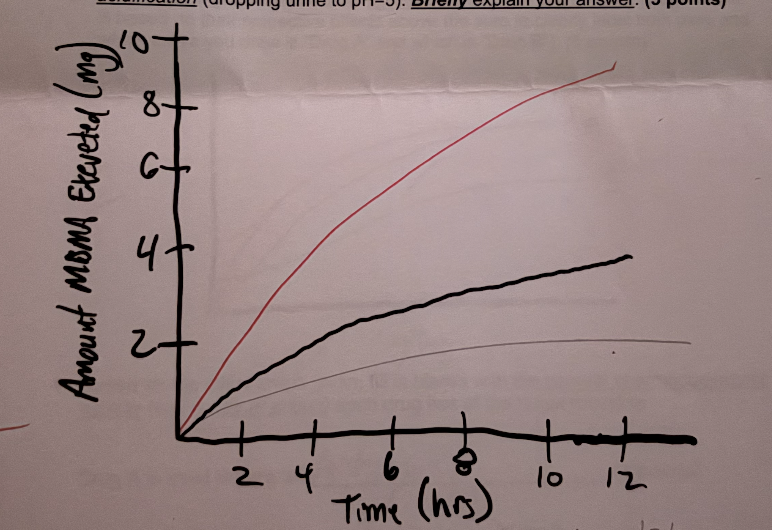
Is MDMA a wear acid or weak base? What’s it’s functional group?
Weak base. NH
Cumulative MDMA graph drawing and explain
Explain: a lower pH equals an increased base with a charge meaning urine increases
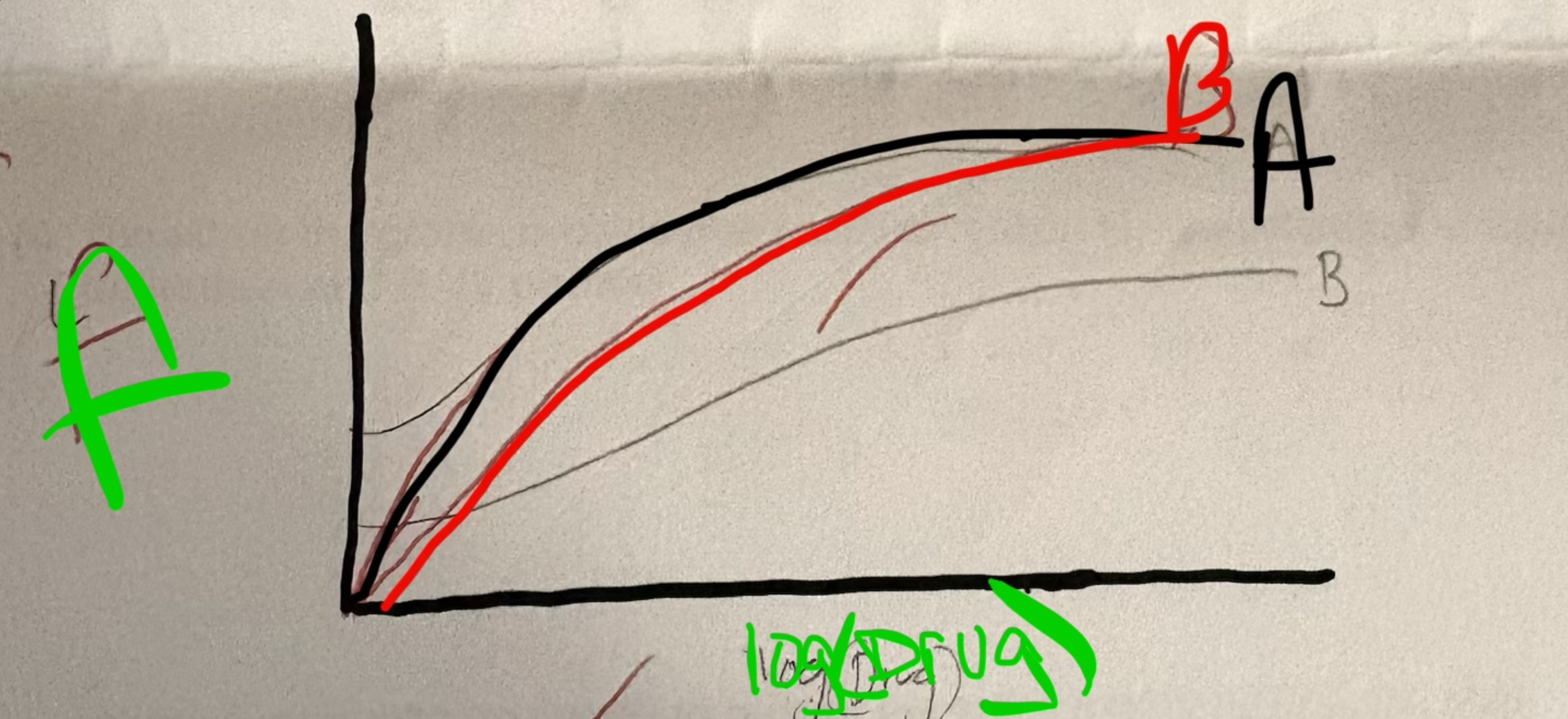
Graph of drug a and drug b- labeling and drawing
Based on initial graph given, fill in blanks:
Drug A is most likely a BLANK
Drug B is most likely a BLANK
Drug A is most likely a ANTAGONIST
Drug B is most likely a PARTIAL AGONIST
Below are steady-state drug accumulation graphs for the same drug given to two different patients, A and B (Cpmax and Cmin values are omitted for clarity). Use this information to answer questions 5 and 6:
5. Based on the graph, provide one possible reason for the difference in Opss for patients A and B.
6. At day 6, suppose you were to reduce patient A's dose by half, but keep everything else about the patient and their dosing regimen the same. Draw on the graph how this patient's Cpss would change from days 6-12 (try to draw as accurately as possible).
PT’S WT OR DRUGS TAKEN
LOOK AT PIC
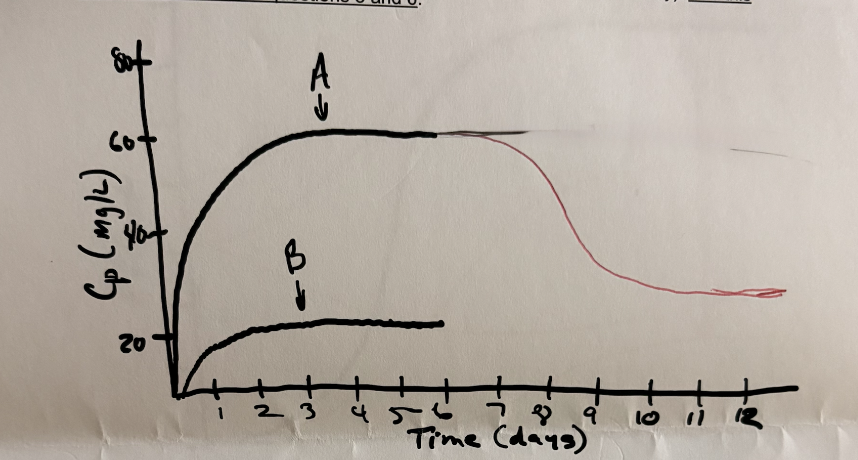
GRAPH: SEVEN
ou have developed two antagonists, A and B, that bind this same receptor. You have determined that Antagonist A has a higher affinity for the receptor than Antagonist B.
You also know that Antagonist A binds irreversibly to the agonist-binding site, and Antagonist B binds reversibly but at an allosteric site.
7. Draw two curves on the graph above, one for the agonist response curve in the presence of Antagonist A and another in the presence of an identical concentration of Antagonist B. Make sure the curves you draw not only depict how each antagonist influences the agonist response in general, but also how they (A and B) are drawn relative to each other.

Suppose MJ's Cpss is below your target goal and you wish to alter his original dosing regimen to achieve a 2-fold increase. Suggeset below one change you could make to the dosing regimen that would result in a doubling of the current Cpss
Smaller doses that are given more frequently
10. While recovering from major surgery, a patient of yours develops a cardiac arrhythmia and you have started her on Cardizem®/diltiazem 50mg IV twice per day. Preparing for her release from the hospital several days later, you need to write a prescription for oral diltiazem to continue treatment.
Knowing that the oral bioavailability (F) is 0.55, what should be the total daily dose of oral diltiazem for this patient?
50/0.55=90.909
=90.909 × 2 = 82 mg
Answer: 82 mg