TMs 2 - Ch 8-11 - TM stability, e-counting, aqueous solns
 Call Kai
 Learn
Learn Practice Test
 Spaced Repetition
 Match
Match Flashcards
 Knowt Play
1/27

There's no tags or description
Looks like no tags are added yet.
Name | Mastery | Learn | Test | Matching | Spaced | Call with Kai | Chat |
|---|
No analytics yet
Send a link to your students to track their progress
28 Terms
state the 18 e- rule, its implications for reactivity, and its exceptions
d e- + ligand e- + charge = 18 e-
if 18 e- = stable
< 18 e- = reduced (+ e-)
> 18 e- = oxidised (- e-)
square planar = 16 e- (dx2−y2 destabilised, - 2e-
L-type ligand
2 e- donor
“neutral”
dative bond formed
X-type ligand
1 e- donor
radical
covalent bond
Z-type ligand
0 e- donor
lewis acid - accepts 2 e- from metal
dative bond
list 5 factors that affect the strength of M-M bonding
spatial overlap: lower down + to left of periodic table = most diffuse orbitals so best spatial overlap
oxidation state: affects how e- dense metal is + how contracted
bond order of M-M bond: ↑ BO = ↓ bond length
ligand size
ligand number
bridging ligands present?
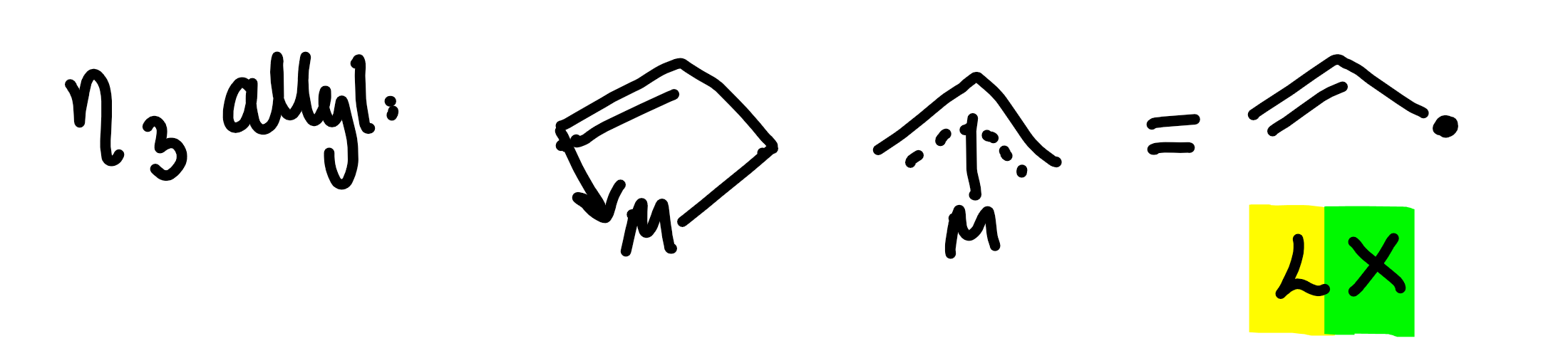
Describe the bonding in the η1 allyl ligand
X-type

Describe the bonding in the η3allyl ligand
LX
what is a μn ligand?
bridging ligand
n = no. of M centres coordinated to
what is a ηn ligand?
η = hapticity, no. of atoms that coordinate to metal.
e.g. Cp = η5
polyalkenes may have multiple hapticities available.
what does κ notation mean?
signals that the atom after it is the ligating one
e.g. dimethylphosphane-κP = P ligates
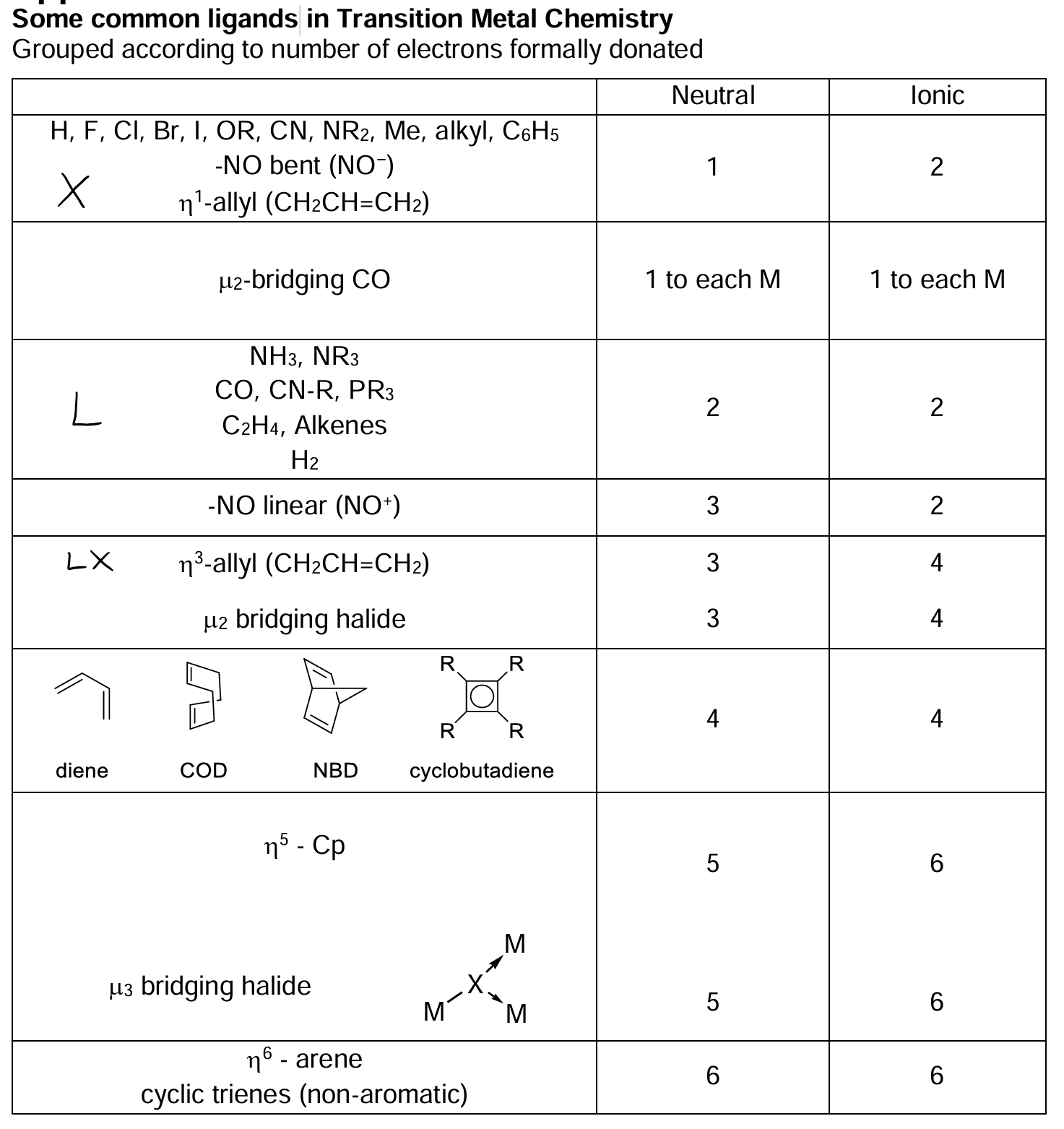
electrons counting table
How does the strength of M-L bonding vary with oxidation state?
↑ ox = stronger bonding
polarise ligand e- density more strongly
why don’t TMs past Mn access their maximum oxidation state?
Zeff ↑ across period
I.E. ↑
stability ↓
How does oxidising power change across a period?
best ox power = ↓ stability as we go left to right
How is the redox potential usually defined?
Relative to SHE, for reduction of metal
+ve = reduction favourable (gain e-)
-ve = oxidation favourable (lose e-)
ΔG=−nFE
Bronsted acidity
how easily a species DONATES PROTON
Trend in Bronsted acidity
across period
for increasing oxidation state
Both increase acidity
explanation:
HSAB - charge density
contracted orbitals
electroneutrality
how can bridging and aggregate formation be encouraged?
↑ pH = bridging
.e.g. @ pH7, bridging may be likely to occur
as acidic metals can easily lose protons + form bridging species e.g. OH-, O2-
Give some examples of aggregate structures
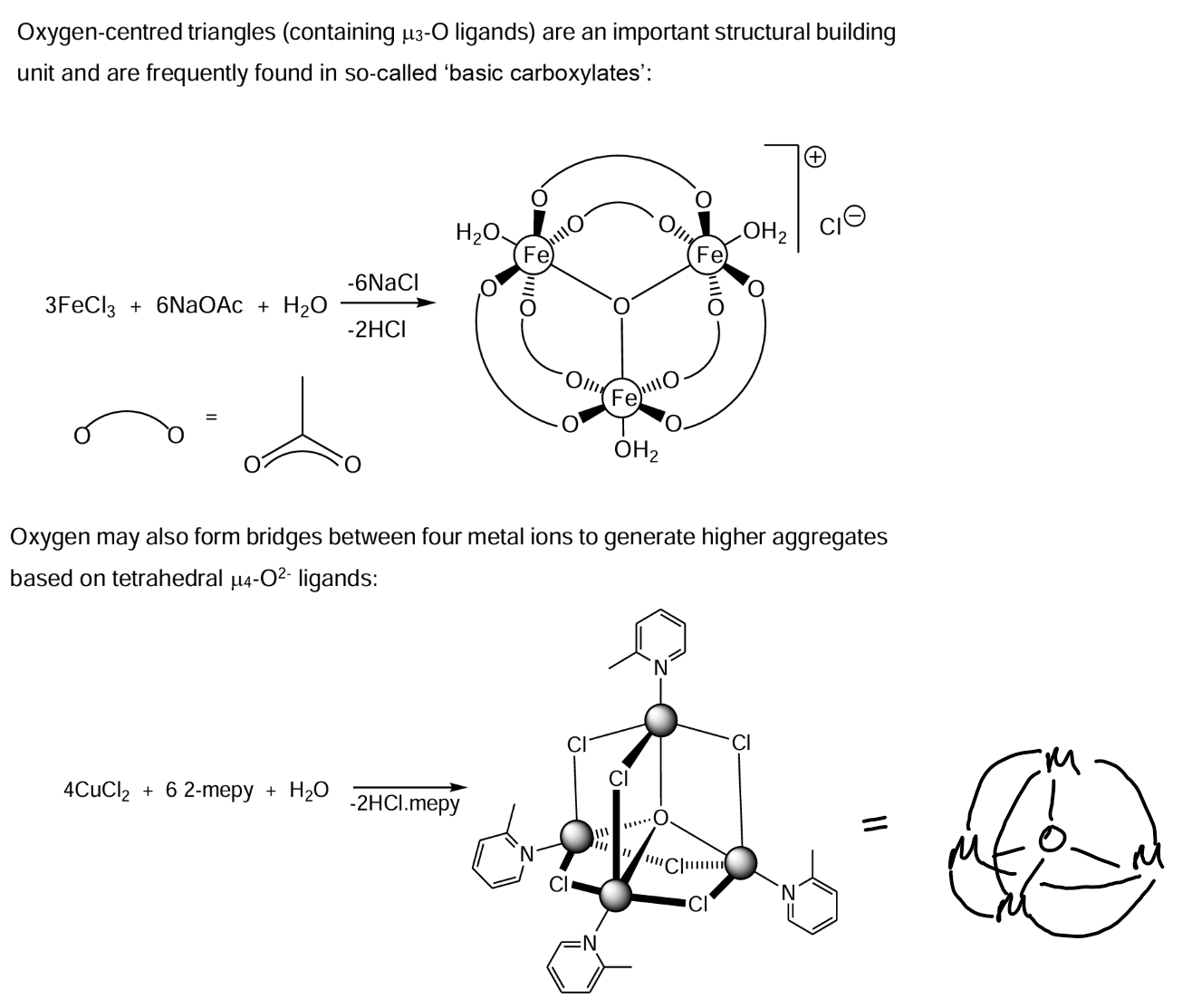
How is a bridging O ligand generated from a hexaquo ion?
Deprotonate water (which is more acidic after coordinating to ion)
Attack another metal centre
Deprotonate + cluster as needed
βn
overall thermo stability constant
= k1k2k3 etc…
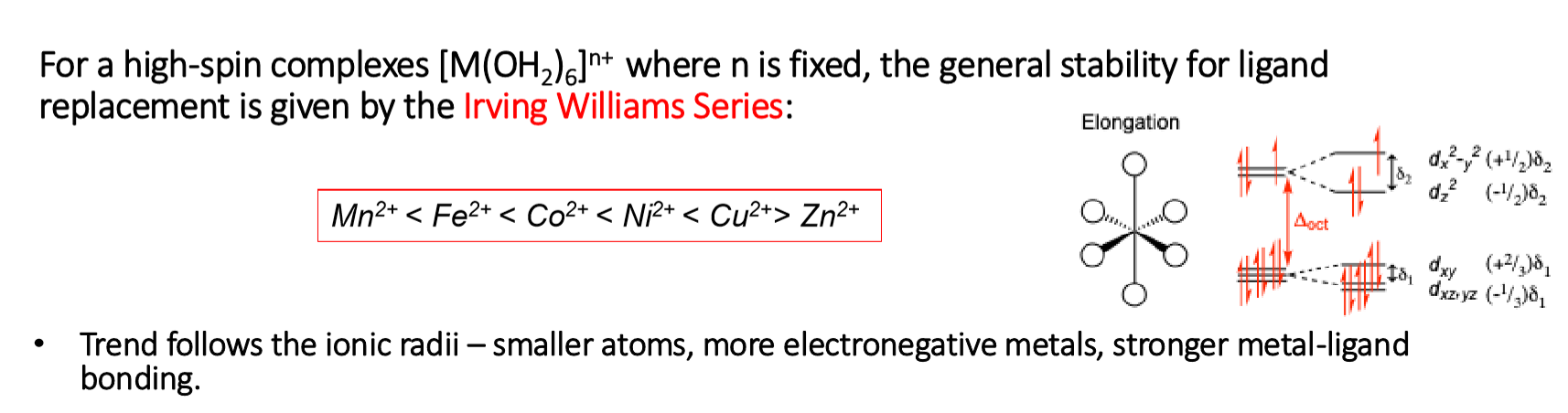
Irving-Williams series
rate of exchange of H2O to L
Zeff ↑ = more contracted = stronger binding to L = ↑βn = easier to replace H2O
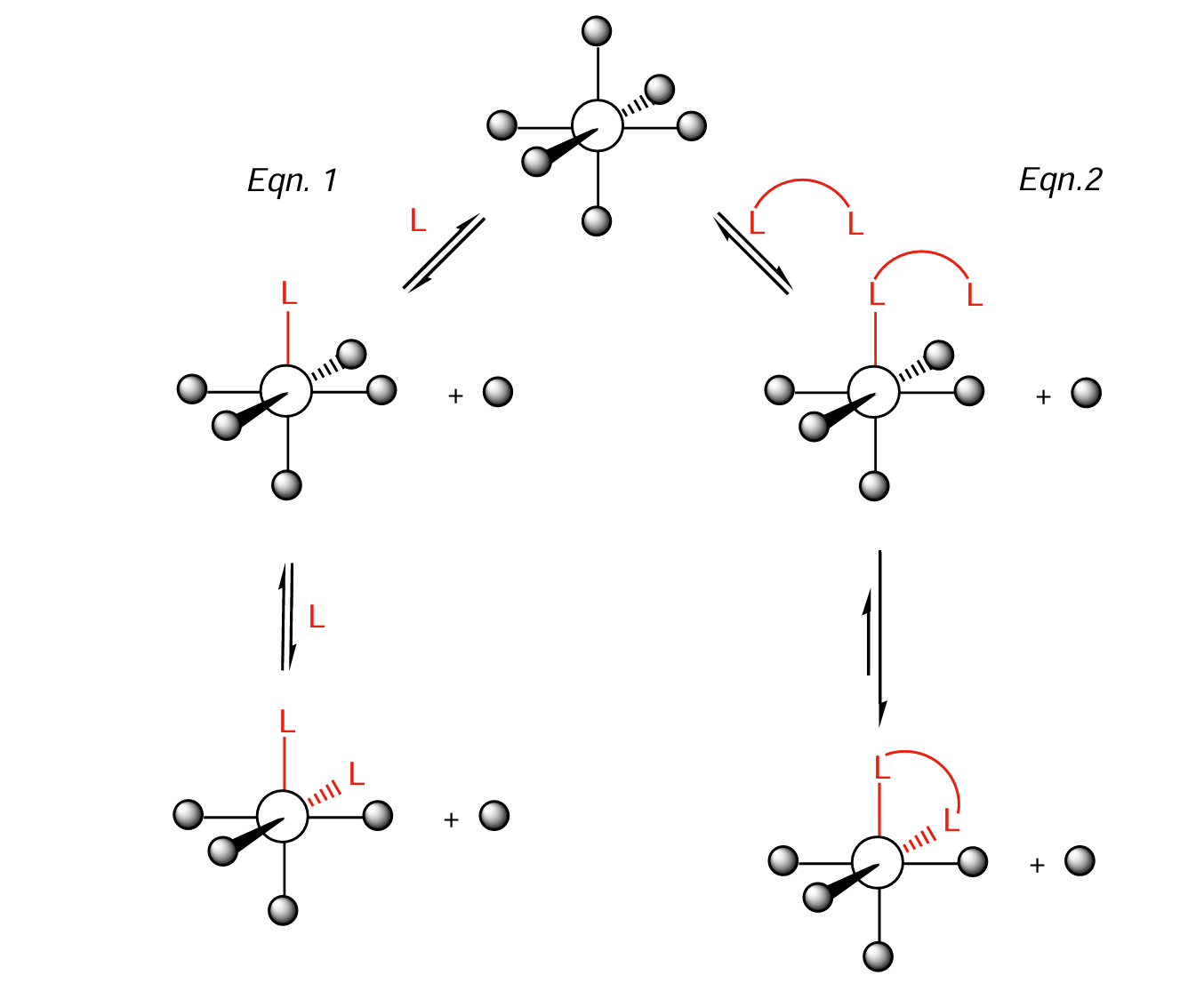
Chelate effect
ENTROPY favours 1x bidentate over 2x monodentate
release 2x small molecules :))
ΔG=−RTln(β)
effective conc. higher once half the bidentate ligand has bound - drive reaction to complete chelation
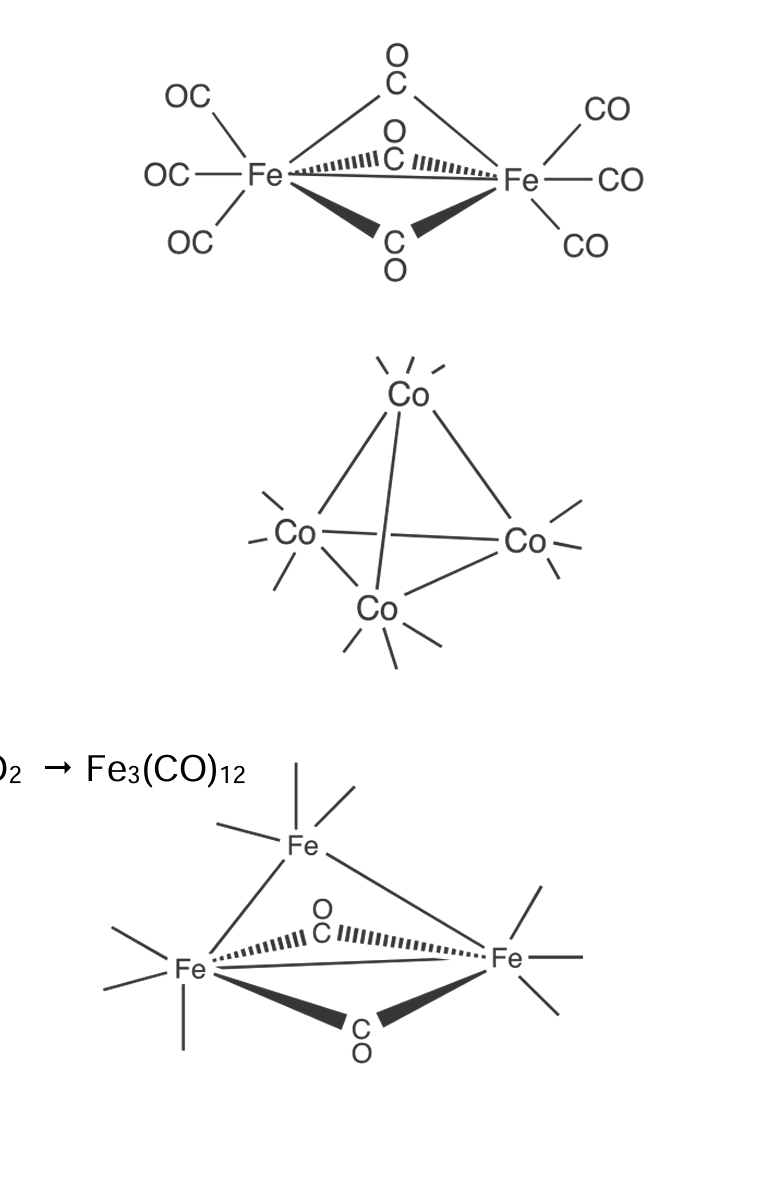
bridging vs terminal CO stretch
bridging (3) ~ 1600-1700
bridging (2) ~ 1750-1850
terminal ~ 2000
Name 4 reaction types that metal-CO complexes can carry out
oxidation
reduction
substitution
Cluster formation (M-M bonds formed to stabilise)
How does the pi-acceptor ability of NO+ compare to CO?
NO+ = better pi acceptor, lower LUMO (+ charge)
how can TM complexes react with [NO+][BF4-]?
BF4- is non nucleophilic as F are very strong EWG
Tm complex reacts w/ NO+ to form NO ligand to metal
What can happen to a coordinated NO2?
reduced to NO ligand using H+