NEPHRO: IE 1
 Call Kai
 Learn
Learn Practice Test
 Spaced Repetition
 Match
Match Flashcards
 Knowt Play
1/150

There's no tags or description
Looks like no tags are added yet.
Name | Mastery | Learn | Test | Matching | Spaced | Call with Kai | Chat |
|---|
No analytics yet
Send a link to your students to track their progress
151 Terms
How do the kidneys play a role in regulating pH?
Kidneys control pH by secreting H+ into the urine and through the return of HCO back to the blood.
Name the 2 hormones produced by the kidneys and their effect on the body.
Calcitrol (active vitamin D) to increase calcium levels and erythropoetin to increase RBC
List waste products excreted by the kidneys
Ammonia, urea, bilirubin, creatinine, uric acid, water, electrolytes, drugs & toxins
Anatomical location of kidney
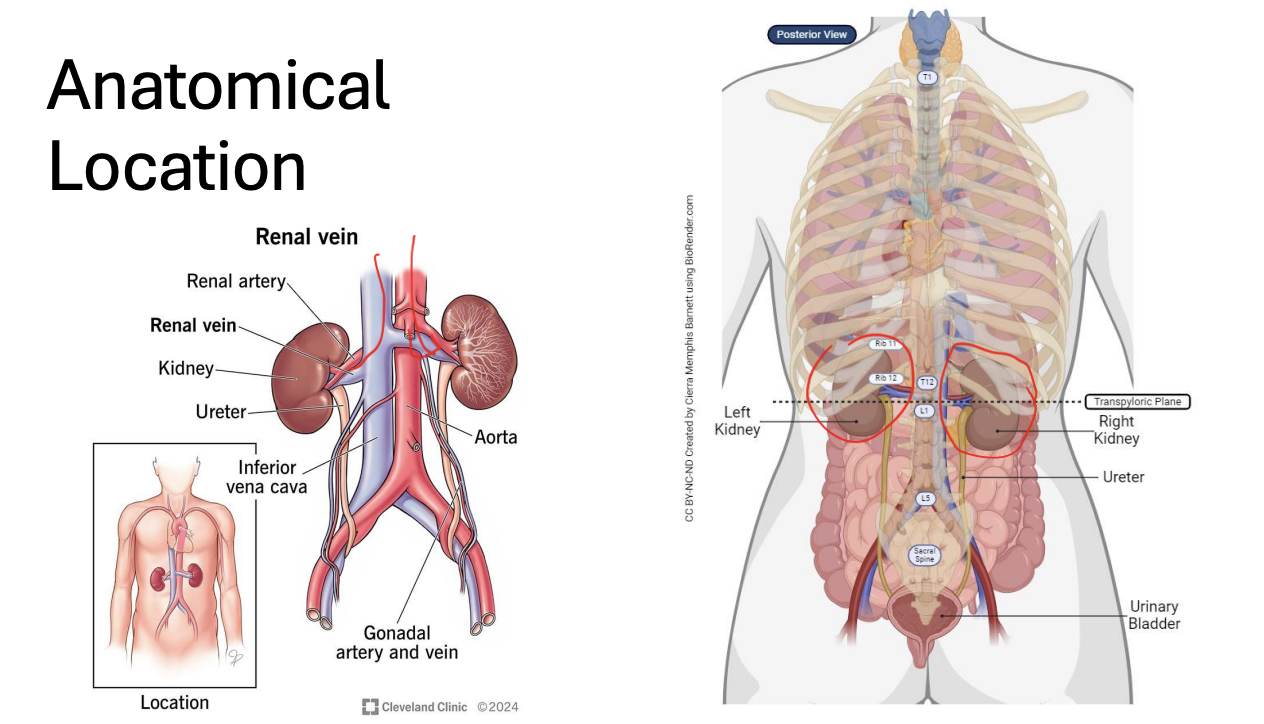
Urinary Anatomy
Describe organs in the urinary system in the order the urine passes through them
Describe fluid flow in the nephron
Kidney → Ureters → Bladder → Urethra
Afferent and efferent arterioles → Glomerulus → PCT → Descending Thin Limb of Henle’s → DCT → Collecting duct

Kidney Anatomy
Renal Capsule Cortex
90% of renal blood flow goes to the cortex, which is where all glomeruli are located.
Medulla
Only receives 10% of renal blood flow.

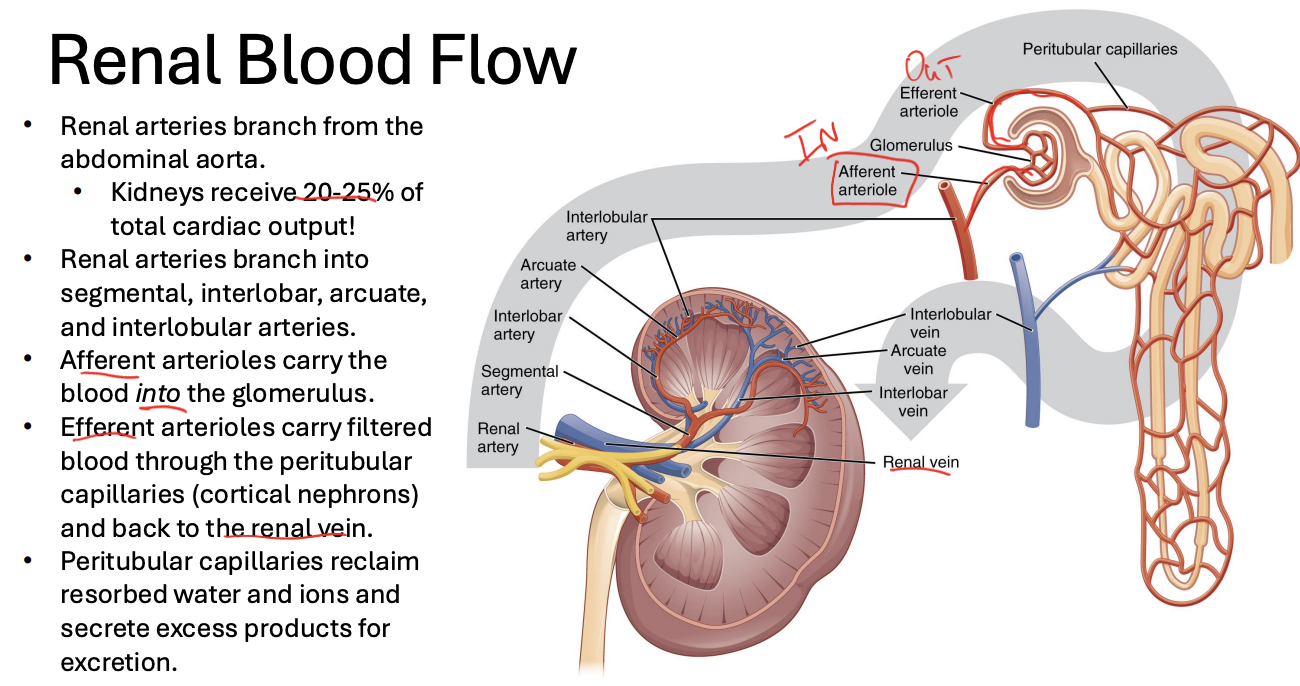
Describe Renal Blood Flow
Renal arteries branch from the abdominal aorta
Renal arteries branch into segmental, interlobar, arcuate, and interlobular arteries.
Afferent arterioles carry the blood into the glomerulus.
Efferent arterioles carry filtered blood through the peritubular capillaries (cortical nephrons) and back to the renal vein
Peritubular capillaries reclaim resorbed water and ions and secrete excess products for excretion.
Compare the 2 types of nephrons
% of all nephrons
Key structural feature/roles
Cortical nephrons
85%
Handle the bulk of blood filtration and routine waste removal
Juxtamedullary nephrons
15%
Possess much longer loops of Henle that extend deep into the renal medulla to concentrate urine and conserve water
Glomerular Histology:
Name the three cell types/layers that make up the glomerular filtration barrier.
Porous endothelial cells
Podocytes
Basement membrane
Glomerulus filter is [] and [] selective
Charge
Size
What is able to pass through the glomerulus freely and what is blocked?
Pass through: Water, ions, glucose, amino acids
Blocked: Proteins and blood cells
What creates the pressure gradient that drives filtration into Bowman's space?
Hydrostatic pressure → Afferent is larger than the efferent, creating back pressure
Proximal Tubule reabsorbs 80-85%s [], 100% [], and most [] and [].
This reabsorption mechanism depends on a [weak/strong] Na+ gradient that has [low/high] Na+ inside the cell
HCO3, Filtered gluose, mineral salts and amino acids
Strong → Low
Which transporter on the apical/luminal membrane secretes H⁺ into the proximal tubule lumen? Which gradient allows it to do so?
Na⁺/H⁺ exchanger (NHE3)
Na⁺/K⁺ ATPase → This process depends on the Na+/K+ ATPase because it maintains a low intracellular Na⁺concentration by pumping Na⁺ out of the cell and K⁺ into the cell, which creates the Na+ gradient that drives NHE3 to bring Na⁺ into the cell in exchange for H⁺.
Once H⁺ is secreted by NHE3 into the proximal tubular lumen, what does it combine with? What does it form?
Filtered HCO₃⁻
Carbonic acid
What allows CO2 to diffuse freely into the tubular cell? What happens after that?
Carbonic anhydrase IV
After CO2 diffuses into the proximal tubule cell, Carbonic Ahydrase II allows for the ionization of H+ & HCO3
Which transporter moves HCO₃⁻ from the proximal tubule cell into the interstitium/blood?
Na+ /HCO3- cotransporter (NBC1)
Compare SGLT2 and SGLT1:
Transporter | Location (early/late) | Affinity (high/low) | Capacity (high/low) | Glucose Reabsorption |
SGLT2 |
| |||
SGLT1 |
Transporter | Location (early/late) | Affinity (high/low) | Capacity (high/low) | Glucose Reabsorption |
SGLT2 | Early | Low | High | 90% |
SGLT1 | Late | High | Low | 10% |
Glucose moves against its concentration gradient by leveraging the [] gradient
Glucose gets transported into the interstitium by []
If plasma glucose exceeds [] mg/dL then SGLT capacity to transport glucose is exceeded, leading to glycosuria
Na+
GLUT2
180
Segment | Water Permeable? (y/n) | What is reabsorbed/ key transporter | Passive/Active Transport |
Thin Descending Limb |
Segment | Water Permeable? (y/n) | What is reabsorbed/ key transporter | Passive/Active Transport |
Thin Descending Limb | Y → High water permeability | Water reabsorption occurs via aquaporin-1 channels and leaky tight junctions between cells | Passive |
Loop of Henle Thin Descending Limb
As the tubule descends, it encounters an increasingly [] medulla
When will water leave?
What is the osmotic gradient generated by in the medulla?
Hyperosmotic medulla
Water leaves the lumen until osmotic equilibrium is reached
The osmotic gradient is generated by counter-current multiplication in the ascending limb
T/F: Tubular fluid becomes progressively more concentrated as it descends through the medulla
T
Segment | Water Permeable? (y/n) | What is reabsorbed/ key transporter | Passive/Active Reabsorption |
Thin Ascending Limb |
Segment | Water Permeable? (y/n) | What is reabsorbed/ key transporter | Passive/Active Reabsorption |
Thin Ascending Limb | N → d/t absence of aquaporins channels | Na+ and Cl- from the tubular fluid into the medullary interstitium | Passive |
T/F: Tubular fluid in the thin ascending limb becomes more concentrated as it ascends.
F → Since there are no aquaporin channels, water cannot follow the solute that is removed from the tubular lumen. Consequently, the tubular fluid becomes progressively more diluted as it ascends.
Segment | Water Permeable? (y/n) | What is reabsorbed/ key transporter | |
Thick Ascending Limb |
Segment | Water Permeable? (y/n) | What is reabsorbed/ key transporter |
Thick Ascending Limb | N | NKCC2 is the primary transporter in the luminal membrane and drives reabsorption of Na+, K+ and Cl- |
What is the main role of the Na⁺/K⁺-ATPase in the distal tubule?
Maintains low intracellular Na+
Segment | What is reabsorbed/ key transporters involved | ||
Distal Convoluted Tubule |
Segment | What is reabsorbed/ key transporters involved |
Distal Convoluted Tubule | Na+, Cl-, Ca2+, Mg2+ Na+-Cl (NCC) → trasport Na+ and Cl- Parathyroid hormone (PTH) receptor → helps reabsorbs Ca2+ Na+/Ca2+ & → transports Ca2+ to blood |
The NCC transporter moves which substances from the tubular fluid into the distal tubule cell?
Na + Cl
What hormone promotes Ca²⁺ reabsorption in the distal tubule?
Parathyroid hormone
→ promotes Ca²⁺ reabsorption by driving expression of voltage-gated Ca2+ channel expression
After Ca²⁺ enters the distal tubule cell, which mechanisms transport Ca²⁺ toward the interstitium? Select all that apply.
A. Na⁺/Ca²⁺ exchanger
B. Ca²⁺-ATPase
C. Na⁺/K⁺-ATPase
D. NCC
A + B
x
x
What is the final site for for water reabsorption?
Collecting duct
T/F: High water permeability exists in the absence of antidiuretic hormone (ADH).
F → Low
Which receptor and intracellular signaling pathway does ADH activate to increase water permeability in the collecting duct?
Circulating ADH activates vasopressin V2 receptors that increase cAMP and cause aquaporins (AQP2) to insert into the apical membrane, increasing water permeability.
What hormone increases the expression of ENaC, ROMK and Na+/K+-ATPase in the collecting duct?
Aldosterone
What drives both Na⁺ reabsorption and K⁺ secretion in the collecting duct?
Passive NA/KATPase
Na+ → Through apical ENaC
K+ → Renal Outer Medullary K+ (ROMK) channels
Nephron Summary

↓ Blood pressure → [] cells detect the decrease → ↑ []
↓ Tubular Na⁺ → [] cells detect the decrease → ↑ [] → stimulation of [] cells → ↑ renin
NSAIDs → inhibition of COX-2 → ↓ [] → ↓ renin release
↓ Blood pressure → juxtaglomerular cells detect the decrease → ↑ renin
↓ Tubular Na⁺ → Macula densa cells detect the decrease → ↑ PGE2 → stimulation of juxtaglomerular cells → ↑ renin
NSAIDs → inhibition of COX-2 → ↓ PGE2 → ↓ renin release
Blood pressure is monitored by [] in the juxtaglomerular apparatus
Stretch receptors

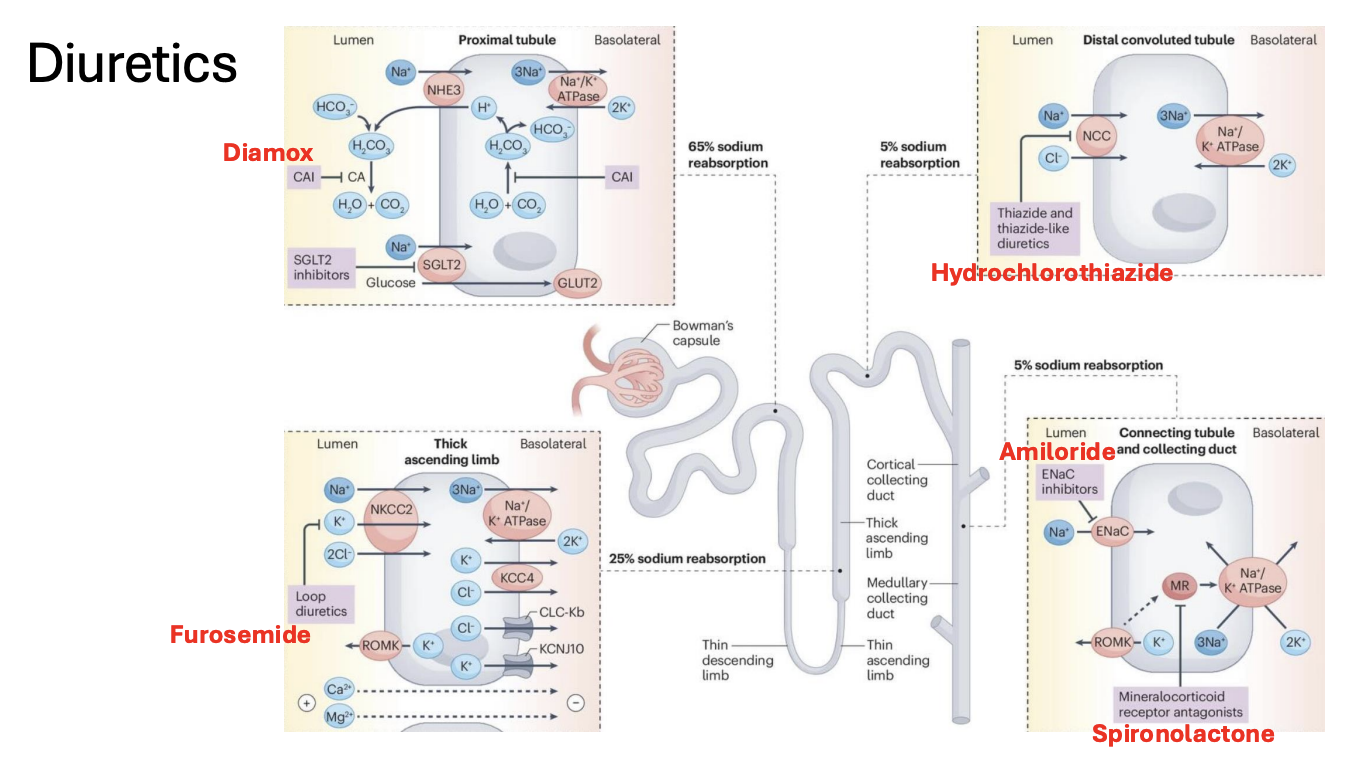
Amiloride: ENaC
Spironolactone: Mineralocorticoid/Aldosterone pathway
Furosemide: NKCC2
Diamox: Carbonic anhydrase
Hydrochlorothiazide: NCC
Which of the following is NOT one of the three jobs of the kidney?
A. Excretory — filtration, secretion, reabsorption
B. Endocrine — renin and erythropoietin
C. Manufacturing red blood cells directly in the renal cortex
D. Metabolic — activating vitamin D and metabolizing drugs
A. Excretory — filtration, secretion, reabsorption
B. Endocrine — renin and erythropoietin
C. Manufacturing red blood cells directly in the renal cortex
D. Metabolic — activating vitamin D and metabolizing drugs
As kidney function declines, Scr increases. The overestimate is about []% at all levels of GFR
10-40%
What is the Basic Metabolic Panel Fishbone?

What is the Elderly CrCl rule?
Age ≥ 65 and Scr < 0.8 → round Scr up to 0.8
What can raise Scr and lower Scr?

What are some medications that can block creatinine secretion?
a. Cimetidine
b. Cobicistat
c. Trimethorprim
d. Dolutegravir
E. Amiodarone
Which medications need to be renally adjusted?
a. Fentanyl
b. Omeprazole
c. Lithium
d. Allopurinol
e. Moxifloxacin
f. Ceftriaxone
g. Gentamicin
h. Rivaroxaban
i. Warfarin
j. Vancomycin
Which medications need to be renally adjusted?
a. Fentanyl
b. Omeprazole
c. Lithium
d. Allopurinol
e. Moxifloxacin
f. Ceftriaxone
g. Gentamicin
h. Rivaroxaban
i. Warfarin
j. Vancomycin

Which antibiotics, fluoroquinolones, antimicrobials, anticoagulants, opioids, diabetes medications, cardiac medications, and GI medications do NOT need to be renally adjusted?
Cetriafoxone, naficillin, dicloxaxillin
Moxifloxacin
Azithromycin, doxycycline, clindamycin, linezolid
Warfarin, unfractioned heparin
Fenatlyl, methadone
Linagliptin
Metoprolol, carvedilol
PPIs


Advantages of Cystatin C
Production is not affected by muscle mass, diet, or activity
Use the combined creatinine + cystatin C equation when Scr is unreliable
Goal Urine Output
>0.5 mL/kg/hr


Which one of these medications does NOT require renal dose adjustment?
A. Enoxaparin B. Metformin C. Ceftriaxone D. Apixaban
C
Which anticoagulant does NOT require renal dose adjustment?
A. Enoxaparin B. Apixaban C. Dabigatran D. Warfarin
D. Warfarin
Which opioid is safest in renal impairment (no renal adjustment needed)?
A. Morphine B. Hydromorphone C. Meperidine D. Fentanyl
D. Fentanyl


What weight should be used for the following obesity populations?
< 30 (normal / overweight)
30-39.9 (class I-II obesity)
≥ 40 (class III / morbid)
< 30 (normal / overweight) → TBW or IBW per the standard rules
30-39.9 (class I-II obesity) → Total body weight (TBW) generally OK
≥ 40 (class III / morbid) → Lean Body Weight (LBW)
Equations to use:
[] to stage; [] to dose; [] is retiring; [] for kid
CKD-EPI to stage; Cockcroft-Gault to dose; MDRD is retiring; Schwartz for kids
T/F: In AKI, use steady-state equations
F → they do not apply


Do the problems from post-class!
🙂
What fraction of total body water is contained in the intracellular fluid (ICF) versus extracellular fluid (ECF)? Which major ions primarily determine the osmolality of each compartment?
ICF: 60% of TBW
Determined by K+ and its accompanything anions (mostly organic and inorganic phosphates)
ECF: 40% of TBW
Na+ and its accompanyting anions (chloride and bicarbonate)
What is the most abundant cation in the body?
Potassium
The sodium-potassium ATPase (Na+-K+-ATPase) pump maintains increased intracellular stores of potassium by transporting [] out and [] into the cell.
3 Na+
2 K+
Compare which factors promote a shift of K⁺ into versus out of cells:
Into cells | Out of cells |
Into cells | Out of cells |
Insulin + Dextrose (1st line treatment) | Cell lysis (hemolysis, rhabdomyolysis, tumor lysis) |
BAR agonists | Hyperosmolality |
Alkalosis | Acidosis |
Aldosterone (chronic) | Exercise |
Sodium bicarbonate | B-Blockers |
What percent of potassium excretion normally occurs via the kidney versus the GI tract, and under what condition does GI excretion become more important?
Potassium Excretion: 90%
GI Excretion: 10%
GI excretion becomes more important in renal impairment.
Complete the table describing renal K⁺ reabsorption:
Nephron Segment | Approximate K⁺ Reabsorbed | Primary Mechanism |
Proximal tubule | ||
Thick ascending limb |
Nephron Segment | Approximate K⁺ Reabsorbed | Primary Mechanism |
Proximal tubule | 65% | K + is reabsorbed via the paracellular route (in between cells) |
Thick ascending limb | 25% | K + is transported actively via NKCC2 then K + /Cl cotransporter |
In the distal tubule and collecting duct, K⁺ secretion is regulated by the coordinated activity of the [], [], and []. [] enhances K⁺ secretion by increasing the expression and activity of these transporters and channels.
In the distal tubule and collecting duct, K⁺ secretion is regulated by the coordinated activity of the Basolateral Na+/K+/ATPase, apical Na+ channel (ENaC), and apical K+ channel. Aldosterone enhances K⁺ secretion by increasing the expression and activity of these transporters and channels.
Normal serum potassium: _ mEq/L | |
Mild hypokalemia: _ mEq/L | Mild hyperkalemia: _ mEq/L |
Moderate hypokalemia: _ mEq/L | Moderate hyperkalemia: _ mEq/L |
Severe hypokalemia: _ mEq/L | Severe hyperkalemia: _ mEq/L |
Normal serum potassium: 3.5-5.0 mEq/L | |
Mild hypokalemia: 3.1-3.49 mEq/L | Mild hyperkalemia: 5.1–5.9 mEq/L |
Moderate hypokalemia: 2.5-3 mEq/L | Moderate hyperkalemia: 6.0–7 mEq/L |
Severe hypokalemia: <2.5 mEq/L | Severe hyperkalemia: >7 mEq/L |
Hypokalemia | Hyperkalemia |
~~ekg changes | |
Hypokalemia | Hyperkalemia |
Flattened T wave | Peaked T waves (early indicator) |
Prolonged PR and QT | Widened QRS |
Prominent U wave | Loss of P wave |
ST Depression | Sine wave pattern (impending arrest) |
Cardiac arrhythmias in hypokalemia vs hyperkalemia
Hypokalemia: Torsades De Pointes, V tach, V fib, ventricular ectopy
Hyperkalemia: Asystole, bradycardia, AV block, V fib
Hypokalemia is associated with diarrhea/constipation and metabolic [], while hyperkalemia is associated with diarrhea/constipation and metabolic [].
Alkalosis
Acidosis
How does Mg2+ exist intracellularly and extraceullarly?
Intracellular: Bone (67%) and muscle (20%)
Extracellular: Ionized form, with just 20% existing as bound to serum protein
What increases renal excretion of Mg2+?
Loop and thiazide diuretics
Nephrotoxin agents that impair tubule function
Chronic alcohol (AUD)
Hypercalcemia
Metabolic acidosis
Gitelman syndrome, Bartter syndrome (specific genetic disorders)
What reduces intestial absorption of Mg2+?
Celiac disease or Crohn’s disease
Chronic diarrhea
Intestinal resection
PPIs and antacids
Age
T/F: You must correct the hypokalemia before trying to correct the hypomagnesemia
F → Switch d/t
ROMK channels in the thick ascending limb and distal tubule secrete intracellular K+ into the urine → Mg2+ normally inhibits ROMK channels, so a drop in Mg2+ levels means loss of K+
What causes a decreased renal excretion of Mg2+?
CKD
AKI
What causes an excessive intake of Mg2+?
Cathartics contain high Mg2+
Hemiacidrin (ureteral irrigant for kidney stones)
Magnesium sulfate (treatment of preeclampsia)
List Electrolytes and their Normal Ranges

. Which potassium oral supplement has the highest elemental potassium?
a. Potassium Bicarbonate
b. Potassium Citrate
c. Potassium Chloride
d. Potassium Gluconate
c. Potassium Chloride
x
x
Hemodialysis → Can cause [] if dialysate K⁺ is low
Hypokalemia
Medications that can cause hypokalemia
Insulin, Albuterol, Loop/thiazide diuretics
Potassium Repletion Management for:
K+: 3.5-4 mEq/L
K+ 3-3.4 mEq/L
K+: <3 mEq/
K⁺ 3.5–4 mEq/L (Early depletion)
No pharmacologic therapy, encourage dietary potassium intake
K⁺ 3–3.4 mEq/L
Asymptomatic → may not need treatment
Symptomatic → initiate oral K+
K⁺ <3 mEq/L → Always treat (goal 4–4.5 mEq/L)
Oral preferred if asymptomatic
IV if severe symptoms or unable to tolerate PO
What Potassium Oral Replacements should you use for the following situations?
Most common, effective for K⁺ and Cl⁻ losses
Hypokalemia with metabolic acidosis - alkanizing effect
Less common, generally mild hypokalemia. Use when chloride is elevated.
Potassium Oral Replacements
Potassium Chloride
Potassium Bicarbonate/Citrate
Potassium Gluconate
Usual dose of K+ to PREVENT hypokalemia: [] mEq/day
Usual dose of K+ to TREAT hypokalemia: [] mEq/dose
20 mEq/day
40-100 mEq/dose
What IV Potassium Replacement should you use for the following situations?
Most common and efficient
Also has metabolic acidosis
Hypophosphatemia
Potassium chloride
Potassium acetate
Potassium phosphate
IV peripheral line & central line max rate & concentration

Never give [] as an IV push → Will cause cardiac arrest
K+
Medications that may cause Hyperkalemia
Digoxin
Management for hyperkalemia when underlying cause is metabolic acidosis
Sodium bicarbonate IV
Chronic Hyperkalemia Medications
Dietary
Limit of potassium rich foods and supplements
Diuretics
Furosemide IV:PO dose ratio (1:2)
Avoid Potassium-sparing diuretics
Cation-exchangers
Kayexalate (SPS), Veltassa, Lokelma (SZC)
Dialysis
Adjust medications, and typically given after dialysis
Order of Operations Symptomatic
1. Protect the heart
IV Calcium
IV Calcium Gluconate 1g (preferred)
IV Calcium Cl-
2. Shift K+ INTO cells
5-10 units regular Insulin (Humulin R) + Dextrose → 1st line
Sodium Bicarbonate IV 50-100 mEq
Adjunctive in pts. w/
Metabolic acidosis
B2 agonists
Nebulized albuterol 10-20 mg over 10 mins
3. K+ Elimination
IV Loop Diuretics
Furosemide 20-40 mg IV
Potassium Binders (Cation Exchange Resins)
Kayexalate (SPS), Veltassa, Lokelma (SZC)
4. Dialysis
Indicated for patients w/ AKI + EKG changes or refractory
For hyperkalemia management:
Drug | Onset | MOA |
Calcium gluconate | ||
Sodium bicarbonate | ||
Insulin with dextrose | ||
Furosemide | ||
Albuterol | ||
Sodium polystyrene sulfonate | ||
Patiromer | ||
Sodium Zirconium Cyclosilicate |
Drug | Onset | MOA |
Calcium gluconate | <3 minutes | Antagonizes cardiac effects of hyperkalemia Raises myocardial threshold potential Reverses ECG changes quickly |
Sodium bicarbonate | 30 min | Raises serum pH, lowering K+ |
Insulin with dextrose | < 30 min | Insulin activates the Na+/K+ -ATPase pump and dextrose protects against low glucose |
Furosemide | 5-15 min | Inhibits renal Na+ reabsorption → Inc urinary K+ loss |
Albuterol | 30 min | B2 agonist |
Sodium polystyrene sulfonate | ~1 hour | Exchanges Na⁺ for K⁺ in the colon |
Patiromer | 7-24 hours (delayed) | Exchanges Ca²⁺ for K⁺ in the distal colon |
Sodium Zirconium Cyclosilicate | ~1 hour | Exchanges Na⁺ for K⁺ throughout GI tract |
Dextrose must precede [] to avoid hypoglycemia
Dextrose must precede insulin to avoid hypoglycemia
5-10* units regular insulin IVP + 25*-50 g dextrose IV
Nurse asks what albuterol dose to give for hyperkalemia. Standard asthma nebulizer is 2.5 mg. What dose do you recommend and how long to nebulize?
A) 2.5 mg over 5 minutes B) 5 mg over 5 minutes C) 10–20 mg over 10 minutes D) 0.5 mg IV push
C) 10–20 mg over 10 minutes
If a provider wants to order SPS STAT for a patient with a K⁺ of 6.9 and peaked T waves, how would you respond as the pharmacist?
Nah bro this shit is emergent and SPS stat has too long of an onset
Do last patient case and practice problems
What cardiac arrhythmias can results from hypomagnesemia?
Vfib + Torsade de pointes
EKG Changes in severe hypomagnesemia
Prolonged PR interval
Widening of QRS complex
Flattened T wave