Digestion and Absorption
 Call Kai
 Learn
Learn Practice Test
 Spaced Repetition
 Match
Match Flashcards
 Knowt Play
1/52

There's no tags or description
Looks like no tags are added yet.
Name | Mastery | Learn | Test | Matching | Spaced | Call with Kai | Chat |
|---|
No analytics yet
Send a link to your students to track their progress
53 Terms
What is Amylopectin?
A long, branched chain of alpha glucose.

What is amylase?
enzyme that breaks down starch
What types of bonds will amylase not cut? (2)
1. 1,6 glycosidic bond aka branch points
2. terminal glucose residue

What are the 3 amylase digestion products of amylopectin?
1. maltose
2. limit dextrin
3. maltotriose

T/F: Amylase digestion never results in a single glucose molecule.
True
What is the disaccharide that humans can't digest?
cellulose (aka fiber)
What is the goal of disaccharide digestion?
breaking them down into monosaccharides
What is the luminal digestion of carbohydrates?
Initial digestion involving enzymes secreted into lumen; begins with salivary amylase, ends with pancreatic amylase

What is the contact digestion of carbohydrates?
he final stage of carbohydrate breakdown, which occurs when specific enzymes attached to the intestinal wall break down disaccharides and oligosaccharides into absorbable monosaccharides.
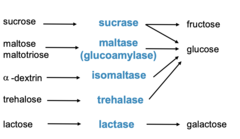
T/F: Luminal digestion occurs at the "brush border" of the small intestine.
False
What are the 3 absorbable monosaccharide products of contact digestion of carbohydrates?
1. glucose
2. fructose
3. galactose

What cells in the small intestine absorb monosaccharides?
Enterocytes
How is fructose absorbed in the small intestine?
via facilitated diffusion using GLUT5 or GLUT2

The (GLUT2/GLUT5) transporter is used to absorb fructose when there are high sugar concentrations in the lumen of the small intestine. The (GLUT2/GLUT5) transporter is used at other times.
GLUT2, GLUT5
What transporter uses Na+ (secondary active transport) to absorb glucose or galactose at any sugar concentration in the lumen of the small intestine?
SGLT1
How is the low intracellular [Na+] maintained in order to transport glucose or galactose via SGLT1?
via an Na/K+ ATPase

What transporter helps absorb glucose, galactose, and fructose when the luminal sugar concentration is high?
GLUT2
Once a monosaccharide is take up by an enterocyte, what transporter is used to transport them into the intracellular region and eventually the capillaries in the villi?
GLUT2

T/F: Sugars leave the enterocyte and enter the blood by passive transport.
True
How is pepsinogen activated into pepsin?
acid
Which protein digestion enzymes (proteases) are made in the pancreas in their inactive form? (5)
1. Trypsinogen (to trypsin)
2. Chymotrypsinogen (to chymotrypsin)
3. Proelastase (to elastase)
4. Procarboxypaptidase A ( to Carboxypeptidase A)
5. Procarboxypaptidase B ( to Carboxypeptidase B)
What enzyme, which is bound to the brush border in the duodenum, cleaves trypsinogen to form trypsin?
enterokinase
What is the function of trypsin relative to the other proteases?
it will cleave all of the inactive proteases produced by the pancreas, activating them.

What are the two main types of luminal proteases?
1. endopeptidases
2. Exopeptidases
What is the function of endopeptidases?
Hydrolyse peptide bonds within a protein
What is the function of exopeptidases?
digest terminal peptide bonds to release amino acids
What are 4 examples of endopeptidases?
1. Pepsin
2. Trypsin
3. Chymotrypsin
4. Elastase
What are 2 examples of exopeptidases?
1. Carboxypeptidase A
2. Carboxypeptidase B
What are 3 mechanisms by which proteins can be absorbed by enterocytes in the small intestine?
1. Amino acids, dependent on Na+ gradient
2. Di- and tripeptides, dependent on H+ gradient from gut lumen to cell,
3. Whole proteins by phagocytosis
T/F: The main mechanism of absorbing proteins is as individual amino acids.
False
T/F: The main mechanism of absorbing proteins is as Di- and Tripeptides.
True
How are proteins absorbed as individual amino acids?
via Na+ dependent amino acid transporters. these transporters are amino acid specific. this is similar to the secondary active transport of glucose via SGLT1.

How are proteins absorbed as di- and tripeptides? (3 steps)
1. di- and tripeptides are directly absorbed by a carrier PepT1 using an inwardly directed H+ gradient
2. once in the cell, they are broken down into amino acids
3. Amino acids are absorbed into the blood by facilitated diffusion (Na+ independent)
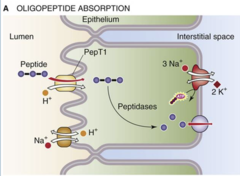
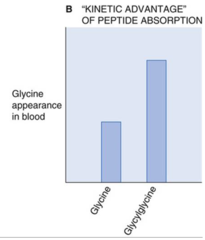
Why is the absorption of proteins as oligopeptides the main mechanism of protein absorption?
this mechanism has a distinct kinetic advantage, as PepT1 can transport multiple amino acids per ATP molecule than the individual AA mechanism.
How are proteins absorbed fully intact?
Endocytosis by either the enterocytes or by M cells (immune cell)

Once intact proteins enter enterocytes or m cells via endocytosis, what are the 2 pathways they can take to reach the interstitial space, and, eventually the rest of the body?
1. Direct pathway aka no processing other than packaging in M calls
2. The degradative pathway aka proteins undergo processing once inside the cell.

____% of absorbed intact proteins reach the interstitial space using the direct pathway, while the other ____% are processed into smaller proteins via the degradative pathway.
10, 90
What are the 3 phases of fat digestion?
1. emulsification of fat and incorporation into micelles
2. action of lipase (main enzyme)
3. absorption of fatty acids and monoglycerides by the enterocyte
T/F: Most dietary lipids are triglycerides.
True
Why is it necessary to emulsify fats as the first step of their digestion?
the GI tract is fairly aqueous
T/F: The emulsification of lipids in the mouth by lingual lipase is the majority of the emulsification.
False
Gastric lipase contributes to about ___-___% of the digestion of lipids.
10-30
What action by the stomach increases the efficacy of emulsification?
grinding via the motion of the stomach walls
How are emulsified lipids stabilized in the stomach?
they are stabilized as fat droplets covered in phospholipids. phospholipids are able to stabilize them due to their amphipathic nature.
Why do we want to stabilize fat droplets in the stomach with phospholipids?
we want to prevent the lipid molecule from coalescing back together in the aqueous environment of the GI tract.
What happens to the stabilized fat droplets once they reach the duodenum?
the fat droplets bind to (pancreatic) lipases and bile salts.
Why is Co-lipase important when fat droplets are binding to lipase and bile salts?
co-lipase stabilizes the interaction of lipase with the bile-salt coated fat droplet, preventing the bile salts from displacing the lipase from the droplet surface

T/F: Co-lipase is only activated in the duodenum.
True
What are micelles?
clusters of bile salts that transport lipids across the cell membrane of the villi

What does it mean when it is said that micelles are in "true" solution?
the particles are no longer large enough to refract light, i.e., invisible
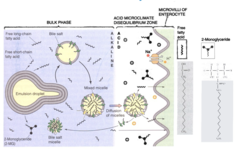
How are long chain fatty acids absorbed by enterocytes? (6 steps)
1. emulsion, fat droplet, and micelle formation all occur during the bulk phase in an alkaline environment
2. Micelles diffuse into the acidic disequilibrium zone near the brush border of the enterocyte.
3. The micelles release their contents at the apical membrane of the enterocyte, where LCFAs are then transported into the cell.
4. once inside the cell, the LCFAs are resynthesized in the SER, then packaged into chylomicrons.
5. The chylomicrons are then taken up by the lacteals and travel through the lymph.
6. The chylomicrons are eventually dumped into circulation via the left thoracic duct
How are short or medium chain fatty acids absorbed by enterocytes?
they can passively enter and exit the cell, entering the hepatic portal vein.
T/F: Most lipid digestion is complete by the end of the jejunum.
True