BIOL 1070 Chapter 1
 Call Kai
 Learn
Learn Practice Test
 Spaced Repetition
 Match
Match Flashcards
 Knowt Play
1/84

Earn XP
Description and Tags
directional terms & major organ systems & their functions
Name | Mastery | Learn | Test | Matching | Spaced | Call with Kai | Chat |
|---|
No analytics yet
Send a link to your students to track their progress
85 Terms
Levels of organization (least to most complex)
chemical
cellular
tissue
organ
system
organism
Superior (cephalad)
towards the head
Inferior (caudad)
away from the head
Anterior (ventral)
pertaining to the front of the body
Posterior (dorsal)
pertaining to the back of the body
Medial
towards the midline of the body
Lateral
away from the midline of the body, towards the sides
Parietal
pertaining to the outer boundary
Visceral
pertaining to the inner boundary
External (superficial)
towards the surface of the body
Internal (deep)
away from the surface of the body
Proximal
part of extremity near attachment to the body
Distal
part of extremity away from attachment to the body
Central
at or near center of the body or organ
Peripheral
away from center of the body or organ
Anatomical position
the position used as reference for all anatomical directional terms, the body facing forward with palms pointing forward

Cephalic region
the head
Cervical region
the neck
Cranial region
the brain area
Facial region
the face area
Abdominal region
region between lowest ribs and pelvis
Pelvic region
region enclosed by pelvic bones
Inguinal region
region containing the groin area
Pectoral region
region containing the chest area
Sternal region
region over the breast bone
Dorsum region
the back of the chest area
Gluteal region
region containing the buttocks
Lumbar region
the lower back between the lowest ribs and the pelvis
Sacral region
the region over the sacrum between buttocks

Axillary region
the armpits
Coxal region
the hips
Genital region
contains the external reproductive organs
Perineal region
the region between the anus and reproductive organs
Antebrachial
pertaining to the forearm
Antecubital
pertaining to the front of the elbow
Cubital
pertaining to the back of the elbow
Brachial
pertaining to the upper arm
Carpal
pertaining to the wrist
Digital
pertaining to fingers or toes
Palmar
pertaining to the palm of the hand
Pollux
pertaining to the thumb
Crural
pertaining to the leg
Femoral
pertaining to the thigh
Patellar
pertaining to the front of the knee
Popliteal
pertaining to the back of the knee
Pedal
pertaining to the foot
Hallux
pertaining to the big toe
Planar (/plantar)
pertaining to the sole of the foot
Tarsal
pertaining to the ankle
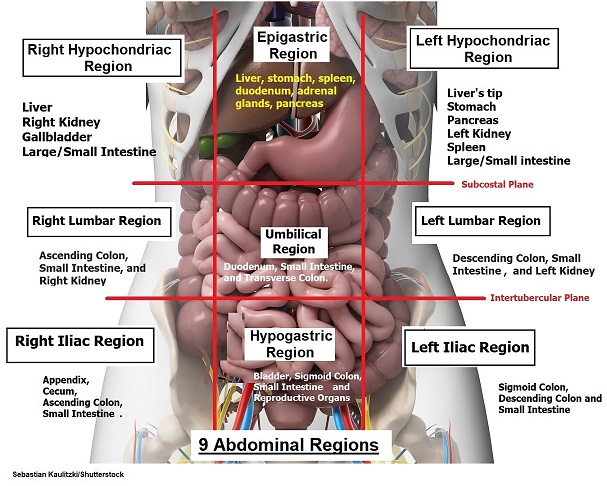
Left hypochondriac region
contains
liver’s tip
stomach
pancreas
left kidney
spleen
large/small intestines

Epigastric region
contains
liver
stomach
spleen
duodenum
adrenal glands
pancreas

Right hypochondriac region
contains
liver
right kidney
gallbladder
large/small intestines

Left lumbar region
contains
descending colon
small intestine
left kidney
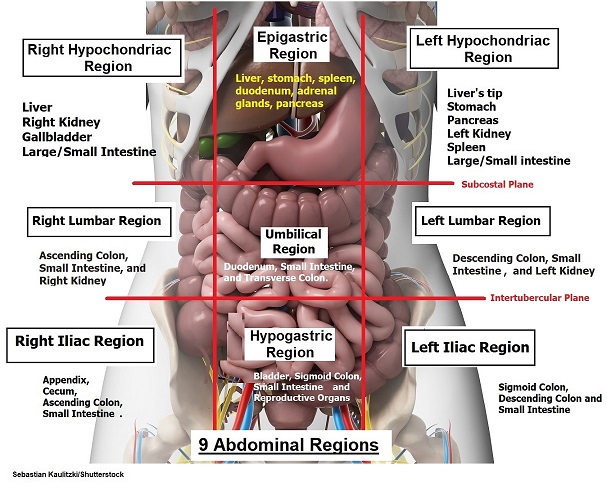
Umbilical region
contains
duodenum
small intestine
transverse colon

Right lumbar region
contains
ascending colon
small intestine
right kidney

Left iliac region
contains
sigmoid colon
descending colon
small intestine

Hypogastric region
contains
bladder
sigmoid colon
small intestine
reproductive organs

Right iliac region
contains
appendix
cecum
ascending colon
small intestine
Integumentary system
skin and structures derived from it (hair, nails)
function: protection, excretion, receptor of stimuli, regulation of temperature
Skeletal system
all bones (206), cartilage and joints
function: support, protection, leverage, production of blood cells, storage of minerals
Muscular system
all body muscles, skeletal, smooth, cardiac
function: movement and heat production
Cardiovascular system
blood, heart, and blood vessels
function: transport of many materials, disease resistance, temperature regulation
Lymphatic system
lymph, lymph nodes, lymph vessels, lymph glands (spleen, tonsils, thymus)
function: transport fats, clean blood, produce white blood cells (lymphocytes), osmotic regulation
Nervous system
brain, spinal cord, nerves, sense organs
function: receive and interpret stimuli, transmit impulses, coordination, regulation of body processes
Respiratory system
lungs, trachea, bronchi, bronchioles, alveoli
function: supply oxygen and excrete carbon dioxide
Digestive system
mouth, espohagus, stomach, intestines, rectum, pancreas, liver, gallbladder
function: mechanically and chemically break down food, prepare it for absorption through walls of intestine into blood, eliminate waste
Urinary system
kidneys, ureters, bladder, urethra
function: eliminate nitrogenous waste, water and salt regulation
Reproductive system
testes or overies, transport tubes, and storage organs
function: create and store haploid gametes (meiosis), nourish baby, birth
Cytology
the study of cells
Anatomy
the study of body organization and structure
Physiology
the study of body functions
Pericardium
the double layered (parietal and visceral layers) membrane surrounding and protecting the heart
Peritoneum
the double layered (parietal and visceral layers) membrane surrounding and protecting the abdominal organs
Pleura
double layered (parietal and visceral layers) membrane surrounding and protecting the lungs
Meninges
protective membrane surrounding and protecting the brain and spinal cord
Homeostasis/equilibrium
maintenance of a dynamic balance of substances in body fluids
Catabolism
breakdown of complex substances
Anabolism
synthesis of complex substances