Child Cognitive Development Theories: Piaget, Vygotsky, Nativism & Information Processing
 Call Kai
 Learn
Learn Practice Test
 Spaced Repetition
 Match
Match Flashcards
 Knowt Play
1/53

There's no tags or description
Looks like no tags are added yet.
Name | Mastery | Learn | Test | Matching | Spaced | Call with Kai | Chat |
|---|
No analytics yet
Send a link to your students to track their progress
54 Terms
What is cognitive development?
The study of how and why thinking changes across the lifespan.
What age range does the focus of cognitive development typically cover?
Children aged 3-12 years old.
What are the three main areas of interest in cognitive development?
Starting point (what infants know at birth), mechanisms of change (what causes development), and variability in these processes.
What are some examples of innate knowledge in children?
Reflexes, propensity to learn, knowledge, and fears.
What is the difference between developmental continuity and discontinuity?
Continuity is like a tree (gradual change), while discontinuity is like a butterfly (distinct stages).
What method did Piaget use to study children's cognitive development?
Interviews with his own children about mathematical and science topics.
What are the four cognitive stages proposed by Piaget?
Sensorimotor (0-2 years), 2. Pre-operational (2-7 years), 3. Concrete operational (7-12 years), 4. Formal operational (12+ years).
What is the main achievement of the sensorimotor stage?
Object permanence: understanding that objects continue to exist across space and time.
What is the main achievement of the Preoperational stage?
Static internal representations, Able to have a mental idea what is happening but cannot update them
What is the main achievement of the Concrete operational stage?
Ability to manipulate internal representations
What is the main achievement of the formal operational stage?
Abstract thought
What is egocentrism in cognitive development?
The inability to take another person's perspective.
What is equilibration in Piaget's theory?
Process of balancing assimilation and accommodation to regain a stable schema
What is permanence/invariance in relation to Piaget’s sensorimotor stage?
Objects continue to exist across space and time.
What is decentration in relation to Piaget’s sensorimotor stage?
Objects and self are different
What is Internalization in relation to Piaget’s sensorimotor stage?
Objects are represented mentally
What is assimilation?
Assimilation is fitting new information into existing schemas
What is accommodation?
Adapting thinking to new experiences
Who is Vygotsky and what is his main contribution to cognitive development?
Vygotsky emphasized the role of the social world in promoting cognitive change.
What are the four systems in Vygotsky's ecological model?
Microsystems, mesosystems, exosystems, and macrosystems.
Microsystems
Direct, immediate relationships, Interactions
Mesosystems
Interrelated microsystems
Exosystems
Contexts children are not a a part of, but nevertheless influential (Ex: Media)
Macrosystem
Broader cultural context
What is Rogoff’s guided participation?
Behavior guided by more experienced others during culturally valued activities.
What is scaffolding in Vygotsky's theory?
The transfer of responsibility from adult to child in learning.
What is the Zone of Proximal Development (ZPD)?
A measure of a child's dynamic developmental state where learning occurs with support, Difference between what child can do alone vs. with adult or peer
What are technical tools and psychological tools according to Vygotsky?
Technical tools are for acting on the environment (e.g., hammers), while psychological tools are for thinking (e.g., language).
What are attractor states?
Within any “landscape” of possible behavioral forms, certain patterns are more likely to arise than others
What are nested timescales?
Behavioral change occurs over different timescales
What is multicausality?
Organisms as complex systems composed of many elements within a complex environment
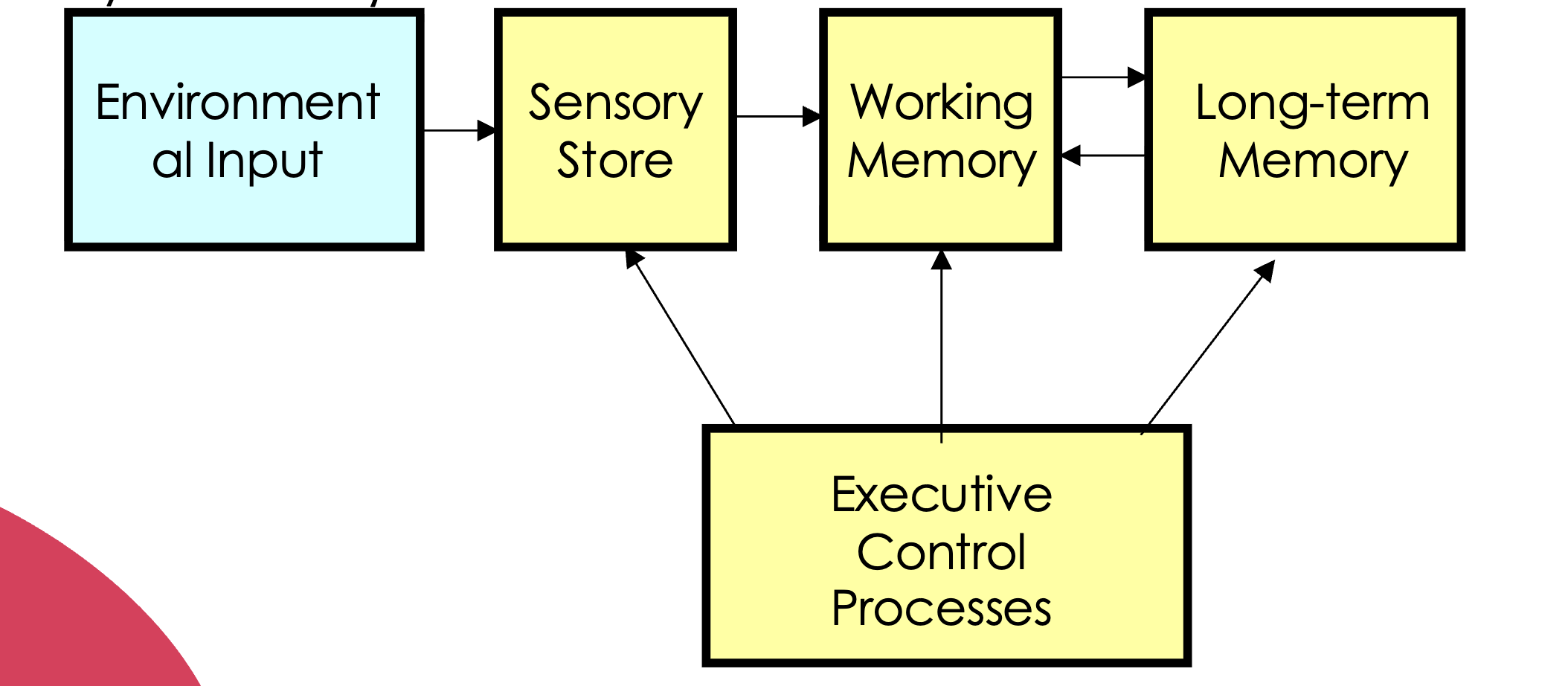
What is the multi-store model?
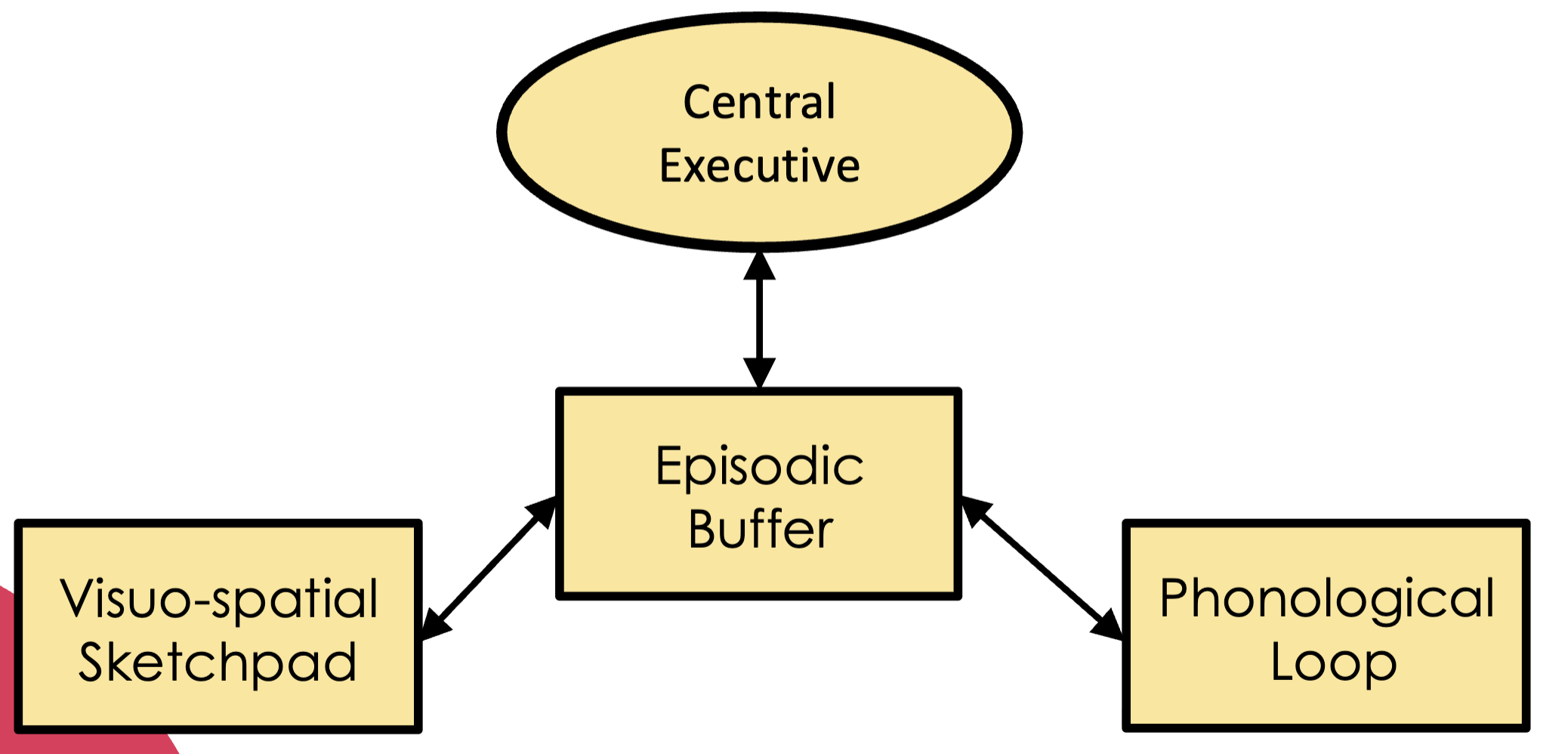
What is the working memory system?
What is Nativism?
Type of theories that place heavy emphasis on innateness
What is domain-general nativism?
There are some learning mechanisms that are innate, and those are used for many things. (Language isn't innate, but we have the tools to learn language innately)
What is domain-specific nativism?
People are born with specific knowledge about certain things (Approximate Number Task)
What is the approximate number task?
A task that assesses a child's ability to determine which of two groups has more items, showing innate numerical understanding.
What is knowledge enrichment in cognitive development?
Children gain new information, their ANS become better (Similar to assimilation)
What is conceptual change?
Children learn or experience something that makes them switch from relying in the core knowledge, to use more accurate knowledge (Similar to accommodation)
What is the working memory system?
Components of the system are innate, Focus not only on the output, but how things are processed
Explain Production systems of information processing theory
Declarative knowledge: "chunks" with production rules
IF [conditions] THEN [actions]
Ex: IF the goal is to determine which of two containers has more liquid, THEN compare the level of the liquid in the containers
Explain dynamic systems model of information processing theory
Dynamic systems theory suggests that behavior emerges from the interaction of multiple factors over time
What is self-organization?
Interactions among elements within a system yield organized patterns of behavior
What is the A not B error?
A task used to assess infant object permanence, where infants search for an object in the last place they found it rather than where they last saw it.
What is object segregation?
The ability to distinguish where one object starts and another ends.
What auditory preferences do newborns exhibit?
Preference for their mother's voice, native language, familiar stories, and familiar music.
Inhibitory control
Being able to control one’s actions, responses, and attention to do what is needed/appropriate (Self control), Heavily depends on environment
High elaborative style of scaffolding
Fill in information and confirm what they share
Executive function (Or cognitive control)
A collection of cognitive processes that include attention control, inhibitory control, working memory, cognitive flexibility
Cognitive flexibility
Ability to adapt to your environment and change your behaviors accordingly (Using a book as a hammer), Can be measured via Wisconsin Sorting Task
Flanker task
→ or ← ignoring everything else around it
Stroop task
Blue Yellow Green Red
Perceptual Narrowing
Babies that are 6 months old are able to discriminate between novel monkey faces, but by 9 months old, they can no longer do this.
Spelke (1976) showed 4mo infants a video of a person drumming and a video of a person playing peekaboo simultaneously, all while drum beat sounds were playing -- With this study, these researchers were investigating ______.
Intersensory integration