Anatomy: Cranial, Facial, Vertebral, and Rib Cage Structures
 Call Kai
 Learn
Learn Practice Test
 Spaced Repetition
 Match
Match Flashcards
 Knowt Play
1/97

Earn XP
Description and Tags
A set of vocabulary flashcards covering anatomical terms, structures, and landmarks of the skull, sinuses, facial bones, mandible, hyoid, vertebral column, and rib cage based on the lecture notes.
Name | Mastery | Learn | Test | Matching | Spaced | Call with Kai | Chat |
|---|
No analytics yet
Send a link to your students to track their progress
98 Terms
Frontal bone
A major bone of the forehead.

Supraorbital notch
A paired opening or notch superior to the orbit.

Superciliary arch
The ridge above the eye socket indicating the location of the frontal sinus.

Parietal bone
A large paired bone located in the superior portion of the skull.

Coronal suture
A suture that runs laterally, joining the frontal and parietal bones.

Sagittal suture
A suture that runs anteroposteriorly, joining the two parietal bones.

Temporal bone
A paired bone located on the lateral sides of the skull.

Squamous suture
A suture that runs anteroposteriorly, joining the temporal and parietal bones.

Mandibular fossa
A fossa that articulates with the condylar process of the mandible.

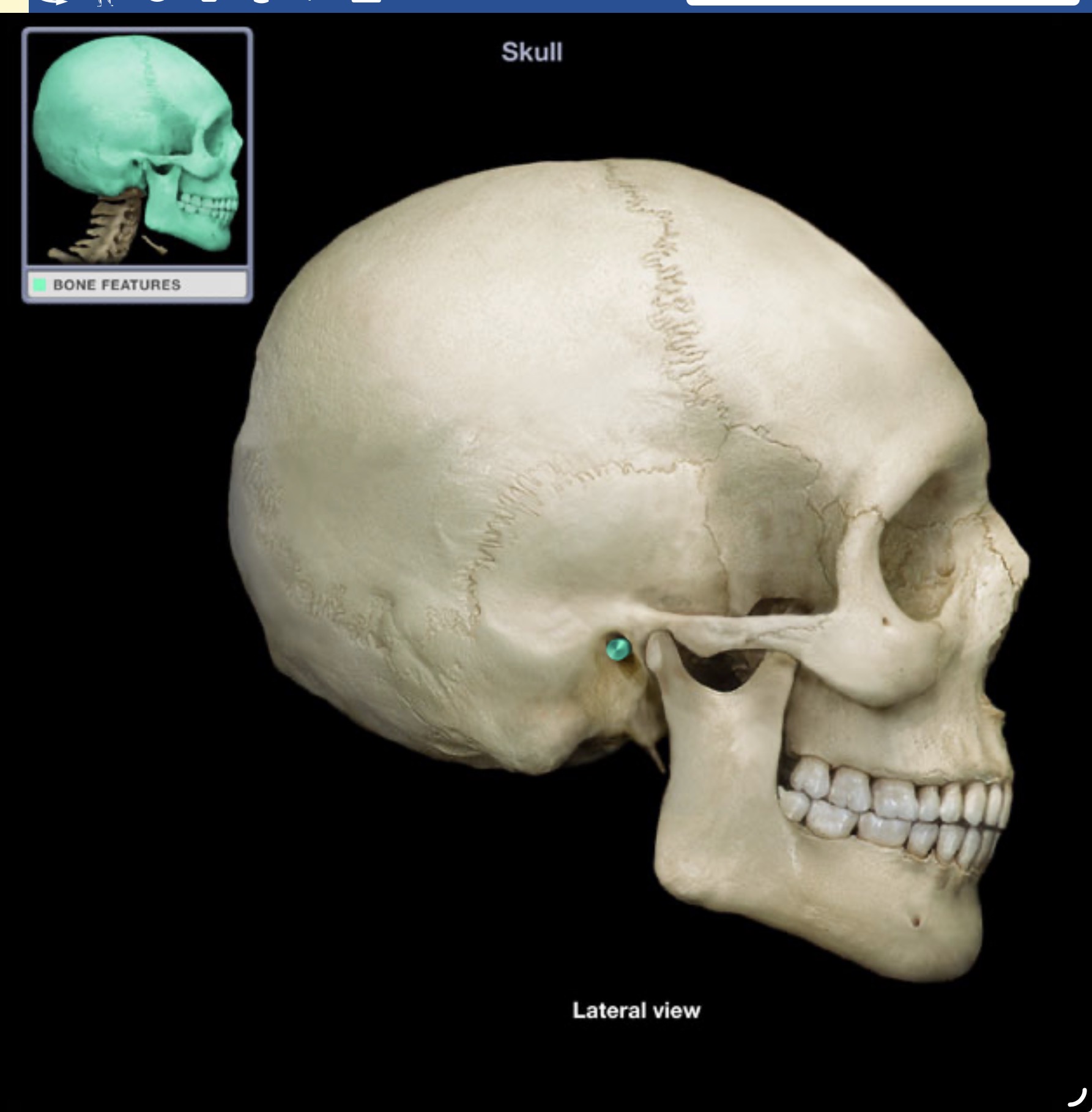
External acoustic meatus
An opening in the temporal bone extending to the inner ear.
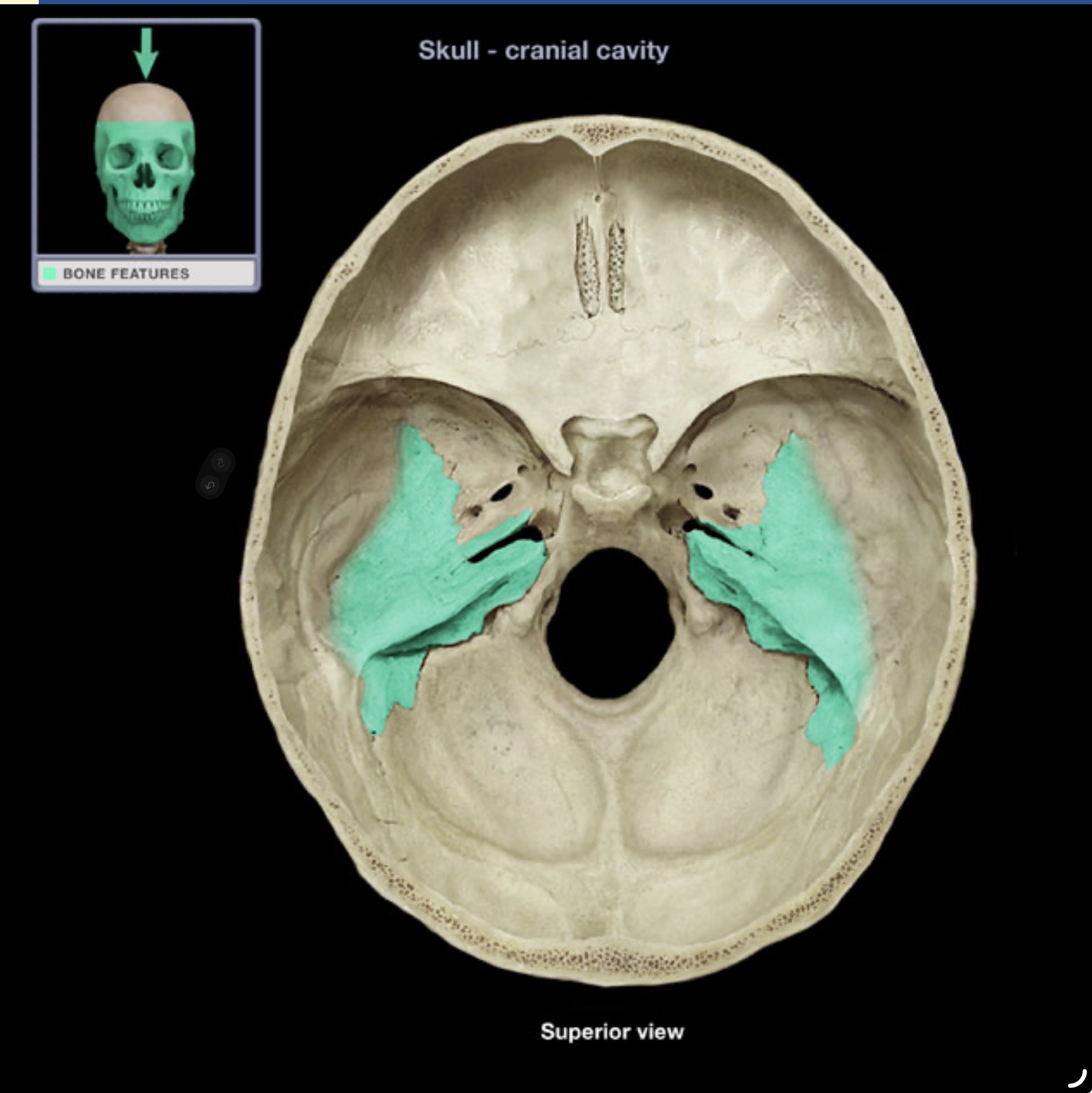
Petrous part of temporal bone
A dense bony ridge on the interior surface of the temporal bone, location of middle and inner ear cavities.
Internal acoustic meatus
A short canal in the petrous part of the temporal bone, extending laterally toward the inner ear.

Styloid process of temporal bone
A long, sharp process of the temporal bone extending inferiorly.

Mastoid process
A rounded process of the temporal bone posterior to the styloid process and extending inferiorly.

Stylomastoid foramen
A foramen located between the styloid and mastoid processes, passageway for facial nerve.

Carotid canal
A canal located on the petrous part of the temporal bone anterior to the jugular foramen.

Jugular foramen
A foramen located on the inferior petrous part of the temporal bone posterior to the carotid canal.
Occipital bone
The most posterior and inferior bone of the skull.
Lambdoid suture
A suture that runs transversely, joining the occipital and parietal bones.
External occipital protuberance
A median protrusion on the occipital bone posterior and superior to foramen magnum.
Foramen magnum
A large opening on the inferior part of the skull.
Occipital condyle
A paired, rounded process lateral to the foramen magnum.
Hypoglossal canal
A paired canal superior to occipital condyle.
Basilar part of occipital bone
A region of the occipital bone anterior to foramen magnum.
Sphenoid bone
A butterfly-shaped bone forming the floor of the cranium.
Greater wing of sphenoid bone
A bone posterior and inferior to lesser wing on the interior of the skull, also visible in the posterior orbit and lateral side of the skull.
Lesser wing of sphenoid bone
A bone anterior and superior to greater wing on the interior of the skull.
Superior orbital fissure
A fissure between greater and lesser wings of sphenoid visible from the orbits.
Inferior orbital fissure
A fissure in the orbit floor between the maxilla and the greater wing of sphenoid.
Sella turcica
A saddle-like depression posterior to lesser wing.
Optic canal
A paired opening through lesser wing of the sphenoid.
Foramen lacerum
A paired opening lateral to the sella turcica.
Foramen ovale
A paired opening lateral to the base of the sella turcica.
Foramen spinosum
A paired opening at the posterior margin of the sphenoid.
Foramen rotundum
A paired opening anterior to the foramen ovale.
Lateral pterygoid plate
A sharp process that laterally and inferiorly projects from the sphenoid.
Medial pterygoid plate
A sharp process that medially and inferiorly projects from the sphenoid.
Ethmoid bone
A bone located between the orbits and between sphenoid and nasal bones, forms roof of nasal cavity.
Cribriform plate
A porous bone surrounding the crista galli in the floor of the cranium, through which olfactory nerves pass.
Crista galli
A superior projection in the middle of the cribriform plate of the ethmoid bone.
Perpendicular plate of ethmoid
A median inferior projection of the ethmoid, forms superior nasal septum.
Vomer
A bone forming the inferior and posterior portion of the nasal septum.
Inferior nasal concha
A paired bone that protrudes into the inferior part of the nasal cavity.
Maxilla
A paired fused bone of the upper jaw and central face.
Infraorbital foramen
A paired opening inferior to the orbit.
Palatine process
The anterior portion of the hard palate.
Palatine bone
A bone situated at the back part of the nasal cavity between the maxilla and sphenoid bones.
Nasal bone
A paired bone composing the superior portion (bridge) of the nose.
Lacrimal bone
A paired bone forming part of the medial wall of the orbit.
Zygomatic bone
A paired bone that forms the prominence of the cheek.
Zygomatic arch
An arch formed by the union of the zygomatic bone and the temporal bone.
Frontal sinus
A cavity within the frontal bone.
Sphenoidal sinus
A paired cavity located within the sphenoid, inferior to the sella turcica.
Ethmoid sinus (ethmoidal cells)
Numerous cavities within the ethmoid bone.
Maxillary sinus
A paired cavity found within the maxilla.
Mandible
The lower jaw.
Body of mandible
The most anterior part extending horizontally to the angle of the mandible.
Angle of mandible
The place where the body and ramus of the mandible meet.
Ramus of mandible
The vertical portion of the mandible extending from the angle.
Coronoid process of mandible
The anterior process of the ramus.
Condylar process of mandible
The most posterior process of the ramus.
Mandibular notch
A notch that separates the coronoid from the condylar process.
Mandibular foramen
A paired opening on the medial surface of the ramus.
Mental foramen
A paired opening on the anterior aspect of the body.
Hyoid bone
A U-shaped bone in the neck, superior to the larynx.
Intervertebral disc
A fibrocartilage cushion between the vertebral bodies.
Vertebra
The basic bone unit of the vertebral column; all types of vertebrae (cervical, thoracic, and lumbar) have common foundational structures.
Body (of vertebra)
The anterior portion of the vertebra.
Vertebral foramen
An opening posterior to vertebral body through which the spinal cord passes.
Pedicle
A posterior projection from vertebral body that supports the lamina.
Transverse process
A lateral projections of the vertebra for muscle and ligament attachment.
Lamina
Paired arches supported by the pedicles located posterior to the vertebral body.
Spinous process
The most posterior projection of the vertebra for muscle and ligament attachment.
Articular process
A paired (superior and inferior) process that articulates with the process of adjacent vertebrae.
Articular facet
A smooth surface of articular processes; superior and inferior.
Cervical vertebrae
Seven total vertebrae (C1–C7); the smallest of the vertebrae.
Transverse foramen of cervical vertebra
Paired opening on the transverse process.
Atlas
(C1) vertebra that supports the head.
Axis
(C2) vertebra that serves as a pivotal point for the atlas and skull.
Dens
The process of the axis that passes through the vertebral foramen of the atlas.
Thoracic vertebrae
Twelve total vertebrae (T1–T12), with circular vertebral foramen and long spinous process.
Costal facet of thoracic vertebra
A depression on transverse process, articulates with the tubercle of the ribs, also named transverse facet of thoracic vertebra in APR.
Costal demifacet of thoracic vertebra
A half facet on superior and inferior edges of each vertebral body, articulates with the head of ribs, also named superior and inferior costal facet of thoracic vertebra in APR.
Lumbar vertebrae
Five total vertebrae (L1–L5) with strongly built components for weight-bearing.
Sacrum
(S1–S5), a bony structure composed of five fused vertebrae forming the posterior wall of the pelvis.
Auricular surface of sacrum
The lateral part of the sacrum that articulates with the os coxa through the sacroiliac joint of the pelvis.
Sacral foramina
Openings in the sacrum anteriorly and posteriorly.
Coccyx
Four fused vertebrae forming the triangular tailbone.
Sternum
The anterior midline anchor for the ribs; composed of three bones.
Manubrium
The superior portion of the sternum that articulates with the clavicle at its clavicular notch.
Jugular notch of sternum
An important anatomical landmark located in the superior portion of the manubrium.
Body of sternum
The middle portion of the sternum that articulates with T2–T7 rib cartilage.
Xiphoid process
The small inferior portion of the sternum.
Costal cartilages
The connective tissue that connects the ribs to the sternum.
Ribs
Twelve pairs of bones, attached to T1–T12 thoracic vertebrae.
True ribs
Ribs that are attached posteriorly to T1–T7 and attached directly anteriorly to the sternum via costal cartilage.
False ribs
Ribs that are attached posteriorly to vertebrae T8–T12; they are not directly attached to the sternum.
Floating ribs
False ribs attached posteriorly to vertebrae T11–T12 but not attached to the sternum.