1065: Chemistry Chapter 5
 Call Kai
 Learn
Learn Practice Test
 Spaced Repetition
 Match
Match Flashcards
 Knowt Play
1/57

There's no tags or description
Looks like no tags are added yet.
Name | Mastery | Learn | Test | Matching | Spaced | Call with Kai | Chat |
|---|
No analytics yet
Send a link to your students to track their progress
58 Terms
Atoms
Interact electrostatically, when they form stable systems, the forces are balanced (attractive/repulsive).
System = interacting atoms
Energy of the system decreases if it is transferred to the surroundings (collisions)
Interactions
All require energy to overcome
Typically derived from collisions or photons
Properties of Compounds
Emergent, as they are different from the isolated component’s properties
Influenced by types of bonds present and spatial organization.
Temperature
A characteristic of a system that details the direction in which heat will flow
Independent of the size of an object

Thermal Energy
The sum of kinetic and other potential energies of particles in a system
Depends on the size of the system; systems with more matter have more energy
Also depends on the type and composition
Joules (J)

Temperature + Movement
Faster-moving particles have a higher temperature
It may take more energy to get particles to move at the same average kinetic energy
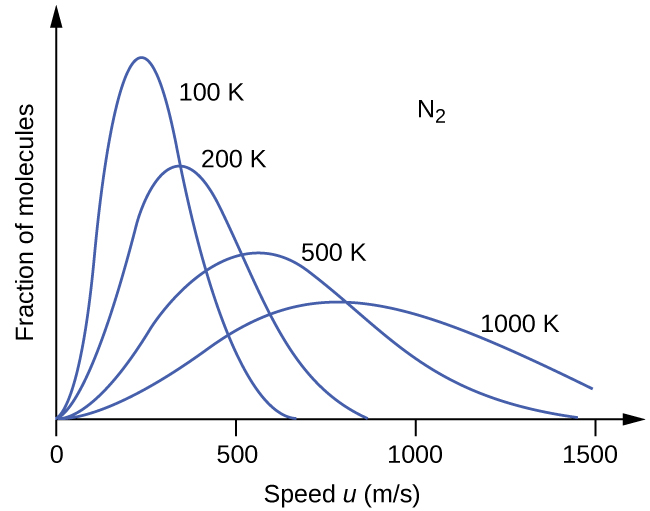
Translational Motion
Atoms can only move from one place to another in a stagnant line until they bump into something else

Kinetic Energy Formula
KE = ½ mv = 3/2 KT (relationship to kinetic energy)
m = mass
v = average velocity
K = Boltzmann constant
T = temperature

Kinetic Energy
The energy of motion, directly related to temperature, but a characteristic that a single atom can have
Molecules in a system can have different kinetic energies
They change constantly
Individual kinetic energies are what are critical
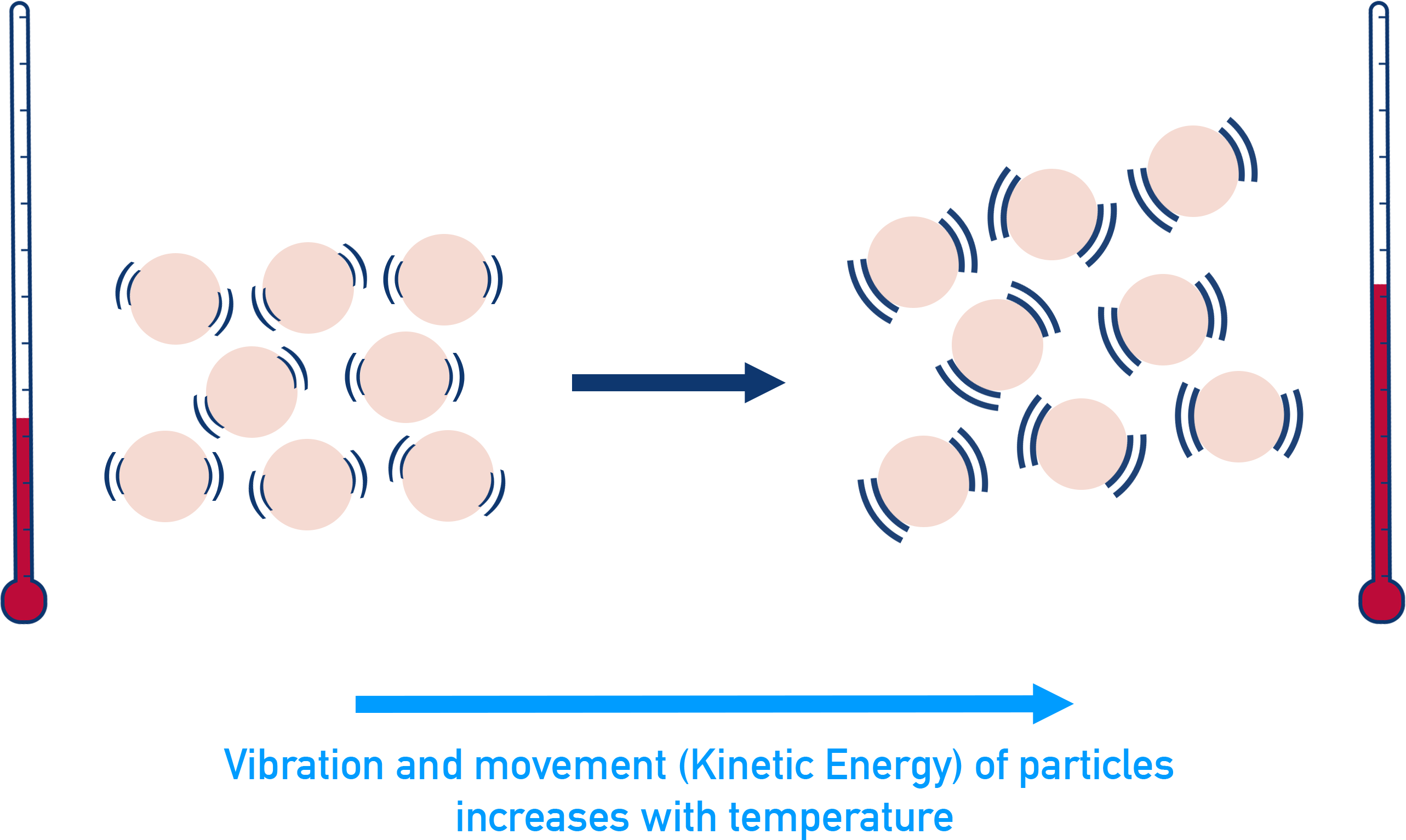
Velocities
Speeds and directions, influenced by collisions
Large # of Particles
When involved in a phenomenon, their individual actions aren’t important
Ex: temperature of pressure
Chemical Reactions
Influenced by the individual collisions of molecules in a population
Populations
Characterized by a distribution with predictable behavior, thus statistical methods are applicable
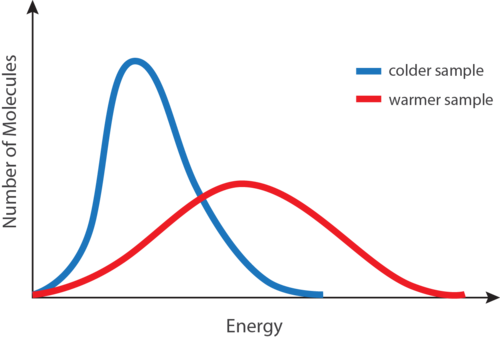
Distribution of Kinetic Energies
Depends on the temperature of the system
Maxwell-Boltzmann Distribution
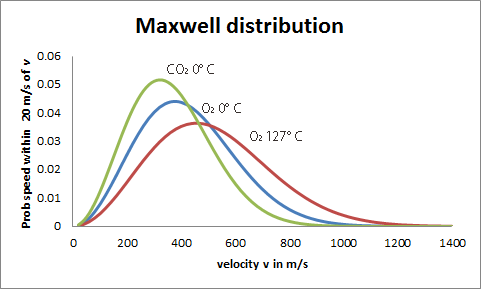
Details the distribution of speeds of a certain population at a specific temperature
Allows us to calculate the probability of a particular molecule moving at a particular speed
Shape as a function of temperature
Peaks quickly and falls at higher velocities/kinetic energies
Probability vs. KE (area = 1)
Most probable speed (peak) + average speed (higher) increase with temperature
Average Kinetic Energies
…of any gas at the same temperature are equal
Average velocities depend on the gases mass (lighter = faster)
Uncertainty Principle
There is some uncertainty in a molecule’s energy
Zero point energy instead of 0K
Monoatomic Gases + Temperature
A measure of the average kinetic energy stored in translation (moving through space)
Complex System: energy added can increase speed, but also cause vibration, bending, or rotation
Distinct and depends on the shape or composition
Quantized: only certain energy packets create specific reactions
Determining a Molecule Through Added Thermal Energy
Utilizing molecule-specific energy states to determine identity and structure
As a molecule moves between vibrational and rotational states
Raising Temperature
More complex structures require more heat because there are more ways for it to vibrate, bend, and rotate
Thermal energy used for vibrations, rotations, translations, and bending
Heat Capacity
Measures how much energy it takes to change the temperature of a substance by 1 degree, and how much energy a substance can store at a given temperature
Specific (J/gC) or molar (J/molC)
Depends on molecular structure and intermolecular forces (IMFs)
The more complex of stronger the forces, the more energy that is required

Specific Heat of Water
4.18 J/gC
Higher than other alcohols because water molecules are smaller, so there are more in a gram, and because water molecules can form more hydrogen bonds, which must be overcome
On earth water absorbs and releases energy, moderating what would otherwise be drastic temperature changes
Removing Energy From A Gas
Done by lowering the temperature, decreasing the average kinetic energy, causing the molecules to fall out/condense into the liquid state
Condensation
Longer interaction times between molecules, where IDF, dipole-dipole, and hydrogen bonds cause them to merge
Smaller volume, higher density

Boiling/Condensation Point
Temperature at which the gas/liquid phase first appears
Temperature of the system doesn’t change until almost all the water vapor has condensed into liquid

Evaporative Cooling
Where some molecules in a liquid are in the gaseous state as they have enough momentum to break free, escaping with a little kinetic energy, removed from the liquid system
Liquid → Solid
Removing energy means molecules can no longer sometimes overcome IMFs, causing them to form structures determined by molecular shape and geometry
More stable
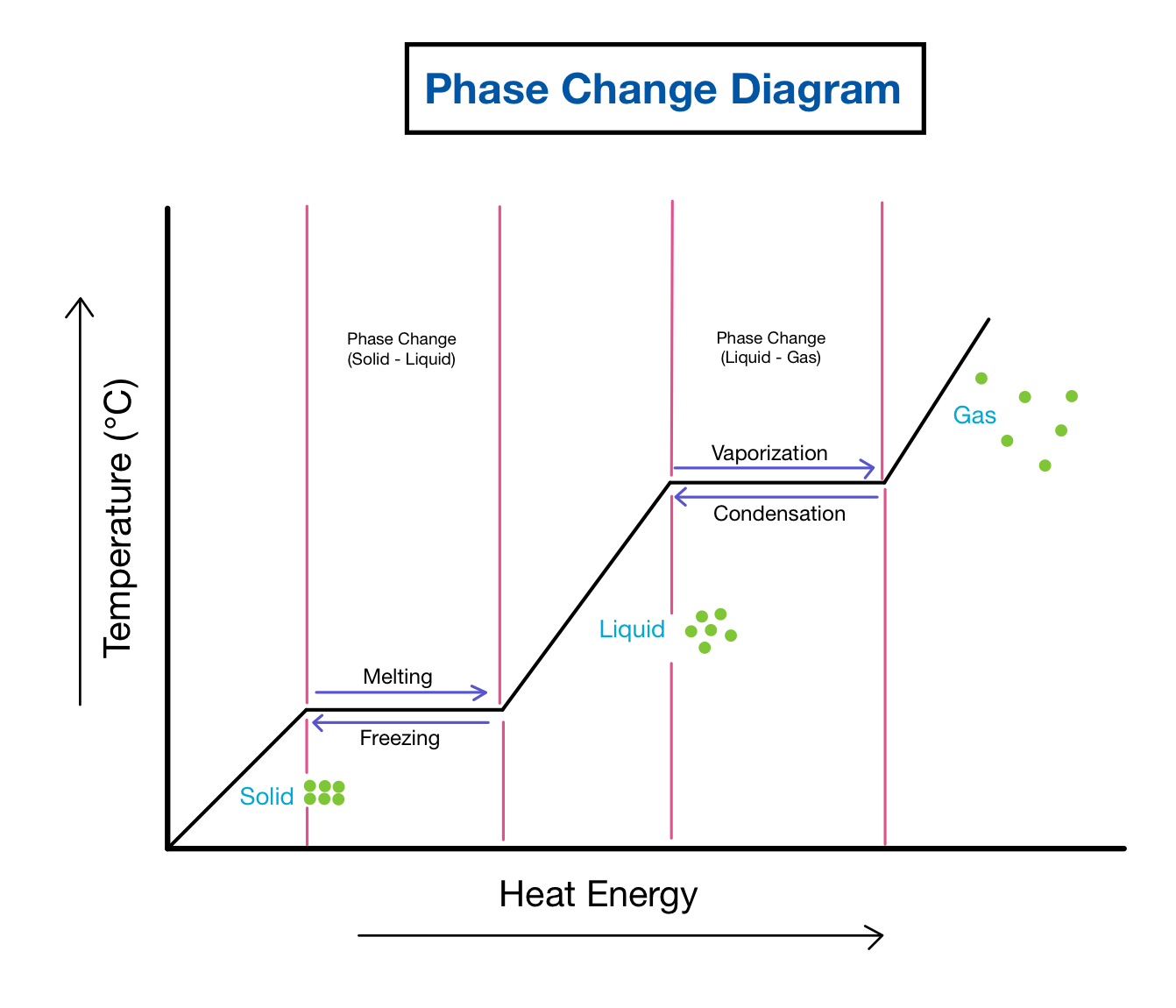
Melting/Freezing Point
Temperature at which a substance becomes a liquid/solid
Melting: energy is used to overcome intermolecular interactions, not really increase speed
System
The part of the universe we are observing
Separated from its surroundings
Important to determine if it is isolate, closed, or open
Isolated Systems
Niether energy or matter moves between the system and its surroundings
Open System
Both energy and matter can enter or leave the system
All biological systems
Closed System
The amount of matter is constant and only energy can enter or leave
Thermochemistry - 1st Law
Energy cannot be created or destroyed, but it can be transferred from a system to its surroundings and vice versa
Internal Energy (E)
Can change by altering the total amount of thermal energy in a system (q), or the system can do work/have work done on it (w)
Can only really measure change (∆E), not the exact quantity
∆E = q + w

Work (w)
Force over a distance, accompanied by expansion or compression of a system that it usually approximated to 0
∆E = q
Enthalpy (H)
A state function of heat change at constant pressure
Describes thermal energy change (∆H) that doesn’t depend of the path, unlike q
Applies to systems with a constant pressure with no volume change
∆H = ∆E

State Funciton
A property of a system that does not depend in the path taken to get to that particular state
Denoted by uppercase letter symbols

Calculating Change in Enthalpy (∆H)
∆H(J) = mass(g) x specific heat (J/gC) x ∆T(K)
-∆H = exothermic, the surroundings gain energy
+∆H = endothermic, the system gains energy
Only applies when the thermal energy is used to increase temperature

2nd Law of Thermodynamics
Any change in the system results in an increase in the entropy (S) of the universe
Some energy will be changed into a form that is no longer useful
The system may become more ordered, but that energy is transferred to the surroundings as ∆S > 0
“Times Arrow” = ∆S
Entropy (S)
A measure of disorder, but also of probability, as to which outcome is most favorable- like heat moving from hot to cold
The more probable arrangements will occur more frequently, but ordered arrangements can happen, just rarely
Ex: gases > liquids > solids
Ex: mixed solutions > unmixed components
Ex: uniform temperature > hot and cold sites
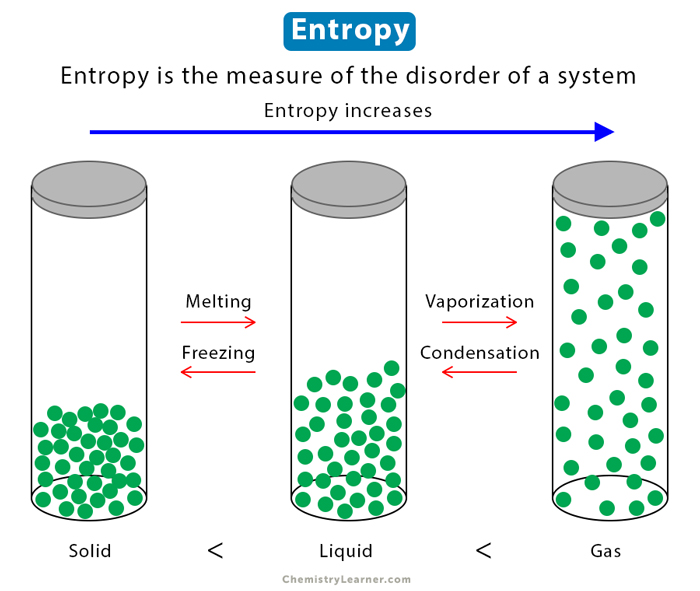
Calculating Entropy
S = K x lnw
K = Boltzmann constant
w = # of possible arrangements of the system (the greater w, the greater entropy)
Gibbs Free Energy Equation
∆G = ∆H - T∆S

Gibbs Free Energy
Used to determine whether reactions are thermodynamically favorable
+∆G = unfavorable, universal entropy decreases; possible only if paired with a larger -∆G
-∆G = favorable, universal entropy is increasing

Change in Gibbs Free Energy
Describes how much energy is available to do work, by differentiating energy produced from change from energy lost to the universe as entropy
-∆G = the direction that the reaction is most likely to occur in
-∆G
Thermodynamically favorable at all temperatures (unaffected)
-∆H = exothermic
+∆S = system increases entropy
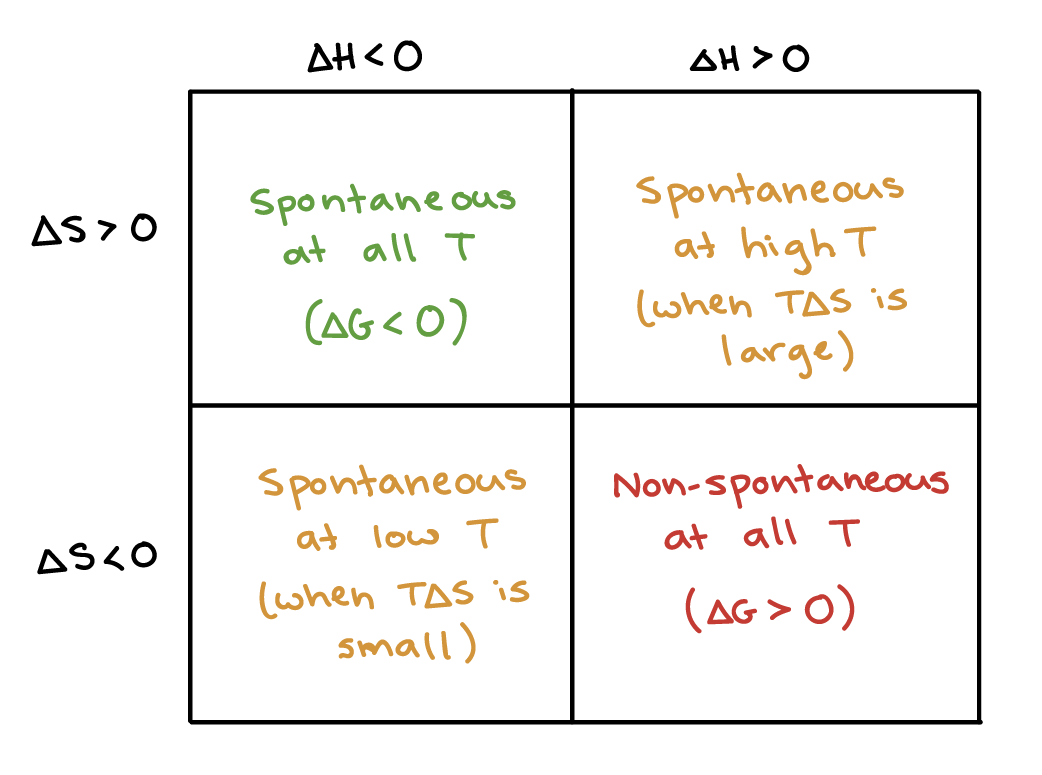
+∆G
Thermodynamically unfavorable at all temperatures and usually coupled
+∆H = endothermic
-∆S = system entropy decreases
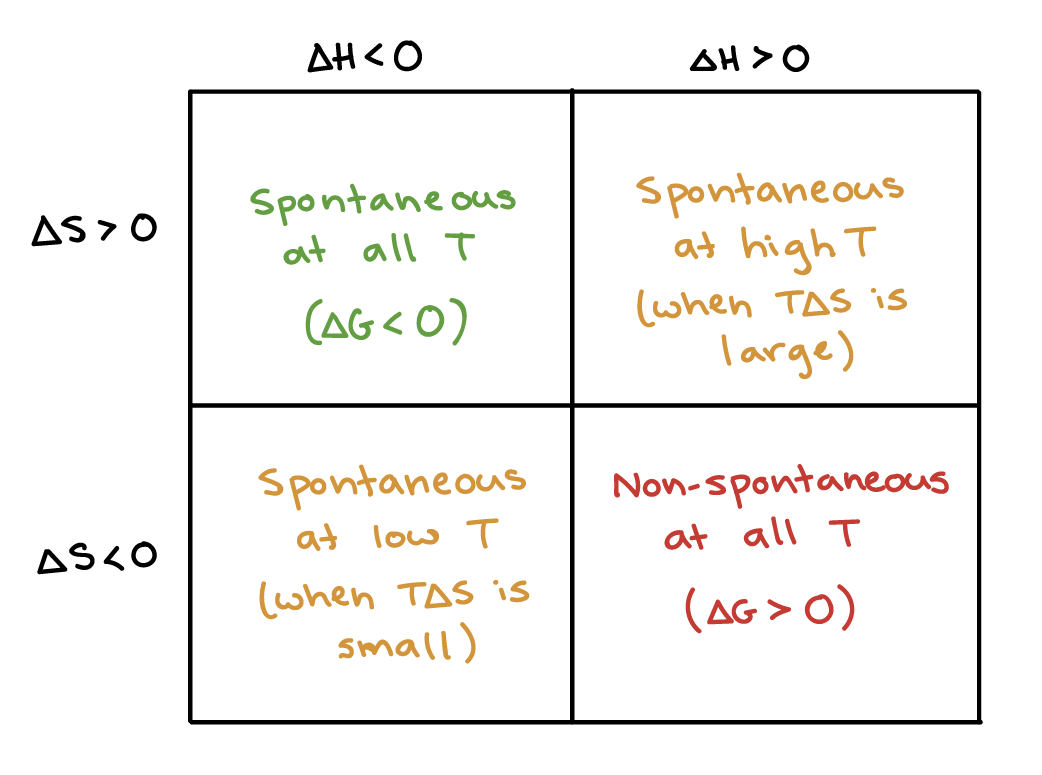
Temperature + ∆G
-∆H (exothermic) + -∆S (entropy decreases): temperature-dependent; as temperature increases, ∆G becomes more positive and less favorable. Favorable at low temperatures.
+∆H (endothermic) + +∆S (entropy increases): temperature-dependent; as temperature increases, ∆G becomes more negative and more favorable. Favorable at high temperatures.

Standard State
298K, 1 atm, and 1M concentration
Denoted with a small circle (nought)
System at Equilibrium
∆G = 0
Ex: A mixture of ice and water is at 0C (273K)
Thermal Energy Notes
Higher T + same amount of matter → more TE
Same T + more amount of matter → more TE
Heat
Measure of thermal energy
Hot → cold (2nd law)
Phase Transitions
Melting/boiling: IMFs are overcome, PE increases, +∆H, and +∆S (entropy increases)
Solidification/Condensation: IMFs take over, PE decreases, -∆H, and -∆S (entropy decreases)
Temperature - Phase Transitions
The average kinetic energy remains constant during the transition
∆H > 0 = energy spent to overcome the IMFs (PE increases)
∆H < 0 = energy released from forming IMFs (PE decreases)
Entropy - Enthalpy + Temperature
∆S = ∆H/T
Second Law Scenarios
The total entropy of the universe must increase, but the signs of the change in entropy for the system and surroundings don’t always have to be opposite
-∆S system + +∆S surroundings = +∆S total
+∆S system + -∆S surroundings = +∆S total
+∆S system + +∆S surroundings = +∆S total
Gibbs Free Energy - Notes
Measures formal entropy change, only using system terms, which are the easiest to measure.
-T∆S universe → ∆G must be negative (thermodynamically favorable)
Always when -∆H and +∆S
Never when +∆H and -∆S
Sometimes when +∆H and +∆S, or -∆H and -∆S
Kelvin is always positive, it is only the magnitude that has an impact
Endothermic Reactions
More likely to happen with increased temperature
Longer Reaction - Conditions
Make a reaction go farther by cooling it down (making ∆G more negative)
Equilibrium - Notes
∆G = 0, and the reaction stops because it is happening in both directions at the same rate
-T∆S = ∆H
Heating further may reverse the reaction in some instances
Ex: Temp of phase change
