Chapter 3.3: Nucleic Acids Are Informational Macromolecules
 Call Kai
 Learn
Learn Practice Test
 Spaced Repetition
 Match
Match Flashcards
 Knowt Play
1/8

Name | Mastery | Learn | Test | Matching | Spaced | Call with Kai | Chat |
|---|
No analytics yet
Send a link to your students to track their progress
9 Terms
Nucleic acids
Polymers that store and express genetic information via nucleotide monomers, grouped into DNA (with deoxyribose) and RNA (with ribose)
DNA encodes for RNA, which encodes for protein types

Nucleotide
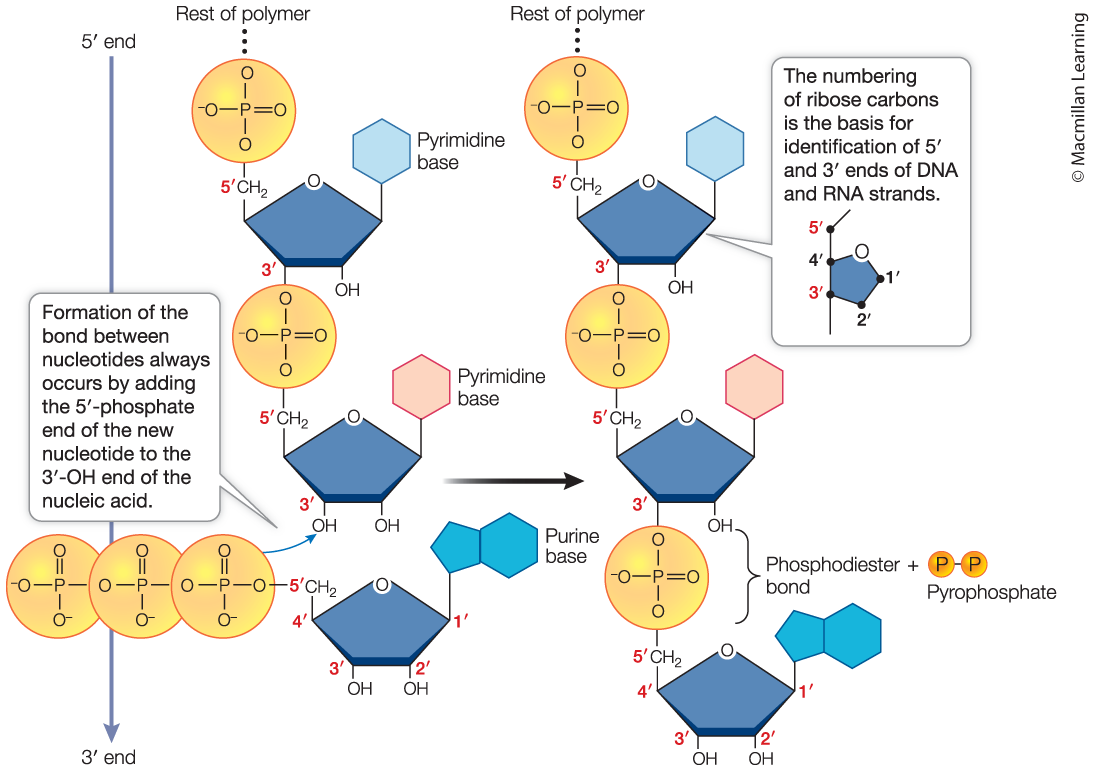
A single unit of a nucleic acid, made of a monosaccharide, a nitrogen-containing base (linked to the 1’ carbon), and one to three phosphate groups (linked to the 5’ carbon)
Can be joined in oligonucleotides for basic regulation as RNA (3 to 20 monomers) or polynucleotides for heredity in DNA (hundreds of millions of monomers)

Base
Nitrogen-containing molecules that form the genetic code for DNA and RNA, classified as pyrimidines (single rings) or purines (double rings)
Linked to the 1’ carbon
Nucleoside
A nitrogenous base and ribose without a phosphate group
Phosphodiester bond
This is formed to create the “sides” in the sugar-phosphate bond, where the 3’ carbon atom on the previous nucleotide is linked to the triphosphate on the next 5’ carbon atom
Requires more than one phosphate due to an increase in free energy
Complimentary base pairing
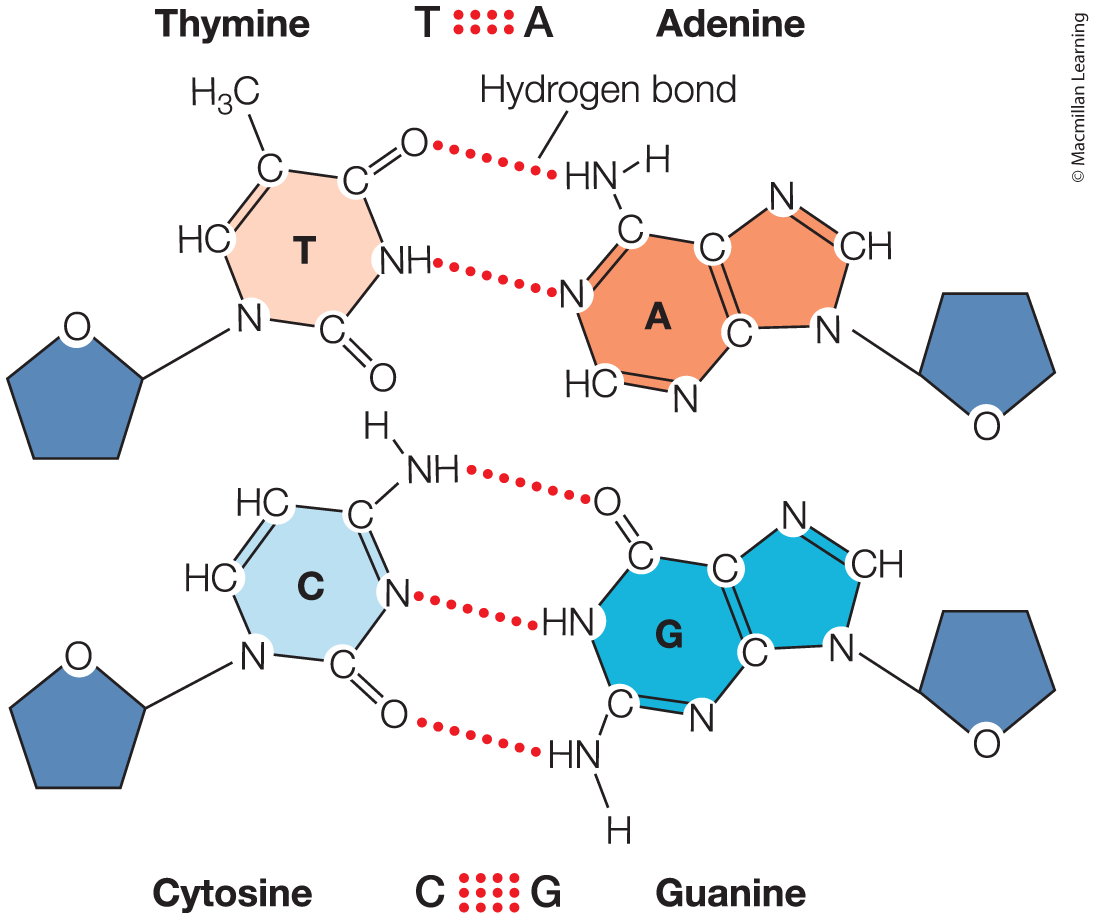
When two nitrogenous bases in DNA or RNA pair with their complimentary parts through hydrogen bonds
These bonds across millions of bases collectively create an attraction that is strong enough to remain together but can be separated with some energy
Required for transcription and translation, which are performed in opposite direction
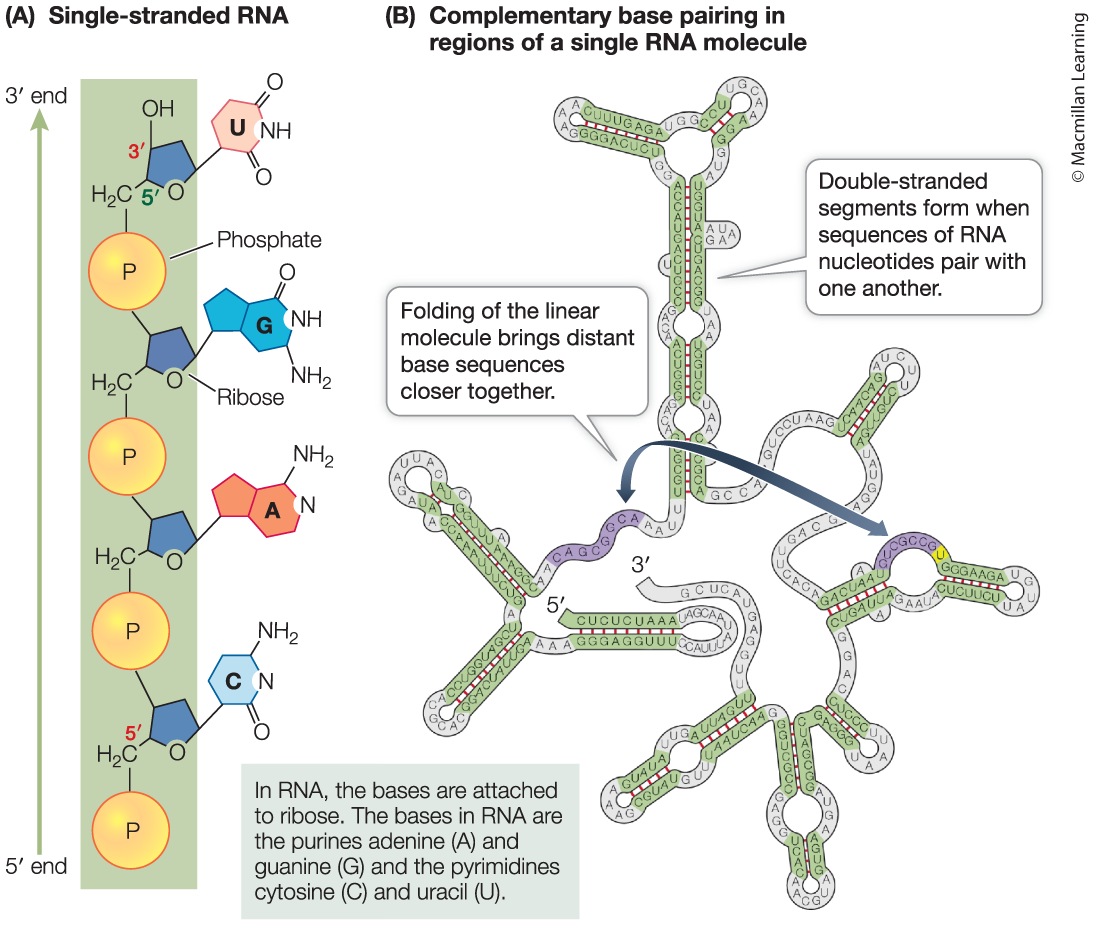
In DNA, this is done with cytosine, thymine, adenine, and guanine; in RNA, this is done with uracil instead of thymine
Deoxyribonucleic acid (DNA)
A double-stranded molecule with informational and complimentary base pairs in the middle, twisting into a helical structure
The expression of this is determined by its function and position in the body despite each cell containing all of this molecule’s instructions
Ribonucleic acid (RNA)
A single-stranded molecule that can fold back, stabilized by complimentary base pairing
Created as a result of transcription from DNA to signal for protein production in translation in smaller groups
DNA replication
The process where DNA is copied onto new DNA molecules for transmission to daughter cells and offspring