Muscular Disorders L2
 Call Kai
 Learn
Learn Practice Test
 Spaced Repetition
 Match
Match Flashcards
 Knowt Play
1/103

There's no tags or description
Looks like no tags are added yet.
Name | Mastery | Learn | Test | Matching | Spaced | Call with Kai | Chat |
|---|
No analytics yet
Send a link to your students to track their progress
104 Terms
What can we determine from the information in this patient case:
A 35 year old woman reports difficulty climbing stairs, difficulty lifting objects over her head, and fatigue when brushing her har.
Her condition involves proximal muscles ~ muscles closer to the trunk
The presentation is bilateral which indicates a systemic condition
What does the term constitutional system indicate?
That there are multiple systems involved. Systemic disturbance.
What are the steps in reaching a diagnosis?
Take the patient’s history
Complete a physical examination
Make a list of differential diagnoses (DDx)
Complete diagnostic testing
Diagnosis
Name five muscle weakness differentials related to the CNS:
Stroke
Multiple sclerosis
Spinal cord lesions
Motor neuron disease
ALS - amyotrophic lateral sclerosis
Name five muscle weakness differentials related to the PNS:
guillain-barre syndrome (paralysis from toes upwards)
radiculopathy
peripheral neuropathy
diabetes
herneated disc
Name two muscle weakness differentials related to the neuromuscular junction:
myasthenia gravis
lambert-eaton syndrome
Name six muscle weakness differentials related to muscle (myopathy):
inflammatory
genetic
endocrine
metabolic
toxic/drug induced
infectious
Innate muscular disease is often _____ and ______.
proximal
bilateral
Define myopathy:
a disease primarily damaging muscle fibers, resulting in muscle weakness and impaired muscle function.
Myopathy is a disease primarily damaging _______, resulting in _____ and impaired _____.
muscle fibers
muscle weakness
muscle function
What does myopathy present as?
weakness of the muscles
fatigue of the muscles
exercise intolerance
+/- myalgia
What is the term for muscle pain?
myalgia
Myopathy commonly involves the _____ muscles.
proximal
T/F: Distal muscles are rarely affected with myopathy.
False. distal muscles become involved later in the course of illness
What is the pathway for myopathy to occur?
Injury to the muscle fiber (sarcoplasmic membrane)
Cell membrane damage
Leakage of intracellular contents
Release of creatine kinase into the bloodstream
Elevated CK in diagnostic testing is indicative of muscle injury
Creatine kinase if primarily found in _____.
skeletal muscles
What is the normal function of creatine kinase?
To provide immediate bursts of energy (physiologically)
Provides energy rapidly during high demand
What are the three places creatine kinase is found?
brain
heart, skeletal muscle
What are common diagnostic tests for muscle injuries?
Blood tests: CK, autoantibodies
Magnetic resonance imaging (soft tissue)
Electromyography (EMG) measures muscle-neural conduction which is good to diagnose neural/muscle disorders
Muscle biopsy
What is another term for inflammatory myopathy?
Myositis
What is the definition of myositis?
a rare autoimmune disorder characterized by inflammation of the SKM
Myositis is a rare __________ characterized by inflammation of the ____.
autoimmune disorder
SKM
What autoimmune disorder is characterized by proximal bilateral SKM weakness?
myositis
What does chronic SKM inflammation lead to?
progressive weakness
What are the two major types of myositis?
polymyositis
dermatomyositis
How is the presentation of polymyositis and dermatomyositis different?
Dermatomyositis has skin-related presentations
T/F: The etiology of myositis is well known and easy to diagnose.
False. the etiology is unknown.
The underlying autoimmune reaction is seen in genetically susceptible individuals ~ may have an HLA subtype difference
The epidemiology for myositis in the US: The ___________ population are disproportionately affected by _______ type of myositis.
African American
polymyositis
For myositis, the ratio of Female to Male individuals affected is:
F>M
2:1
What time of day is polymyositis symptoms typically the worst?
worse in the morning
Patients with polymyositis may have difficulty with what two actions?
difficulty rising from a chair
difficulty climbing up stairs
Polymyositis is defined as:
Chronic, slow onset, bilateral proximal muscle weakness
What is the term for difficulty swallowing?
dysphagia
How many patients with polymyositis will experience dysphagia?
1/3 patients
What is the term for difficulty in articulating words due to disease of the central nervous system?
dysarthria
When oropharyngeal muscles are involved in the polymyositis disorder, what three things might the patient present with?
dysphagia
dysarthria
aspiration risk
T/F: Patients with polymyositis may experience myalgia.
True
T/F: Patients with polymyositis experience proximal and distal muscle weakness at the beginning of the disease.
False. distal muscle weakness presents later in disease onset.
What cells are directed against muscle antigens in polymyositis pathogenesis?
cytotoxic CD8+ cells
Which myositis disorder is caused by cytotoxic CD8+ cells directed against muscle antigens?
polymyositis
What infiltrates the endomysium in polymyositis pathogenesis?
CD8+ T cells and macrophages cause endomysial infiltration
Where is inflammation found in polymyositis?
Around each muscle fiber in the endomysium
What is the function of CD8+ T cells and macrophages in polymyositis pathogenesis?
endomysial infiltration
T/F: in polymyositis, there is a direct attack on the necrotic muscle fibers.
False. There is a direct attack on the non-necrotic muscle fibers that leads to inflammation.
What is the end result of polymyositis on the muscle?
Polymyositis eventually destroys the muscle fibers, leading to necrosis.
When evaluating a polymyositis muscle biopsy, what would you expect to see?
Endomysial infiltration - partial invasion of lymphocytes within/around the muscle fibers
How does dermatomyositis differ clinically from polymyositis?
It is the same as polymyositis clinically EXCEPT for skin findings
What are four clinical skin findings of dermatomyositis?
heliotrope rash
gottron papules
shawl and V sign
mechanics hands
What are the two most common clinical skin presentations of dermatomyositis?
Helitrope rash
Gottron papules
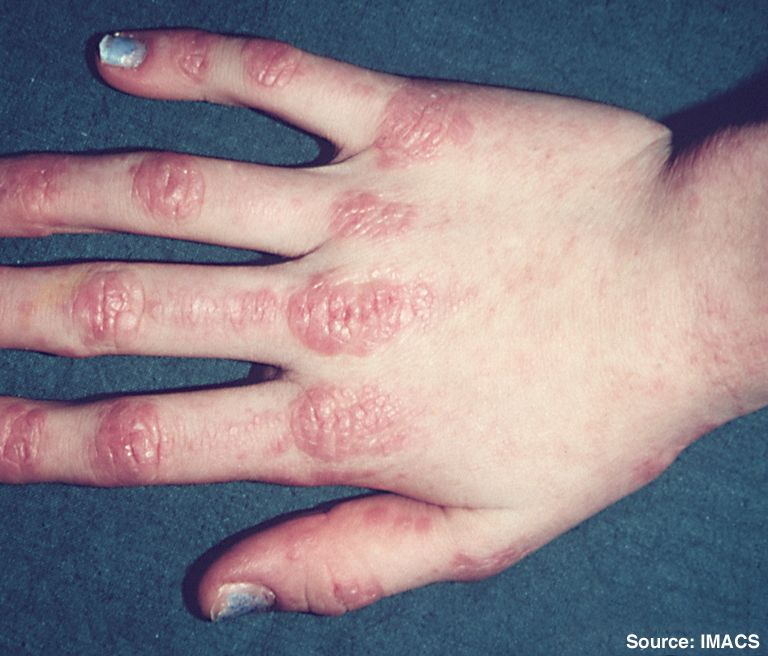
What skin presentation caused by dermatomyositis is shown here?
gottron papules - erythmatous, scaly rash on the DIP, MIP, PIP knuckles
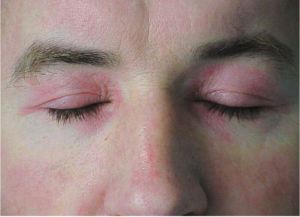
What skin presentation caused by dermatomyositis is shown here?
heliotrope rash - a bilateral, violet or bluish-purple rash on the upper eyelids, sometimes extending to the lower eyelids. It may be raised, shiny, bumpy, or patchy, and can be accompanied by swelling, burning, or itching
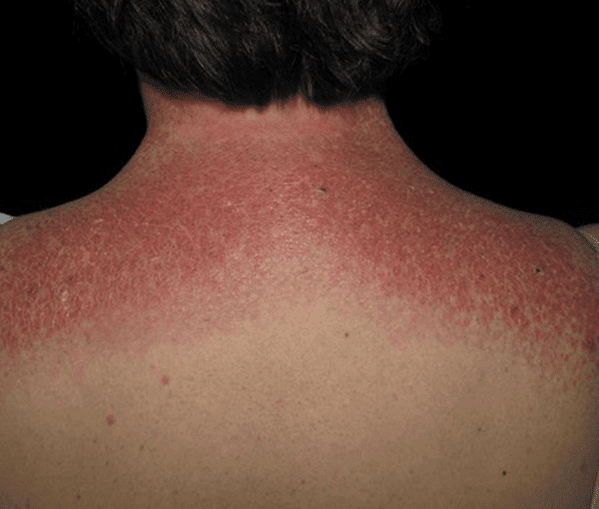
What skin presentation caused by dermatomyositis is shown here?
Shawl and V sign - photosensitivity due to sun on back and chest
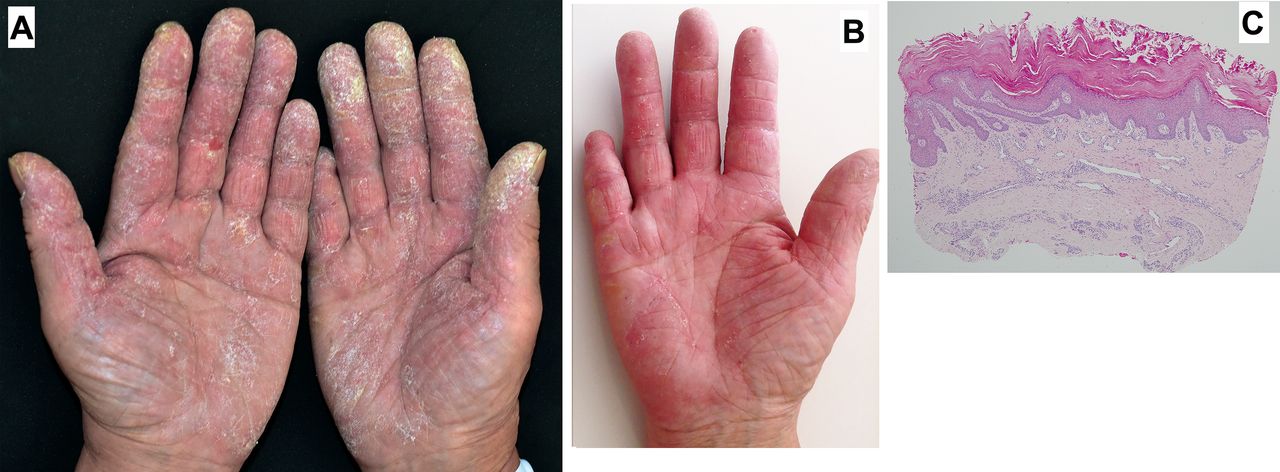
What skin presentation caused by dermatomyositis is shown here?
Mechanics hands
Dermatomyositis pathogenesis is a _______ response.
humoral mediated
Which myositis is an antibody-mediated activation of the complement system leading to MAC deposits into the endomysial vasculature and within the perimysium?
dermatomyositis
Describe the pathogenesis of dermatomyositis.
An antibody-mediated activation of the complement system leading to MAC deposits (B cells, CD4 T cells, T-helper cells) into the endomysial vasculature, which causes blood vessel inflammation, capillary destruction, and little to no blood supply reaching the muscle fascicle leading to atrophy.
What MAC deposits are deposited into the endomysium and perimysium vasculature with dermatomyositis?
B cells
CD4 T cells
T helper cells
What does the activation of antibody-mediated activation of the complement system and MAC deposition into the endomysial and perimysial vasculature lead to?
Blood vessel inflammation
capillary destruction
microinfarction
Perifascicular atrophy due to decreased or total lack of blood supply to the muscle fascicle
What is defined as obstruction of the blood supply to an organ or region of tissue, typically by a thrombus or embolus, causing local death of the tissue..
Infarction
T/F: In dermatomyositis, the skin is affected due to antibody-mediated activation of the complement system leading to MAC depositions.
False. the skin is affected due to the activation of IFN-1.
it is not a downstream response
In dermatomyositis, IFN-1 leads to:
the clinical presentation of affected/involved skin
When looking at a muscle biopsy of a patient with dermatomyositis, what would you expect to see?
the destruction of blood vessels ~ infiltration of inflammatory cells surrounding the vessel
perifascicular atrophy seen as thick white bands through the muscle fibers.
What are the diagnostic tests used for myositis?
Muscle biopsies - confirmatory diagnosis
Elevated CK - nonspecific
Autoantibody tests
What are the three autoantibody tests used for myositis?
Anti-nucleic antibodies (ANA) - found in 80-90% of patients. it is SENSITIVE, not specific
Anti-Jo1 antibodies (against histones) in 30% of patients. it is SPECIFIC, not sensitive.
If a patient has Anti-Jo1 antibodies, what additional disease are they at risk of developing? What percentage of patients has this disease?
Interstitial lung disease
90% of patients with anti-jo1 antibodies will develop ILD
Which autoantibody test is specific, not sensitive?
anti-jo1 antibody test
Which autoantibody test is sensitive, not specific?
anti-nucleic antibody test
What are two additional autoantibody tests used to diagnose myositis?
anti-Mi2
anti-SRP
Myositis is linked to malignancy, with the most common being in the:
lung
What types of supportive management are available for patients with myositis?
physical
occupational
speech therapy
Both polymyositis and dermatomyositis are associated with increased risk of cancer. The most common two types being:
adenocarcinoma
squamous cell carcinoma
Where are malignancies associated with myositis often found?
lung
thyroid
breast
cervical (most prevalent)
What is the first line of medical management for myositis?
glucocorticoids - prescribed for patients with a decreased immune response for inflammation management
What is a risk associated with glucocorticoids?
risk of delayed wound healing
What are the common chronic therapy medications provided to patients with myositis?
Immunosuppressives: methotrexate, azathioprine
What management methods are recommended for dermatomyositis rash?
photoprotection
hydroxychloroquine (has an immunological component)
What is a muscular dystrophy?
a genetic myopathy
What is the term used for a group of inherited diseases that cause progressive muscle degeneration?
muscular dystrophies
Define muscular dystrophy.
A group of inherited diseases that cause progressive muscle degeneration
What is the common cause of muscular dystrophies?
Mutations involving muscular genes.
Muscular dystrophy is commonly due to mutations involving muscular genes. What ratio is hereditary and what ratio is sporatic?
hereditary 2/3
sporatic 1/3
A patient presenting with a muscular dystrophy will have a chief complaint of:
muscular compaints that affect specific muscle groups
T/F: With muscular dystrophy, the pelvic girdle musculature is affected least.
False. pelvic girdle musculature (thigh and gluteal muscles) are commonly involved.
What are the two most common types of muscular dystrophy?
Duchene Muscular Dystrophy (DMD)
Becker Muscular Dystrophy (BMD)
Between the two most common types of muscular dystrophies, which is more severe and which is of lesser severity?
DMD is most severe
BMD is least severe
What is the largest known protein-coding gene in the human DNA?
Dystrophin
What is dystrophin’s function?
acts as an anchor, connecting each muscle cell's structural framework (cytoskeleton/filamental actin) with the lattice of proteins and other molecules outside the cell (extracellular matrix/sarcoplasmic membrane).
Where is dystrophin gene found?
On the short arm of the X-chromosome
In which muscle types can dystrophin protein be found?
skeletal
cardiac
Dystrophin anchors intracellular _____ to the ______, stabilizing the sarcolemma.
actin
extracellular matrix
What is the downstream effects of a genetic mutation involving dystrophin?
genetic mutation
dysfunctional protein ~ disturbance of cellular signaling pathways
necrosis of affected muscles
replacement of the affected muscle tissue with connective and fatty tissue
weak muscles that appear large (pseudohypertrophy)
What does the term pseudohypertrophy refer to?
weak muscles that appear large
If the dystrophin gene experiences a nonsense or frameshift mutation, what happens to the protein?
the entire protein area is deleted and the protein is not there
What disorder is caused by a nonsense or frameshift mutation of the dystrophin gene?
Duchenne Muscular Dystrophy
If the dystrophin gene experiences a missense mutation, what happens to the protein?
Part of it may be altered or missing
the protein is still there, just not at 100%
What disorder is caused by a missense mutation of the dystrophin gene?
Becker Muscular Dystrophy
Which is more severe, DMD or BMD?
DMD is more severe
Which has a later onset in adolescence, DMD or BMD?
BMD
Which has an earlier onset between 2-5 years of age, BMD or DMD?
DMD
Which is the milder form of a muscular dystrophy, DMD or BMD?
BMD